AI brand mentions: what they are, how to track them, and how to earn more
AI brand mentions are the times ChatGPT, Perplexity, Gemini or Google's AI features name your company in an answer, with or without a link. They matter because the answer is often the buyer's shortlist. This guide covers the types of mentions, how to track them, and a practical plan to earn more.
- In AI answers the mention itself is the outcome, linked or not. Unbranded recommendations are the ones that build pipeline.
- In Ahrefs' study of 75,000 brands, branded web mentions correlated with AI Overview visibility about three times as strongly as backlinks (0.664 vs 0.218).
- Track mention rate across repeated runs of unbranded prompts, not single answers or 'rankings'.
- Assistants lean on Reddit, YouTube, LinkedIn, review sites and editorial roundups. Earn mentions where they already look.
- Fix your own facts first, then work the specific pages assistants cite for your category.
What AI brand mentions are
An AI brand mention is any time an AI assistant names your company or product in its answer. That includes ChatGPT, Perplexity, Gemini, Claude, Google AI Overviews and Google AI Mode. The mention can come with a link to your site, a link to someone else's page about you, or no link at all.
That last point matters. In classic SEO, an unlinked mention was a nice-to-have. In AI answers, the mention itself is the outcome. A buyer who reads "For a 50-person team, look at A, B and C" has a shortlist, whether or not anyone clicked anything.
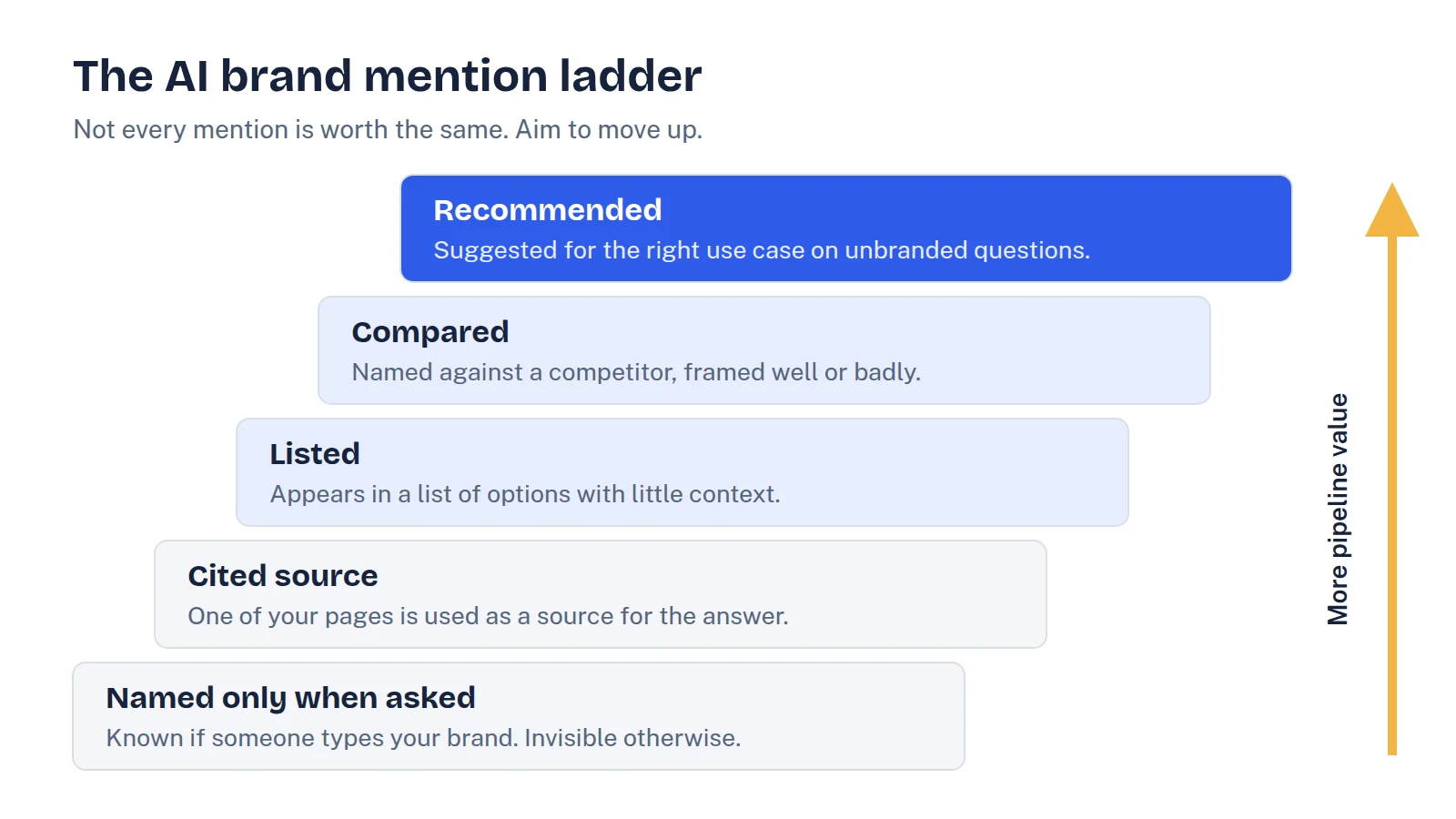
Not all mentions are equal. It helps to sort them by how much they do for you:
- Recommended: you're named as a good answer to the question, ideally for the right use case.
- Compared: you're named alongside or against a competitor, favorably or not.
- Listed: you appear in a list of options with little or no context.
- Cited source: one of your pages is used as a source, even if the answer doesn't recommend you.
- Named only when asked: the assistant knows you if someone types your brand, but you never come up on unbranded category questions.
Being known when someone types your name is the easy part. The real work is moving up the ladder, so you're recommended on the unbranded questions buyers ask before they know you exist.
Why mentions matter more than links in AI answers
The best public evidence here comes from Ahrefs. In a study of 75,000 brands, Ahrefs compared how often each brand appeared in Google AI Overviews with a range of off-site and on-site factors. Branded web mentions had the strongest correlation (0.664), well ahead of backlinks (0.218) and Domain Rating (0.326).
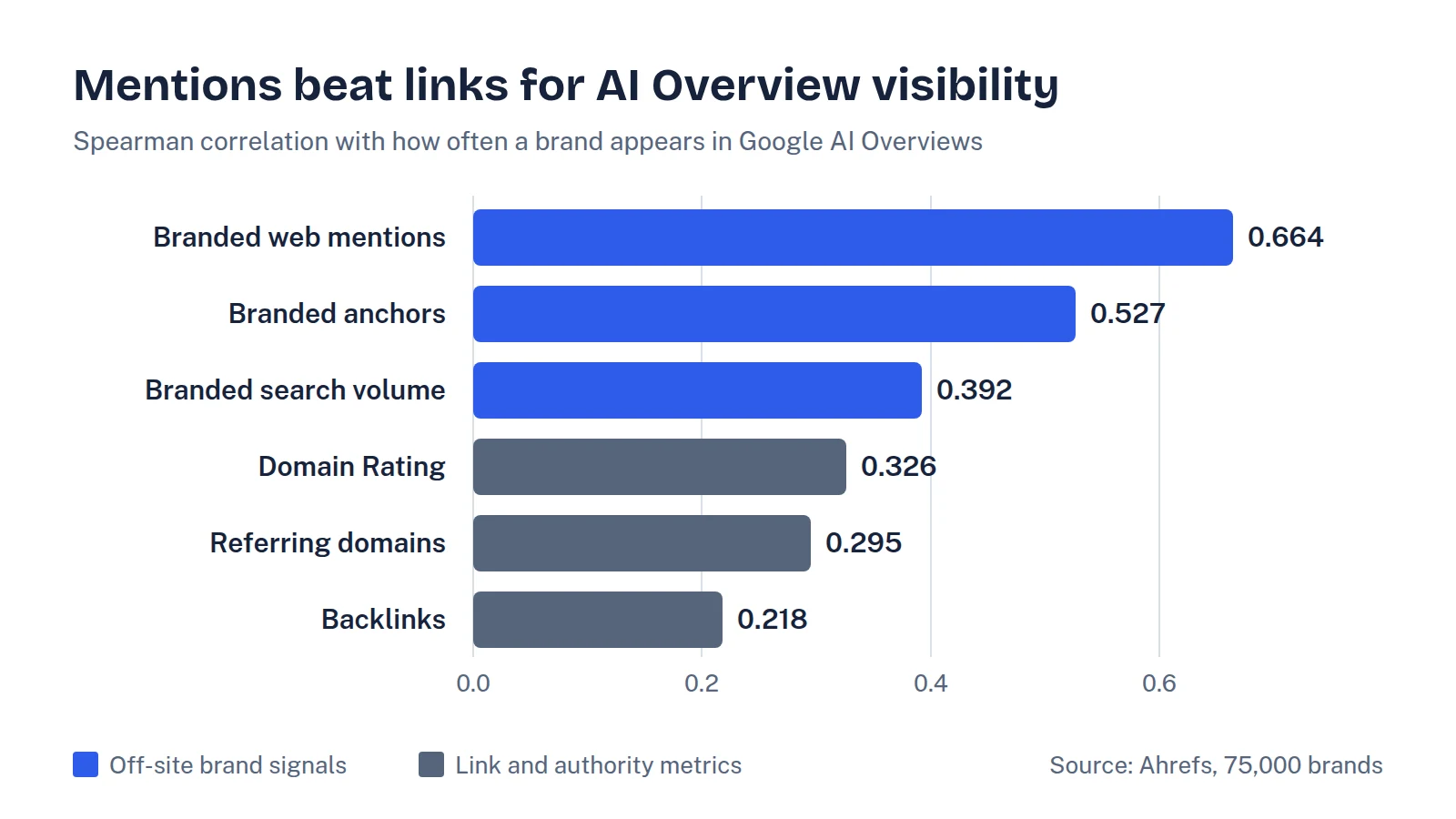
The same study found that brands in the top quartile for web mentions averaged 169 AI Overview mentions, against 14 for the next tier. Correlation isn't causation, and bigger brands naturally get talked about more. Still, the direction is clear: what the web says about you shapes what AI says about you.
Ahrefs' later Q1 2026 benchmark report went a step further and found YouTube mentions were the strongest single signal of AI visibility across the brands it analyzed, with link volume and page count showing only weak correlation.
Demand for this topic is growing fast. When we pulled data for this guide (Ahrefs, US, September 2026), "ai brand mentions" had about 1,600 monthly searches at a keyword difficulty of 16. Long-tail versions such as "how to track brand mentions in ai search" (800) and "brand mentions ai overviews" (500) show that most searchers want two things: how to see their mentions, and how to get more.
Where AI assistants find brands to mention
Assistants that search the web before answering pull from a fairly predictable set of sources. Several large citation studies point the same way:
- A Peec AI analysis of 30 million sources across ChatGPT, Google AI Mode, Gemini, Perplexity and AI Overviews found Reddit was the most-cited domain overall, followed by YouTube, LinkedIn, Wikipedia and Forbes. Review platforms like G2 showed up often for recommendation queries, and Perplexity leaned on Reddit, LinkedIn and G2 for B2B queries.
- Semrush tracked 230,000 prompts over 13 weeks and saw citation patterns shift sharply. Reddit's share of ChatGPT responses dropped from about 60% to about 10% in a few weeks, while sources like PR Newswire and Forbes gained.
The takeaway isn't "post on Reddit." It's that assistants form their view of your category from a mix of community discussion, video, professional networks, editorial coverage and review sites, and the mix changes by engine and over time. You need to be present in several of them, not just one.
How to track your AI brand mentions
You can't search a log of every AI answer ever given, so tracking always means sampling. You pick the questions your buyers ask, run them through the assistants, and record what comes back.
The key points for mention tracking specifically:
- Use unbranded prompts. "Best customer onboarding software for mid-market SaaS" tells you far more than "what is [your brand]?"
- Run each prompt more than once. SparkToro's research found less than a 1 in 100 chance that ChatGPT or Google's AI returns the same brand list if asked the same question 100 times. Measure how often you appear, not where you rank.
- Record the mention type. Recommended, listed, compared or absent. A raw count hides whether you're being positioned well.
- Save the cited sources. They tell you which pages to work on next.
If you want the full setup (prompt set size, cadence, metrics and a leadership report), follow our guide to AI visibility tracking. If you just want a quick baseline this week, the free manual AI visibility check walks you through it with a spreadsheet.
How to earn more AI brand mentions
Earning mentions is closer to PR and product marketing than to technical SEO. Here's how the main source types compare for a B2B SaaS company.
| Source type | Why assistants use it | How to earn a mention | Effort |
|---|---|---|---|
| "Best X software" roundups and comparison articles | They answer the exact question buyers ask | Find the pages already cited for your prompts, pitch the author with updated facts, offer a demo account | Medium |
| Review sites (G2, Capterra, TrustRadius) | Structured, category-level data with many buyer voices | Complete your profile, pick the right categories, ask happy customers for reviews on a steady schedule | Low to medium |
| Community threads (Reddit, niche forums, Slack groups) | Real users describing real use cases | Have staff answer questions openly as themselves; help customers share their setups | Medium, ongoing |
| YouTube and podcasts | Demos, reviews and interviews name products in context | Work with creators who review tools in your category; publish your own walkthroughs and comparisons | Medium to high |
| Editorial and industry press | Trusted publications frame who leads a category | Original data, customer stories with numbers, founder commentary on category shifts | High |
| Heavily cited by Google AI Mode and Perplexity | Consistent posts from founders and subject experts that state what you do and for whom | Low to medium | |
| Your own site | Assistants need a clear source of facts about you | Plain category positioning, use-case pages, honest comparison pages, current pricing | Low |
A six-step plan to earn more mentions
- Pull the cited sources for your top 20 prompts. From your tracking, list every page the assistants cited. Group them by domain and count how often each appears.
- Mark where you're missing. For each frequently cited page, note whether it mentions you, mentions you incorrectly, or skips you. This is your target list.
- Fix your own facts first. Make sure your homepage, product pages and review profiles say the same thing about your category, audience and main use cases. Outreach works better when the facts are easy to check.
- Work the cited pages directly. Contact authors of the roundups and comparisons that assistants rely on. Be specific: what's changed, why you fit the article's reader, and a way to verify it.
- Build a steady flow of third-party mentions. Set a monthly rhythm for reviews, community participation, creator partnerships and one newsworthy piece of original data or customer evidence per quarter.
- Re-measure after 30 to 60 days. Rerun the same prompts and compare mention rate and mention type. Keep investing in the source types that moved the numbers.
See your own AI visibility, free
Get a one-page audit of how ChatGPT, Perplexity and Gemini treat your brand against up to three competitors, plus your biggest gap. In your inbox within 48 hours.
Get my free auditCommon mistakes to avoid
- Counting branded prompts. Almost every assistant will mention you when asked about you by name. It says nothing about whether you win category questions.
- Treating one answer as the truth. A single screenshot of ChatGPT recommending (or ignoring) you is noise. Look at mention rate across many runs.
- Chasing volume over fit. Being mentioned for a use case you don't serve leads to bad-fit demos. Aim for mentions on the questions your best customers ask.
- Planting fake reviews or astroturfing forums. Communities catch it, platforms remove it, and it can damage the very sources assistants rely on to describe you.
- Ignoring accuracy. Ahrefs' benchmark report ran a fabricated-company experiment and found most AI models repeated false claims as fact. Keep your own facts clear and consistent so there's less room for errors.
Where AI brand mentions fit in your wider strategy
Mentions are one part of AI visibility, alongside share of voice, citations and how accurately you're described. They're also the part most directly tied to pipeline, because a mention on an unbranded buying question is a place on the shortlist.
If you're deciding whether to buy a tracking tool, our comparison of the best AI visibility tools explains when manual tracking is enough and when it isn't. And if you want the measurement side in more depth, the guide to LLM visibility covers mention rate, share of voice and citations in detail.
FAQ
How do I see if AI mentions my brand?
Write 20 to 50 unbranded questions your buyers ask, run each one a few times in ChatGPT, Perplexity, Gemini and Google AI Mode, and record whether you appear. The share of answers that include you is your mention rate. Tools like Ahrefs Brand Radar automate this at larger scale.
Do unlinked brand mentions help with AI visibility?
Yes. Assistants learn about brands from what the web says about them, linked or not. In Ahrefs' 75,000-brand study, branded web mentions correlated with AI Overview visibility far more strongly than backlinks did.
How long does it take to earn more AI brand mentions?
Assistants that search the web can use a new or updated page once they can find it, so fixes to your own site and to cited roundups can show up relatively quickly. Broader shifts, such as being recommended more often across a category, usually take months of steady work on reviews, roundups and community presence. Re-measure every 30 to 60 days.
Can I pay to be mentioned in ChatGPT?
You can't buy your way into the answer itself. You can influence the sources assistants draw on, such as review profiles, comparison articles and community discussions, by earning genuine coverage there.
Sources
- Ahrefs: An analysis of AI Overview brand visibility factors (75K brands studied)
- Business Wire: Across 75,000 brands, YouTube mentions are the strongest signal of AI visibility (Ahrefs Q1 2026 report)
- SparkToro: AIs are highly inconsistent when recommending brands or products
- Search Engine Land: AI search engines cite Reddit, YouTube and LinkedIn most (Peec AI study)
- Semrush: The most-cited domains in AI, a 3-month study
- Semrush: Brand mentions guide