What is AI visibility? A clear definition for B2B SaaS teams
AI visibility is how often, and how accurately, AI assistants such as ChatGPT, Perplexity, Gemini and Google's AI Overviews and AI Mode mention, recommend and cite your brand when people ask about your category. For B2B SaaS, it decides whether you make the shortlist before a buyer ever visits your site.
- AI visibility has four parts: presence, share of voice, citations and accuracy. Each one points to a different fix.
- ChatGPT, Perplexity, Gemini and Google's AI features draw on different sources, so strength in one does not carry over to the others.
- In Ahrefs' study of 75,000 brands, web mentions correlated three times more strongly with AI Overview visibility than backlinks did.
- You can get a useful baseline in an afternoon with 15 to 20 buyer prompts and three real competitors.
What is AI visibility?
AI visibility is a measure of how present and how accurately represented your brand is in answers generated by AI systems. For a B2B SaaS company, the practical version is simple: when a buyer asks an assistant about your category, do you show up, where do you show up, how are you described, and which sources does the assistant lean on to say it?
It is not a single number. It is a pattern across many prompts, several assistants and repeated runs, because AI answers vary. The same question asked twice in ChatGPT can return a different shortlist. That variability is why AI visibility has to be measured across a set of prompts rather than judged from one screenshot.
You will also see it called LLM visibility, AI search visibility or generative search visibility. The labels overlap. Generative engine optimization (GEO) and answer engine optimization (AEO) are names for the work of improving it; AI visibility is the outcome you measure. If you want the distinction between those disciplines and classic SEO, read our comparison of GEO vs SEO.
Where AI visibility happens
Five surfaces matter most for B2B software buyers today. They differ in one important way: how much of the answer comes from what the model already learned, and how much comes from live web results fetched for that question.
| Surface | How it gets information | What that means for you |
|---|---|---|
| ChatGPT | Model knowledge, plus web search when OpenAI's system decides a question "would benefit from current information". Searched answers can include citations. | Your reputation on the wider web shapes both what the model learned and what it retrieves. Your site must not block OAI-SearchBot. |
| Perplexity | Searches the web in real time for each question and adds numbered citations. | Closest to search. Current, crawlable, clearly written pages win citations. |
| Gemini | Google's assistant. Answers from model knowledge and can pull in live web information. | Treat it like ChatGPT: consistent facts across the web matter more than any single page. |
| Google AI Overviews | A generated summary above the organic results, with supporting links drawn from Google's index. | Pages must be indexed and eligible to show with a snippet. No special markup is required. |
| Google AI Mode | A conversational search mode. Google says both AI features may use "query fan-out", running several related searches across subtopics. | You can be cited for sub-questions you never targeted directly, so depth on a topic helps. |
Two practical points follow. First, the assistants do not agree on sources. Ahrefs found that among the top 50 most-cited domains, only 7 appeared across Google AI Overviews, ChatGPT and Perplexity, meaning 86% of those sources were unique to one assistant. Visibility in one place does not transfer automatically. Second, you cannot pay for placement in the organic answer. What you can influence is the material the answer is built from.
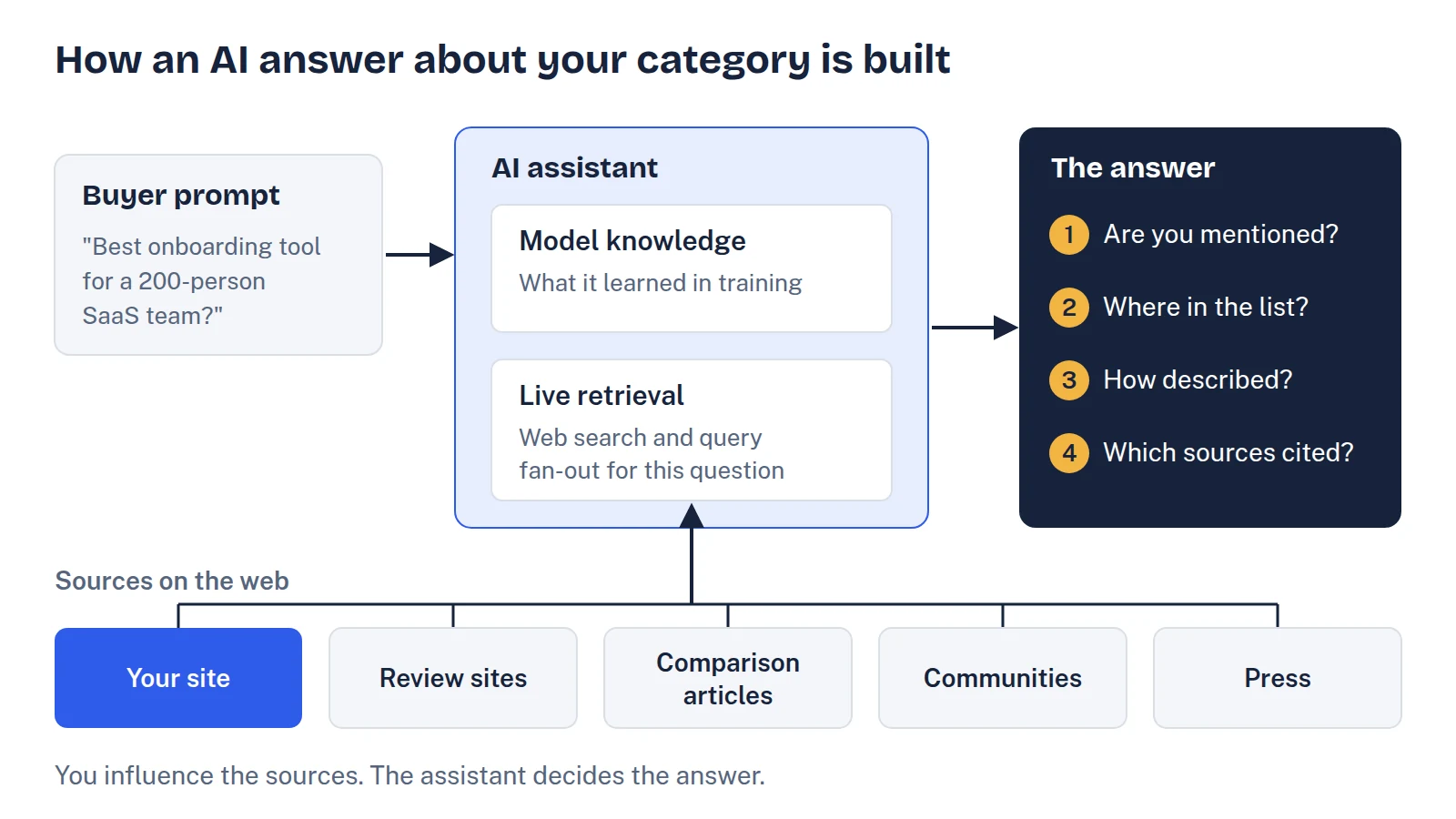
Why AI visibility matters for B2B SaaS pipeline
Most B2B buying starts with research the vendor never sees. AI assistants compress that research. A buyer who once opened ten tabs from a results page can now ask one detailed question and get a short, reasoned list of vendors.
Those questions are detailed. Research cited by Ahrefs found the average ChatGPT prompt in its sample was 42 words long, far longer than a typical search query. A buyer can describe team size, stack, budget and must-have integrations in one go, and the assistant tries to match vendors to that exact situation. That is good news if your positioning is clear, and bad news if the assistant has you filed under the wrong use case.
Three pipeline effects follow:
- The shortlist forms earlier. If you are missing from the answer, the buyer may never search for you by name, and no analytics tool records the visit that did not happen.
- Positioning gets set for you. The assistant's one-line description of your product is often the first framing a buyer hears. If it is wrong or dated, your sales team starts the first call correcting it. We cover how to fix that in our guide to AI brand visibility.
- Competitors gain by default. Answers usually name several vendors. Every prompt where a rival appears and you do not is share of voice you did not compete for.
Some of this does show up in your data. Google reports clicks from AI Overviews and AI Mode inside the normal Search Console Performance report under the "Web" search type, blended with regular results. Referral traffic from ChatGPT and Perplexity appears in web analytics. But the larger effect, being on or off the shortlist, has to be measured in the answers themselves.
The four parts of AI visibility
When you measure AI visibility, split it into four parts. Each one leads to a different fix.
- Presence (mention rate). The share of relevant prompts where your brand appears at all. This is the headline number.
- Share of voice. Your mentions compared with named competitors across the same prompts. It tells you your position in the category, not in isolation.
- Citations. Which pages the assistant cites or links to when it answers. These are the sources shaping the category story, and they are your outreach list.
- Accuracy and positioning. Whether the description is correct: right category, right buyer, right use case, current pricing model and features.
Our guide to measuring LLM visibility walks through prompt sets, share-of-voice math and a 30-day plan. If you want to run this every month and report it upward, see how to set up AI visibility tracking.
What shapes AI visibility
No assistant publishes a ranking formula, and OpenAI's publisher FAQ describes how to be crawlable, not how answers are ranked. The best evidence is correlational, so treat it as direction, not law.
Mentions across the web beat links
Ahrefs analyzed 75,000 brands and found that branded web mentions had the strongest correlation with how often a brand appeared in Google AI Overviews (0.664), well ahead of backlinks (0.218) and Domain Rating (0.326). About 26% of the brands studied had no AI Overview mentions at all. The takeaway for SaaS: being discussed on review sites, comparison articles, community threads and industry press matters more than raw link counts.
Third-party pages frame your category
For "best X software" style prompts, assistants tend to lean on pages that already compare vendors. If the most-cited roundups in your category skip you, the answers usually do too. Earning those mentions is its own discipline, covered in our guide to AI brand mentions.
Your own site sets the facts
Assistants need an unambiguous source for what you are, who you serve and what you cost. A homepage that says "the platform for modern teams" gives them nothing to work with. Clear category language, use-case pages and current pricing and feature pages do.
Freshness and access
Ahrefs' review of 17 million citations found AI assistants cite content that is 25.7% fresher than what ranks in organic search. On the technical side, keep Googlebot and OAI-SearchBot allowed in robots.txt. OpenAI says that for your content to be included in summaries and snippets in ChatGPT, you should not block OAI-SearchBot.
See your own AI visibility, free
Get a one-page audit of how ChatGPT, Perplexity and Gemini treat your brand against up to three competitors, plus your biggest gap. In your inbox within 48 hours.
Get my free auditWhat people search for about AI visibility
We pulled US search data for the main AI visibility terms from Ahrefs Keywords Explorer (Ahrefs, US, September 2026). Two things stand out.
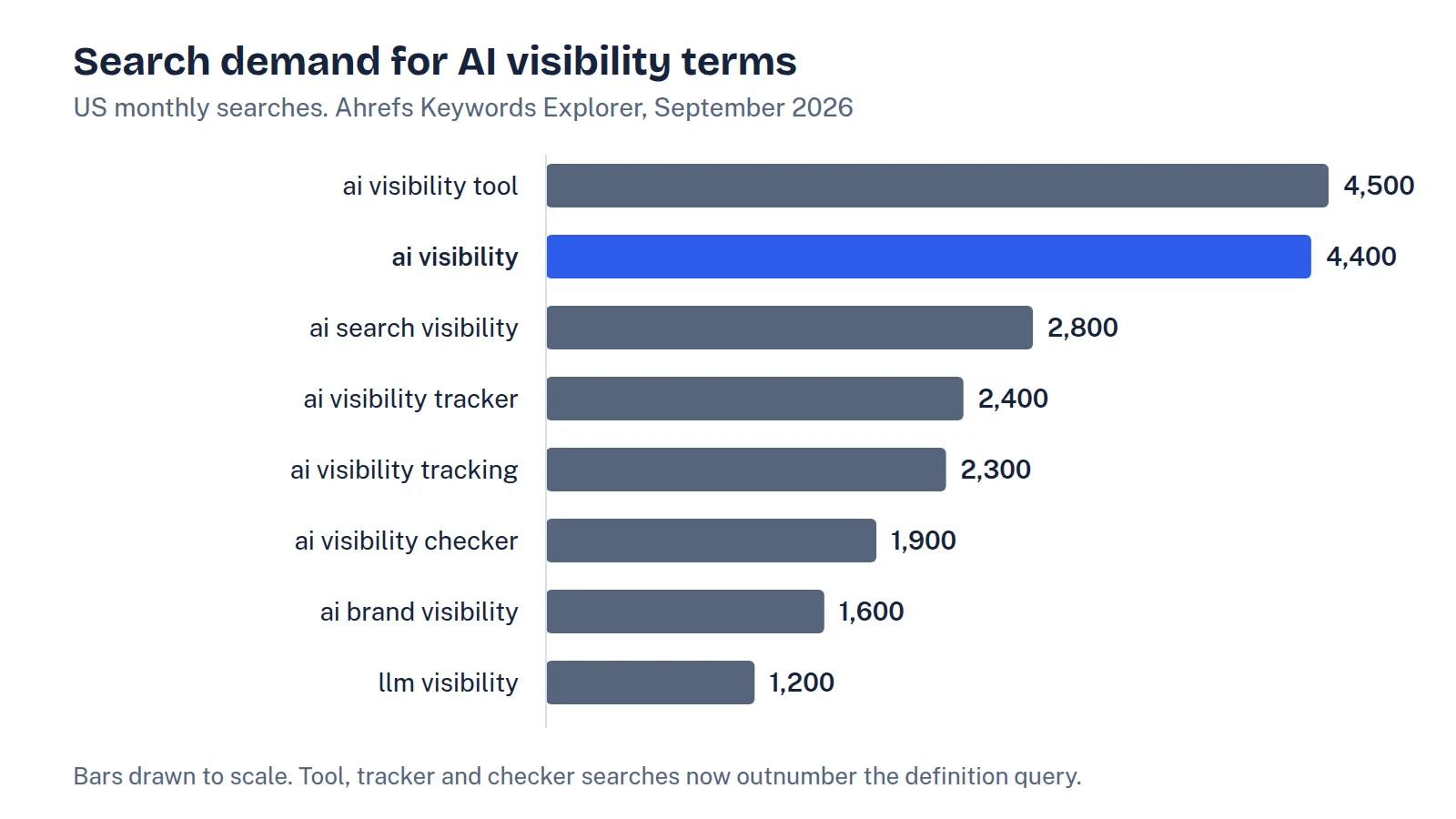
First, demand has moved past definitions. "AI visibility tool" (4,500 searches a month) now edges out "ai visibility" itself (4,400), and tracking, tracker and checker terms add thousands more. Teams are no longer asking whether this matters. They are asking how to measure it.
Second, the term is still ambiguous. The US top 10 for "ai visibility" includes a security news story about AI identity risks and an employee-analytics product page alongside marketing content. "AI visibility" also means seeing how AI is used inside a company. When you report on it internally, define it in one sentence so finance and security do not read your dashboard as something else.
Keyword difficulty for "ai visibility" is 0 in Ahrefs, and "what is ai visibility" is 4. The topic is new enough that clear, accurate explanations can still earn attention.
How to get a first read on your AI visibility
You can form a useful baseline in an afternoon without buying anything. The steps below are the short version; our free AI visibility check has the full walkthrough and a spreadsheet layout.
- Write 15 to 20 buyer prompts. Mix category ("best X for Y"), comparison ("X vs Y"), problem ("how do I fix Z") and alternative ("alternatives to competitor A") questions. Use the words your buyers use on sales calls.
- Pick three competitors. The ones you actually lose deals to, not the category leader you never meet.
- Run each prompt in ChatGPT, Perplexity and Gemini, in a logged-out or fresh session, and search the key ones in Google to see if an AI Overview appears.
- Record who is mentioned and in what order for every answer, including you.
- Copy the description of your brand word for word wherever you appear.
- List every cited URL. Note which ones are yours, which are third-party pages that mention you, and which mention only competitors.
- Calculate mention rate and share of voice, then mark every inaccurate description.
The output tells you which of the four parts is weakest. Low presence points to third-party mentions. Low accuracy points to your own positioning and brand facts. A citation list full of pages that skip you is your outreach plan.
FAQ
What is a good AI visibility score?
There is no universal benchmark, because every tool builds its score from a different prompt set and formula. A more useful test is relative: are you mentioned about as often as the competitors you lose deals to, across the same prompts? Track your own number over time rather than comparing it with another vendor's scale.
How do I check my AI visibility?
Write 15 to 20 prompts your buyers would ask, run them in ChatGPT, Perplexity and Gemini, and record which brands appear, in what order, and which sources are cited. Repeat each prompt at least twice. Dedicated tracking tools automate this once the prompt set grows.
Is AI visibility the same as GEO or AEO?
No. Generative engine optimization and answer engine optimization are the practices you use to improve how you appear in AI answers. AI visibility is the outcome you measure to see whether that work is paying off.
Does AI visibility show up in Google Search Console?
Partly. Google includes clicks and impressions from AI Overviews and AI Mode in the Performance report under the Web search type, but it does not separate them from regular results. Mentions in ChatGPT, Perplexity and Gemini do not appear in Search Console at all.
Sources
- Google Search Central: AI features and your website
- OpenAI Help Center: Searching the web with ChatGPT
- OpenAI Help Center: Publishers and developers FAQ
- Perplexity Help Center: How does Perplexity work?
- Ahrefs: An analysis of AI Overview brand visibility factors (75K brands studied)
- Ahrefs: What we actually know about optimizing for LLM search