AI brand visibility: how to fix what ChatGPT and AI search get wrong about you
AI brand visibility is not only whether ChatGPT, Perplexity, Gemini and Google's AI features mention your brand, but what they say when they do. If they describe you with outdated facts or recommend you for the wrong use case, the fix is to correct the sources behind that description, not to argue with the chatbot.
- A mention with the wrong category, buyer or pricing can cost you as much as no mention at all.
- Most errors fall into six types, and each one traces back to a different kind of source.
- Write a brand fact sheet before fixing anything, so your site, profiles and outreach all say the same thing.
- You cannot edit the model, but you can fix the pages it retrieves and earn new mentions that state the right facts.
- Track accuracy rate and positioning match monthly, next to mention rate and share of voice.
What AI brand visibility covers
Most AI visibility reporting counts mentions. That is half the picture. AI brand visibility also asks what the assistant says when it does mention you: which category it puts you in, which buyer it thinks you serve, what it believes you cost and which competitor it compares you with.
Those details decide whether a mention helps you. An assistant that recommends you to a 10-person startup when you only sell to enterprise teams creates bad-fit demos. One that still quotes a pricing model you dropped last year sends buyers into the first call with the wrong expectations. One that calls you "a simpler alternative to" a competitor has let that competitor frame your product.
If you are new to the wider topic, start with what AI visibility is. This guide is about the second half: finding and fixing inaccurate or off-target descriptions of your brand in ChatGPT, Perplexity, Gemini and Google's AI Overviews and AI Mode.
It is a real problem people are searching for help with. In Ahrefs Keywords Explorer (Ahrefs, US, September 2026), "ai brand visibility" gets about 1,600 searches a month and "llm brand visibility" about 700. Smaller, very specific queries show up too, such as "how to fix brand reputation in ai answers" (90) and "chatgpt making up facts about my company" (40). Yet the pages ranking for "ai brand visibility" today are almost all tool pages focused on counting mentions, not on correcting what is said.
Why assistants get your brand wrong
Assistants do not look up a single official record for your company. They assemble an answer from what the model learned during training and, often, from pages retrieved for that specific question. Errors come from both.
- Old training data. Model knowledge is a snapshot. A rebrand, a new pricing model or a move upmarket may not be in it yet.
- Stale third-party pages. Roundups, review profiles and comparison articles written two years ago still rank and still get retrieved. Ahrefs found AI assistants tend to cite fresher content than organic search does, but only if fresher content exists.
- Your own vague positioning. If your homepage says "the platform for modern teams", the assistant fills the gap with whatever other sources say.
- Name collisions. Short or generic brand names get merged with other companies, products or older namesakes.
- Confident guessing. Assistants rarely say "I don't know". When the Tow Center at Columbia Journalism Review tested ChatGPT search with 200 quotes from news articles, it returned 153 wrong or partly wrong answers and signaled uncertainty only 7 times. That test was about attributing articles, not describing companies, but the pattern of confident errors carries over.
OpenAI's own help page is direct about it: ChatGPT "search results and citations can be incomplete, outdated, or incorrect." You cannot assume the description is right just because it sounds fluent.
Six ways AI misdescribes a SaaS brand
Classifying errors matters, because each type traces back to a different kind of source and needs a different fix. The examples below are illustrative, not taken from a real brand.
| Error type | Example | Usually comes from | First fix |
|---|---|---|---|
| Wrong category | Called a "project management tool" when you sell resource planning | Vague homepage copy, old directory categories | State the category plainly on your homepage and in every profile |
| Wrong buyer or segment | Recommended for small teams when you sell to enterprise | Old reviews, roundups written before a move upmarket | Publish a clear "who it's for" page and update roundup entries |
| Outdated facts | Old pricing, a retired free plan, missing integrations | Stale review profiles and comparison articles | Keep pricing and integration pages current; ask editors to refresh |
| Missing differentiator | Described accurately but generically, with no reason to choose you | No third-party source repeats your main strength | Earn mentions that state it; make it explicit on your site |
| Brand confusion | Mixed up with a similarly named company or your pre-rebrand name | Name collisions, unlinked profiles | Disambiguate with Organization markup and consistent profiles |
| Competitor framing | Described as "a cheaper alternative to" a rival | Competitors' "vs" and "alternatives" pages | Publish your own honest comparison pages |
Prioritize the first two. For B2B SaaS they are usually the costliest, because they send the wrong buyers to sales while the right buyers never hear your name.
How to diagnose the problem
The work follows a loop. You collect what assistants say, classify the errors, trace them to their sources, fix those sources and then test again.
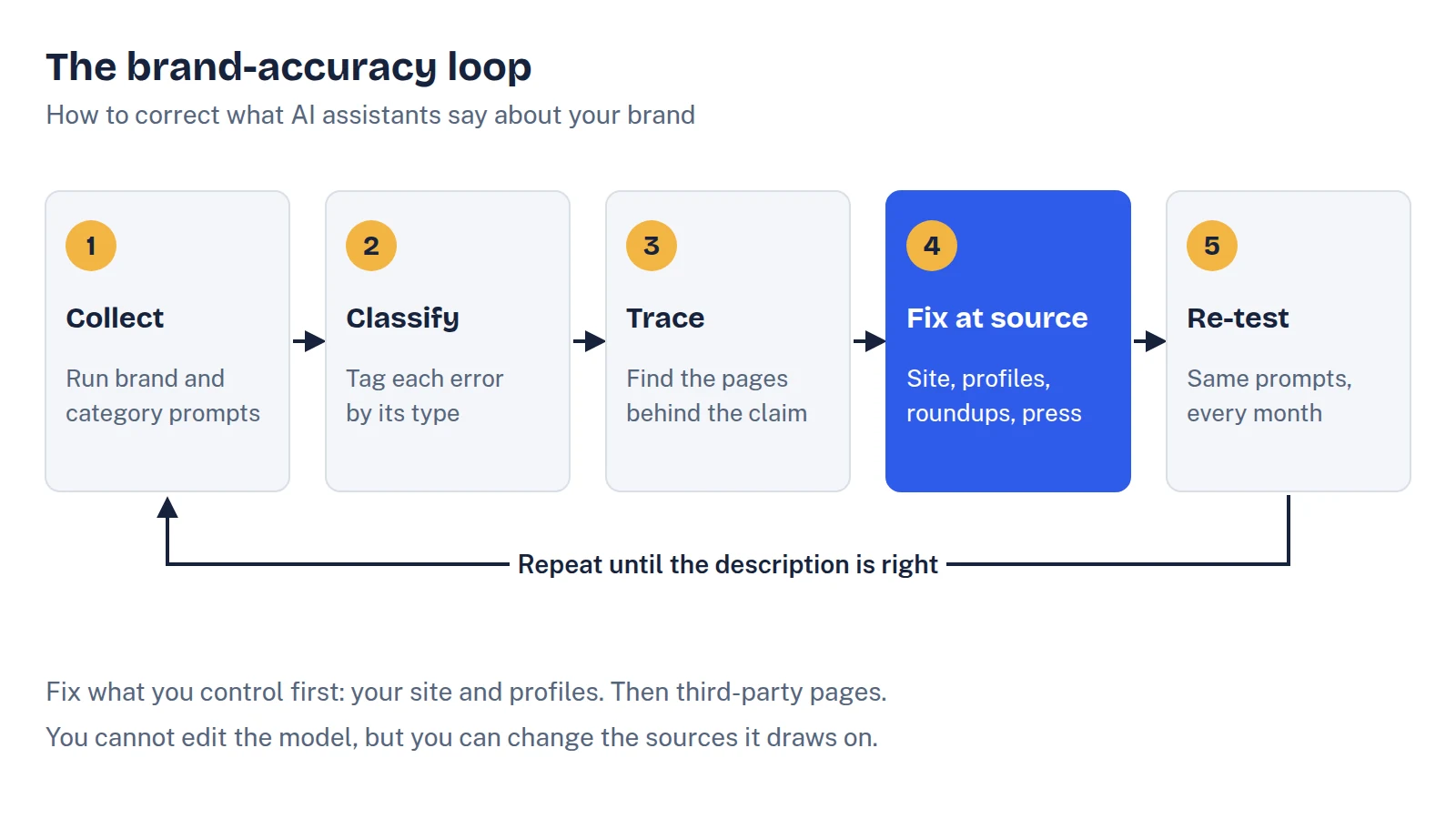
- Collect the descriptions. Run a set of brand prompts in ChatGPT, Perplexity, Gemini and Google: "What is [brand]?", "Who is [brand] for?", "How much does [brand] cost?", "[brand] vs [competitor]", "Is [brand] a good fit for [use case]?" Add five or so category prompts where you should appear. Copy the answers word for word.
- Classify every error. Tag each wrong or weak statement with one of the six types above. Note which assistant said it and how often it repeats across runs.
- Trace each claim to its source. Open the citations in Perplexity and in ChatGPT answers that searched the web. For Google, check the supporting links in the AI Overview. Then search the exact wrong phrase in Google to find other pages repeating it.
- Fix it at the source. Correct your own pages first, then the third-party pages you found. The next two sections cover how.
- Re-test on a schedule. Rerun the same prompts monthly and log whether each error is gone, reduced or unchanged.
If you do not have a prompt set yet, our free AI visibility check gives you a spreadsheet layout you can reuse here.
Build a brand fact sheet first
Before you fix anything, write down the correct answer. Many teams discover at this step that marketing, sales and the website disagree about who the product is for. If your own descriptions are inconsistent, the assistants' versions will be too.
A brand fact sheet is one internal page with the canonical version of each fact assistants tend to get wrong:
- One-sentence definition: "[Brand] is a [category] for [buyer] that [main outcome]."
- Category: the term buyers use, not your internal label.
- Primary buyer: role, company size and industry you are built for.
- Top three use cases, and the ones you are not a fit for.
- Pricing model: per seat, usage-based, free plan or not, and where current prices live.
- Key integrations and platforms supported.
- Main differentiator in one line a third party could repeat.
- Identity details: legal name, former names, founding year, headquarters and official profile URLs.
Then put the public parts where assistants and search engines can find them: your homepage, an about page, a "who it's for" page and your pricing page.
sameAs links to your official profiles. Google says this markup can help it "disambiguate your organization in search results", which is exactly what you want if your name collides with another company or you have rebranded.See your own AI visibility, free
Get a one-page audit of how ChatGPT, Perplexity and Gemini treat your brand against up to three competitors, plus your biggest gap. In your inbox within 48 hours.
Get my free auditFix the sources assistants rely on
Assistants reflect the web. Change what the web says and the answers tend to follow. Work in this order, because the earlier steps are fully in your control.
Your own site
Rewrite the homepage headline and meta description so the category and buyer are unmistakable. Keep pricing, integrations and feature pages current and dated. If you moved upmarket, say so on the page, not only in a press release. OpenAI notes that your content can only appear in ChatGPT search summaries if you do not block OAI-SearchBot, so check robots.txt while you are there.
Your profiles
Update every review site, directory, marketplace listing and social profile to match the fact sheet word for word where possible: category, description, pricing model, company size served. Remove or merge duplicate profiles left over from a rebrand.
Third-party roundups and comparisons
Take the cited URLs from step 3 of the loop and contact the editors of any page with outdated facts. Send a short note with the specific correction and a link to the page that proves it. Keep the request to facts. Asking for a better placement in the same email makes it easier to ignore.
Competitors' framing
If assistants describe you through a competitor's comparison page, publish your own honest "[you] vs [competitor]" and alternatives pages. Be fair about where the competitor is the better fit. Balanced pages are more credible to readers and give assistants a second source to weigh.
Google's knowledge panel
If your company has a knowledge panel, get verified. Google says verified users can suggest edits and that it reviews their feedback within a few days.
New mentions that state the right facts
Corrections fix what is wrong; new mentions reinforce what is right. In Ahrefs' study of 75,000 brands, branded web mentions had the strongest correlation with appearing in Google AI Overviews (0.664, versus 0.218 for backlinks). Podcasts, guest posts, analyst notes and customer stories that describe you correctly all add weight. Our guide to earning AI brand mentions covers the channels in detail.
What you cannot fix, and how to track progress
You cannot edit a model directly. OpenAI's publisher FAQ explains how to stay crawlable, but it does not describe any way to request a correction to how ChatGPT describes a company. Answers built from live retrieval can change once the pages behind them are updated and recrawled. Answers built from model knowledge change more slowly, as new model versions are trained on newer data. That is why the fixes above focus on sources.
Track accuracy alongside your mention metrics, with two simple numbers:
- Accuracy rate: the share of brand answers with no factual errors.
- Positioning match: the share of answers that name the right category and buyer.
Report both monthly next to mention rate and share of voice. Our guide to measuring LLM visibility covers those. A brand that gets mentioned less often but described correctly is usually in a better position than one mentioned everywhere for the wrong use case, and the accuracy number makes that visible to leadership.
FAQ
Why should I track AI brand visibility?
Because buyers increasingly form a shortlist from AI answers before they visit your site. Tracking shows whether you are on that shortlist and whether the assistant describes you correctly. Without it, wrong positioning shows up only as bad-fit leads and slower deals.
How do I increase brand visibility in AI?
Make your category and buyer unmistakable on your own site, keep your profiles consistent, and earn mentions on the third-party pages assistants cite, such as roundups, reviews and industry press. Then measure the same prompt set monthly to see what moved.
Can I ask ChatGPT to correct wrong information about my company?
Telling ChatGPT it is wrong only affects that conversation. OpenAI's publisher guidance covers crawler access, not correction requests. The lasting fix is to update the pages the answer draws on and publish clear, current facts on your own site.
How long does it take for AI answers about my brand to change?
It varies. Answers built from live web retrieval, like most Perplexity answers, can change once the underlying pages are updated and recrawled. Answers based on the model's training data change more slowly, usually with new model versions, so re-test monthly and expect gradual movement.
Sources
- Columbia Journalism Review, Tow Center: How ChatGPT search (mis)represents publisher content
- OpenAI Help Center: Searching the web with ChatGPT
- OpenAI Help Center: Publishers and developers FAQ
- Google Search Central: Organization structured data
- Google Knowledge Panel Help: Get verified on Google
- Ahrefs: An analysis of AI Overview brand visibility factors (75K brands studied)
- Ahrefs: What we actually know about optimizing for LLM search