AI visibility audit: a 5-layer method and scorecard for B2B SaaS
An AI visibility audit measures whether assistants like ChatGPT, Perplexity, Gemini and Google's AI Overviews name your brand for buyer questions, and explains why. It checks five layers: crawler access, product facts, answer-ready pages, third-party evidence and measurement. Below you'll get the process, a 24-point scorecard and the mistakes to avoid.
- A prompt list tells you whether assistants mention you. A full AI visibility audit also checks the inputs that explain why: access, facts, pages and third-party evidence.
- Fix layers bottom-up. Blocking OAI-SearchBot keeps you out of ChatGPT search answers, and no content work can fix that.
- Third-party mentions usually decide the result: in Ahrefs' 75,000-brand study, branded web mentions correlated 0.664 with AI Overview visibility, against 0.218 for backlinks.
- Run each prompt several times and report mention rate, not position. SparkToro found the same brand list repeats less than 1 time in 100.
- Score 12 checks from 0 to 2, fix the weakest layer first, and re-audit with the same prompts after 60–90 days.
What an AI visibility audit covers
An AI visibility audit answers two questions. First, what do AI assistants say about your category, and are you in it? Second, why do you get the result you get?
Most guides stop at the first question. They give you a prompt list and a spreadsheet, which is useful, and we cover that method in our free AI visibility check. But a mention rate on its own doesn't tell you what to fix. A full audit also looks at the inputs assistants rely on: whether their crawlers can reach you, whether the facts about your product are clear and consistent, whether your pages answer buyer questions directly, and what third-party pages say about you.
For a B2B SaaS company, that second half is where the work is. The answer to "best SOC 2 automation tool for a 50-person startup" is usually assembled from review sites, comparison articles, community threads and a few vendor pages. Your audit has to cover all of them.
AI visibility audit vs a classic SEO audit
People also search for this as a "GEO audit" or an "AI SEO audit". The names differ, but the scope is the same. Here is how it compares with the SEO audit your team probably already runs.
| Classic SEO audit | AI visibility audit | |
|---|---|---|
| Main question | Can Google crawl, index and rank our pages? | Do assistants name us, describe us correctly and cite pages that help us? |
| Crawlers checked | Googlebot, Bingbot | Also OAI-SearchBot, PerplexityBot, Claude's crawlers and Google-Extended |
| Unit of measurement | Keyword rankings and organic clicks | Mention rate across a fixed prompt set, run several times |
| Off-site focus | Backlinks and referring domains | Brand mentions on review sites, listicles, communities and press |
| Content focus | Topical coverage, on-page SEO | Direct answers, clear product facts, pricing and comparison pages |
| Typical output | Technical issue list | A scorecard by layer, plus a short list of fixes ranked by effect |
The two overlap more than the table suggests. Google says there are no additional requirements to appear in AI Overviews or AI Mode beyond being indexed and eligible to show with a snippet. So a broken SEO foundation also breaks your Google AI visibility. Run both, and share findings between them.
The five layers of an AI visibility audit
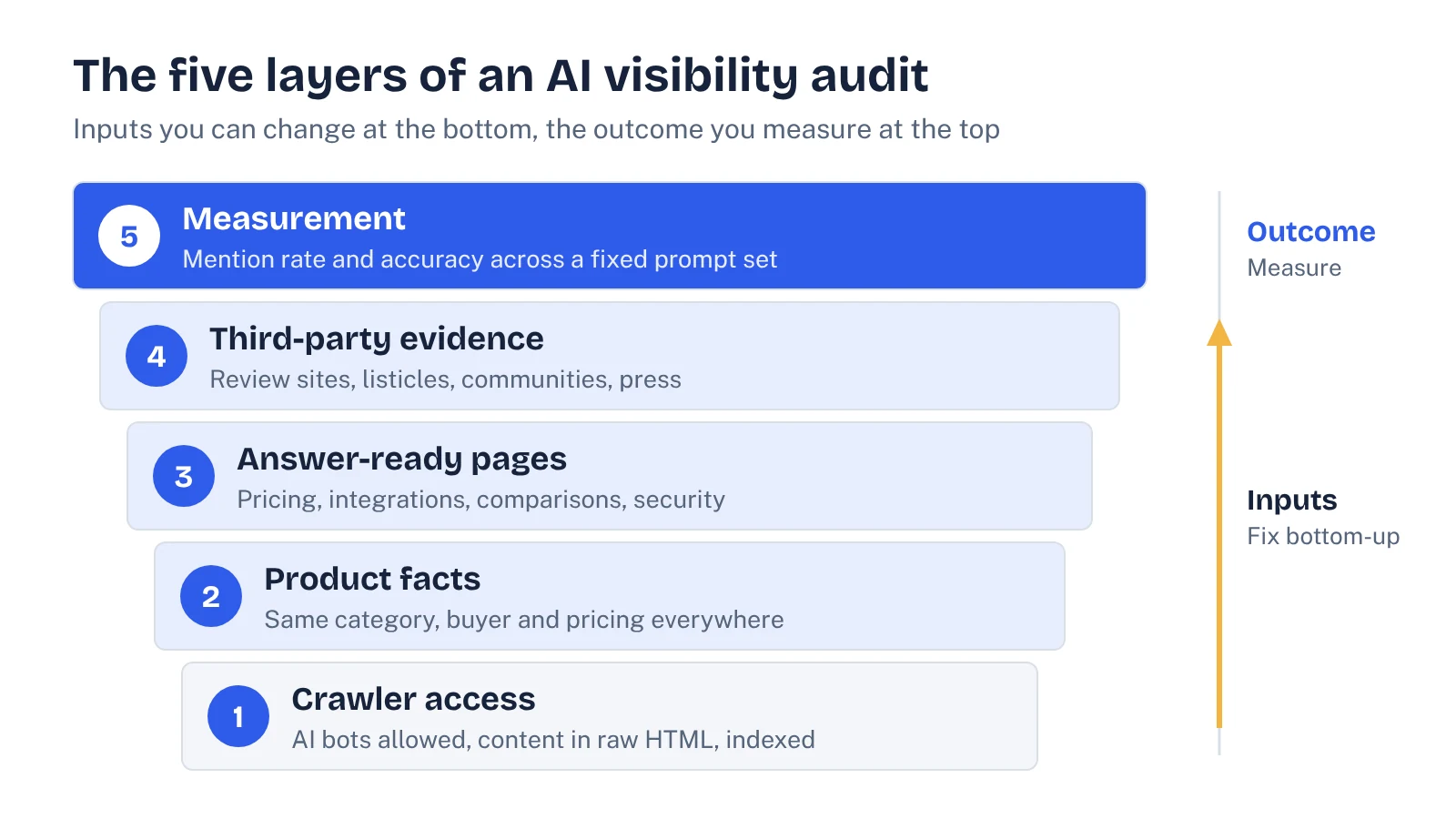
We split the audit into five layers. The first four are inputs you can change. The fifth is the outcome you measure. Working in this order stops you from rewriting content when the real problem is a firewall rule blocking a crawler.
1. Crawler access
Assistants can only cite pages their systems can fetch. Check your robots.txt, CDN and firewall rules for each AI crawler, not only Googlebot. OpenAI's documentation is explicit: sites that opt out of OAI-SearchBot will not be shown in ChatGPT search answers. It also separates OAI-SearchBot (search) from GPTBot (model training), so you can allow one and block the other. Our guide to AI crawlers lists the main user agents and a robots.txt template for SaaS sites.
Also check rendering. If your pricing table or feature list only appears after JavaScript runs, fetch the raw HTML and confirm the content is there.
2. Product facts
Assistants describe you using whatever they can find. If your homepage says "platform for revenue teams", your G2 profile says "sales engagement tool" and an old press release says "email automation", expect a muddled answer. Audit the core facts: category, who it is for, main use cases, pricing model, key integrations and notable limits. They should match across your site, review profiles, LinkedIn and directories.
3. Answer-ready pages
Buyers ask assistants specific questions: how much it costs, whether it integrates with Salesforce, how it compares with a named competitor. Check whether you have a page that answers each of those directly, near the top, in plain text. For SaaS, the pages that matter most are usually pricing, integrations, comparison or alternatives pages, security and compliance, and use-case pages. Schema helps machines parse some of this, but don't expect it to do the job alone (see schema markup for AI search).
4. Third-party evidence
This layer often decides the result. In Ahrefs' study of 75,000 brands, branded web mentions had the strongest correlation with AI Overview brand visibility (0.664), well ahead of referring domains (0.295) and backlinks (0.218). Correlation isn't causation, as Ahrefs notes, but it tells you where to look. List every third-party page that assistants cite for your prompts, then group them: review sites, editorial listicles, community threads, partner and integration directories, analyst and press coverage. Note which ones mention you, which mention only competitors, and which are out of date. More on this in AI brand mentions.
5. Measurement
Measure the outcome with a fixed set of buyer prompts. Two rules matter. First, run each prompt several times, because answers vary a lot. SparkToro's research found that ChatGPT and Google's AI had less than a 1 in 100 chance of returning the same list of brands across two responses to the same prompt. Second, report a mention rate (how often you appear), not a "rank in ChatGPT". SparkToro found ordering even less stable than the lists themselves.
For Google, add Search Console. Google has started rolling out generative AI reports that show impressions in AI Overviews and AI Mode by page, to a subset of sites so far. They show impressions, not clicks, so treat them as a complement to your prompt set, not a replacement.
How to run an AI visibility audit, step by step
This is the process we'd use for a B2B SaaS company with one core product. Budget one to two working days for a first pass.
- Write 25–40 buyer prompts. Cover five groups: category ("best X for Y"), problem ("how do I fix Z"), comparison ("A vs B"), alternatives ("alternatives to A") and brand ("is [you] good for Y"). Write them as a buyer would, with company size, role or stack where relevant.
- Pick your assistants. ChatGPT, Perplexity, Gemini and Google (AI Overviews and AI Mode) cover most B2B research. Add Claude or Copilot if your buyers use them.
- Run each prompt at least three times in clean, logged-out or temporary sessions, across at least two days. Log every brand named and every URL cited.
- Score the outcome. Mention rate for you and your top three competitors, plus accuracy: is what the assistant says about you correct?
- Audit layers 1–4 with the scorecard below. Score each check 0 (missing), 1 (partial) or 2 (done).
- Map gaps to causes. If you're missing from comparison prompts and you have no comparison pages and no listicle mentions, that is your answer. Most findings fall into one or two layers.
- Rank fixes by effect and effort, pick the top five, and set a re-audit date 60–90 days out using the same prompts.
See your own AI visibility, free
Get a one-page audit of how ChatGPT, Perplexity and Gemini treat your brand against up to three competitors, plus your biggest gap. In your inbox within 48 hours.
Get my free auditAn AI visibility audit scorecard you can copy
Here are the checks we use for layers 1–4. Twelve checks, two points each, 24 points in total. The score isn't an industry benchmark. It is a way to see which layer is weakest and to compare your own audits over time.
| Layer | Check | 2 points when… |
|---|---|---|
| Access | AI search crawlers allowed | OAI-SearchBot, PerplexityBot and Googlebot are allowed in robots.txt and not blocked by CDN or WAF rules |
| Access | Key content in raw HTML | Pricing, features and docs are readable without JavaScript |
| Access | Indexed and snippet-eligible | Core pages are indexed in Google and Bing, with no stray nosnippet or noindex |
| Facts | Consistent category and ICP | Same category and audience on your site, review profiles, LinkedIn and directories |
| Facts | Pricing model is public | Plans or a clear pricing model are stated in text |
| Facts | Accurate AI descriptions | No factual errors about you across the brand prompts |
| Pages | Comparison and alternatives pages | Fair, specific pages for your main competitors |
| Pages | Integration and use-case pages | One page per major integration and use case, answering the question in the first paragraph |
| Pages | Security and compliance page | Certifications, data handling and hosting stated plainly |
| Evidence | Review profiles current | Active, complete profiles on the review sites cited for your category |
| Evidence | Listicle coverage | Named in most of the third-party "best X" pages that assistants cite |
| Evidence | Community presence | Real, helpful mentions in the community threads assistants cite |
A low Access score is the most urgent, because nothing above it can work. A low Evidence score is the most common for younger SaaS brands, and the slowest to fix, so start early.
How many people search for an AI visibility audit
Demand for this is growing into its own search category. We pulled US search volumes from Ahrefs Keywords Explorer on October 22, 2026.
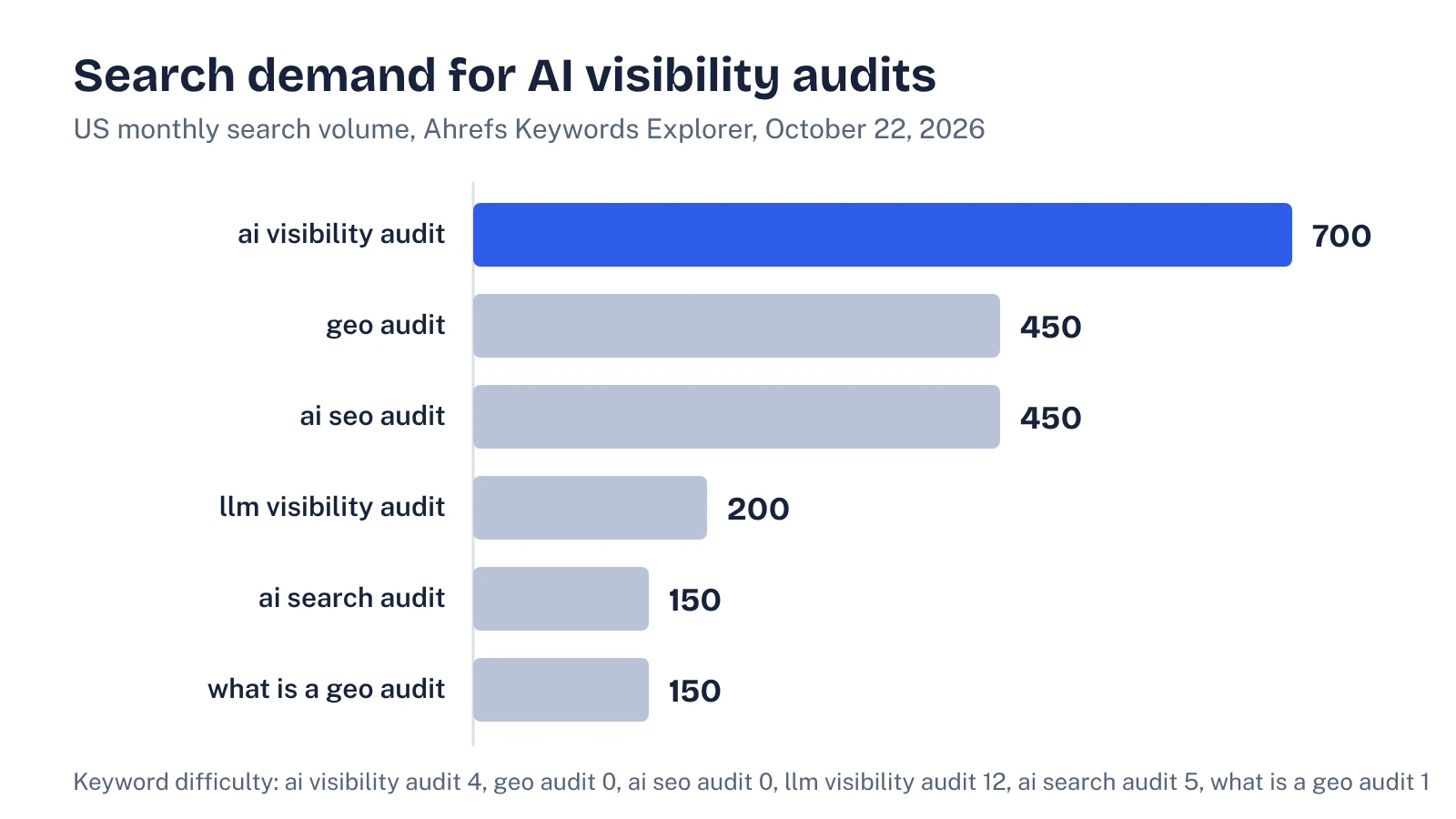
"AI visibility audit" has 700 monthly US searches with a keyword difficulty of 4, and Google shows an AI Overview for it. The top results are mostly free report tools and short checklists. Few cover the technical, factual and third-party layers together, and none we read had B2B SaaS page types or a scoring method. That gap is why we wrote this guide.
Common audit mistakes
- Running each prompt once. A single run is a sample of one. You'll mistake noise for a finding.
- Reporting position. "We rank third in ChatGPT" is not a stable measure. Report mention rate and accuracy instead.
- Only auditing your own site. If assistants cite three listicles and a Reddit thread for your category, those pages are part of your audit.
- Blocking the wrong bot. Blocking GPTBot to opt out of training is a valid choice. Blocking OAI-SearchBot removes you from ChatGPT search answers. Check which one your rules hit.
- No baseline. Without a dated first audit, you can't show that any of the follow-up work paid off.
What to do after the audit
Turn the findings into a short plan: access fixes this week, fact fixes this month, page and evidence work over the next quarter. Then track progress with the same prompts each month. Our guides to AI share of voice and tracking AI traffic in GA4 cover how to report it, and LLM visibility covers what tends to move the number.
If you'd rather start with an outside view, our free audit runs this same process on your category and sends you the scorecard.
FAQ
What is an AI visibility audit?
It is a structured check of how AI assistants describe and recommend your brand for buyer questions, plus a review of the causes. A full audit covers crawler access, consistency of your product facts, whether your pages answer buyer questions directly, third-party mentions, and a repeatable measurement of mention rate.
What is a GEO audit, and how is it different from an SEO audit?
A GEO (generative engine optimization) audit is another name for an AI visibility audit. An SEO audit asks whether Google can crawl, index and rank your pages. A GEO audit also checks AI crawlers, how assistants describe you, and which third-party pages they cite for your category.
How often should you run an AI visibility audit?
Run a full audit once to set a baseline, then re-audit every 60–90 days with the same prompts. In between, a monthly check of mention rate on a fixed prompt set is enough to spot changes.
Can I do an AI visibility audit for free?
Yes. The measurement part needs only a prompt list, the free tiers of the main assistants and a spreadsheet. The access, facts, pages and evidence checks need your robots.txt, Search Console and a careful read of the pages assistants cite. Paid tools mainly save time once your prompt set grows.
Sources
- OpenAI: Overview of OpenAI crawlers
- Google Search Central: AI features and your website
- Ahrefs: An analysis of AI Overview brand visibility factors (75K brands studied)
- SparkToro: AIs are highly inconsistent when recommending brands or products
- PPC Land: Google gives Search Console its own generative AI visibility reports
- Ahrefs Keywords Explorer (US data pulled October 22, 2026)