Schema markup for AI search: what helps, what doesn't, and what to keep
Schema markup does not get you cited in AI answers on its own. Google says no special structured data is needed for AI Overviews or AI Mode, and a 1,885-page Ahrefs test found no meaningful citation lift after adding JSON-LD. It still helps systems identify your company and products. This guide shows which types a SaaS site should keep, which to skip, and how to audit yours in 30 minutes.
- Google states there is no special schema.org markup required to appear in AI Overviews or AI Mode.
- Ahrefs' matched test of 1,885 pages found no meaningful AI citation lift from adding JSON-LD on AI Overviews, AI Mode or ChatGPT.
- Microsoft says schema helps its LLMs understand content, which is about clarity, not a citation boost.
- For SaaS, Organization (with sameAs), Article with author and BreadcrumbList are worth keeping accurate; FAQ rich results stopped appearing in May 2026.
- Markup that contradicts the visible page is the real risk. Audit consistency before adding anything new.
The short answer
Schema markup is structured data, usually JSON-LD, that labels what a page is about: the company behind it, the product it describes, the article and its author. It has been part of technical SEO for years. Since AI answers arrived, it has also picked up a reputation as an "AI ranking factor."
The evidence doesn't support that reputation. Google says plainly that there is "no special schema.org structured data that you need to add" to appear in AI Overviews or AI Mode. The largest controlled test we know of, from Ahrefs, found that adding JSON-LD to pages produced no meaningful change in AI citations. Microsoft has said schema helps its models understand content, but has not said it changes which pages get cited.
So the useful question isn't "which schema gets me into ChatGPT?" It's "which markup is worth maintaining on a SaaS site, and why?" That's what this guide answers.
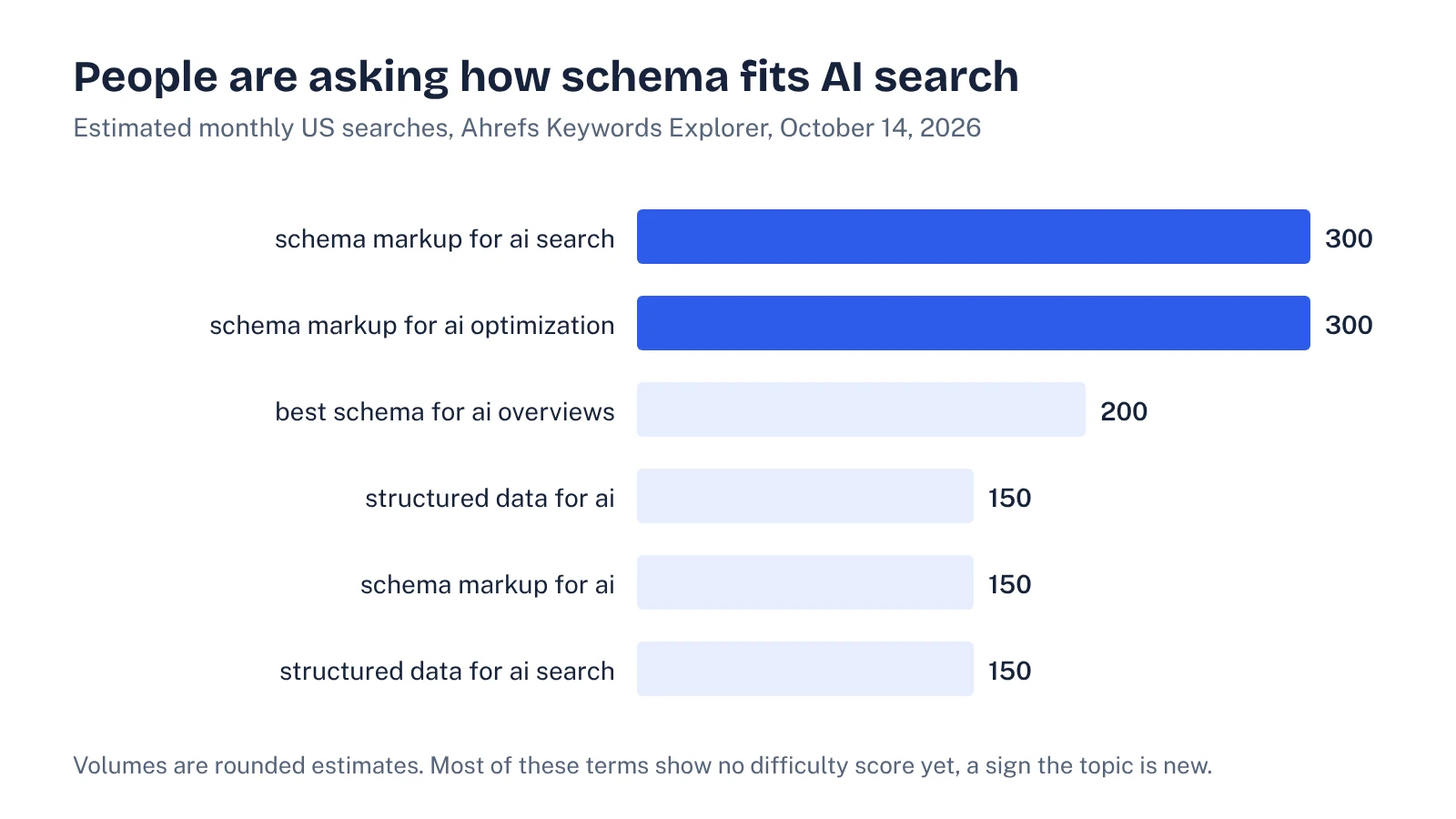
The topic is clearly on people's minds. In Ahrefs Keywords Explorer this morning, "schema markup for ai search" and "schema markup for ai optimization" each showed about 300 US searches a month, with "best schema for ai overviews" at about 200. Most of these terms have no difficulty score yet, which usually means a young topic where a lot of the ranking advice hasn't been tested.
What Google, Microsoft and OpenAI actually say
Start with the platforms, because their statements are the most reliable evidence you have.
Google's page on AI features and your website says there are "no additional requirements to appear in AI Overviews or AI Mode, nor other special optimizations necessary." It adds that you don't need "new machine readable files, AI text files, or markup." The one structured data instruction it gives is an old SEO rule: make sure your structured data matches the visible text on the page.
Google's newer AI optimization guide (updated July 2026) goes further. Under "what you don't need to do," it lists "overfocusing on structured data" and says structured data "isn't required for generative AI search." It still recommends structured data as part of normal SEO, because it helps pages qualify for rich results.
Microsoft Bing and Copilot
Microsoft is the one platform that has spoken positively. At SMX Munich in March 2025, Bing's Fabrice Canel confirmed that schema markup helps Microsoft's LLMs understand content, as reported by Search Engine Land. Note what that statement covers: understanding. It doesn't say marked-up pages are cited more often.
OpenAI and other assistants
OpenAI hasn't published guidance saying ChatGPT search reads or rewards schema markup. Treat any claim that "ChatGPT prefers FAQ schema" as unverified unless it comes with a test you can inspect.
What the citation data shows
In May 2026, Ahrefs published a study of schema and AI citations. It started with a correlation many vendors quote: AI-cited pages were almost three times more likely to have JSON-LD than non-cited pages. Then it tested whether that relationship was causal.
The team took 1,885 pages that added JSON-LD between August 2025 and March 2026, matched each with three similar pages that never added it, and compared citations in the 30 days before and after. The results:
| Platform | Change vs. control pages | What it means |
|---|---|---|
| Google AI Overviews | −4.6% | Statistically significant but small, and the decline started before schema was added |
| Google AI Mode | +2.4% | Not distinguishable from zero |
| ChatGPT | +2.2% | Not distinguishable from zero |
The authors' own summary: "Adding schema produced no major uplift in citations on any platform." Their explanation for the correlation is that sites with schema tend to be stronger at SEO overall. Schema travels with good sites; it doesn't make them good.
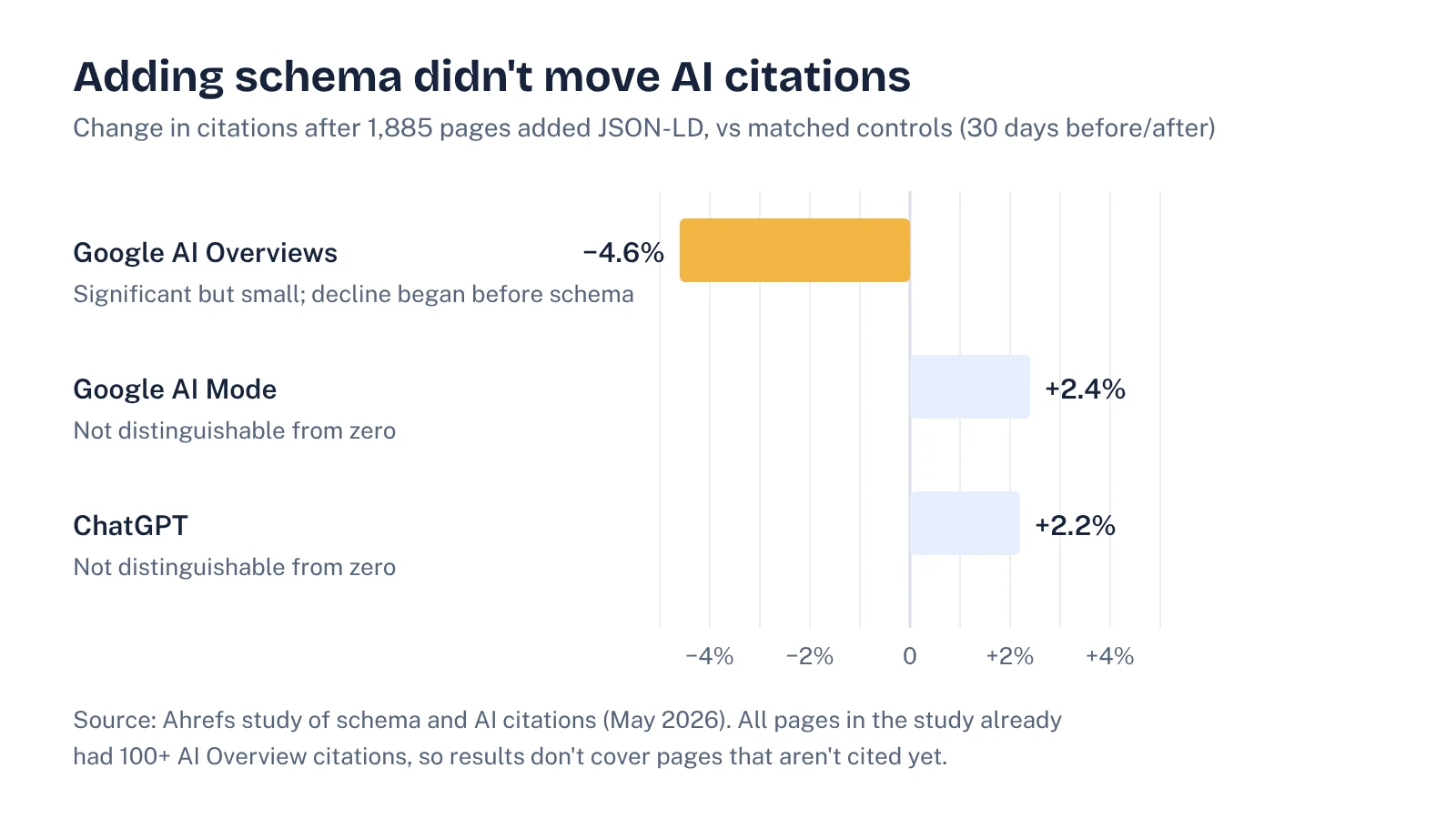
The study has limits worth knowing. Every page in it already had more than 100 AI Overview citations, so it says nothing about pages that aren't cited yet. Schema types were pooled together, the window was 30 days, and only JSON-LD was tested. It's strong evidence against schema as a quick citation lever. It isn't proof that schema never matters.
What schema still does for a SaaS site
None of this makes structured data pointless. It does three useful jobs, and none of them depends on AI hype.
- Entity clarity. Google says Organization markup helps it "disambiguate your organization in search results." For a SaaS brand with a common-word name, this is the most valuable markup you have. The
sameAsproperty links your site to your LinkedIn page, G2 profile, Crunchbase entry and other places that describe you, so systems can connect them. - Rich results in classic search. Some types still earn visual enhancements in Google, which affects clicks from the blue links that AI answers sit on top of.
- Machine-readable facts that stay consistent. Product name, category, pricing model, ratings and author details in one predictable format. Whether or not an AI system reads the JSON-LD, the discipline of keeping these facts consistent fixes the same errors that make AI assistants describe your brand wrongly.
Offer, a renamed product or a former CEO in founder is the kind of inconsistency Google's guidance warns about, and it's common on SaaS sites that redesigned without touching their JSON-LD.Which schema types to keep, add or drop
Most ranking guides recommend the same list for everyone. Here's how the common types look for a B2B SaaS site specifically, based on Google's current documentation.
| Schema type | Where it goes | Status in Google today | Our call |
|---|---|---|---|
Organization (with sameAs, logo) | Home or about page | Supported; helps disambiguate your company | Keep. Highest value for brand clarity |
| SoftwareApplication | Product or pricing page | Supported rich result; requires name, an offers.price and a rating or review | Add only if you have genuine ratings to mark up |
| Article / BlogPosting with author | Blog posts and guides | Supported | Keep. Ties content to a named expert |
| BreadcrumbList | Site-wide | Supported | Keep. Cheap and clarifies site structure |
| FAQPage | FAQ sections | FAQ rich results stopped appearing on May 7, 2026 | Optional. Fine to leave; don't add it expecting AI gains |
| HowTo | Tutorials | Rich results fully deprecated since September 2023 | Low priority |
The FAQPage change is the one most teams missed. Google added a deprecation notice in May 2026, the end of a phase-out that began in August 2023, when FAQ rich results were limited to authoritative government and health sites (PPC Land has the timeline). Leaving FAQ markup in place causes no errors. Adding it now as an "AI tactic" has no supporting evidence.
On SoftwareApplication, be careful. Google requires a rating or review property. Marking up reviews you collected on another site, or ratings that aren't shown on the page, breaks the rule that markup must match visible content.
See your own AI visibility, free
Get a one-page audit of how ChatGPT, Perplexity and Gemini treat your brand against up to three competitors, plus your biggest gap. In your inbox within 48 hours.
Get my free auditA 30-minute schema audit for AI search
You don't need a big project. This checklist covers what matters, in priority order.
- Inventory what you have. Run your home page, pricing page, one product page and one blog post through Google's Rich Results Test and the Schema.org validator. Note every type found.
- Check Organization first. Confirm the
namematches how you want to be described, thelogois current, andsameAslists your real profiles: LinkedIn, G2 or Capterra, Crunchbase, GitHub if relevant. Remove dead links. - Compare markup to the page. For every price, rating, product name and author in your JSON-LD, confirm the same fact appears on the page. Fix mismatches before anything else.
- Add author markup to guides. Make sure each post names a real person with a profile page. This supports the experience and expertise signals Google already looks for.
- Leave FAQPage and HowTo alone. Don't spend time adding or removing them.
- Write down the facts you want AI to repeat. Category, who you're for, main use cases, pricing model. Make sure your about page, pricing page and third-party profiles say the same thing. This matters more than any markup.
- Measure, don't assume. If you change markup, track a fixed prompt set before and after. Our guide to AI visibility tracking covers how to set that up so random answer variation doesn't fool you.
What moves AI citations instead
If schema isn't the lever, what is? The same research that downplays schema points at the basics. Pages must be indexed and eligible for a snippet in Google before they can appear in AI Overviews at all. After that, the pages that get cited tend to be the ones that already rank and answer the question clearly in their own text.
For SaaS brands, two areas tend to matter more than markup:
- Clear, extractable content on your own site. Direct answers near the top of the page, comparison tables, specific numbers with sources. Our AI search optimization checklist puts these in priority order.
- Third-party mentions. Review sites, comparison articles and industry press shape which brands assistants name. See our guide to AI brand mentions for how to earn more of them.
Schema sits underneath all of this as hygiene. It's the same story as llms.txt: a reasonable thing to maintain, not a shortcut past the work that actually earns citations.
The bottom line
Keep your Organization, Article and breadcrumb markup accurate and complete. Add SoftwareApplication only when you have honest ratings to show. Don't add FAQ or HowTo markup expecting AI gains. Then spend the time you saved on content and mentions, which is where the evidence points.
FAQ
Does schema markup help you rank in AI Overviews?
Not directly, based on current evidence. Google says no special structured data is needed for AI Overviews or AI Mode, and Ahrefs found no meaningful citation lift after pages added JSON-LD. It can still help Google understand your organization and qualify pages for rich results.
Is FAQ schema still relevant?
Much less than it was. Google says FAQ rich results stopped appearing in Search from May 7, 2026. You can leave existing FAQPage markup in place without errors, but there's no published evidence that adding it improves AI citations.
Which schema type matters most for a SaaS company?
Organization markup on your home or about page, with an accurate logo and sameAs links to profiles such as LinkedIn, G2 and Crunchbase. Google says it helps disambiguate your organization, which is useful when your brand name is a common word.
Does ChatGPT read schema markup?
OpenAI hasn't published guidance saying ChatGPT search uses or rewards schema markup. Ahrefs' test showed a +2.2% change in ChatGPT citations after pages added JSON-LD, which was not distinguishable from zero.
Can I use AI to generate schema markup?
Yes, AI tools can draft JSON-LD quickly. Validate the output with Google's Rich Results Test and check every fact against the visible page, because invented ratings or outdated prices break Google's structured data guidelines.
Sources
- Google Search Central: AI features and your website
- Google Search Central: Optimizing for generative AI search
- Ahrefs: schema markup and AI citations study (May 2026)
- Search Engine Land: Microsoft Bing/Copilot use schema for its LLMs
- Google Search Central: Organization structured data
- Google Search Central: Software app structured data
- Google Search Central: FAQ structured data (deprecation notice)
- PPC Land: Google kills FAQ rich results
- Ahrefs Keywords Explorer (US data, October 14, 2026)