llms.txt: what it is, who actually reads it, and whether your SaaS site needs one
llms.txt is a plain Markdown file at the root of your site that gives AI tools a short summary of what you do and links to your most useful pages. It is a proposal, not a standard: Google says its search features don't use it, and no major assistant says it reads it. For most SaaS marketing sites it is optional. This guide covers what the file is, what the evidence shows, and where your effort pays off more.
- llms.txt is a proposed Markdown file at /llms.txt that summarizes your site for AI tools. Only the H1 title is required.
- Google says Search, including its AI features, doesn't use AI text files. No major assistant has said it reads llms.txt.
- Ahrefs found 28% of 137,210 domains publish one, but 97% of valid files got zero requests in May 2026.
- It is most useful for developer docs that coding agents read. For a marketing site, it is a 20-minute nice-to-have.
- What moves AI visibility is crawler access, clear pages and what other sites say about you.
What is llms.txt?
llms.txt is a Markdown file that lives at the root of a website, at /llms.txt, and gives AI tools a short, clean summary of the site plus links to the pages that matter most. Jeremy Howard first proposed it in September 2024. The current version of the proposal describes it as "a proposal to standardise on using an /llms.txt file to provide information to help agents use a website."
The idea is simple. A web page is full of navigation, scripts and layout that a language model has to wade through. A short Markdown file that says "here is who we are and here are our key pages" is cheaper for a machine to read. It sits alongside robots.txt and sitemap.xml, but it does a different job:
- robots.txt tells crawlers what they may and may not fetch. Crawlers from Google and OpenAI follow it.
- sitemap.xml lists the URLs you want search engines to discover.
- llms.txt describes your site in plain language and points to the best pages. Nobody is obliged to read it.
That last point is the one most articles skip, and it's the one that matters for your roadmap.
What goes in the file
The format is light. According to the proposal, the only required part is an H1 with the name of the site or project. Everything else is optional, in this order:
- An H1 with your company or product name (required).
- A blockquote with a one or two sentence summary of what you do.
- Optional paragraphs with context a reader needs, such as who the product is for.
- H2 sections, each with a list of Markdown links and a short note on what each page covers.
The proposal also suggests offering clean Markdown copies of key pages at the same URL with .md added. Documentation platforms take this further. Mintlify, for example, automatically hosts both an llms.txt and an llms-full.txt, which "combines your entire documentation site into a single file." llms-full.txt is a platform convention, not part of the core proposal.
Here is a template for a B2B SaaS marketing site. It takes about 20 minutes to fill in:
# Acme Analytics

> Acme Analytics is product analytics software for B2B SaaS teams
> with 50 to 500 employees. It tracks feature adoption and
> churn signals without engineering support.

## Product
- [Features](https://acme.com/features): What the product does, by use case
- [Pricing](https://acme.com/pricing): Plans, limits and what each includes
- [Integrations](https://acme.com/integrations): Supported tools and data sources

## Comparisons
- [Acme vs Competitor](https://acme.com/vs/competitor): Honest side-by-side

## Docs
- [Getting started](https://docs.acme.com/start): Setup in under an hour
Keep the summary factual and specific. If you'd be embarrassed to see a line quoted back in an AI answer, cut it.
Who actually reads llms.txt?
This is where the hype and the evidence part ways.
Google says it doesn't use it. Google's guide to optimizing for generative AI features, updated in July 2026, is blunt: "You don't need to create new machine readable files, AI text files, markup, or Markdown to appear in Google Search (including its generative AI capabilities), as Google Search itself doesn't use them." That covers AI Overviews and AI Mode.
No major assistant says it reads it. The AI labs publish llms.txt files for their own developer docs. The proposal names OpenAI, Anthropic and Gemini as examples, and OpenAI's crawler documentation page links to its own llms.txt. But publishing a file for your docs is not the same as reading everyone else's. OpenAI's crawler page describes OAI-SearchBot, GPTBot and ChatGPT-User, and says OAI-SearchBot "is used to surface websites in search results in ChatGPT's search features." It says nothing about reading other sites' llms.txt. Ahrefs' review of the major providers reached the same conclusion: "No major LLM provider has formally adopted llms.txt."
Server data shows almost nobody asks for it. In June 2026, Ahrefs published a study of 137,210 domains using its Web Analytics product. The findings:
- 28% of the domains (38,360) published an llms.txt file.
- 97% of those files received zero requests in May 2026.
- Across the roughly 1,100 domains whose file was requested at all, there were about 22,000 requests in the month.
- 96% of those requests came from bots, and 77% of the bots weren't AI tools.
- Zero AI bots went looking for llms.txt files that didn't exist.
The sample leans toward tech-savvy sites that already care about AI, so adoption across the wider web is likely lower. But the request data is the part that counts, and it's hard to read as anything other than "mostly ignored."
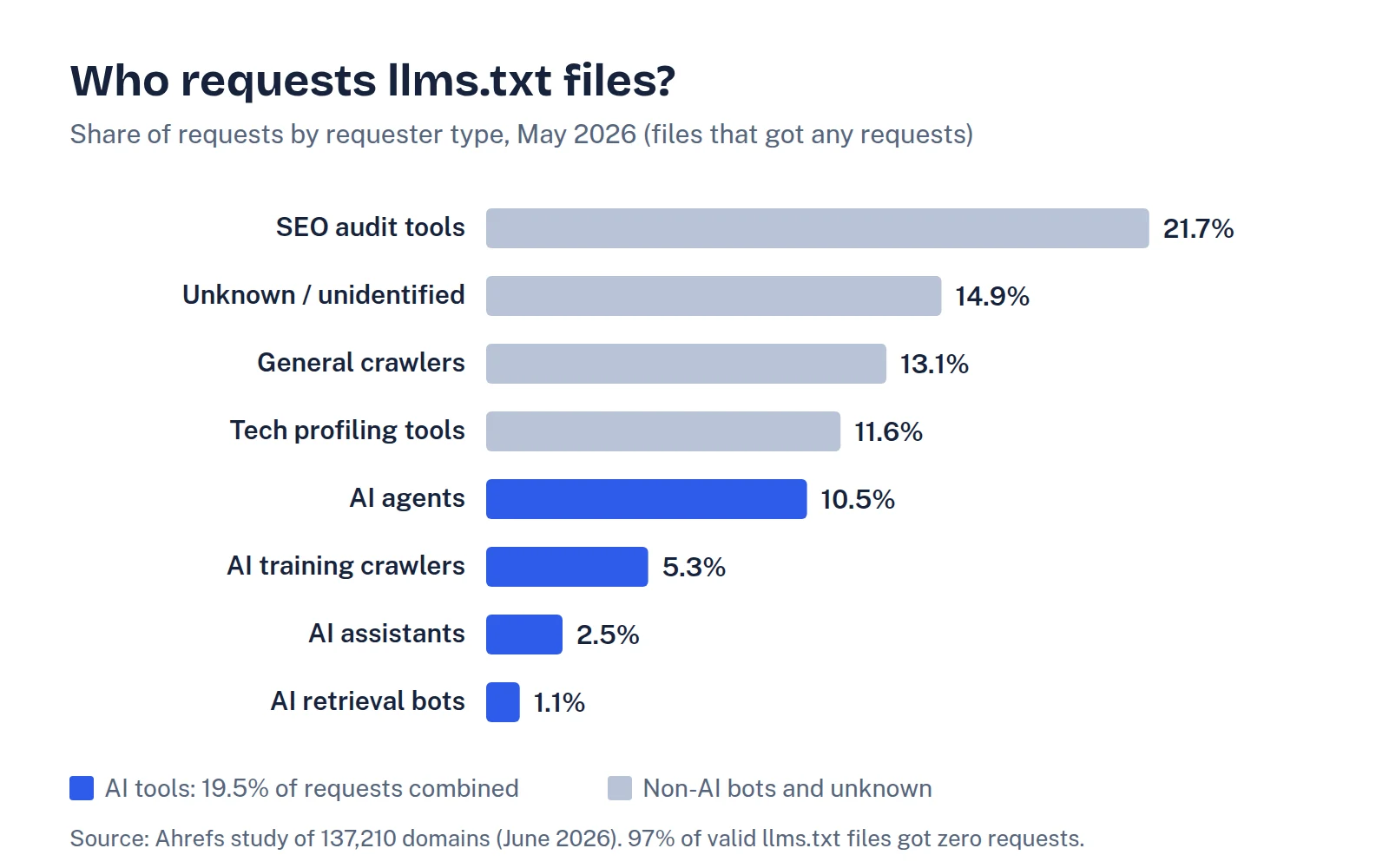
Look at the bottom of that chart. AI retrieval bots, the ones that fetch pages to answer a user's question in real time, made about 1% of the requests. SEO audit tools checking whether you have the file made about a fifth. Much of the traffic to llms.txt is other tools checking that it exists.
What about Chrome Lighthouse?
The one concrete sign of mainstream support is Chrome's Lighthouse, which now has an llms.txt audit in its agentic browsing checks. It's worth reading the details before you treat it as a ranking signal.
The audit flags a page only if a server error occurs when Lighthouse tries to fetch the file. If you don't have one at all (a 404), the audit is marked not applicable, because the file is optional. Chrome's documentation describes llms.txt as "an emerging convention" and notes that without it, "agents may spend more time crawling the site to understand its high-level structure."
So Lighthouse is about AI agents that browse and act on sites, such as agents that navigate a product or read docs to complete a task. It is not a Google Search ranking factor, and the documentation doesn't claim it is. The practical rule from the audit: if you publish a file, make sure it loads cleanly. A broken llms.txt is worse than none.
Why so many people are asking about it
The gap between interest and evidence is striking. We pulled the numbers in Ahrefs Keywords Explorer (US) on 28 September 2026:
| Search | US monthly volume | Keyword difficulty |
|---|---|---|
| llms.txt | 2,800 | 0 |
| what is llms.txt | 1,800 | 0 |
| llm.txt | 700 | 41 |
| llms.txt file | 450 | n/a |
| websites using llms.txt | 400 | n/a |
| should i create an llms.txt file? | 350 | 5 |
| will llms.txt file help your seo | 350 | n/a |
The question-style searches tell you what people want to know: should I bother, and will it help? The results page for "llms.txt" itself shows a Google AI Overview citing the proposal, Chrome's documentation, Semrush, Ahrefs, Reddit and documentation platforms. The questions Google surfaces underneath are "Is llms.txt actually used?" and "Is llms.txt mandatory?" The short answers are "rarely" and "no."
Should your SaaS site have one?
It depends on what the site is for. Here's how we'd decide.
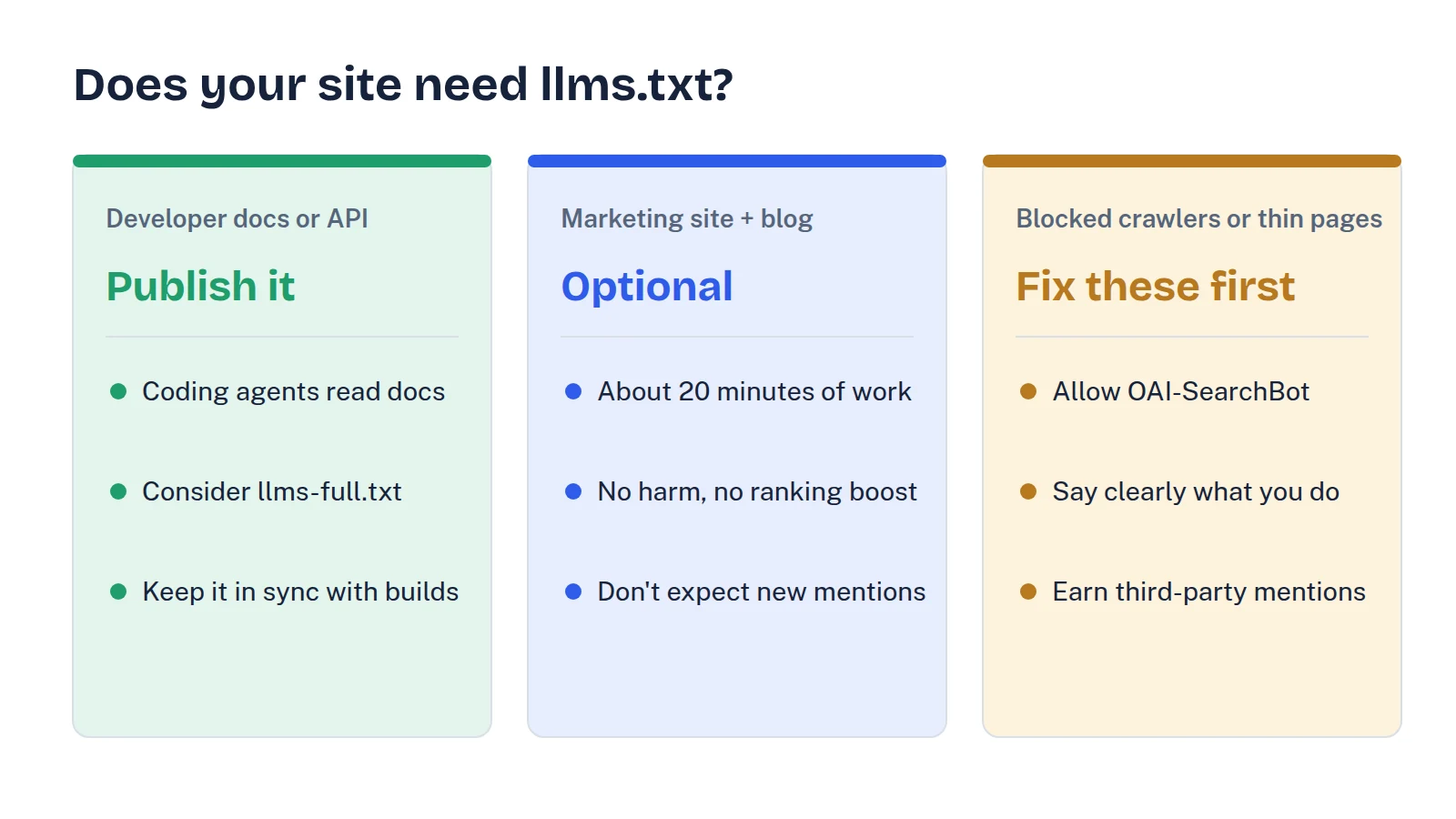
You have public API or developer docs. Publish one. This is the use case with the best case behind it. Coding assistants and agents read docs to write integrations, and a clean index plus Markdown pages saves them effort. Google's John Mueller, quoted by Ahrefs, called it a "temporary crutch, perhaps to save some tokens" for AI coding tools reading developer docs. If your docs platform generates the file automatically, check it's accurate and move on.
You have a marketing site and a blog. Optional. It costs 20 minutes and a line in your deploy, and it does no harm. Just don't expect it to change whether ChatGPT or AI Overviews mention you. If your team is debating it for a week, that week is better spent elsewhere.
Your AI crawler access or core pages are in bad shape. Fix those first. llms.txt can't help a page that crawlers are blocked from, or a product page that never says clearly who the product is for.
See your own AI visibility, free
Get a one-page audit of how ChatGPT, Perplexity and Gemini treat your brand against up to three competitors, plus your biggest gap. In your inbox within 48 hours.
Get my free auditWhat moves AI visibility instead
It helps to know how assistants choose sources in the first place. Our guide to LLM SEO walks through that selection process step by step.
If the goal is to be mentioned and cited when buyers ask assistants about your category, these are the levers with evidence behind them:
- Let the right crawlers in. Allow OAI-SearchBot and other search and retrieval bots in robots.txt, and make sure key pages are indexable. Google's AI features documentation says a page must be indexed and eligible for a snippet to appear as a supporting link in its AI features.
- Say what you do in plain words on your own pages. Category, who it's for, pricing model, key integrations. Assistants repeat what they can find and verify.
- Earn mentions where assistants look. Comparison articles, review sites, community threads and press. Our guide to earning AI brand mentions covers where to start, and GEO vs SEO explains why off-site work carries so much weight.
- Rank for the sub-questions buyers ask. Google's AI features run several related searches behind each answer. Pages that answer those questions well get cited. See how to rank in AI Overviews.
- Measure it directly. Run a fixed set of buyer prompts each month and log who gets named. You can check your AI visibility by hand in an afternoon.
How to add llms.txt in 20 minutes
If you've decided it's worth doing, keep it simple:
- Copy the template above into a file named
llms.txt. - Write a two-sentence summary that names your category and ideal customer.
- List 5 to 15 of your most useful pages: product, pricing, integrations, comparisons, docs and your best guides. Skip thin or outdated pages.
- Upload it to your site root so it loads at
yourdomain.com/llms.txt, served as UTF-8 text. - Open the URL in a browser to confirm it returns a 200, not a redirect or error. Then run Lighthouse to confirm the audit passes.
- Regenerate it when you launch or retire a key page. Static site generators and docs platforms can do this on every build.
We generate ours automatically on every deploy, and it took less time than writing this section. That's the right size of effort for a file that nobody has promised to read.
The bottom line
llms.txt is a sensible idea without much uptake yet. Google says it doesn't use it, no major assistant says it reads it, and server logs from tens of thousands of sites show almost no requests. It helps most with developer docs that coding agents read.
For a B2B SaaS marketing team, treat it as housekeeping, not strategy. Spend the real effort on crawler access, clear product pages and the third-party sources that shape what assistants say about your category.
FAQ
Is llms.txt actually used?
Rarely, going by the best public data. Ahrefs looked at about 38,000 domains with a valid llms.txt and found 97% received zero requests for it in May 2026. Of the requests that did happen, most came from SEO audit tools and other non-AI bots.
Is llms.txt mandatory?
No. It is an optional proposal. Google says you don't need AI text files to appear in Search or its AI features, and Chrome's Lighthouse marks a missing file as not applicable rather than as a failure.
Will an llms.txt file help my SEO?
Not directly. Google says Search doesn't use these files, so adding one won't change your rankings or AI Overview visibility. It won't hurt either.
Where does the llms.txt file go?
At the root of your domain, so it loads at yourdomain.com/llms.txt, next to robots.txt. Serve it as plain text or Markdown with UTF-8 encoding.
What is llms-full.txt?
A companion convention some documentation platforms use: a single file containing the full text of your docs rather than just links. It isn't part of the core proposal. It makes sense for API and product docs, rarely for a marketing site.
Sources
- Jeremy Howard: The /llms.txt file (proposal, v2)
- Google Search Central: Optimizing your website for generative AI features on Google Search (updated July 2026)
- Chrome for Developers: Lighthouse llms.txt audit (agentic browsing)
- Google Search Central: AI features and your website
- Mintlify docs: llms.txt and llms-full.txt
- Ahrefs: llms.txt study of 137,210 domains (June 2026)
- Ahrefs: What is llms.txt, and should you care about it? (updated June 2026)
- OpenAI: Overview of OpenAI crawlers
- Ahrefs Keywords Explorer and SERP overview, US, pulled 28 September 2026