GEO vs SEO: what overlaps, what changes, and how to split your effort
GEO vs SEO comes down to what you win. SEO earns ranked links and clicks; GEO earns mentions and citations inside AI answers from ChatGPT, Perplexity, Gemini and Google. They share most of their foundation, so it's not either-or. Here's what overlaps, what changes, and how to split your effort.
- SEO wins ranked links and clicks; GEO wins mentions, recommendations and citations inside AI answers.
- The foundation is shared: Google says optimizing for its AI features is still SEO.
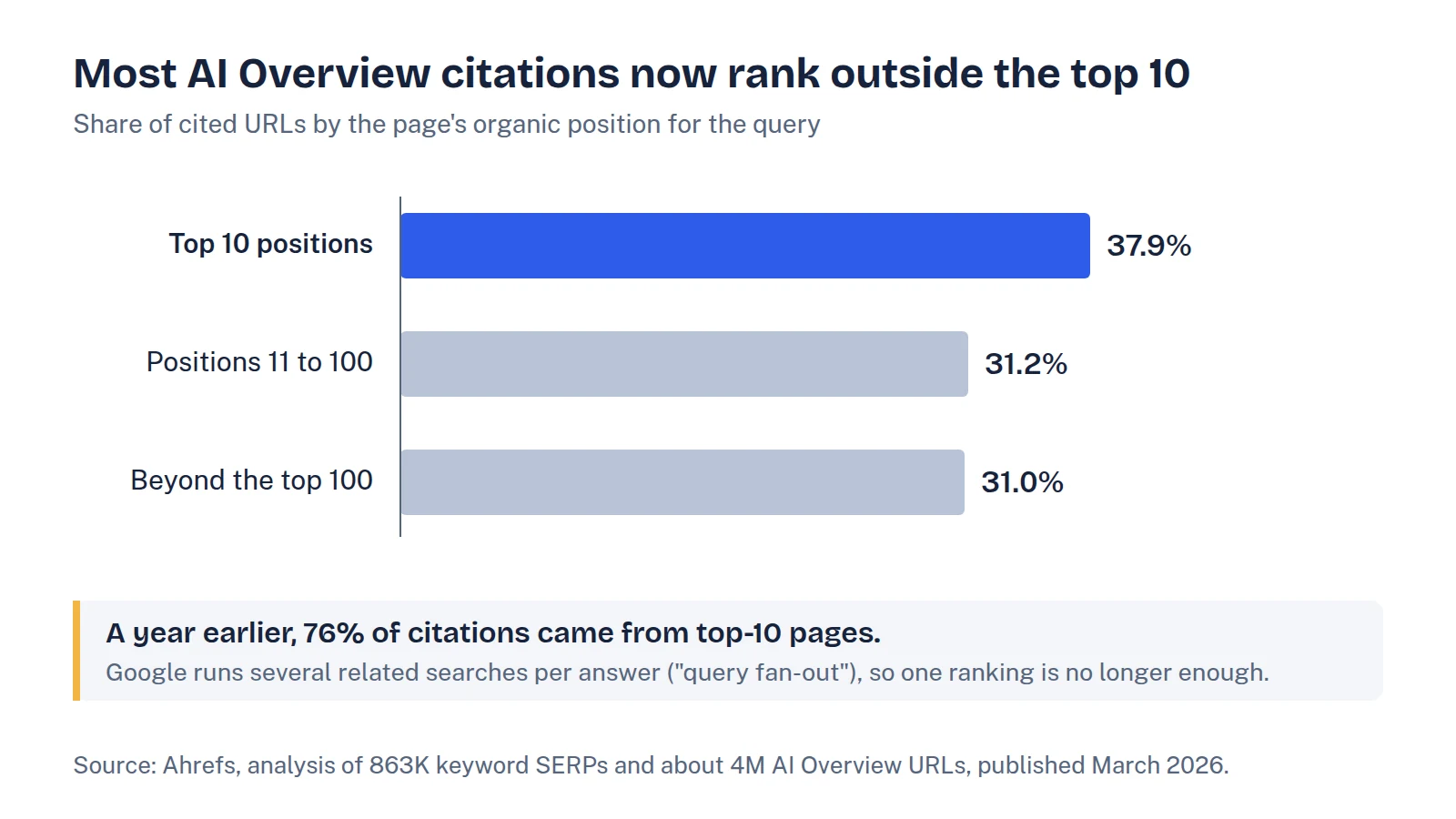
- Rankings explain less than they did: Ahrefs found 38% of AI Overview citations came from top-10 pages, down from 76% a year earlier.
- GEO adds off-site work (mentions on the pages assistants cite) and new metrics (mention rate, share of voice, accuracy).
- Set your split from your own SEO and GEO baselines, then re-measure each quarter.
GEO vs SEO: the short answer
SEO (search engine optimization) is the work of ranking your pages in search results so people click through to your site. GEO (generative engine optimization) is the work of getting your brand mentioned, described correctly and cited inside AI-generated answers from ChatGPT, Perplexity, Gemini and Google's AI Overviews and AI Mode.
The term GEO comes from a 2023 research paper by Aggarwal and colleagues, "GEO: Generative Engine Optimization", published at KDD 2024. The authors reported that content changes could boost a source's visibility in generative engine responses by up to 40% on their benchmark, and that what worked varied by domain.
So GEO vs SEO is less "which one" and more "how much of each." They share a foundation. GEO adds a layer of off-site work and a different way of measuring success. You may also hear GEO called answer engine optimization; our AEO guide covers that term and how to start.
What GEO and SEO have in common
Most of what makes a page rank also makes it usable by an answer engine. Google is direct about this for its own products. Its guide to optimizing for generative AI features says "the best practices for SEO continue to be relevant because our generative AI features on Google Search are rooted in our core Search ranking and quality systems." It goes further: "optimizing for generative AI search is optimizing for the search experience, and thus still SEO."
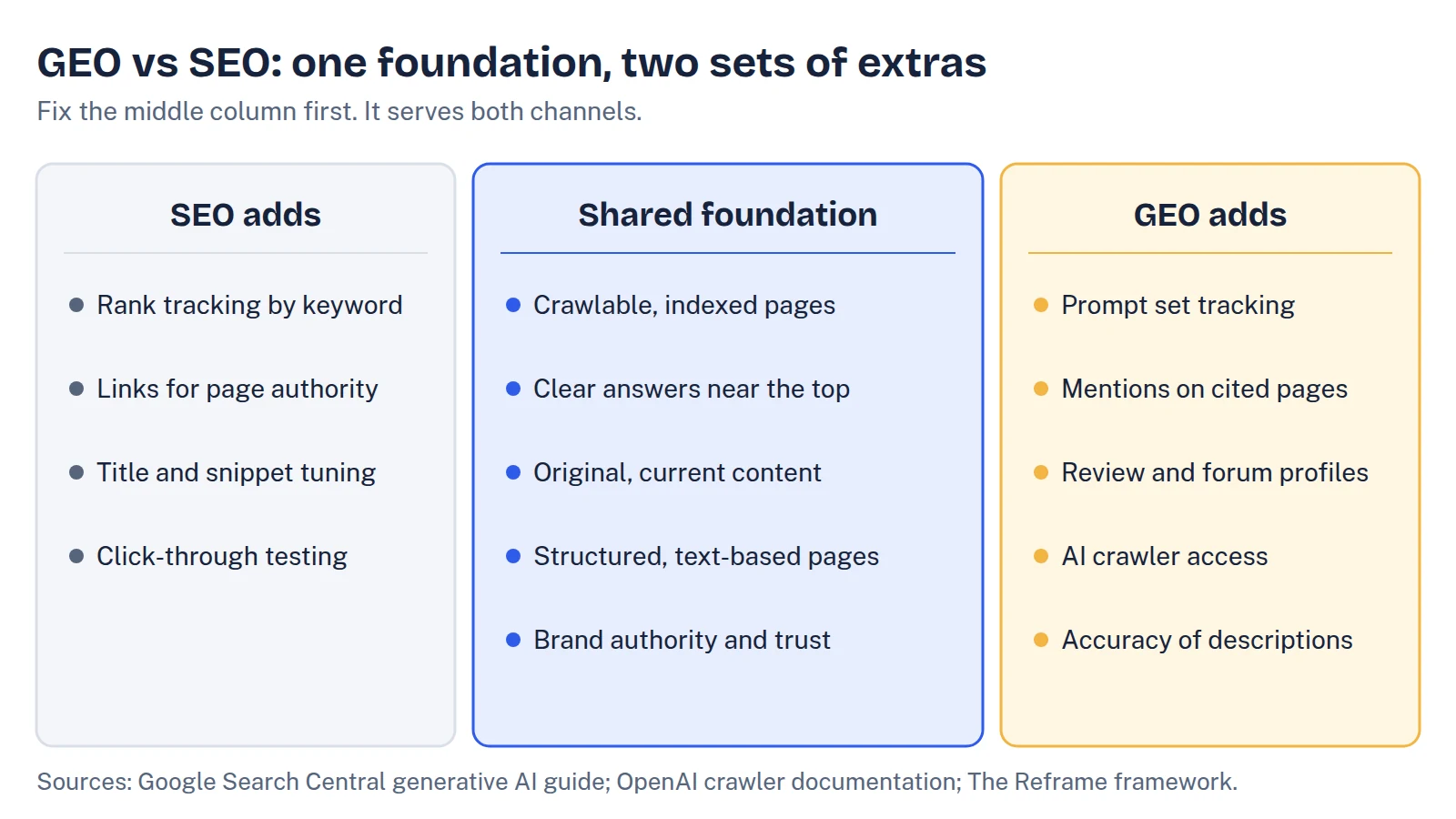
The shared foundation looks like this:
- Crawlable, indexable pages. Google's AI features documentation says a page must be indexed and eligible to show with a snippet to appear as a supporting link. There are no extra technical requirements.
- Content that answers real questions clearly. Direct answers near the top, clear headings, and text rather than content locked in images or scripts.
- Original substance. Google recommends unique content over "commodity content" that recycles what's already published. That applies to rankings and to citations.
- Authority. Pages and brands that other sites reference tend to do better in both.
If your SEO basics are weak, fix those first. GEO work sits on top of them, not beside them.
Where GEO and SEO differ
The differences are in what you're trying to win, where the decision gets made and how you know it worked.
| SEO | GEO | |
|---|---|---|
| The prize | A ranked link and the click that follows | A mention, a recommendation or a cited source inside an answer |
| The query | Short keywords, often 2 to 4 words | Longer questions with context, plus the related searches the engine runs behind the scenes |
| What decides it | Your page's relevance and authority for that query | What many sources say about your category and your brand, gathered across several searches |
| Where you compete | Your pages vs competitor pages | Your pages plus review sites, roundups, Reddit, YouTube and press |
| Core metrics | Rankings, impressions, clicks, organic conversions | Mention rate, share of voice, citations, accuracy of description |
| Tooling | Mature: Search Console, rank trackers, keyword tools | Younger: prompt tracking, AI visibility tools, Search Console for Google's AI surfaces |
| Crawler access | Googlebot, Bingbot | The same, plus assistant crawlers such as OpenAI's OAI-SearchBot |
That last row catches teams out. OpenAI's crawler documentation says OAI-SearchBot is what surfaces sites in ChatGPT search, and that sites blocking it won't appear in those answers. Blocking GPTBot, a separate crawler, only opts you out of model training. It's worth checking your robots.txt for both. You don't need a special AI file for any of this; our guide to llms.txt explains what that file does and doesn't do.
What the data says about the gap
Two recent Ahrefs studies show why strong rankings alone no longer guarantee AI visibility.
First, rankings explain less than they used to. Ahrefs analyzed 863,000 keyword SERPs and about 4 million AI Overview URLs and found that just 38% of AI Overview citations came from top-10 pages (March 2026), down from 76% a year earlier. Google's documentation explains the mechanism: AI features use "query fan-out," running several related searches and pulling from all of them.
Second, off-site reputation carries real weight. In a study of 75,000 brands, branded web mentions correlated with AI Overview visibility at 0.664, compared with 0.218 for the number of backlinks. A quarter of the brands studied (26%) had no AI Overview mentions at all. These are correlations, not proof of cause, but they point the same way as the first study: the conversation about you across the web matters as much as your own pages.
You can see this on the "geo vs seo" results page itself. In Ahrefs (US, September 2026) the keyword has 2,700 monthly searches and a Keyword Difficulty of 30, and an AI Overview sits above the results. Its cited links included a LinkedIn post and a YouTube video alongside an article, and Reddit threads held the next organic spot. Ahrefs estimates the top page's traffic potential at only about 350 visits a month, well below the search volume. That fits a pattern where many searchers get their answer before they click, though Ahrefs' data can't say that for certain.
How to split effort between SEO and GEO
There's no industry benchmark for the right split, and anyone quoting one is guessing. What you can do is decide it from your own data. Here's the process we use.
- Audit the shared foundation first. Check indexing, crawl access (including OAI-SearchBot), page speed and whether your key pages answer buyer questions clearly. Anything broken here hurts both channels, so it comes first.
- Measure both baselines. For SEO, pull non-branded clicks and conversions from Search Console. For GEO, run 25 to 50 buying prompts in ChatGPT, Perplexity, Gemini and Google AI Mode and record mention rate, share of voice and cited sources.
- Find the bigger gap. If you rank well but rarely get mentioned, shift effort toward GEO. If you're mentioned but your organic traffic is thin, SEO still has easy wins. If both are weak, start with the foundation and your category pages.
- Look at how your buyers research. Add "ChatGPT or another AI assistant" to your "how did you hear about us" field and ask in sales calls. If it shows up often, that's a signal to invest more in GEO.
- Set the split for one quarter, then re-measure. Rerun the same prompts and compare. Adjust next quarter's split based on what moved.
A worked example
Here's how that plays out for a hypothetical mid-market SaaS company selling expense management software. The numbers are illustrative, not client data.
- SEO baseline: the company ranks on page one for most of its category keywords, and organic search is already a steady source of demo requests.
- GEO baseline: across 40 buying prompts, it's mentioned in 8 answers (20%). Two larger competitors show up in more than half. When it is mentioned, two answers describe it as a tool for small businesses, which is no longer its market.
- Cited sources: the same three "best expense management software" roundups and one Reddit thread appear again and again. The company isn't in two of the roundups.
The gap is clearly on the GEO side, and it's specific. The plan for the quarter: update the homepage and pricing page so the mid-market positioning is unmistakable, pitch the two roundups with current product information, refresh the review profiles, and answer questions in the community where the Reddit thread lives. SEO work continues at its normal pace because it's already producing. At the end of the quarter, the team reruns the same 40 prompts and compares mention rate, share of voice and how the product is described.
Notice what the example doesn't do. It doesn't pause SEO or start a separate "GEO content" program. Most of the fixes, clearer positioning and current facts, help both channels at once.
See your own AI visibility, free
Get a one-page audit of how ChatGPT, Perplexity and Gemini treat your brand against up to three competitors, plus your biggest gap. In your inbox within 48 hours.
Get my free auditIs GEO replacing SEO?
No, and it's unlikely to soon. Google's AI features are built on its core ranking systems, and Google itself calls optimizing for them "still SEO." Pages still need to be found, crawled and trusted before any answer engine can use them.
What's changing is the payoff. Some searches that used to end in a click now end in an answer, so rankings alone understate or overstate how visible you really are. GEO adds the measurement and off-site work that fill that gap. Think of it as an extension of SEO with a wider field of play, not a replacement.
Also be skeptical of GEO tactics that promise shortcuts. Google's guide says it doesn't use llms.txt files, doesn't need content chopped into small chunks, and gets little value from manufactured mentions. The work that holds up is the unglamorous kind: clear pages, current facts and genuine third-party coverage. If you want to go deeper on Google's surfaces specifically, see how to rank in AI Overviews.
What to report for each
Keep SEO and GEO metrics side by side so leadership sees one picture, not two competing ones.
- SEO: non-branded clicks, rankings for priority keywords, organic sign-ups or demo requests.
- GEO: mention rate and share of voice across a fixed prompt set, citations to your domain, accuracy of how you're described, and self-reported "AI assistant" attribution.
- Shared: branded search volume, which tends to rise when either channel works, and pipeline influenced by organic and AI discovery together.
For the GEO side, the LLM visibility guide explains how to set up mention rate and share of voice, and the guide to AI brand mentions covers how to earn the third-party coverage that moves them.
FAQ
What is the difference between SEO and GEO?
SEO aims to rank your pages in search results and win clicks. GEO aims to get your brand mentioned and cited in AI-generated answers, which draw on many sources beyond your own site. The technical and content basics are the same; GEO adds off-site work and different metrics.
Is GEO replacing SEO?
No. Google's AI features are built on its core ranking systems, and Google describes optimizing for them as still SEO. GEO extends SEO to cover AI answers and the third-party sources behind them.
Which is more important for a B2B SaaS business, SEO or GEO?
It depends on your baseline. If you rank well but rarely appear in AI answers, GEO is the bigger gap. If AI assistants mention you but organic traffic is thin, SEO still has more easy wins. Measure both before deciding.
Does good SEO automatically give you good GEO?
It helps a lot but doesn't guarantee it. Ahrefs found only 38% of AI Overview citations came from top-10 pages, and brand mentions across the web correlated more strongly with AI visibility than backlinks did.
Is GEO the same as AEO?
In practice, yes. Generative engine optimization and answer engine optimization describe the same goal of appearing in AI answers. The labels come from different starting points, but the work overlaps almost entirely.
Sources
- Aggarwal et al., GEO: Generative Engine Optimization (KDD 2024)
- Google Search Central: Optimizing your website for generative AI features on Google Search
- Google Search Central: AI features and your website
- OpenAI: Overview of OpenAI crawlers
- Ahrefs: Just 38% of AI Overview citations come from top 10 pages (March 2026)
- Ahrefs: An analysis of AI Overview brand visibility factors (75K brands studied)
- Semrush: GEO vs. SEO, a comparative guide