GEO strategy: a one-page plan for B2B SaaS teams
A GEO strategy is a short written plan for how your brand gets recommended and cited in AI answers: which buyer questions you want to win, which assistants matter, which sources you need to appear in, and how you'll measure progress. This guide gives you a one-page template built on six decisions, plus the metrics to report.
- A GEO strategy is a set of choices, not a tactics list. Google says no special optimizations are needed for AI Overviews or AI Mode, so the edge comes from choosing well.
- Fill in six boxes on one page: goal, prompt set, engines, source map, claims and ownership. Decide the goal and the prompt set first.
- Map where assistants get answers today. In Ahrefs' 75,000-brand study, branded web mentions correlated far more with AI Overview visibility than backlinks did.
- Report mention rate and share of voice across repeated runs, not rank. SparkToro found AI brand lists almost never repeat between responses.
- Spell out "generative engine optimization" at least once: three of the eight organic results for "geo strategy" are about geopolitics.
What a GEO strategy is (and what it isn't)
Generative engine optimization (GEO) is the work of getting your brand mentioned, recommended and cited in AI answers: ChatGPT, Perplexity, Gemini, Google's AI Overviews and AI Mode. If you need the basics first, our comparison of GEO vs SEO covers what overlaps and what changes.
A GEO strategy is different from a GEO tactics list. Tactics are things like adding FAQ sections, tightening your schema or answering questions in the first paragraph. A strategy is the set of choices that tells you which of those things to do, for which questions, and how you'll know it worked.
That distinction matters more than usual here, because there's no secret technical switch. Google's own guidance on AI features says it plainly: "There are no additional requirements to appear in AI Overviews or AI Mode, nor other special optimizations necessary" (Google Search Central). When the mechanics are mostly shared with SEO, the advantage comes from choosing well: the right questions, the right sources, the right claims.
So the useful output isn't a 40-page deck. It's one page your team can read in five minutes and argue with.
What people search when they plan GEO
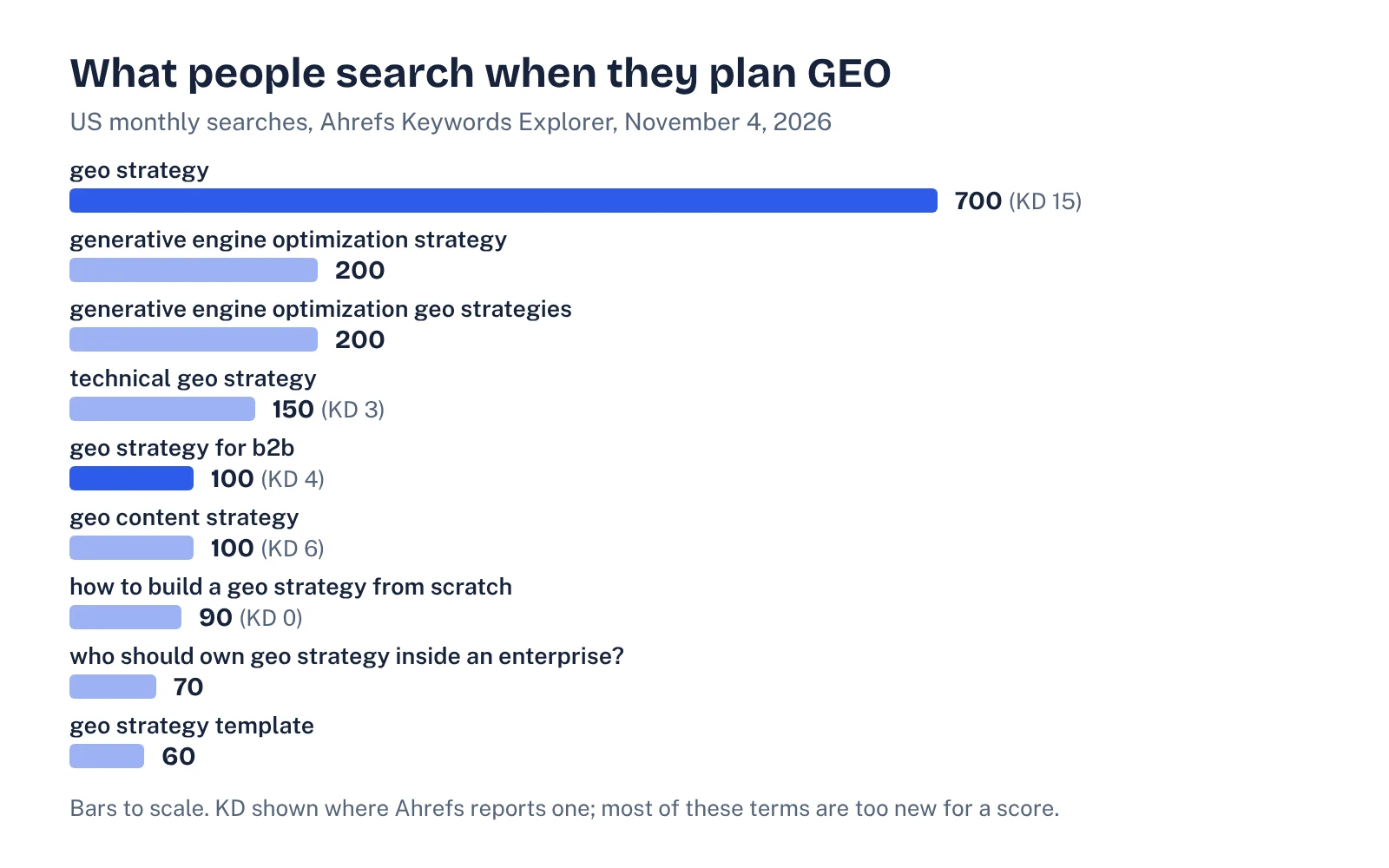
We pulled GEO strategy queries from Ahrefs Keywords Explorer this morning (US data, November 4, 2026). "Geo strategy" gets about 700 searches a month with a keyword difficulty of 15. Around it sit "generative engine optimization strategy" (200), "technical geo strategy" (150, KD 3), "geo strategy for b2b" (100, KD 4), "geo content strategy" (100, KD 6) and "how to build a geo strategy from scratch" (90, KD 0).
Two smaller queries tell you where teams get stuck: "who should own geo strategy inside an enterprise?" (70) and "geo strategy template" (60). People aren't only asking what GEO is. They're asking who does it and what the plan should look like.
There's also a lesson in the results page itself. In the Ahrefs SERP snapshot for "geo strategy", five of the eight classic organic results were about generative engine optimization and three were about geopolitical strategy (Wikipedia, a YouTube playlist and Merriam-Webster). The AI Overview above them drew on Wikipedia, EY and a geopolitics dictionary. The acronym isn't settled yet. If you write about GEO, spell out "generative engine optimization" at least once so both search engines and assistants know which GEO you mean. The same applies to your own product category if its name is ambiguous.
The one-page GEO strategy
Every GEO plan we'd trust answers six questions. Put them on one page, one or two sentences each, before anyone opens a content calendar.
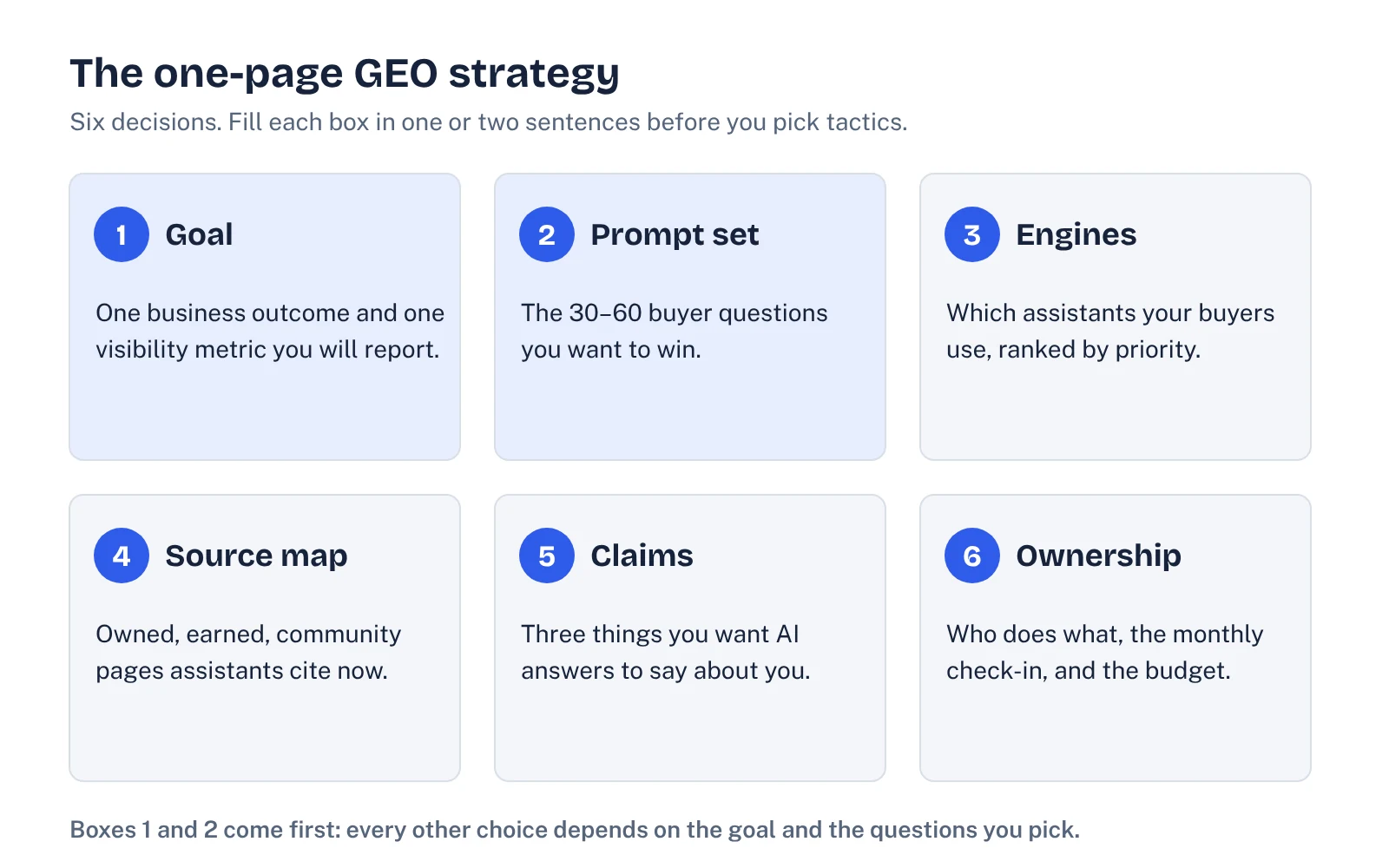
| Decision | The question to answer | What a good answer looks like |
|---|---|---|
| 1. Goal | What business result should AI visibility support? | One outcome (for example, more demo requests from mid-market buyers) and one visibility metric you'll report monthly |
| 2. Prompt set | Which buyer questions do we want to be recommended for? | 30–60 prompts grouped by stage: category, comparison, alternatives, use case, pricing |
| 3. Engines | Which assistants matter for our buyers? | A ranked list with a reason for each, not "all of them" |
| 4. Source map | Where do assistants get their answers for our prompts today? | A list of the domains and pages cited, split into owned, earned and community |
| 5. Claims | What should an answer say about us? | Three specific, provable claims, each backed by a page you control |
| 6. Ownership | Who does the work, how often do we check, what does it cost? | Named owners per workstream, a monthly review and a quarterly budget |
How to fill in each box
1. Goal: one outcome, one metric
Start with the business result, not with "be visible in ChatGPT". For most B2B SaaS teams that's pipeline from a specific segment, fewer lost deals to one competitor, or a new category you want to be known for. Then pick one visibility metric that moves before revenue does. Share of voice on your prompt set is the usual choice; our guide to AI share of voice shows how to calculate it.
Avoid "average rank in ChatGPT" as the headline number. SparkToro's January 2026 study ran 12 prompts through ChatGPT, Claude and Google's AI features almost 3,000 times and found less than a 1-in-100 chance that two ChatGPT or Google AI responses would return the same list of brands (SparkToro). Position in a list that reshuffles every time isn't a stable metric. How often you appear across many runs is.
2. Prompt set: the questions you want to win
This is the most important box, because every later decision depends on it. Write the questions your buyers ask an assistant at each stage, in their words:
- Category: "best [category] software for [company type]"
- Comparison: "[you] vs [competitor]" and "[competitor A] vs [competitor B]"
- Alternatives: "alternatives to [market leader]"
- Use case and integration: "how do I [job] with [tool they already use]"
- Pricing and fit: "how much does [category] cost for a 50-person team"
Keep it between 30 and 60 prompts. Fewer and you're measuring noise; many more and nobody will review the results. Remember that assistants don't answer the prompt as typed. Google says AI Overviews and AI Mode may use "query fan-out", issuing multiple related searches across subtopics. Our explainer on query fan-out shows how to work out those hidden sub-questions, so you can cover them on your pages.
3. Engines: rank them, don't spread evenly
Ask sales which assistants prospects mention, check AI referrals in your analytics, and look at where your audience already works. A developer tool and an HR platform will rank engines differently. Each assistant also leans on different sources, so the ranking changes what goes in box 4. Write one line per engine explaining why it's on the list.
4. Source map: where answers come from today
Run your prompt set and log every cited URL. Sort them into three groups: owned (your site, docs, help center), earned (review sites, comparison articles, analyst and press coverage) and community (Reddit, forums, YouTube). The map tells you where effort will pay off.
Don't stop at your own site. In Ahrefs' study of 75,000 brands, branded web mentions had the strongest correlation with AI Overview visibility (0.664), while backlinks were far weaker at 0.218 (Ahrefs). Correlation isn't causation, and that's one Google surface, but it's a good reason to budget for earned mentions. For software, that usually starts with B2B review sites and the comparison pages that already rank for your category.
5. Claims: what you want answers to say
Write three claims you want an assistant to repeat about you, such as who you're best for, what you do that others don't, and a fact about price or setup. Each claim needs a page that states it clearly and early, in plain words, and ideally a third-party source that agrees. If you can't point to the page, the claim isn't ready to be part of the strategy.
This is also where you check accuracy. Wrong pricing, a retired feature or the wrong category label in AI answers usually traces back to a specific outdated page, on your site or someone else's.
See your own AI visibility, free
Get a one-page audit of how ChatGPT, Perplexity and Gemini treat your brand against up to three competitors, plus your biggest gap. In your inbox within 48 hours.
Get my free audit6. Ownership: who, how often, how much
GEO cuts across teams, which is why the "who should own it" query exists. A workable split for a SaaS marketing team:
- Content or SEO lead: owns the prompt set, the monthly measurement and owned pages.
- Product marketing: owns the three claims, comparison pages and positioning.
- PR, partnerships or community: owns earned and community sources from the map.
- Web or engineering: owns crawl access, structured data and site performance.
Name one person as accountable for the overall number. Agree on a monthly review of 30 minutes and a quarterly reset of the prompt set. Then write down the budget, split between content, earned media and tooling, so you can judge it in a quarter rather than argue about it every week.
How to measure whether the strategy works
Report leading signals monthly and business signals quarterly. Before you start, record a baseline. Our guide to running an AI visibility audit includes a free template for exactly that.
| Metric | What it tells you | How often |
|---|---|---|
| Mention rate on your prompt set | How often you appear at all, across repeated runs | Monthly |
| Share of voice vs 3–5 named competitors | Whether you're gaining ground or just moving with the market | Monthly |
| Citations to your own pages | Which owned pages assistants actually use | Monthly |
| Accuracy of the three claims | Whether answers say what you want, correctly | Monthly |
| AI referral sessions and conversions | Whether visibility turns into visits and demos | Quarterly |
Run each prompt several times per engine and report percentages, not single screenshots. If you're tracking at scale, our guide to LLM citation tracking compares the manual and tool-based options.
Turning the page into a first quarter
Once the six boxes are filled in, the plan for the next 90 days almost writes itself:
- Week 1–2: run the prompt set, record the baseline and build the source map.
- Week 3–4: fix blockers on owned pages: crawl access, missing comparison or pricing pages, unclear claims.
- Month 2: rewrite the five owned pages closest to your top prompts so each answers the question in the first paragraph and states one of your claims.
- Month 2–3: work the "missing us" and "outdated" lists from the source map.
- End of month 3: re-run the prompt set, compare against the baseline and reset the prompt list.
For a fuller week-by-week version, see our 90-day AI visibility optimization roadmap. The strategy page decides what goes into it.
What to leave out of the strategy
A good strategy is also a list of things you won't do this quarter.
- Generic tactic lists copied wholesale. The original GEO research paper from Princeton and collaborators, accepted to KDD 2024, found that its methods could boost visibility in generative engine responses by up to 40%, but also that their effectiveness varies across domains (Aggarwal et al.). Test on your prompts before you roll anything out site-wide.
- Every engine at once. Two or three engines done properly beat six done badly.
- Prompts nobody in your market asks. If sales has never heard a question, it doesn't belong in the set.
- Rank-tracking screenshots as proof. Given how much answers vary, a single run proves very little either way.
Write the page, share it with the people named in box 6, and review it in a month. If the strategy doesn't change what anyone does next week, it's still a tactics list.
FAQ
What is a GEO strategy?
A GEO strategy is a written plan for getting your brand mentioned, recommended and cited in AI answers from tools like ChatGPT, Perplexity, Gemini and Google's AI Overviews. It sets which buyer questions you want to win, which assistants matter, which sources you need to appear in and how you'll measure progress. Tactics such as FAQ sections or schema come after those choices.
How do I build a GEO strategy from scratch?
Start with one business goal and a set of 30 to 60 buyer prompts. Run those prompts in the assistants your buyers use, log every cited source, and decide which three claims you want answers to repeat. Then name owners, set a monthly review and record a baseline before changing anything.
Who should own GEO strategy?
One person should be accountable for the overall visibility number, usually the content or SEO lead. The work itself is shared: product marketing owns positioning and comparison pages, PR or community owns earned mentions, and web or engineering owns crawl access and structured data.
Is a GEO strategy different from an SEO strategy?
They share most of the foundations, since AI search features still rely on crawlable, indexed, helpful pages. The GEO plan adds a prompt set instead of only a keyword list, puts more weight on third-party mentions, and measures mention rate and share of voice in AI answers rather than rankings alone.
Sources
- Google Search Central: AI features and your website
- Ahrefs: An analysis of AI Overview brand visibility factors (75K brands studied)
- SparkToro: AIs are highly inconsistent when recommending brands or products (January 2026)
- Aggarwal et al.: GEO, Generative Engine Optimization (KDD 2024)
- Ahrefs Keywords Explorer and SERP overview, US data pulled November 4, 2026