LLM citation tracking: how to see which of your pages AI assistants cite
LLM citation tracking means recording which URLs ChatGPT, Perplexity, Copilot and Google's AI features link to when they answer your buyers' questions, and how often those URLs are yours. Bing and Google now report part of this for free. This guide shows how to combine those reports with prompt sampling into one monthly citation ledger.
- A citation is a link to a specific URL. Track it per page, not per brand, because that tells you what to fix.
- Bing Webmaster Tools' AI Performance report shows Copilot citations, cited pages, grounding queries and citation share for free.
- Google Search Console's generative AI report shows impressions of links to your pages in AI Overviews and AI Mode, but no queries or clicks.
- No first-party report covers ChatGPT or Perplexity citations, so sample a fixed prompt set and log every cited URL, including competitors'.
- Report four numbers monthly: cited pages, citation share, citation rate for priority pages, and the third-party domains cited instead of you.
What LLM citation tracking measures
When an AI assistant answers with sources, it links to specific URLs. LLM citation tracking is the habit of recording those URLs: which of your pages get cited, for which questions, on which engine, and who gets cited when you don't.
This is different from tracking mentions. A mention is your brand name in the answer text. A citation is a link to a page the assistant used to build the answer. You can be mentioned with no citation (the model knows you, but sourced the answer from a review site), and you can be cited with no mention (your glossary page explained a concept, but the shortlist named three competitors). Our guide to tracking AI brand mentions covers the first. This post covers the second.
Citations are the more useful number for a marketing team because they point at a page. If your pricing page is never cited for pricing questions, you know which page to fix. A brand-level mention rate can't tell you that.
Why this is suddenly a search topic
We pulled the main phrasings from Ahrefs Keywords Explorer this morning (US data, October 28, 2026). "LLM citation tracking" leads with 700 searches a month and a keyword difficulty of 8. Tool-shaped queries follow close behind: "ai citation tracking tools" (400, KD 4), "ai citation tracker" (300) and "ai citation tracking software" (250).
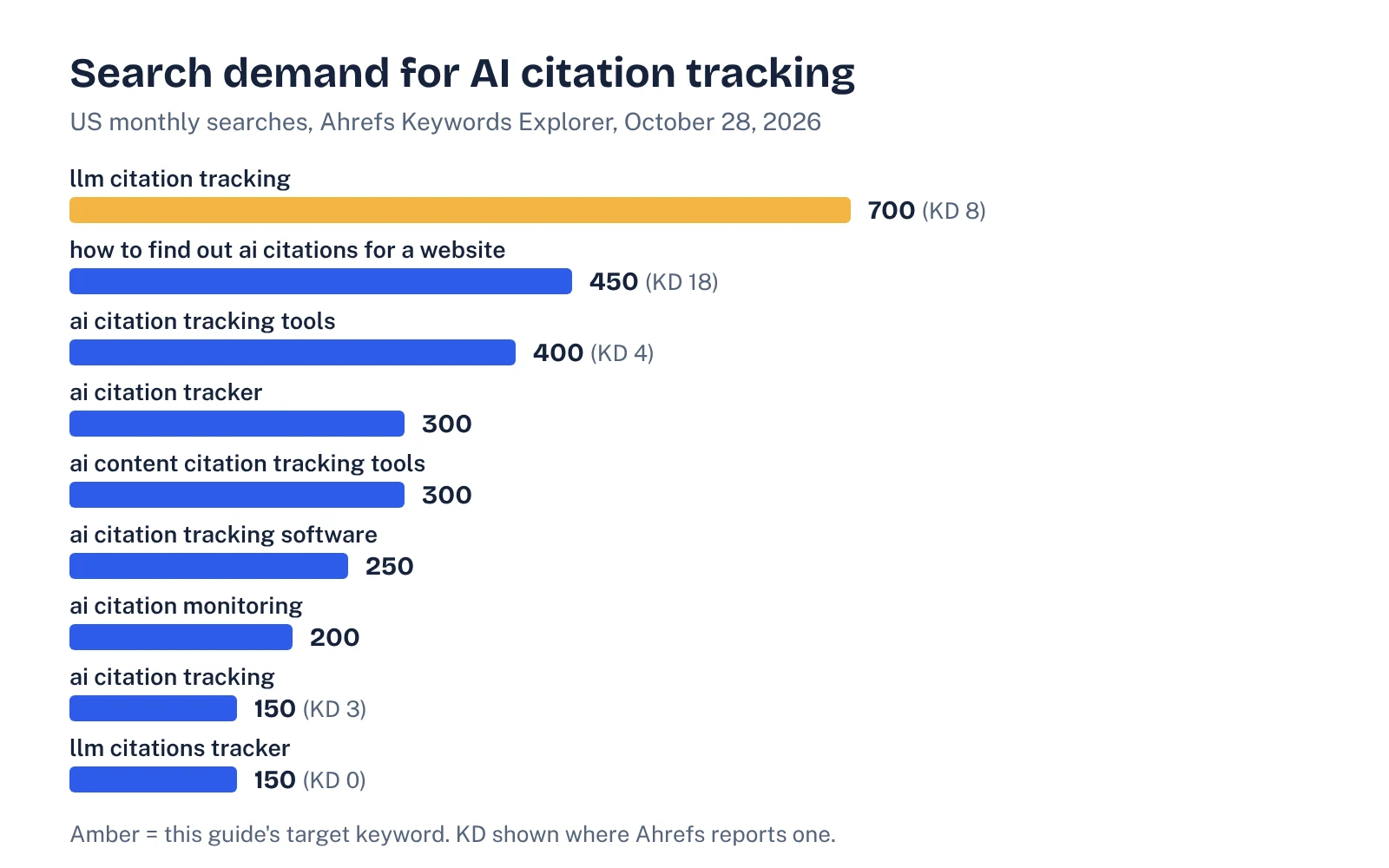
The pattern says most people searching want a tool. The top results for the main keyword are mostly vendor feature pages, plus a Reddit thread of marketers asking what everyone else uses. What those pages tend to skip is the free first-party data that now exists, and how to tell a real change from noise. That's where we'll spend most of this guide.
Where citation data comes from
There is no single report that shows your citations across every assistant. There are five sources, each with a blind spot.
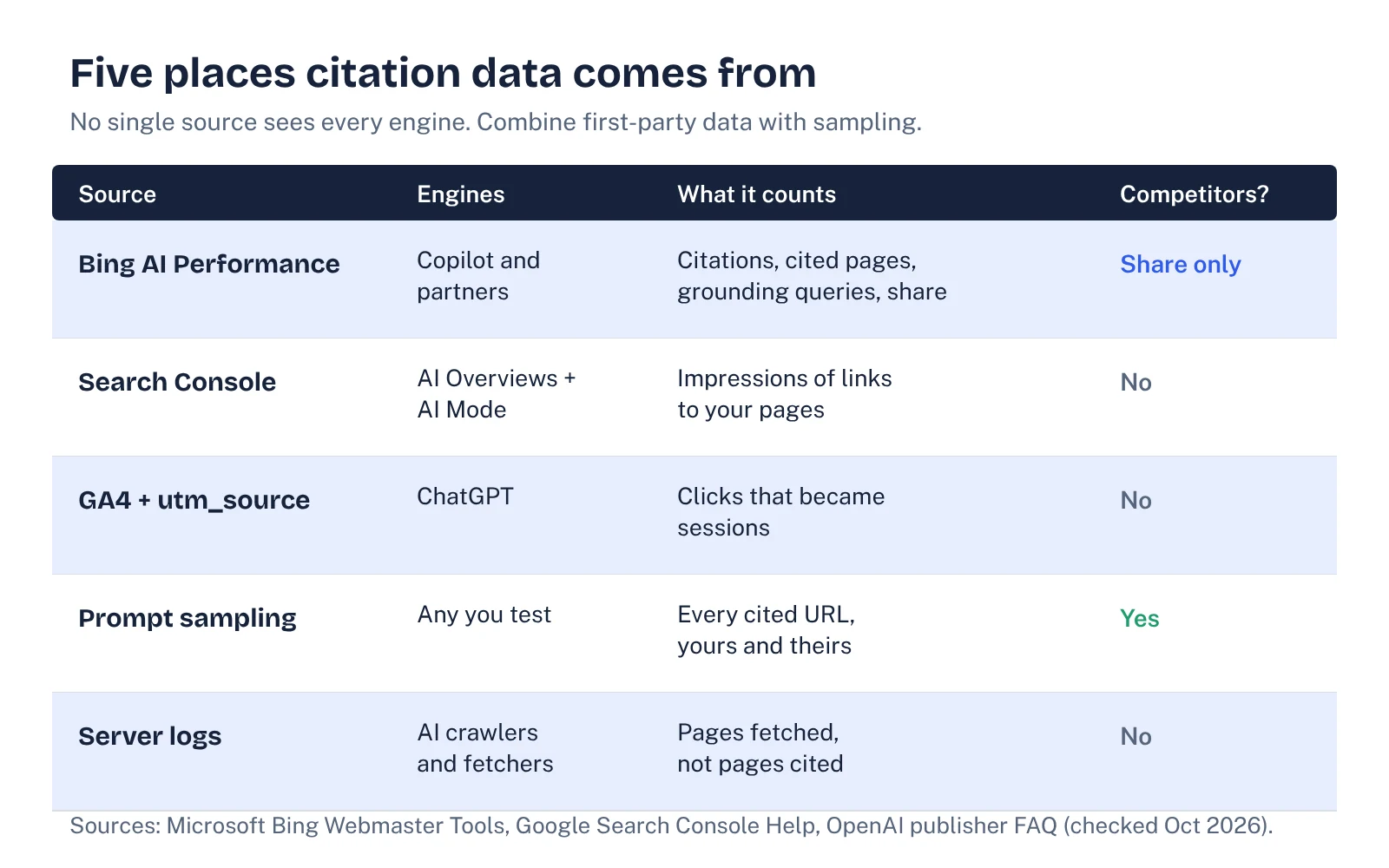
1. Bing Webmaster Tools: AI Performance
This is the closest thing to a citation report any platform offers. Search Engine Land describes it as showing how many times Copilot cited your site, how many of your pages were cited, the grounding queries behind those citations, and the cited pages themselves. It has no click data.
A June 2026 update added query intent, query topic, average unique pages cited per day, and citation share: the percentage of citations for a grounding query that went to your site. That last one is the first platform-reported share metric for AI answers we know of.
The report is Copilot-only. But it's free, it's per page, and it shows the queries. Set it up first.
2. Google Search Console: generative AI performance
Google's generative AI performance report counts impressions: "how many times links to your site were shown to a user in a generative AI feature on Google Search." It covers AI Overviews and AI Mode together, and you can group by page, country, date and device.
What it doesn't give you is queries or clicks. So it answers "which of my pages are linked from AI answers, and is that growing?" but not "for what?". Google's main Performance report still includes AI feature traffic within the overall Web numbers, as its AI features documentation explains, so you can't separate AI clicks there either.
3. GA4 and the ChatGPT UTM
OpenAI's publisher FAQ says ChatGPT automatically adds utm_source=chatgpt.com to referral links. That lets you see which landing pages get visits from ChatGPT answers. It only shows citations someone clicked, so treat it as a floor, not a count. Our guide to tracking AI traffic in GA4 has the channel setup.
The same FAQ notes that this only works if you don't block OAI-SearchBot. If you're not sure, check your robots.txt against our AI crawlers guide.
4. Prompt sampling
For ChatGPT, Perplexity and Gemini there is no first-party citation report. The only way to see citations there is to ask the questions yourself and write down the sources. This is also the only method that shows competitors' and third-party citations, which is often the most useful part.
5. Server logs
Logs show which pages AI crawlers and user-triggered fetchers request. That tells you a page is reachable and being retrieved. It doesn't tell you the page was cited. Use logs to rule out access problems, not to count citations.
| Source | Engines | Per page? | Queries? | Clicks? | Cost |
|---|---|---|---|---|---|
| Bing AI Performance | Copilot and partners | Yes | Grounding queries | No | Free |
| Search Console generative AI report | AI Overviews, AI Mode | Yes | No | No | Free |
| GA4 with utm_source=chatgpt.com | ChatGPT | Landing page | No | Yes (only clicks) | Free |
| Prompt sampling | Any you test | Yes | Your prompts | No | Time or a tool |
| Server logs | Crawlers and fetchers | Yes | No | No | Free |
How to build a citation ledger in a week
A citation ledger is one spreadsheet where every cited URL you see gets a row. It's the simplest LLM citation tracker you can run, and it's enough to make decisions.
- Verify the site in Bing Webmaster Tools and Search Console. Export the AI Performance page and grounding-query data, and the generative AI report by page. Note the date range.
- Pick 30 to 50 buyer prompts. Use the questions sales hears, not your keyword list: "best [category] tool for [team size]", "[you] vs [competitor]", "how much does [category] cost". Our post on building a prompt set covers how to choose and freeze them.
- Run each prompt three to five times per engine. Answers change between runs, so one run per prompt tells you very little. Use logged-out or clean sessions so personal history doesn't skew results.
- Log every cited URL. Columns: date, engine, prompt, run, cited URL, cited domain, owner (you, competitor, third party), and whether your brand was named in the text.
- Add the first-party rows. Paste the Bing cited pages and Google's AI-linked pages into the same sheet with the engine column set, so you see one picture.
- Tag your URLs by page type. Pricing, comparison, integration, docs, blog. Patterns show up at this level fastest.
- Repeat monthly on the same day. Same prompts, same number of runs, same export ranges.
See your own AI visibility, free
Get a one-page audit of how ChatGPT, Perplexity and Gemini treat your brand against up to three competitors, plus your biggest gap. In your inbox within 48 hours.
Get my free auditThe four citation metrics worth reporting
Most dashboards show more than you need. These four answer the questions a marketing lead will actually ask.
| Metric | How to calculate it | What it tells you |
|---|---|---|
| Cited pages | Count of your unique URLs cited in the period, per engine | How much of your site is in play at all |
| Citation share | Your citations ÷ all citations across your prompt set (Bing reports this per grounding query) | How much of the source list you own versus competitors and third parties |
| Priority page citation rate | Runs where a priority page was cited ÷ runs of the prompts it should answer | Whether your pricing, comparison and integration pages do their job |
| Displacing domains | Top third-party domains cited on prompts where you're not | Where to spend off-site effort |
Keep the denominators visible. "Cited in 6 of 15 runs" is honest. "40% citation rate" from 15 runs sounds more precise than it is.
Reading changes without fooling yourself
Citation data is volatile. In a 91-day analysis of its own Bing AI Performance data, Search Influence recorded 19,717 Copilot citations across 86 pages. One page took 69% of them, and daily citations fell from an average of about 1,520 in early December to 34 in February. The author couldn't say for certain why.
Three lessons from that one dataset are worth applying to your own:
- Citations concentrate. A handful of pages usually carry most of them. Find yours and protect them.
- Spikes fade. Don't report a single big week as a trend. Compare month to month, and look at the run of several months.
- One engine isn't the market. A drop in Copilot citations may not show up in ChatGPT or Google at all. That's why the ledger keeps an engine column.
When something does move, check the boring causes first: a URL change or redirect, a robots.txt edit, a page that lost its Google snippet, or a prompt-set change on your side.
When an AI citation tracking tool is worth paying for
The manual ledger works up to roughly one person-day a month. Past that, a tool earns its cost. Look for these features, and test them on your own prompts before you buy:
- Cited URLs stored per answer, not only brand mentions
- Multiple runs per prompt, with the run count shown next to each rate
- Competitor and third-party domains in the source list
- Exports you can join with Bing, Search Console and GA4 data
- A fixed, versioned prompt set so month-to-month numbers compare
Our comparison of AI visibility tools covers specific vendors. Whatever you choose, keep the free first-party reports alongside it. They're the only data in this space that comes from the platforms themselves.
What to do with what you find
Once the ledger has a month of data, sort prompts into three groups. Where you're cited and named, protect those pages and keep their facts current. Where a third party is cited instead of you, work on that third party. Where nobody useful is cited, you have a content gap, and our playbook on getting cited by ChatGPT covers what to change on the page.
Then run the same ledger next month. Citation tracking is only useful as a series.
FAQ
What is the difference between an AI mention and an AI citation?
A mention is your brand name appearing in the answer text. A citation is a link to a specific URL that the assistant used as a source. You can be mentioned without being cited, and your page can be cited without your brand being named in the text, so track both separately.
How do I find out which AI citations my website gets?
Start with the free reports: Bing Webmaster Tools' AI Performance report for Copilot, and the generative AI performance report in Google Search Console for AI Overviews and AI Mode. For ChatGPT and Perplexity, run a fixed set of buyer prompts several times each and record every cited URL.
Do I need an AI citation tracking tool?
Not to start. A spreadsheet and 30 to 50 prompts run monthly will show you which pages get cited and which competitors and third-party sites win instead. A tool becomes worth it when the prompt set, the number of engines or the number of runs grows past what one person can log in a day.
How often should I check LLM citations?
Monthly is enough for most B2B SaaS teams. Citations swing a lot from week to week, so weekly checks mostly show noise. Pull the Bing and Google reports at the same time each month so the periods line up.
Sources
- Search Engine Land: Bing Webmaster Tools testing new AI Performance report
- Search Influence: Inside Bing's AI Performance report, what 20,000 Copilot citations taught us (February 2026)
- Practical Ecommerce: Bing's improved AI Performance section (June 2026)
- Google Search Console Help: Generative AI performance report (Search)
- Google Search Central: AI features and your website
- OpenAI Help Center: Publishers and developers FAQ
- Ahrefs Keywords Explorer (US data pulled 28 October 2026)