How to get cited by ChatGPT: a page-level playbook for B2B SaaS
To get cited by ChatGPT, let OAI-SearchBot crawl your site, publish facts only you can state (pricing, specs, original data) on plain, crawlable pages, and open each section with a short, self-contained answer it can lift. Ahrefs' October 2026 study found ChatGPT leaning toward official, original sources. This guide turns that into a page-by-page checklist and a way to measure it.
- A citation is a linked source in the answer. It is different from a mention, and you should track the two separately.
- OpenAI says any public site can appear in ChatGPT search, but only if OAI-SearchBot is allowed to crawl it.
- In Ahrefs' October 2026 study, 84.4% of factual answers cited at least one official source, against 68.3% for comparison prompts.
- In a 15-site audit published by Search Engine Land, 72.4% of ChatGPT-cited blog posts opened with a short answer capsule.
- Measure citations at the URL level: utm_source=chatgpt.com in GA4, plus a fixed prompt set where you log every cited link.
Citation vs mention: know which one you are chasing
When ChatGPT answers with search turned on, two different things can happen to your brand. It can mention you, naming your product in the answer text. Or it can cite you, showing one of your pages as a linked source. They often come apart. ChatGPT may recommend your product and link a G2 page as the source, or link your pricing page while recommending a competitor.
This guide is about citations. They matter for three reasons:
- They send traffic. A citation is the only part of the answer a buyer can click to reach you.
- They control the facts. When ChatGPT cites your page, the pricing and feature claims come from you, not from a two-year-old review.
- They can be measured per page. You can see which URLs get cited and fix the ones that should be but are not.
If your goal is being named on shortlists, read our guide to how ChatGPT picks SaaS brands alongside this one. Mentions depend more on what third parties say about you; citations depend more on your own pages.
Demand for this topic is real and spread across many phrasings. We pulled the main variants from Ahrefs this morning:
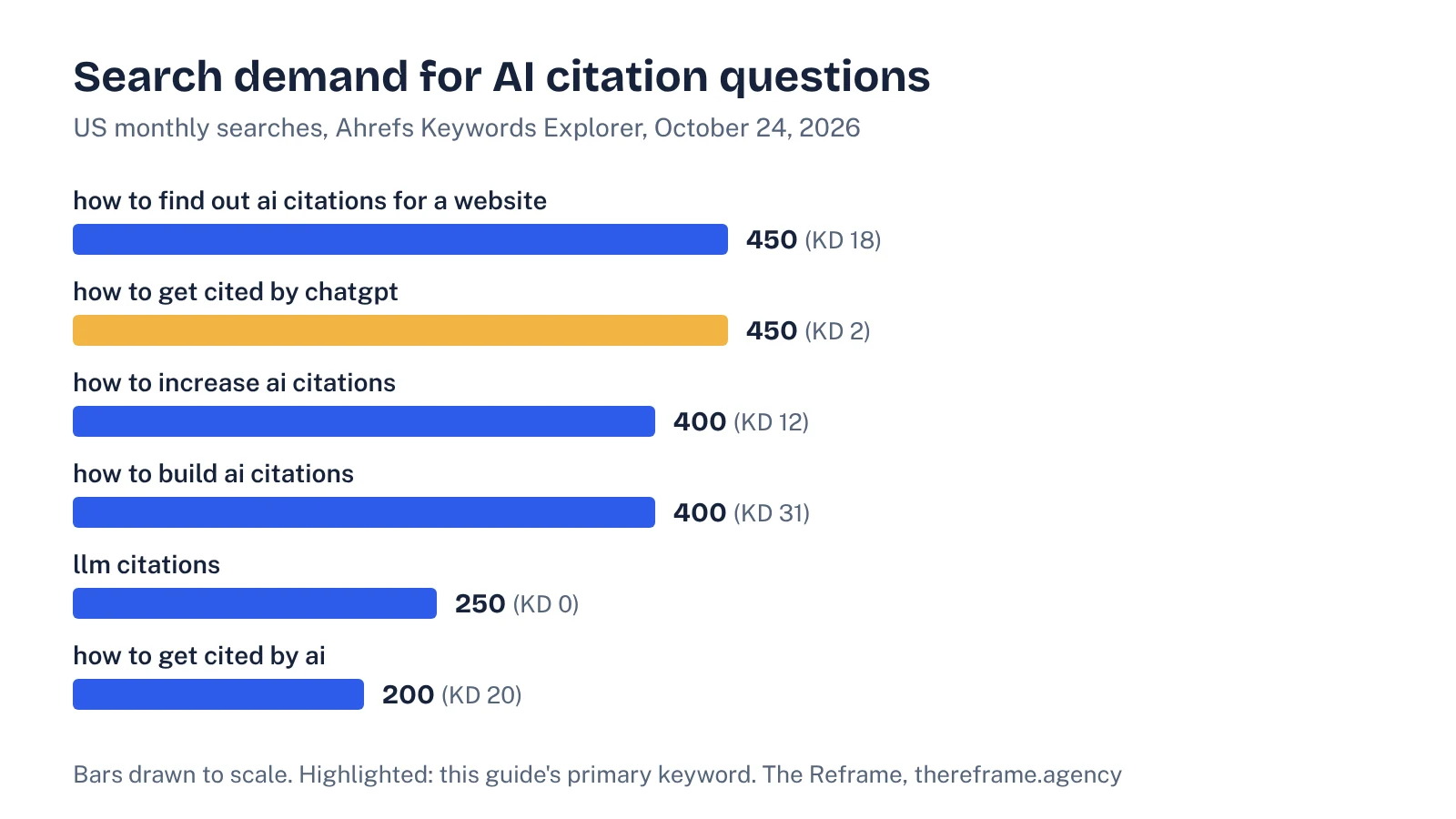
Notice that "how to find out AI citations for a website" is as common as "how to get cited by ChatGPT." Teams want to know where they stand before they change anything. We cover both, starting with what ChatGPT actually cites.
What ChatGPT cites in 2026: the evidence
The best recent data comes from Ahrefs' study of ChatGPT query fan-out, published October 12, 2026. It analyzed 66.6 million logged-out ChatGPT responses from August and September 2026 and the 15 million searches ChatGPT ran behind them, plus US citation data from March to September. Four findings matter for SaaS teams:
- Official sources win on facts. On a set of 20,000 US prompts, 84.4% of factual answers cited at least one official source. For comparison prompts the figure was 68.3%.
- ChatGPT searches brand sites directly. 6.8% of fan-out queries used the
site:operator, and 75.9% of thesite:searches aimed at the roughly 160 most-searched domains targeted brand sites. - Price questions are growing. The share of English fan-out queries containing "price" rose from 6.0% in August to 8.9% in September. "Official" rose from 10.1% to 13.1%. We map these patterns to specific SaaS pages in our guide to query fan-out.
- Aggregators lost ground. In US answers, Reddit citations fell 88% between March and September (from about 1 in 5 answers to about 1 in 43) and Wikipedia fell 80%. Ahrefs' read is that ChatGPT "seems to be prioritizing original sources over sites that summarize them."
Ahrefs is clear about the limits: it is one model snapshot over two months, free logged-out sessions search less than paid ones, and Ahrefs sells the tool that supplied the citation data. Treat it as direction, not law.
A second data point looks at pages, not domains. A Search Engine Land audit of 15 sites (about 7,500 ChatGPT referral sessions) reviewed the blog posts that ChatGPT sent traffic to. 72.4% of them included an "answer capsule," a self-contained explanation of about 20 to 25 words right after the title or a question-style H2. 52.2% contained original data or owned insight. Roughly 91% of capsules contained no links. The audit is correlational and did not compare against posts that were not cited, so read it as a pattern among winners, not proof of cause.
One more finding changes how you plan. In an earlier Ahrefs study of 15,000 prompts, only 8.0% of ChatGPT's in-text citations ranked in Google's top 10 for the same prompt (data from July 2025). ChatGPT rewrites the buyer's question into its own narrower searches, so a page can be cited without ranking for the head term, and a top-ranking page can be skipped.
The five checks for a citable page
Put the evidence together and a page needs to pass five checks before ChatGPT will cite it reliably. Run them in order, because a failure early on makes the later ones irrelevant.
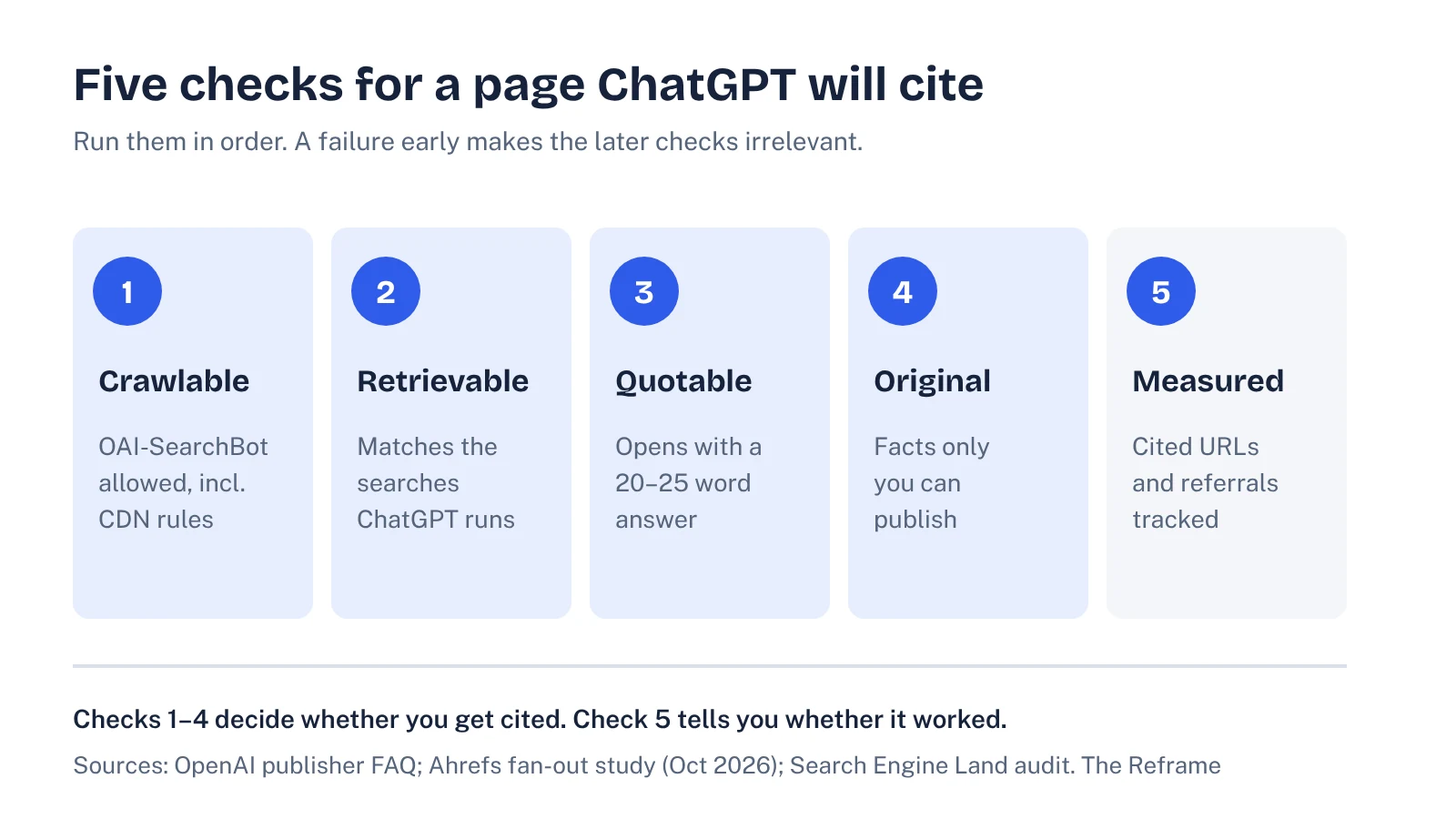
| Check | Question to ask | How to test it | Typical SaaS failure |
|---|---|---|---|
| 1. Crawlable | Can OAI-SearchBot fetch the page? | robots.txt, CDN/WAF bot rules, server logs | A CDN bot rule blocks it |
| 2. Retrievable | Does the page match the narrow searches ChatGPT runs? | Search the likely fan-out phrasing ("[brand] pricing", "[brand] SOC 2") | Facts buried in a PDF or behind a demo form |
| 3. Quotable | Can one passage answer the question on its own? | Read the first two sentences under each H2 in isolation | Sections open with context, not the answer |
| 4. Original | Does the page say something only you can say? | Would a summary site have the same content? | Generic "what is X" posts that restate others |
| 5. Measured | Do you know if it is cited today? | GA4 referrals plus a logged prompt set | Checking once by hand and calling it done |
Steps 1 and 2: fix access, then make facts findable
OpenAI's publisher FAQ is short on this point: "Any public website can appear in ChatGPT search," and to be included in summaries and snippets you should not block OAI-SearchBot. Blocking GPTBot is a separate choice that only affects training. CDN and firewall bot-protection rules can block it even when robots.txt allows it, so check both. Our guide to AI crawlers lists every user agent and the rules to set.
Retrieval is the step most teams skip. Because ChatGPT runs site: searches on brand domains and asks more price and "official" questions, the facts it looks for need to live on plain, crawlable HTML pages with clear titles. For a B2B SaaS company, that usually means:
- A pricing page with real numbers or a clear pricing model in text, not only in an image or a calculator.
- One page per major integration, named the way buyers search ("[product] Salesforce integration").
- A security and compliance page listing certifications, data residency and the date of the last audit.
- Docs and changelog pages that are public and indexable, so feature questions resolve to you.
- A comparison page for each main competitor that states the differences factually.
See your own AI visibility, free
Get a one-page audit of how ChatGPT, Perplexity and Gemini treat your brand against up to three competitors, plus your biggest gap. In your inbox within 48 hours.
Get my free auditSteps 3 and 4: write passages worth quoting
Once ChatGPT finds a page, it needs a passage it can lift. The pattern from the Search Engine Land audit is easy to apply: under the title and each question-style H2, put a 20 to 25 word answer that stands on its own, with no links and no "as mentioned above." Then expand.
Compare two openings for a section titled "Does Acme integrate with HubSpot?":
- Hard to quote: "Integrations are central to how modern teams work, and we've invested heavily in our ecosystem over the years."
- Easy to quote: "Yes. Acme has a native two-way HubSpot integration that syncs contacts, companies and deals every 15 minutes on all paid plans."
(Acme is a made-up example.) The second version answers the question, names the specifics and can be cited without editing.
Originality is the other half. Ahrefs' data points to ChatGPT preferring the source over the summary, and the Search Engine Land audit found original data in about half of cited posts. For a SaaS company, the things only you can publish include product facts, usage benchmarks from your own data, results from tests you ran, and clear opinions from people who do the work. A "what is X" post that restates the top five results gives ChatGPT no reason to cite you over them. Our LLM SEO guide covers how models weigh sources more broadly.
Two quick rules keep pages citable over time. Put a visible "last updated" date on factual pages and update it when facts change. And keep one canonical page per fact, so old blog posts with outdated pricing do not compete with your pricing page.
Step 5: find out which of your pages get cited
You can measure citations at the URL level with two methods. Use both, because each misses things the other catches.
Referral data in GA4
OpenAI says ChatGPT "automatically includes the UTM parameter utm_source=chatgpt.com in referral URLs." Build a GA4 exploration with session source = chatgpt.com and landing page as the dimension. That gives you the pages buyers clicked through from a citation. It undercounts, since many people read the answer and never click. Our guide to tracking AI traffic in GA4 shows how to set up the channel properly.
A logged prompt set
Write 30 to 50 prompts your buyers would ask, split across factual ("what does [brand] cost"), comparison ("[brand] vs [competitor]") and category ("best [category] for mid-market") questions. Run each with search on, several times, and log every cited URL. You will see three lists: your pages that get cited, your pages that should be but are not, and third-party pages cited in your place. AI answers vary from run to run, so compare totals over several runs rather than reacting to one. Our guide to AI visibility tracking covers prompt design and sample sizes.
For Google's AI Overviews and AI Mode, the rules are simpler. Google says a page needs to be indexed and eligible for a snippet, and "there are no additional requirements" or special optimizations, per its AI features documentation. The same citable pages tend to serve both.
A 30-day plan to earn your first citations
- Week 1: baseline. Check OAI-SearchBot access in robots.txt and your CDN. Build the prompt set and log today's cited URLs. Set up the GA4 chatgpt.com report.
- Week 2: fact pages. Fix or create the pricing, integration, security and comparison pages your factual prompts need. Put the facts in plain text.
- Week 3: capsules. Rewrite the opening of your top 10 pages and each question-style H2 so the first 20 to 25 words answer the question.
- Week 4: original content and re-measure. Publish one piece built on your own data or testing. Rerun the prompt set and compare cited URLs with week 1.
Expect the factual prompts to move first, because they map to pages you control. Comparison and category prompts take longer, since ChatGPT still leans more on third-party sources there. That is where earning brand mentions on review sites and industry press takes over.
FAQ
What is the difference between being mentioned and being cited by ChatGPT?
A mention is your brand name appearing in the answer text. A citation is a link to one of your pages shown as a source. You can be mentioned without being cited (ChatGPT names you but links a review site), and cited without being recommended. Track both, because they need different fixes.
How do I find out which of my pages ChatGPT cites?
Start with GA4: OpenAI says ChatGPT adds utm_source=chatgpt.com to referral links, so a landing-page report filtered to that source shows the pages people clicked through to. Then run a fixed set of buyer prompts in ChatGPT with search on and log every cited URL. AI visibility tools automate the second step.
Can I pay or submit my site to get cited by ChatGPT?
No. OpenAI's publisher FAQ says any public website can appear in ChatGPT search and offers guidelines, but no submission process or guaranteed placement. The levers are crawl access, retrievable pages and content worth quoting.
Does ranking on Google mean ChatGPT will cite me?
It helps less than you might expect. In an Ahrefs study of 15,000 prompts (data from July 2025), only 8.0% of ChatGPT's in-text citations ranked in Google's top 10 for the same prompt. ChatGPT runs its own fan-out searches, so pages need to match those narrower queries too.
How long does it take to start getting ChatGPT citations?
There is no published timeline. If OAI-SearchBot was blocked, fixing access is the fastest change. Content changes depend on when pages are recrawled and which prompts trigger a search, so measure over several weeks with repeated runs rather than single checks.
Sources
- Ahrefs: How ChatGPT does query fan-out (15 million queries studied), October 2026
- Search Engine Land: How to get cited by ChatGPT, the content traits LLMs quote most
- OpenAI: Publishers and developers FAQ
- Ahrefs: Only 12% of AI cited URLs rank in Google's top 10 for the original prompt (August 2025)
- Google Search Central: AI features and your website
- Ahrefs Keywords Explorer and SERP overview, US, pulled October 24, 2026