How to rank in ChatGPT: how it picks SaaS brands and what you can influence
How to rank in ChatGPT comes down to being named in the answers it gives your buyers. Those answers draw on what the model learned in training and on pages ChatGPT search retrieves. You influence the second by allowing OAI-SearchBot, getting onto the pages it cites, and stating clearly what you do.
- ChatGPT answers from model knowledge, live web search, or both. Buying questions usually trigger search, which is the part you can influence quickly.
- Don't block OAI-SearchBot. It's the crawler ChatGPT search uses; GPTBot is for training and is a separate choice.
- Only 8% of URLs ChatGPT cited ranked in Google's top 10 for the same prompt in an Ahrefs study, so Google rankings alone won't get you named.
- Third-party roundups, reviews, forums and YouTube shape most category answers. Get listed where ChatGPT already looks.
- Measure with a fixed prompt set run repeatedly, not one-off screenshots.
How ChatGPT decides which brands to recommend
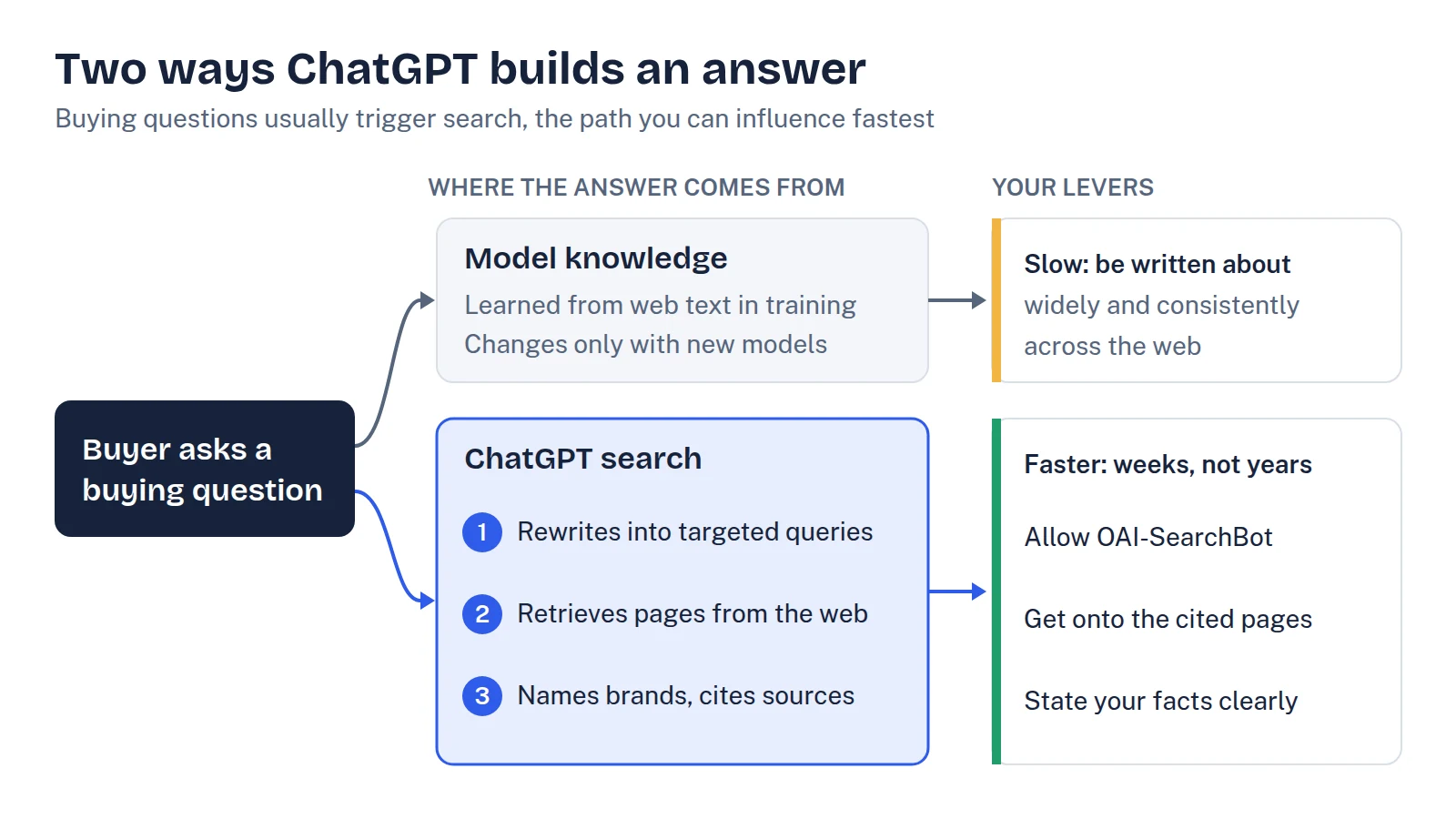
When a buyer asks ChatGPT "what's the best customer success platform for a mid-market SaaS company?", the answer comes from one of two places, and often a blend of both.
- What the model already knows. The underlying model was trained on a huge amount of web text. If your brand was written about often and consistently before the training cutoff, the model can name you without looking anything up. You can't edit this directly, and it only changes when a newer model ships.
- What ChatGPT finds when it searches. ChatGPT searches the web automatically when a question benefits from current information, and users can trigger it by hand. OpenAI's help page on ChatGPT search says it "typically rewrites your question into one or more targeted queries" and sends them to search partners, then shows citations and a Sources panel.
Buying questions like "best X for Y", "X vs Y" and "alternatives to X" usually trigger search, because the answer depends on current products and prices. That's good news: the search path is the part you can influence in weeks rather than years.
What "ranking in ChatGPT" actually means
There is no position one in ChatGPT. There is an answer, which names some brands and not others, puts some first, describes each in a sentence or two, and may cite a handful of pages. So "ranking" really means four things:
- Being named in the answer at all.
- Being named early and framed as a fit for the buyer's situation.
- Being described accurately, with the right category, use case and price point.
- Being cited, either your own page or a third-party page that recommends you.
It also means a different set of pages matters. In an Ahrefs study of 15,000 prompts, only 8% of the URLs ChatGPT cited in its answers ranked in Google's top 10 for the same prompt. Perplexity was the outlier at 28.6%. The reason is query fan-out: ChatGPT runs several related searches and merges the results, so it often cites pages that rank for a neighboring query rather than the one the user typed.
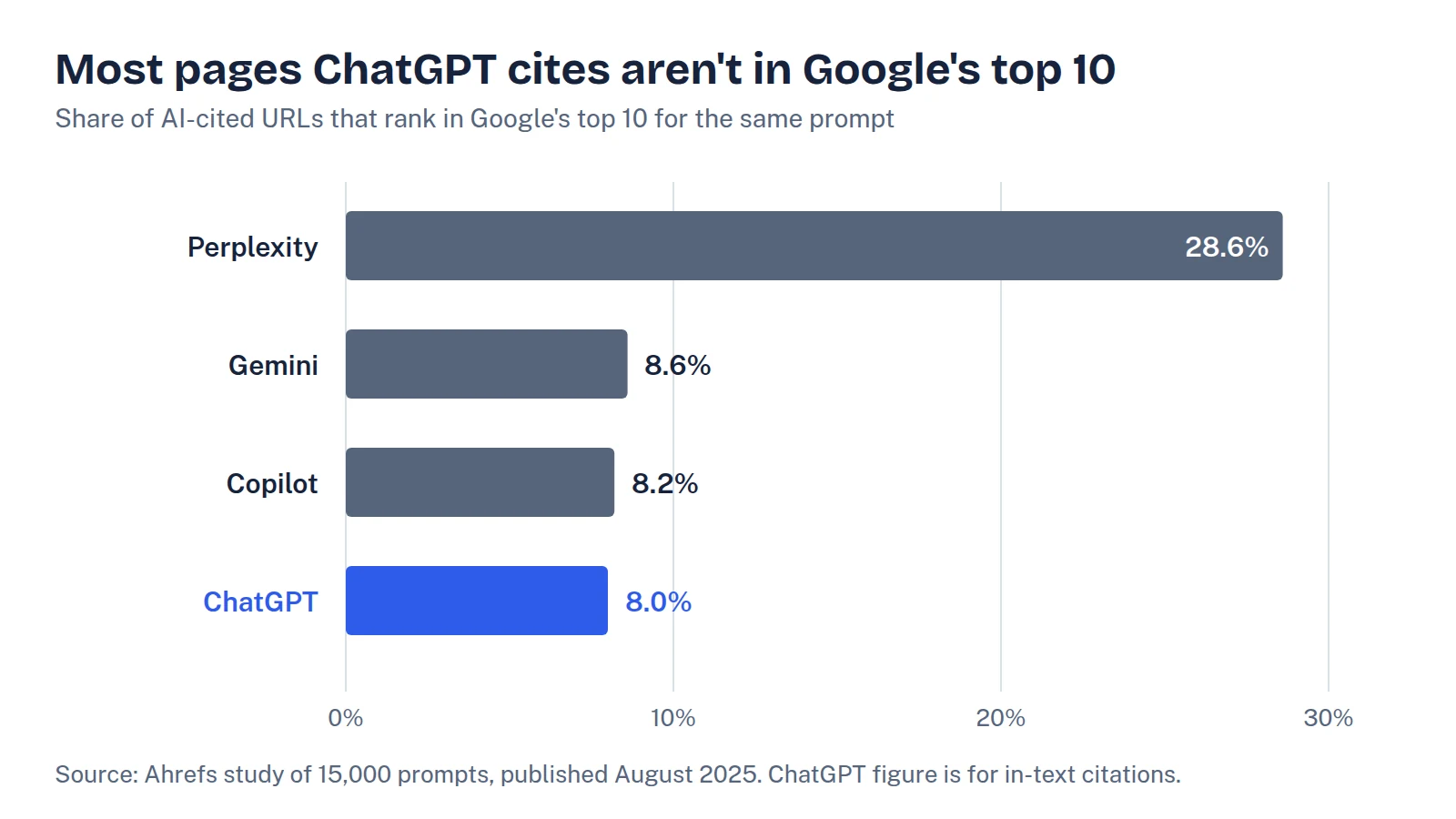
Strong SEO still helps, because many of those pages rank somewhere for a related query. But a first-page Google ranking for your head term does not put you in ChatGPT's answer by itself. The GEO vs SEO comparison goes deeper on where the two overlap.
| Google SEO | ChatGPT SEO | |
|---|---|---|
| What you win | A ranked link | A named recommendation inside an answer |
| Crawler that matters | Googlebot | OAI-SearchBot, plus the search partners ChatGPT queries |
| Pages that decide it | Mostly your own | Mostly third-party: roundups, reviews, comparisons, forums, videos |
| Can you pay to appear? | Ads sit beside organic results | Ads are separate and, per OpenAI, don't influence the answer |
| How you track it | Rank tracker, Search Console | A fixed prompt set, run repeatedly, plus utm_source=chatgpt.com referrals |
Step 1: make sure ChatGPT search can reach you
This is the only part of ChatGPT SEO with official documentation, and it takes an hour to check. OpenAI's crawler documentation separates three user agents that often get lumped together:
- OAI-SearchBot is "used to surface websites in search results in ChatGPT's search features." Block it and your pages won't be used in ChatGPT search answers.
- GPTBot collects content for training future models. Blocking it is a separate choice and doesn't remove you from ChatGPT search.
- ChatGPT-User fetches a page when a user's request needs it. It isn't an automatic crawler.
The OpenAI publishers FAQ is direct about it: "Any public website can appear in ChatGPT search," and to be included in summaries and snippets, "make sure you aren't blocking OAI-SearchBot." There's no submission form and no paid inclusion.
Run this checklist on your site:
- Open
yoursite.com/robots.txtand confirm OAI-SearchBot isn't disallowed, either by name or by a blanket rule. - Check your CDN or bot-protection settings. Some firewall presets block AI crawlers by default, which overrides a clean robots.txt.
- Skip the llms.txt debate for now. ChatGPT doesn't say it reads the file; see what llms.txt does and who reads it.
- Make sure key pages (pricing, product, comparison, integration pages) render their main text in HTML, not only after JavaScript runs or behind a login.
- Confirm those pages aren't carrying a stray
noindex. - Because ChatGPT's search leans on partner search indexes, confirm your important pages are indexed in Bing Webmaster Tools as well as Google.
- In your analytics, create a segment for
utm_source=chatgpt.com. OpenAI adds this parameter to referral links from ChatGPT search.
Step 2: get onto the pages ChatGPT reads
For category questions, ChatGPT tends to cite the same kinds of pages buyers already use: "best tools" roundups, comparison articles, review sites, Reddit threads and YouTube reviews. If a roundup lists eight tools and you're not one of them, the answer built from that roundup won't include you.
The data points the same way. In an Ahrefs study of 75,000 brands across ChatGPT, AI Mode and AI Overviews, YouTube mentions had the strongest correlation with AI visibility of any factor tested (about 0.737), while the number of pages on a brand's own site barely correlated at all (about 0.194). For ChatGPT specifically, classic authority signals like domain rating correlated more weakly than on Google's AI features. Correlation isn't proof of cause, but the pattern is consistent: being talked about beats publishing more.
A practical way to work this:
- Run your top 20 buying prompts in ChatGPT with search on and list every cited URL.
- Group them: roundups, review sites, forums, videos, competitor pages, your pages.
- For each roundup that skips you, find the author or editor and send a short, factual pitch: what you do, who it's for, one proof point, and an offer of a demo login.
- Make sure your review profiles (G2, Capterra or whichever sites get cited in your category) are current and have recent reviews.
- Show up where buyers ask questions, with useful answers, disclosed as coming from your company.
We cover this in more depth in how to earn AI brand mentions.
Step 3: make your own pages easy to quote
Your site still matters, mostly as the source of facts. When ChatGPT describes you, it needs a clear, current statement of what you are. Pages that help most:
- A homepage that states your category in plain words. "Customer success platform for B2B SaaS teams of 50 to 500" beats "the future of customer relationships."
- Use-case and industry pages that match how buyers phrase questions ("for agencies", "for remote teams", "for healthcare").
- Honest comparison pages ("X vs Y", "alternatives to Y") that include where the competitor is the better choice. Pages that only praise you are less likely to be treated as useful comparisons.
- A public pricing page, or at least a clear starting price. Assistants often guess when pricing is hidden, and guesses tend to be wrong.
- Short, direct answers near the top of each page. A two-sentence answer to the question the page targets is easy to lift into a response.
If ChatGPT already mentions you but gets your positioning wrong, that's a slightly different problem. Our guide on fixing how AI describes your brand walks through it.
How to rank in ChatGPT: a worked example
Here's how the three steps fit together for a hypothetical company: a help desk tool built for startups with small support teams. The names and numbers below are illustrative, not client data.
The starting point. The team runs 20 buying prompts in ChatGPT with search on, three times each. Prompts like "best help desk software for a 5-person startup" and "Zendesk alternatives for small teams" return answers naming six to eight tools. Their product is named in a handful of answers, always near the end, and once described as "an enterprise ticketing platform", which it isn't.
What the citations show. Listing every cited URL shows a clear pattern: four "best help desk software" roundups appear again and again, along with a review site category page, two Reddit threads and one YouTube comparison. The product appears in only one of the four roundups, and its review profile hasn't had a new review in over a year.
What they do, in order.
- Check robots.txt and the CDN's bot settings. OAI-SearchBot turns out to be blocked by a firewall preset, so they allow it.
- Rewrite the homepage headline to say "help desk software for startups and small support teams" and add a public starting price.
- Publish two honest comparison pages against the tools most often named alongside them.
- Pitch the three roundup authors who left them out, with a demo login and one concrete proof point each.
- Ask recent happy customers for reviews on the review site ChatGPT cites.
How they judge it. They rerun the same 20 prompts every month and track three numbers: how many answers name them, how many name them in the first three, and how many describe them correctly. They don't judge the work on any single answer.
Nothing in that list is exotic. The value is in doing it against the specific pages ChatGPT cites for your category, rather than guessing.
See your own AI visibility, free
Get a one-page audit of how ChatGPT, Perplexity and Gemini treat your brand against up to three competitors, plus your biggest gap. In your inbox within 48 hours.
Get my free auditWhat you can't influence
Plenty of advice on how to rank in ChatGPT promises things nobody can deliver. Be skeptical of these:
- Paying for placement in answers. ChatGPT now shows ads to some users, but OpenAI's ads help page states that "Ads do not influence ChatGPT's answers" and that they appear below the response, labeled as sponsored.
- Guaranteed results in 48 hours. Answers vary between sessions, phrasings and users. A single screenshot proves nothing, good or bad.
- Rewriting the model's memory. What the model learned in training changes only when a new model ships. You shape it slowly, by being described well across the web.
- Special markup that "tells" ChatGPT to recommend you. Clean structure and schema help machines read a page. They don't override what third-party sources say.
How to measure progress
Because answers vary, you need a repeatable test rather than spot checks. Build a set of 20 to 50 real buying prompts, run each one several times with search on, and record whether you're named, where, how you're described and what gets cited. Track the same numbers monthly against three competitors.
Search demand shows how many teams are asking this question. In Ahrefs (US, September 2026), "how to rank in chatgpt" gets about 500 searches a month, "how to rank in chatgpt search" about 400 and "chatgpt seo" about 800, all with very low keyword difficulty. The teams that measure properly will be the ones who can tell whether their work moved anything.
Our guide to measuring LLM visibility explains the core metrics, and how to set up AI visibility tracking covers prompt sets, cadence and reporting to leadership.
FAQ
Can you pay to rank in ChatGPT?
No. ChatGPT shows ads to some Free and Go users, but OpenAI says ads run on separate systems and don't influence the answer. Ads appear below the response and are labeled as sponsored.
Does ChatGPT use Google results?
OpenAI says ChatGPT search rewrites a question into targeted queries and sends them to its search partners, which it doesn't list in full. In practice, most pages ChatGPT cites don't rank in Google's top 10 for the same prompt, so a strong Google ranking helps but isn't enough.
How long does it take to show up in ChatGPT?
Crawler fixes can take effect within days; OpenAI says robots.txt changes take about 24 hours to register. Earning mentions on the pages ChatGPT cites usually takes weeks to months, and changes to what the model knows from training only arrive with new model versions.
How does a small website rank in ChatGPT?
Focus on specific buying questions where the cited pages are winnable: niche roundups, integration directories, review sites and community threads. A small brand that is clearly positioned and listed on the right third-party pages can be named alongside much larger competitors.
Is ChatGPT SEO different from regular SEO?
It overlaps but isn't the same. Technical access, clear content and authority still matter, but ChatGPT leans more on what third-party sources say about you, and success is measured by mentions and citations rather than positions.
Sources
- OpenAI Help Center: Searching the web with ChatGPT
- OpenAI: Overview of OpenAI crawlers
- OpenAI Help Center: Publishers and developers FAQ
- OpenAI Help Center: Ads in ChatGPT
- Ahrefs: Only 12% of AI cited URLs rank in Google's top 10 for the original prompt
- Ahrefs: Top brand visibility factors in ChatGPT, AI Mode and AI Overviews (75k brands studied)