How to rank in Perplexity: a practical guide for B2B SaaS teams

To rank in Perplexity, PerplexityBot must be able to crawl your pages, your pages must come back in Perplexity's live search for the buyer's question, and they must state facts clearly enough to quote. Perplexity's citations overlap with Google's top 10 far more than ChatGPT's do, so good SEO carries further here. This guide covers each step for B2B SaaS, plus how to measure the result.
- Perplexity searches the web live and cites numbered sources, so being indexed and retrievable matters more than being in training data.
- Allow PerplexityBot in robots.txt and in your CDN or WAF; many SaaS sites block it by default without knowing.
- In an Ahrefs study, 28.6% of Perplexity's cited URLs ranked in Google's top 10 for the same query, versus 8.0% for ChatGPT.
- Published ranking-factor research on Perplexity is unverified. Treat it as hypotheses, not rules.
- Measure mentions and citations separately across repeated runs of a fixed prompt set.
How Perplexity builds an answer
Perplexity describes itself plainly. Its help hub says it uses AI to "search the internet in real time," and that "each answer includes numbered footnotes linking to the original sources." That makes it different from a chatbot answering from memory. Every answer starts with a live search, and every claim is meant to point at a page.
For a B2B SaaS team, that has one big consequence. You don't need to be in a model's training data to show up. You need to be in Perplexity's search index, rank well enough in its retrieval step to be picked up, and say something clear enough to be quoted.
It helps to think of it as four stages, each with its own lever:
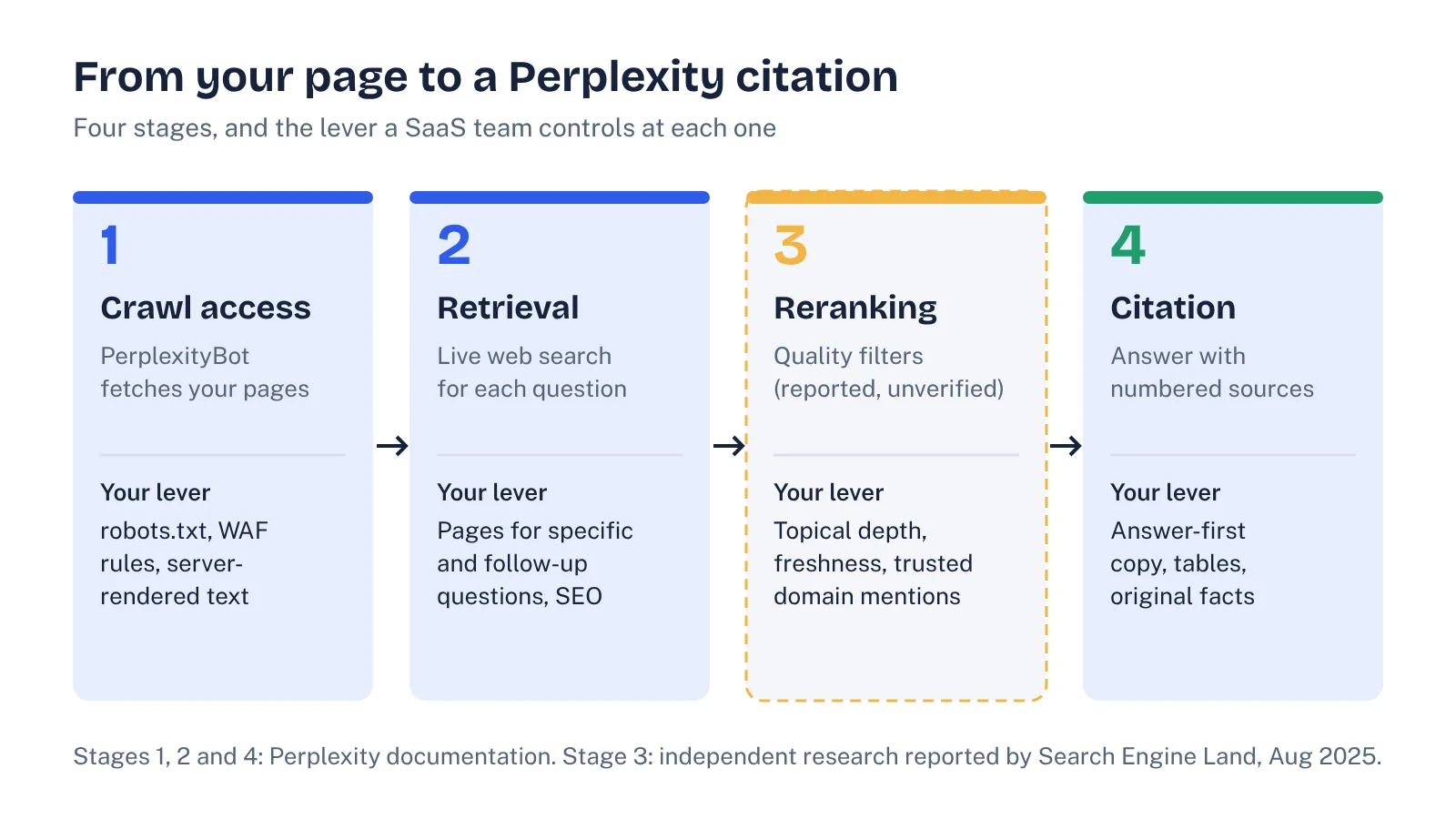
- Crawl access. PerplexityBot has to be able to fetch your pages.
- Retrieval. Your page has to come back when Perplexity searches for the buyer's question and the related questions it generates.
- Reranking. The candidates are filtered and reordered for quality and relevance.
- Citation. The model writes the answer and attaches the sources it used.
Most "how to rank in Perplexity" advice jumps straight to stage 4 (write better content). Stages 1 and 2 are easier to fix, and easier to miss, so start there.
Step 1: Make sure PerplexityBot can reach you
Perplexity runs two user agents, and its crawler documentation is specific about each:
| User agent | What it does | Robots.txt | What to do |
|---|---|---|---|
| PerplexityBot | Surfaces and links websites in Perplexity search results. Perplexity says it "is not used to crawl content for AI foundation models." | Respects it | Allow it. Blocking it removes you from the pool Perplexity searches. |
| Perplexity-User | Visits a page when a user's question needs it, and may link to it in the answer. | "Generally ignores robots.txt rules," because a person requested the fetch | Allow it at the firewall too, or live fetches fail. |
Two details catch SaaS teams out. First, robots.txt changes can take up to 24 hours to apply, according to the same docs. Second, firewalls and bot-management rules often block Perplexity even when robots.txt allows it. Perplexity publishes IP ranges for both bots and recommends that WAF rules match the user agent and those ranges together.
There's a history here worth knowing. In August 2025, Cloudflare reported that Perplexity used undeclared crawlers that impersonated a Chrome browser when its declared bots were blocked, and removed Perplexity from its verified bots list. Cloudflare also added those signatures to its managed AI-crawler rule, available on all plans. If your site sits behind Cloudflare with AI-bot blocking switched on, check what it actually allows. A default chosen by someone else may be deciding your Perplexity visibility.
Also check that your key pages work without JavaScript. In Vercel and MERJ's crawler tests, PerplexityBot was among the AI crawlers that didn't render JavaScript. If your pricing table or integration list only appears after scripts run, Perplexity may index an empty page.
Step 2: Win the retrieval step (it's closer to SEO than you think)
Here's the most useful number for planning Perplexity work. In an Ahrefs study of 15,000 long-tail queries (published August 2025), 28.6% of the URLs Perplexity cited also ranked in Google's top 10 for the same query. For ChatGPT, the figure was 8.0%.
So Perplexity's sources line up with classic search results more than three times as often as ChatGPT's. It's still far from one-to-one: most Perplexity citations come from pages outside Google's top 10. But it means the work that makes you rank for the long-tail questions buyers ask also feeds Perplexity. We compare the ChatGPT side in detail in how to rank in ChatGPT.
In practice, for B2B SaaS that means three things:
- Own the specific questions, not just the head term. "Best SOC 2 automation tool" is one prompt. "SOC 2 automation for a 50-person startup with AWS and Jira" is the version buyers type into Perplexity. Pages that answer the specific version get retrieved.
- Write pages for the follow-up questions. Pricing, integrations, security, migration, and "X vs Y" comparisons. If your site doesn't answer them, Perplexity finds the answers on a competitor's or reviewer's page.
- Keep facts current and dated. Perplexity searches live, so stale pricing or a discontinued feature on an old blog post can be retrieved just as easily as your current pricing page.
Step 3: What we know (and don't) about reranking
Perplexity hasn't published its ranking factors. The most-cited outside analysis is independent researcher Metehan Yesilyurt's, reported by Search Engine Land in August 2025. He described a three-layer machine-learning reranker for entity searches (people, companies, topics) that can discard a whole result set if too few results pass its quality threshold. He also reported manually maintained lists of authoritative domains, including GitHub, LinkedIn, Amazon and Coursera, and factors such as topic classification, freshness and engagement.
Search Engine Land called the findings "unverified," and they came from browser-level observation, not from Perplexity. Treat them as hypotheses. The safe reading is that they point in the same direction as good SEO anyway: topical depth, freshness, and being referenced on domains Perplexity already trusts.
For a SaaS company, that last point is concrete. Your company LinkedIn page, your GitHub organization and repos (if you have developer products), and your documentation are all on domains the research suggests get extra weight. They're worth keeping accurate and specific, not just present.
Step 4: Make your pages easy to quote
Once a page is retrieved and survives reranking, the model has to decide which sentences to use. Pages that state facts directly get used more easily than pages that bury them.
- Lead with the answer. Put a two- or three-sentence answer under each heading before the nuance. "Plans start at $49 per user per month, billed annually" is quotable. "Flexible pricing to fit your needs" is not.
- Use tables for comparisons. Feature-by-plan, us-vs-competitor, integration lists. Tables give the model clean, attributable facts.
- Name who it's for. Buyer prompts often include company size, industry or stack. A page that says "built for mid-market fintech teams on Snowflake" matches those prompts. Generic positioning doesn't.
- Add something only you know. Benchmarks from your product, setup times from your onboarding data, and clear limitations. Original facts are harder for a competitor's page to replace.
- Date your updates. A visible "updated" date and current figures help a live-search engine choose your page over an older one.
Step 5: Get named on the pages Perplexity already cites
For category prompts like "best customer success platform for B2B SaaS," the cited sources often include roundups, review platforms, comparison articles and community threads, not just vendor pages. Check this for your own category rather than assuming it. You can't control those pages, but you can find them and work on them.
The method is simple. Run your top buyer prompts in Perplexity, open the numbered sources, and log every domain. Within an afternoon you'll have a list of the 10 to 20 pages shaping your category's answers. Then check each one: are you listed, described accurately, and next to the right competitors? That becomes your outreach and review-profile list. We cover the wider version of this in our guide to earning AI brand mentions.
See your own AI visibility, free
Get a one-page audit of how ChatGPT, Perplexity and Gemini treat your brand against up to three competitors, plus your biggest gap. In your inbox within 48 hours.
Get my free auditHow to measure your Perplexity visibility
Perplexity answers vary from run to run, like every AI assistant. A single screenshot of your brand in an answer proves it happened once. To measure it properly:
- Fix a prompt set. 20 to 40 real buyer questions across stages: category, use case, comparison, alternatives, pricing.
- Run each prompt several times, in clean sessions, and log every answer.
- Record two things separately: whether your brand is named in the answer text (a mention) and whether your domain appears in the numbered sources (a citation). You can be cited without being recommended, and recommended based on someone else's page.
- Log the cited domains for every answer. This is your third-party target list.
- Re-run the same set monthly and report mention rate, citation rate and share of voice against two or three competitors.
Our guide to AI share of voice covers the formulas and how many runs you need for a stable number.
Then check referral traffic, carefully. Search Engine Journal reported in July 2026 that Perplexity wasn't on GA4's recognized list for the new AI Assistant channel and was landing in Referral instead. A custom channel group with a source regex that includes perplexity fixes that. The setup is in our guide to tracking AI traffic in GA4.
What buyers are searching for
Interest in this is real but early. We pulled US search volumes in Ahrefs Keywords Explorer this morning (October 19, 2026):
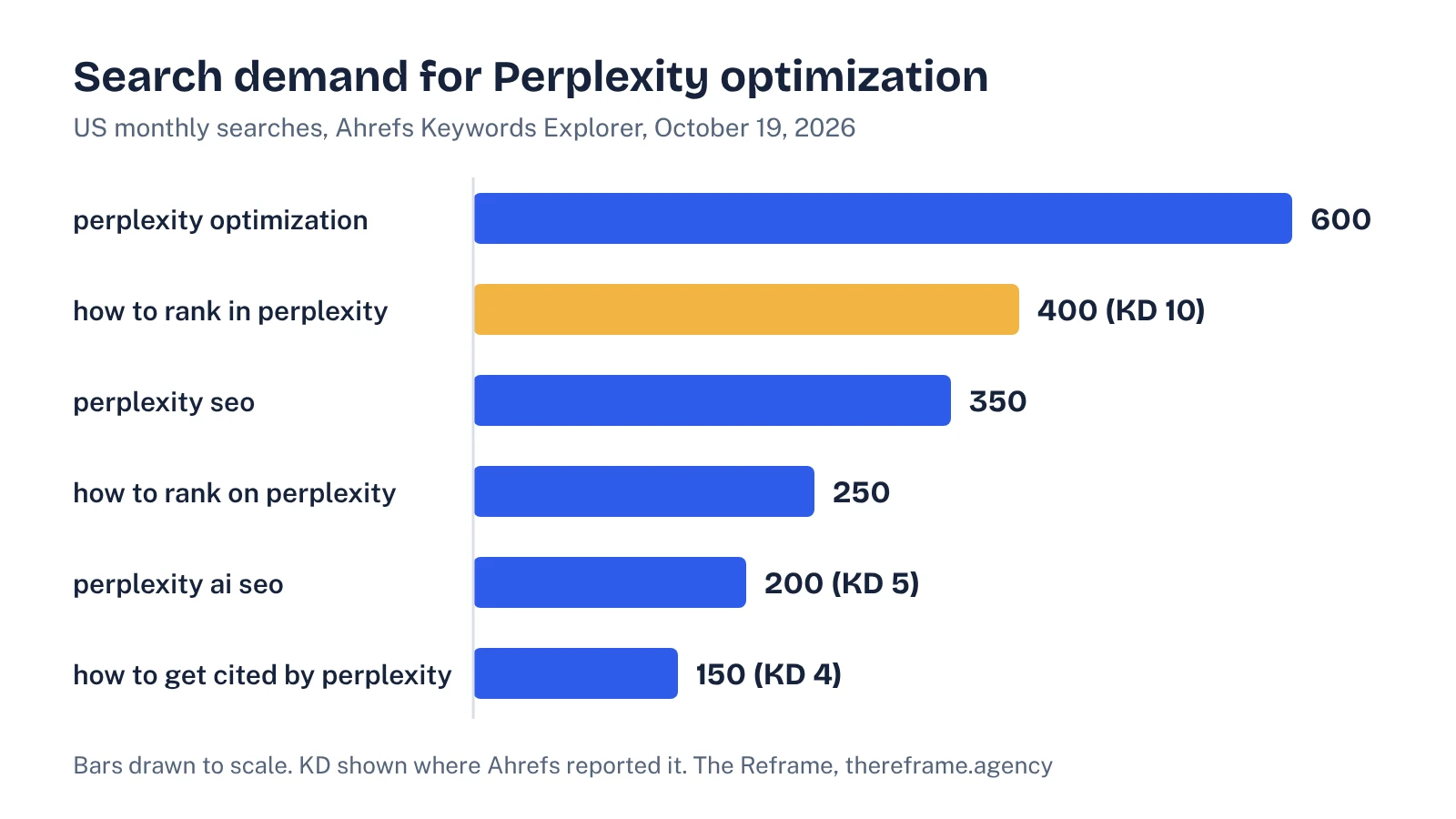
"How to rank in Perplexity" had a keyword difficulty of 10, and Ahrefs recorded no AI Overview on its latest SERP check for it. The top-ranking pages today are mostly agency and website-builder guides. When we read them, none gave a measurement method or covered SaaS-specific pages like pricing, integrations and comparisons. That's the gap this guide is written to fill.
Ahrefs also returned dozens of near-identical variants such as "perplexity seo tracking tool" with suspiciously similar volumes in the 600 to 1,100 range. Those look like noise from automated queries rather than human demand, so we've left them out of the chart.
A 30-minute Perplexity check for your SaaS site
- 5 minutes: search robots.txt for PerplexityBot and check your CDN's AI-bot setting.
- 5 minutes: open your pricing and main product page with JavaScript disabled. Is the key text there?
- 10 minutes: run five buyer prompts in Perplexity. Note whether you're named and which sources are cited.
- 5 minutes: ask Perplexity "What is [your product] and who is it for?" Is the description accurate and current?
- 5 minutes: in GA4, filter Referral traffic for perplexity to see whether visits arrive and where they land.
If step 1 or 2 fails, fix that first. Nothing else in this guide matters until Perplexity can read your pages.
FAQ
How does Perplexity choose which sources to cite?
Perplexity searches the web in real time for each question and attaches numbered footnotes to the sources it used. It hasn't published its ranking factors. Independent research suggests a reranking step that favors topical authority, freshness and trusted domains, but those findings are unverified.
Does Perplexity use Google rankings?
Not directly, but its sources overlap with Google's more than other assistants'. In an Ahrefs study of 15,000 queries, 28.6% of Perplexity's cited URLs ranked in Google's top 10 for the same query, compared with 8.0% for ChatGPT. Strong organic rankings help, but most citations still come from outside the top 10.
Should I block PerplexityBot?
Not if you want to appear in Perplexity answers. Perplexity says PerplexityBot is used to surface and link sites in search results and is not used to train foundation models. Blocking it removes your pages from the pool Perplexity searches.
How long does it take to show up in Perplexity?
Crawler changes can take up to 24 hours to apply, according to Perplexity's documentation. Content and third-party changes take longer and vary, so re-run the same prompt set monthly and compare against your baseline rather than checking daily.
Is Perplexity worth optimizing for if it's smaller than ChatGPT?
For most B2B SaaS teams, yes, because the work overlaps heavily with SEO and with ChatGPT optimization. Crawler access, clear pages and third-party coverage help across assistants. Check your own referral data and prompt tests to decide how much dedicated effort it deserves.
Sources
- Perplexity: How does Perplexity work?
- Perplexity crawler documentation (PerplexityBot and Perplexity-User)
- Ahrefs: Only 12% of AI cited URLs rank in Google's top 10 for the original prompt (August 2025)
- Search Engine Land: How Perplexity ranks content, research uncovers core ranking factors (August 2025)
- Cloudflare: Perplexity is using stealth, undeclared crawlers to evade website no-crawl directives (August 2025)
- Vercel: The rise of the AI crawler
- Search Engine Journal: GA4's AI Assistant channel undercounts your AI traffic (July 2026)
- Ahrefs Keywords Explorer and SERP overview, US, pulled October 19, 2026