AI share of voice: how to calculate it, and what a good number looks like
AI share of voice is the share of brand mentions in AI-generated answers that belong to you, compared with the competitors you track. The basic formula is your mentions divided by all tracked brands' mentions, times 100. The catch: tools and guides use at least three different formulas under the same name. This guide shows how to calculate each, how many answers you need before the number means anything, and what a good score looks like.
- "AI share of voice" can mean mention share, presence rate or a position-weighted score. On the same data they can differ by more than 10 points, so always state which one you report.
- AI answers rarely repeat. SparkToro found under a 1 in 100 chance of getting the same brand list twice, so single checks tell you almost nothing.
- With 100 answers, a 30% presence rate carries roughly a ±9 point margin of error. Changes smaller than that are probably noise.
- There is no credible universal benchmark. Compare yourself with your competitors, your fair share of the set, and your own trend.
What AI share of voice means
Share of voice is an old marketing idea: of all the attention in your category, how much goes to you? In AI search, the "attention" is the set of brands an assistant names when a buyer asks a category question. Ask ChatGPT for the best onboarding tools for a mid-size SaaS company and it will name several products. AI share of voice measures how often one of them is you, compared with the competitors you track.
It sits next to the other AI visibility metrics we use. Mention rate tells you whether you show up at all. Citation rate tells you whether your pages are used as sources. Share of voice adds the competitive frame: you can appear in 40% of answers and still be losing if your main rival appears in 70%. If you are setting up measurement from scratch, start with our guide to AI visibility tracking, which covers prompt sets and reporting. This post goes deep on the one number executives tend to ask for.
Interest is growing. In Ahrefs Keywords Explorer this morning, "ai share of voice" showed about 350 US searches a month with a keyword difficulty of 2, and the question "what is ai share of voice and how is it measured?" showed about 400. Google already answers the head term with an AI Overview. The question people keep asking is the "how is it measured" part, and that is where most guides get vague.
Three formulas that all get called AI share of voice
We read the top-ranking guides before writing this one. They agree on the idea but not on the math. Semrush defines it as your AI mentions divided by total AI mentions across all brands in your category, and says its own tools also factor in how prominently a brand appears. Nightwatch uses the same mentions-based formula. HubSpot's glossary gives one example based on mentions and another based on how many responses a brand appears in. Those are different numbers.
In practice you will meet three versions:
| Name we use | Formula | What it answers |
|---|---|---|
| Mention share | Your mentions ÷ mentions of all tracked brands × 100 | Of the brand "slots" in AI answers, how many are yours? All brands sum to 100%. |
| Presence rate | Answers that name you ÷ all answers × 100 | How often does a buyer asking this kind of question see your name? Brands don't sum to 100%. |
| Weighted share | Your position-weighted points ÷ all brands' points × 100 | Same as mention share, but being named first counts for more than being named fifth. |
None of these is wrong. The problem is comparing one month's mention share with another tool's presence rate, or a competitor deck's weighted score, as if they were the same metric. The same problem applies to the single-brand composite most tools display; we unpack it in our guide to how an AI visibility score is calculated.
A worked example: same data, three answers
Here is a hypothetical but realistic setup. You track 20 buyer prompts in ChatGPT and run each one five times, giving 100 answers. You track yourself and three competitors. Each brand is counted at most once per answer.
- Your brand appears in 30 answers: named first in 6, second in 10, third or later in 14.
- Competitor A appears in 50 answers: first in 30, second in 12, later in 8.
- Competitor B appears in 40 answers: first in 14, second in 16, later in 10.
- Competitor C appears in 20 answers: first in 4, second in 6, later in 10.
Total tracked mentions are 30 + 50 + 40 + 20 = 140. For the weighted version we give 3 points for first place, 2 for second and 1 for anything later. That makes your score 6×3 + 10×2 + 14×1 = 52 points, out of 292 points across all four brands.
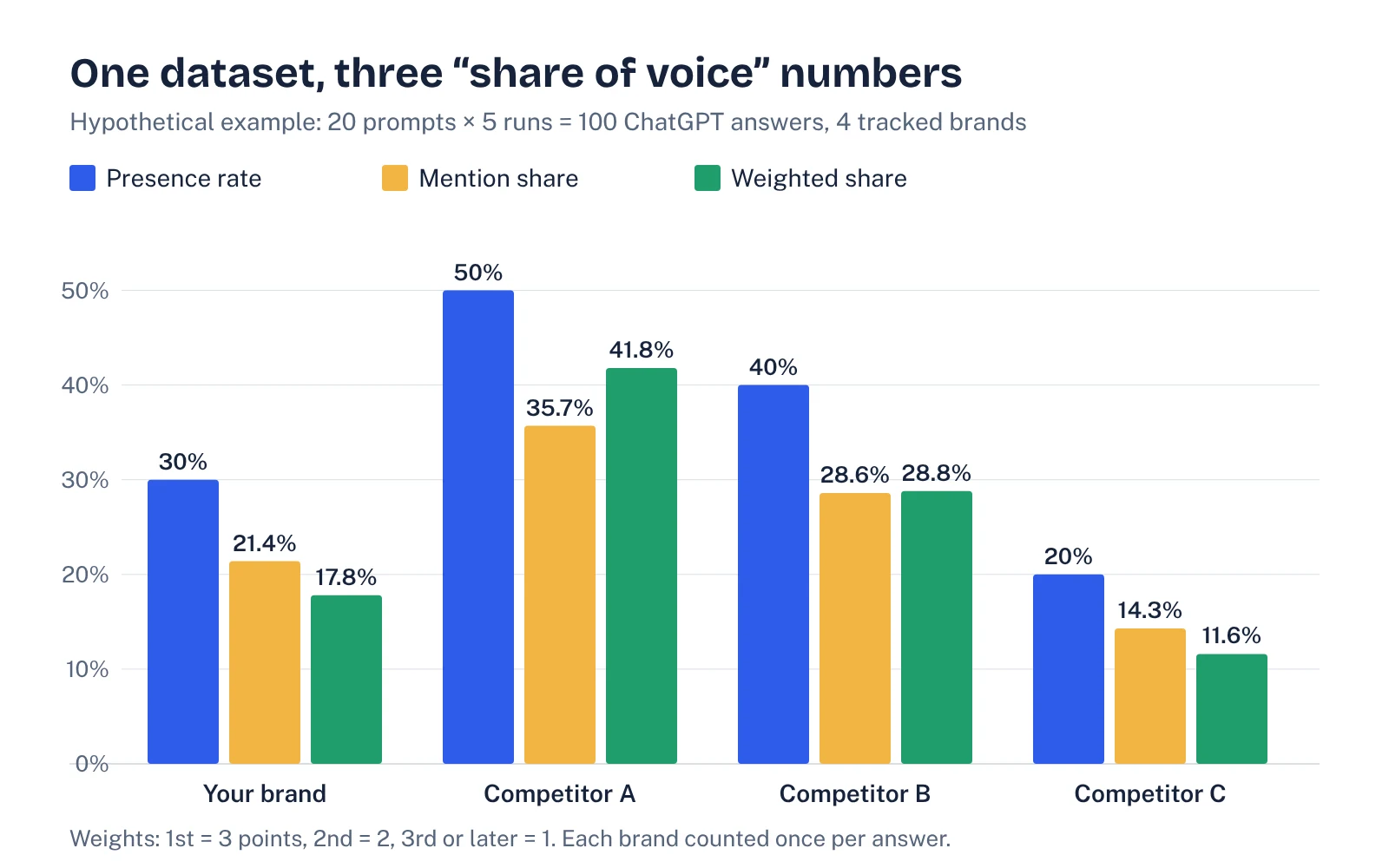
So is your AI share of voice 30%, 21% or 18%? All three, depending on the formula. Notice what the weighted version does to Competitor A: it is named first so often that its weighted share (41.8%) runs well above its mention share (35.7%). If someone reports "we went from 21% to 30%", ask whether the method changed before celebrating.
How many answers you need before the number means anything
This is the part most guides skip. AI answers are not stable, so any share of voice figure is an estimate from a sample, and small samples swing a lot.
The evidence on instability is strong. In SparkToro's study, around 600 volunteers ran 12 prompts through ChatGPT, Claude and Google's AI 2,961 times. Rand Fishkin reports under a 1 in 100 chance that ChatGPT or Google's AI returned the same brand list twice, and under 1 in 1,000 for the same list in the same order. Ahrefs tracked 43,000+ keywords and found AI Overview content changed between consecutive observations 70% of the time, with 46% of named entities changing too.
Here is what that means for your number. If your true presence rate is 30%, the 95% margin of error from simple sampling math is roughly:
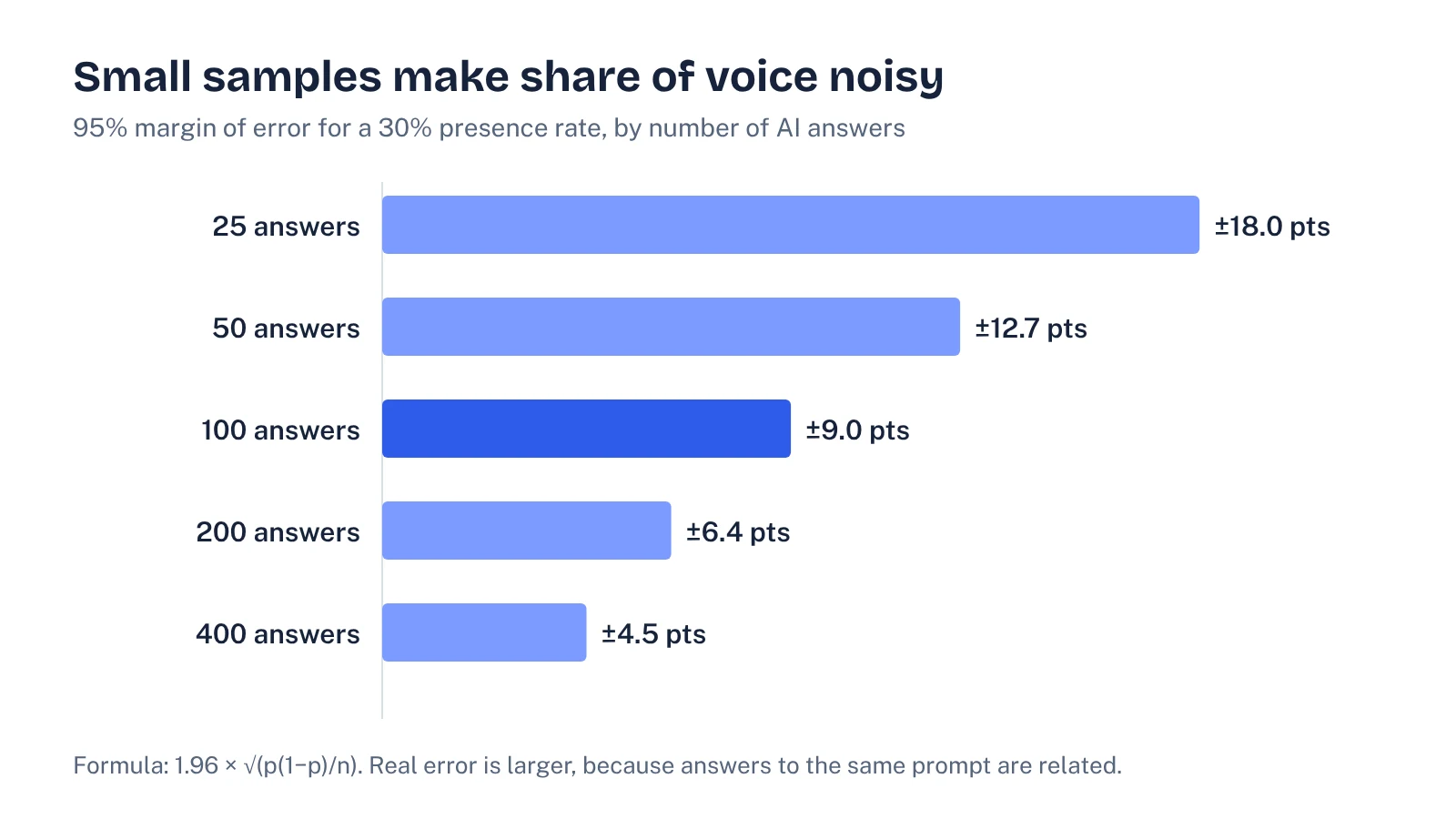
With 25 answers, a reading of 30% could plausibly be anything from about 12% to 48%. With 100 answers it narrows to about 21% to 39%. That is still wide, which is why a move from 28% to 33% in one month should not go in a board deck as a win.
Two caveats. First, this is a lower bound: answers from the same prompt are correlated, so the real uncertainty is higher than the formula suggests. Second, more runs of the same prompts do not fix a bad prompt set. Ten runs of five unrepresentative prompts give you a precise measure of the wrong thing. SparkToro's own advice is to run prompts many times, often 60 to 100, average the results, and check them against other sources. The study notes it could not establish exactly how many runs are enough, so treat any rule of thumb, including ours, as a starting point.
How to calculate AI share of voice, step by step
- Choose the assistants. Start with the two or three your buyers use most, usually ChatGPT, Google AI Overviews or AI Mode, and Perplexity or Copilot. Report each one separately; don't blend them into a single score.
- Build a fixed prompt set. Write 20 to 50 prompts that real buyers ask: category shortlists, "best X for Y", comparisons and problem-led questions. Keep branded prompts out, since asking about your brand by name inflates the result.
- Fix the competitor set. Track yourself plus three to six direct competitors. Changing the set changes every brand's share, so freeze it for the year and log any change.
- Run each prompt several times. Aim for at least 100 answers per assistant per period, for example 25 prompts × 4 runs. Use a logged-out or clean session where you can.
- Record every brand in every answer. Note position (first, second, later), whether it was a recommendation or a passing mention, and the cited URLs if any.
- Calculate your chosen formula, plus presence rate as a secondary number. Add the margin of error so readers know what counts as a real change.
- Repeat on a schedule. Monthly suits most B2B SaaS teams. Compare trends over three or more periods rather than reacting to single months.
If you'd rather start smaller, our free manual AI visibility check walks through a one-afternoon version with a spreadsheet. For larger prompt sets, we compared the trade-offs of tracking tools in best AI visibility tools. Before you trust any tool's share of voice figure, ask which of the three formulas it uses, how many runs sit behind each prompt, and whether position is weighted.
See your own AI visibility, free
Get a one-page audit of how ChatGPT, Perplexity and Gemini treat your brand against up to three competitors, plus your biggest gap. In your inbox within 48 hours.
Get my free auditWhat a good AI share of voice looks like
You will find benchmark claims online, such as 30% being a "reasonable first target". We could not find one backed by a published method and sample, so we don't recommend anchoring on any single figure. Category structure matters too much. In SparkToro's data, big headphone brands appeared in 55% to 77% of human-written prompts, while a B2B prompt asking for brand design agencies put the top names at only 30% to 40%. Fragmented B2B categories naturally spread mentions thin.
Three comparisons are more useful than an absolute target:
| Compare against | How to read it |
|---|---|
| Fair share | With N tracked brands, fair mention share is 100 ÷ N. With five brands that is 20%. Above it, you are over-represented; below it, under-represented. |
| Your other channels | If you hold 30% of organic search share of voice but 12% in ChatGPT, the gap is your opportunity. AI assistants lean on third-party pages, so the fix is often reviews, comparisons and mentions, not your own site. |
| Your own trend | A steady rise over three or more periods, beyond the margin of error, is the clearest sign your work is paying off. |
A score below fair share is not a verdict, it's a diagnosis. Look at which prompts you're missing from and which pages the assistants cite for them. That usually points to the fix: a missing comparison page, an outdated review profile, or a category list you were never added to. Our guide to earning more AI brand mentions covers those levers.
Common mistakes when reporting it
- Mixing formulas. Comparing a mention share from one tool with a presence rate from another. Write the definition on every chart.
- Ranking positions as if they were stable. SparkToro found the order of brand lists almost never repeats. Use position only as a light weight, if at all, and never report "we rank #2 in ChatGPT".
- Branded prompts in the set. "Is [your brand] good for X?" will mention you nearly every time. It measures reputation, not discovery, so track it separately.
- Blending assistants. ChatGPT, AI Overviews and Perplexity retrieve from different places. A blended number hides where you are strong and where you're absent.
- Reacting to one month. Without the margin of error, normal variation looks like progress or decline.
How to report it to leadership
Keep the monthly view to one slide per assistant: mention share for you and each competitor as a bar chart, your presence rate with its margin of error, the trend over the last three to six periods, and the three prompts where you gained or lost the most. Add one line on what you changed and one on what you'll do next. That framing keeps the conversation on actions rather than on a single percentage.
AI share of voice is a useful number when the method behind it is consistent and the sample is large enough. Define it once, measure it the same way every period, and judge it against competitors and your own trend, not someone else's benchmark.
FAQ
What is AI share of voice and how is it measured?
It is the percentage of brand mentions in AI answers that go to your brand rather than to the competitors you track. You measure it by running a fixed set of buyer prompts in each assistant several times, recording which brands each answer names, and dividing your mentions by the total for all tracked brands.
What is a good AI share of voice percentage?
There is no reliable industry benchmark yet, and the figures you see quoted rarely show their method. A practical bar is your fair share: with five tracked brands, 20% mention share means you are holding your own. Above that, and rising over several months, is good.
What does 50% share of voice mean?
In mention share terms it means half of all tracked brand mentions in the answers were yours, which is a dominant position. In presence-rate terms it means you appeared in half of the answers. The two are not the same, so check which formula produced the number.
How many prompts do I need to measure share of voice in ChatGPT?
Aim for at least 100 answers per assistant per reporting period, for example 25 prompts run four times each. Fewer than that and month-to-month swings of 10 points or more can be pure chance. SparkToro's guidance is to repeat prompts many times and average the results.
Do I need an AI share of voice tool?
Not to start. A spreadsheet works for a few dozen prompts. Tools become worth it when you want hundreds of prompts, several assistants and weekly runs, but check how each tool defines the metric before you compare numbers.
Sources
- SparkToro: AIs are highly inconsistent when recommending brands or products (January 2026)
- Search Engine Land: AI recommendation lists repeat less than 1% of the time
- Ahrefs: AI Overviews change constantly (43,000+ keywords)
- Semrush: How to measure AI share of voice
- HubSpot glossary: AI share of voice
- Nightwatch: AI share of voice
- Ahrefs Keywords Explorer (US data pulled 12 October 2026)