Best AI visibility tools: an honest comparison for B2B SaaS teams
The best AI visibility tools for most B2B SaaS teams are the ones attached to the SEO platform you already use, Ahrefs Brand Radar or the Semrush AI Visibility Toolkit, with Profound, Peec AI and OtterlyAI as dedicated alternatives. Below: verified prices and engines, how to judge them, and when a spreadsheet is enough.
- Start with the AI visibility add-on for the SEO platform you already pay for, then look at dedicated trackers if you need more engines or enterprise controls.
- Judge tools on sample size, engine coverage, citations and price transparency, not feature count.
- AI answers change almost every run, so ignore any tool's single "rank" and track the share of answers you appear in.
- Run a free manual baseline first; it makes you a better buyer and a check on what tools report.
- Tools measure. The work that improves visibility happens on the pages assistants cite.
The best AI visibility tools at a glance
This comparison covers five tools that come up repeatedly in the category: Ahrefs Brand Radar, the Semrush AI Visibility Toolkit, Profound, Peec AI and OtterlyAI. Every price and engine list below comes from the vendor's own pricing or help pages as we read them on September 25, 2026. Where a vendor doesn't publish a number, we say so rather than guess. Prices change often, so check before you buy.
| Tool | Best for | AI engines (as listed by vendor) | Published entry price |
|---|---|---|---|
| Ahrefs Brand Radar | Ahrefs users who want category-wide data without writing hundreds of prompts | AI Overviews, AI Mode, ChatGPT, Perplexity, Gemini, Copilot; Claude on custom prompts only | A few custom prompts included with Ahrefs plans (5 on Lite); AI Visibility Index $199/mo |
| Semrush AI Visibility Toolkit | Semrush users who want AI visibility next to their SEO data | ChatGPT, Google AI Mode and others | $99/mo; no free trial per Semrush's help page |
| Profound | Enterprise teams that need many engines, SSO and API access | Up to 9 on Enterprise, including ChatGPT, Perplexity, AI Mode, Gemini, Copilot, Claude, AI Overviews | Free 7-day trial (50 prompts); Enterprise pricing on request |
| Peec AI | Teams that want a dedicated tracker with unlimited seats | Choose 3 models on standard plans; up to 13 on Enterprise | Not shown in the page text we could read; plans scale by prompts (50, 150, 350) |
| OtterlyAI | Small teams and tight budgets | ChatGPT, AI Overviews, Perplexity, Copilot; Claude, AI Mode and Gemini as paid add-ons | $29/mo for 15 prompts; $189/mo for 100 |
If you only read one line: pick the tool that sits next to the SEO platform you already pay for, unless you need engine coverage or enterprise controls it doesn't have. The rest of this post explains the trade-offs, and when you don't need a tool at all.
How we compared the tools
Most "best AI visibility tools" lists rank on feature count. That favors the biggest platforms and says little about whether the numbers are trustworthy. We looked at six things that matter more for a B2B SaaS team:
- Prompt model. Do you write your own prompts, or does the tool draw on a large pre-collected index of prompts? Custom prompts match your buyers; an index shows the wider category. The best setups offer both.
- Engine coverage. Does it cover the assistants your buyers actually use, and are some engines paid extras?
- Sample size. How many answers per month does your plan produce? This matters more than it sounds (see the next section).
- Citations. Does it show which pages the assistants cite, so you know where to act?
- Competitor benchmarking. Can you see share of voice against named competitors?
- Price transparency. Can you work out the cost before a sales call?
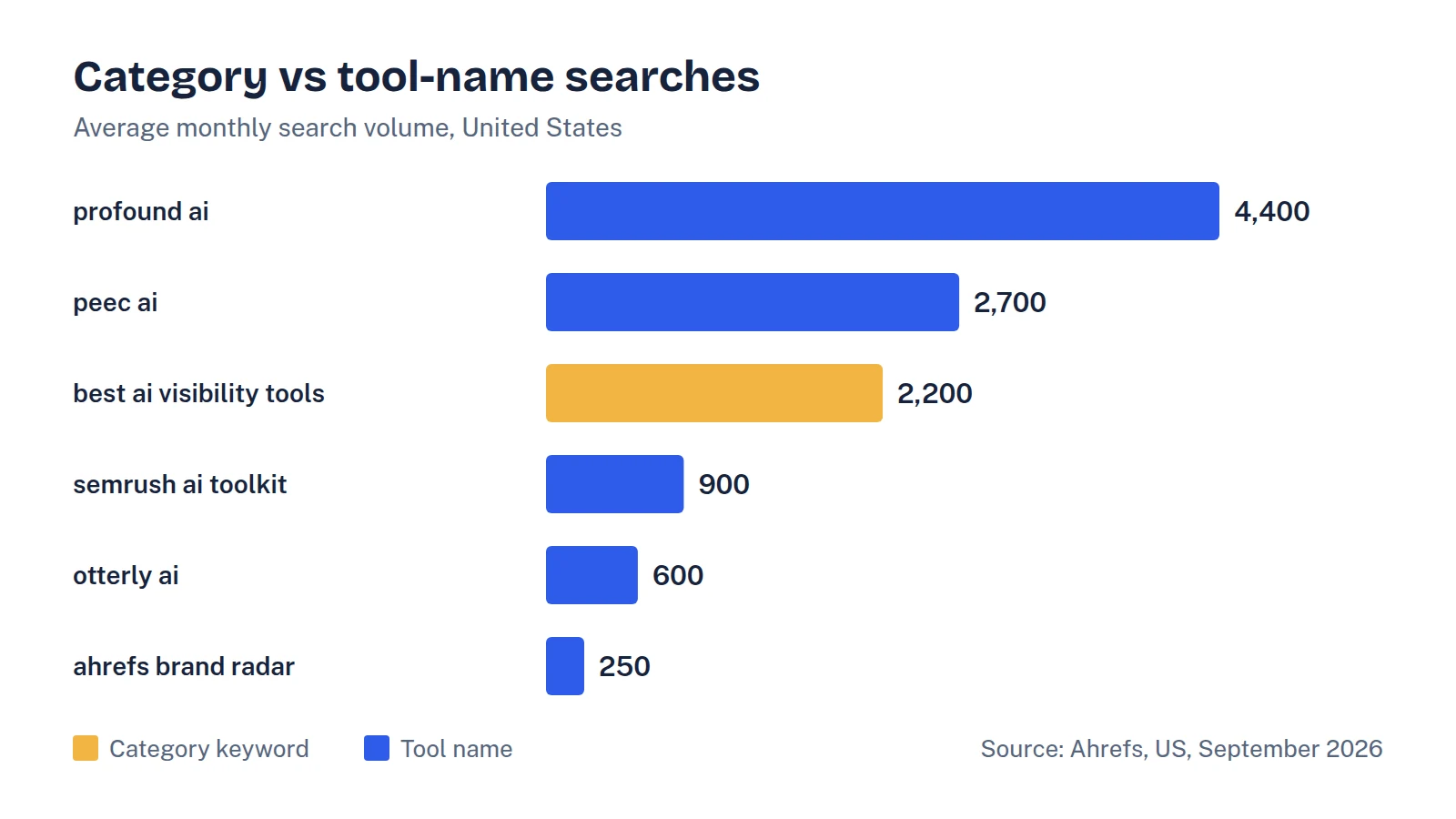
One more thing to watch when you read other comparisons. We checked the top 10 Google results for "best ai visibility tools" in Ahrefs (US, September 2026). Of the eight organic pages, three are published by companies that sell a tool in this category, and at least one of those ranks its own product first. That isn't wrong, but it's worth knowing who wrote the list you're reading.
Why sample size matters more than features
AI answers are not stable. SparkToro's study of 2,961 runs across ChatGPT, Claude and Google's AI found less than a 1 in 100 chance of getting the same brand list twice from the same prompt, and closer to 1 in 1,000 for the same order. Their conclusion: tools that report a "ranking position in AI" aren't measuring anything useful, and the metric that holds up is how often you appear across many prompts and runs.
That has a practical consequence for buying. A plan with 15 prompts on one engine produces a small sample, and small samples swing month to month on noise alone. Before you compare dashboards, work out how many answers per month each plan actually generates for the engines you care about. Peec AI, for example, lists 4,500 monthly AI answers on its 50-prompt Starter plan (50 prompts, 3 models, daily), which is the kind of number you want to see stated.
Tool-by-tool notes
Ahrefs Brand Radar
Brand Radar combines two approaches. Custom prompts let you track your own buyer questions daily, weekly or monthly, and Ahrefs includes a small allowance with its plans (5 prompts and 150 checks a month on Lite). The AI Visibility Index, listed at $199 a month, adds pre-collected answers from what Ahrefs describes as 451M+ search-backed prompts. It reports mentions, citations, share of voice and estimated impressions weighted by search volume, and has beta tracking for YouTube, TikTok and Reddit. The index is its main advantage: you see the whole category, including questions you wouldn't have thought to write. It makes most sense if you already use Ahrefs.
Semrush AI Visibility Toolkit
According to Semrush's knowledge base, the toolkit costs $99 a month, with extra prompt packs at $60 a month for 50 prompts and no free trial. It includes an AI Visibility Score, competitor gap research, prompt research, brand performance (share of voice, sentiment and narratives), daily prompt tracking and a site audit for AI crawler access. Like Brand Radar, its strength is sitting next to your existing SEO data.
Profound
Profound's pricing page lists a free trial (50 prompts run daily for 7 days on ChatGPT, Gemini and Google AI Overviews) and an Enterprise plan with custom pricing that tracks up to nine answer engines, with SSO/SAML, SOC 2 compliance, API access and all-time history. It's built for larger teams, and the trial is a low-risk way to see whether the depth is worth a sales conversation.
Peec AI
Peec AI's plans are structured by prompt count: Starter (50 prompts), Pro (150) and Advanced (350), each with three models of your choice, daily refreshes and unlimited users, plus an Enterprise tier with up to 13 models and API access. Advanced adds multi-country support and a Looker Studio integration. We couldn't read the plan prices in the page text on the day we checked, so confirm them on the page.
OtterlyAI
OtterlyAI has the lowest published entry point: $29 a month for 15 prompts tracked daily on ChatGPT, Google AI Overviews, Perplexity and Copilot. Standard is $189 a month for 100 prompts, Premium $489 for 400, with a 15% discount on annual billing and a free trial. Claude, Google AI Mode and Gemini are paid add-ons, so price the engines you need, not just the base plan.
Free checkers
Before paying for anything, run a free snapshot. The Ahrefs free AI visibility checker reports total mentions, mentions by platform, top topics and top cited domains and pages across ChatGPT, Gemini, Perplexity, Copilot and AI Overviews. It won't give you trends or your own prompts, but it's a useful baseline. Our guide to checking your AI visibility for free shows how to do the rest by hand.
See your own AI visibility, free
Get a one-page audit of how ChatGPT, Perplexity and Gemini treat your brand against up to three competitors, plus your biggest gap. In your inbox within 48 hours.
Get my free auditDo you need a tool, or is manual tracking enough?
Plenty of teams buy a tool before they know what they want to measure. A manual baseline first makes you a much better buyer. Here's a simple way to decide.
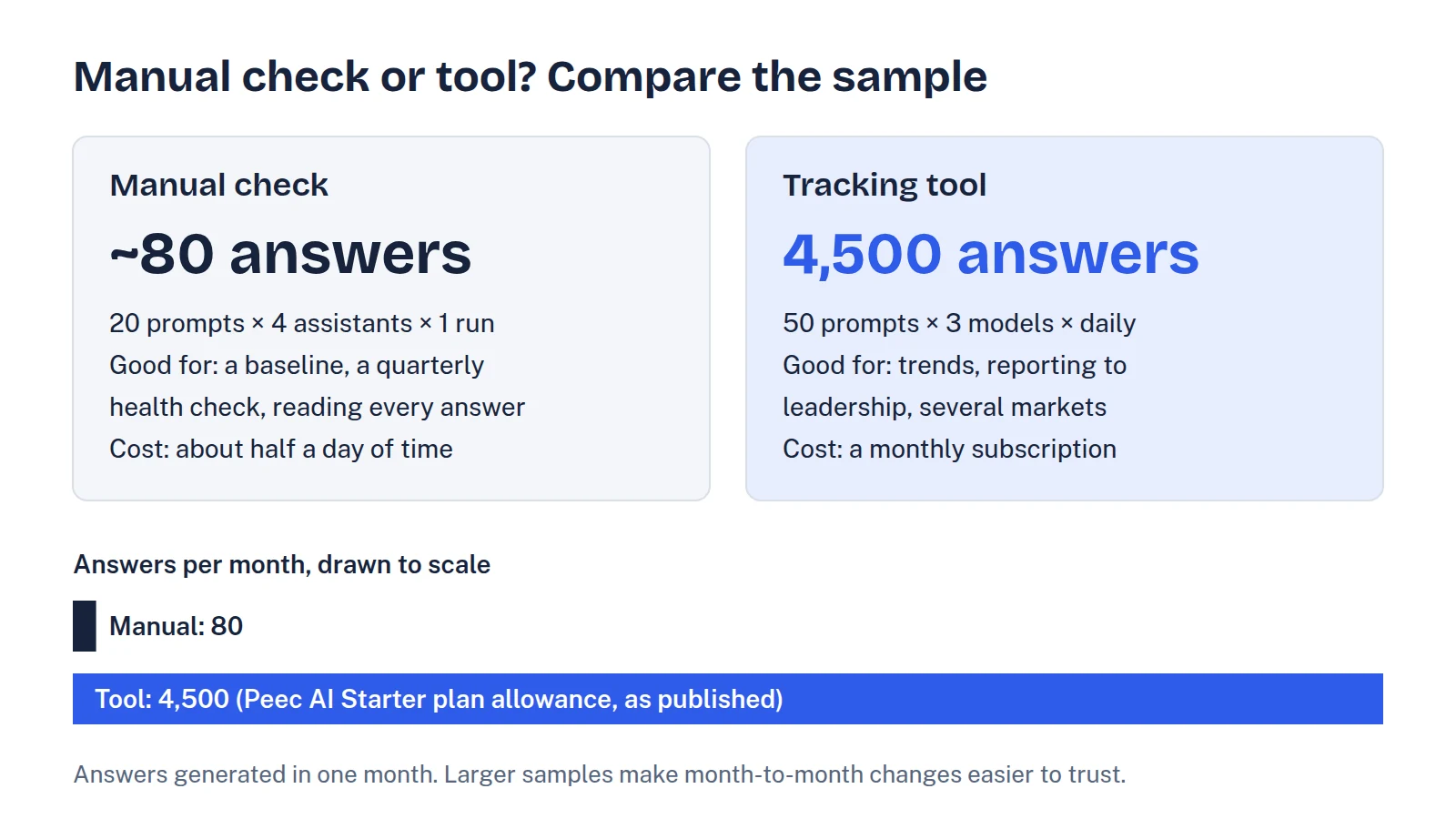
A manual check is enough if all of these are true:
- You track 50 prompts or fewer, in one country and language.
- You need a baseline or a quarterly health check, not a weekly trend line.
- Nobody outside marketing needs a recurring dashboard.
You're ready for a tool when any of these become true: leadership asks for a monthly number, you need to prove whether a campaign moved share of voice, you track several markets, or the manual log is eating more than half a day a month. For the reporting side, see our guide to setting up AI visibility tracking.
How to choose: a two-week trial process
- Build your prompt set first. Write 20 to 50 buyer prompts across category, problem, comparison and alternatives questions. Use the same set in every trial so results are comparable.
- Run a manual baseline. One pass by hand on your top 20 prompts. This is your check on whatever the tools report.
- Shortlist two tools. One that sits next to your SEO platform, and one dedicated tracker. Confirm each covers your buyers' assistants without add-on surprises.
- Trial both on the same prompts for two weeks. Compare mention rates against your manual baseline. Big disagreements are worth asking the vendor about.
- Check what you can act on. The deciding feature is usually citations: a clear list of the pages shaping answers in your category, since that's where the work happens.
- Price the real configuration. Prompts × engines × refresh rate, plus any add-ons, at the size you'll need in six months.
What a tool won't do for you
Every tool on this list measures. None of them fixes. The work that moves the numbers is the same whichever dashboard you pick: getting onto the comparison pages and review sites the assistants cite, correcting wrong facts about your product, and publishing pages that answer buying questions directly. Our guides to earning AI brand mentions and to what AI visibility is and why it matters cover where to start. Budget time for that work before you budget for the tool.
FAQ
What is the best AI visibility tool?
There isn't one best tool for everyone. If you already use Ahrefs or Semrush, their AI visibility products are the easiest start. Teams that need many engines, SSO or API access tend to look at dedicated platforms such as Profound or Peec AI, and OtterlyAI has the lowest published entry price of the tools we checked.
Are there free AI visibility tools?
Yes. Free checkers such as the Ahrefs AI visibility checker give a one-off snapshot of mentions and cited sources, and Profound and OtterlyAI offer free trials. You can also track visibility manually with a fixed prompt set and a spreadsheet.
How do AI visibility tools work?
They send a set of prompts to assistants such as ChatGPT, Perplexity, Gemini and Google's AI features on a schedule, then record which brands are mentioned and which pages are cited. Some also draw on large pre-collected prompt datasets to show the wider category.
Why do AI visibility tools show different numbers?
They use different prompts, engines, locations and refresh rates, and AI answers vary from run to run. Compare tools on the same prompt set, and trust trends in the share of answers you appear in rather than any single score.