AI visibility optimization: a 90-day roadmap for B2B SaaS teams
AI visibility optimization is the work of getting ChatGPT, Perplexity and Google's AI features to mention and describe your brand accurately when buyers ask about your category. It's mostly SEO and PR done in the right order: measure a baseline, fix the pages assistants quote, then earn mentions elsewhere. This guide lays that out as a 90-day plan with a scorecard.
- Google says optimizing for its AI features is still SEO. There are no special files or markup to add.
- Start with a frozen set of 30–50 buyer prompts, run several times per engine, so you have a real baseline.
- Month two: make 5–10 key pages answer-first, structured and original.
- Month three: work on review sites and roundup lists. In Ahrefs' 75,000-brand study, branded web mentions correlated with AI Overview visibility more strongly than backlinks.
- Re-run the same prompts at day 90 and report mention rate, citation rate and accuracy against the baseline.
What AI visibility optimization actually covers
AI visibility optimization is the work of making AI assistants mention, describe and cite your brand accurately when buyers ask questions in your category. That covers ChatGPT, Perplexity, Gemini, Claude, and Google's AI Overviews and AI Mode.
It isn't a new discipline with secret levers. Google says it plainly in its guide to generative AI features: "optimizing for generative AI search is optimizing for the search experience, and thus still SEO." The same guide says you don't need new machine-readable files, AI text files or special markup to appear.
So why a separate roadmap? Because the output you're judged on is different. In classic SEO you report rankings and clicks. Here you report whether assistants name you, what they say, and which sources they lean on. That changes what you fix first and how you prove progress.
Search demand reflects the confusion. In Ahrefs Keywords Explorer this morning (US, October 15, 2026), "ai visibility optimization" showed about 1,200 searches a month with a keyword difficulty of 21. Most closely related terms were tool searches, such as "best ai visibility optimization tools" (about 1,100). People are shopping for software before they have a plan. This guide is the plan.
If you need the basics first, start with what AI visibility is. If you're choosing software, our comparison of AI visibility tools covers that. Here we focus on the sequence of work.
Why most "best practices" lists stall
We read the pages ranking for this keyword today. The top organic results are mostly tool roundups. The how-to pages list sensible practices: clarify your entity, publish comparison content, earn third-party mentions, monitor crawlers. What they rarely give you is an order, a timeframe, or a baseline to measure against.
That's where teams stall. They rewrite a few pages, check ChatGPT once, see nothing obvious, and drop the project. AI answers vary from run to run, so a single check can't show progress either way. You need a frozen prompt set, repeated runs and a dated baseline before you change anything.
The roadmap below fixes that. Each 30-day phase has one job and one output you can show your leadership team.
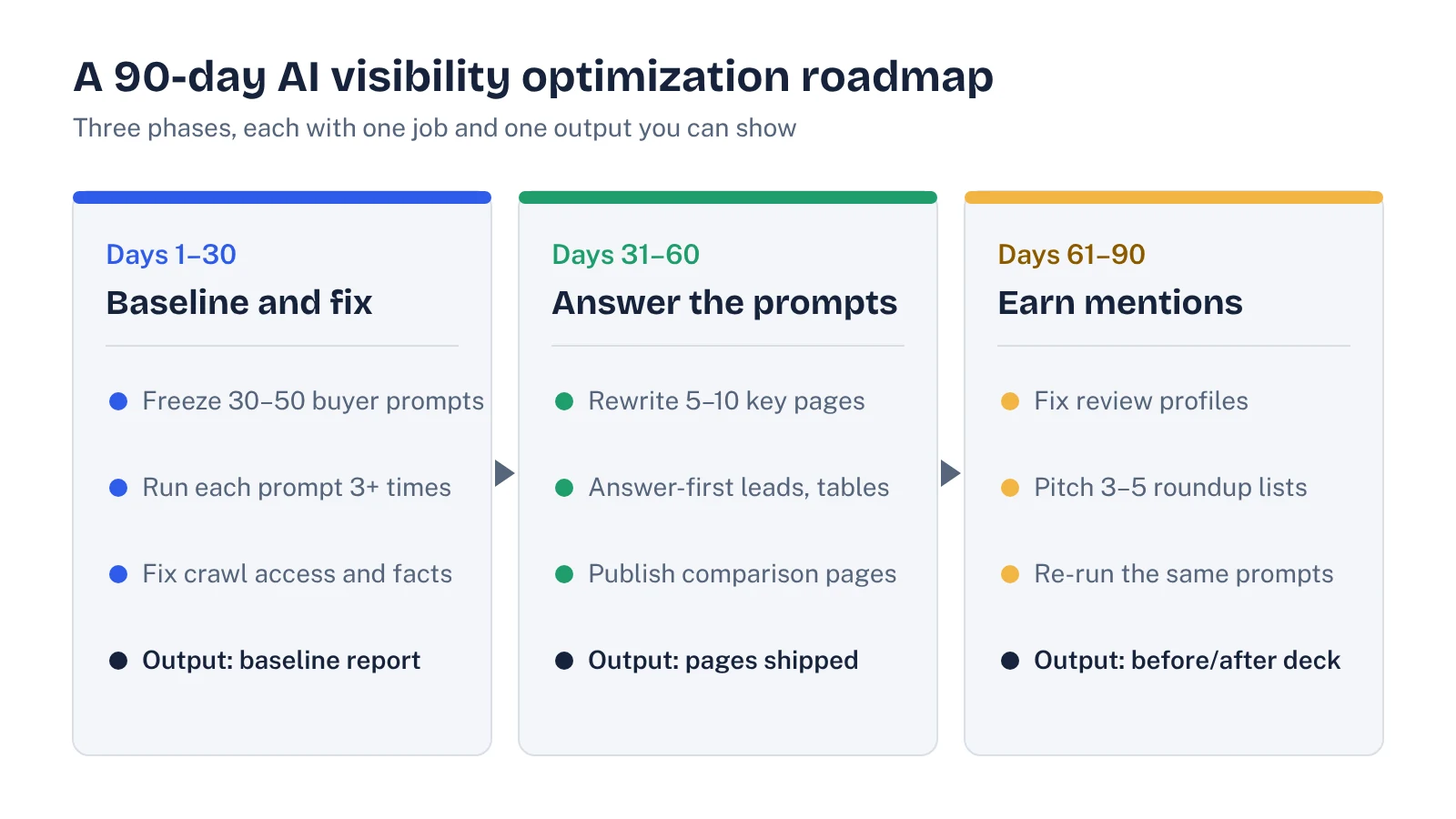
Days 1–30: build a baseline and remove blockers
Freeze a prompt set
Write 30 to 50 prompts a real buyer would type. Split them across three groups: category prompts ("best tools for X"), problem prompts ("how do I fix Y"), and comparison prompts ("A vs B", "alternatives to A"). Use your sales call notes and support tickets, not your keyword list. Once you start measuring, don't edit the set. Our guide to AI visibility tracking walks through prompt design in more detail.
Run each prompt several times
Run every prompt at least three times per engine and record three things per answer: whether you're mentioned, whether one of your pages is cited, and whether the description is accurate. Report mention rate as a percentage across runs. One screenshot is an anecdote.
Check access and facts
Two technical checks matter most. First, make sure assistants can reach your site. OpenAI's crawler documentation says sites that block OAI-SearchBot "will not be shown in ChatGPT search answers," and that robots.txt changes can take about 24 hours to apply. GPTBot is the separate training crawler, so you can allow search while blocking training. Second, Google's guide says a page must be indexed and eligible for a snippet to appear in its AI features.
Then fix factual drift. Pricing, plan names, integrations and your category label should match across your site, G2 or Capterra, LinkedIn and Crunchbase. Assistants repeat what they find, including outdated versions.
Days 31–60: make your pages easy to quote
Now work on the pages assistants should be using. Pick 5 to 10 that map to your highest-value prompts: the homepage, two or three product or use-case pages, pricing, and your strongest comparison or "alternatives" pages.
- Lead with the answer. Put a two or three sentence answer to the core question at the top of each page. Say what the product is, who it's for, and what it replaces.
- Use structure assistants can lift. Comparison tables, short definitions, numbered steps and clear H2s. Google's guide recommends clear organization and headings.
- Add what only you know. Google's guide asks for original, non-commodity content with first-hand experience. Benchmarks from your own product data, real implementation timelines and honest limits beat a rewritten category explainer.
- Publish fair comparison pages. Comparison prompts are where buying decisions happen. Be honest about where a competitor is the better fit. Buyers notice one-sided pages, and fair ones are easier to trust.
- Skip the shortcuts. Google says structured data "isn't required for generative AI search," and llms.txt files are ignored by Google Search. Keep schema accurate as normal SEO hygiene. Don't expect it to move citations. Our schema for AI search post covers the test data.
Don't mass-produce pages for every prompt. Google's guide warns that scaled content made to manipulate rankings or AI responses falls under its spam policies.
See your own AI visibility, free
Get a one-page audit of how ChatGPT, Perplexity and Gemini treat your brand against up to three competitors, plus your biggest gap. In your inbox within 48 hours.
Get my free auditDays 61–90: earn mentions and re-measure
Your own site is only part of the picture. Assistants also draw on what review sites, publications and roundup articles say about you. The best public evidence here is correlational, but it's consistent.
Ahrefs studied 75,000 brands and found that branded web mentions had the strongest correlation with brand visibility in AI Overviews (0.664), ahead of branded anchors (0.527) and branded search volume (0.392). Classic link metrics were weaker: Domain Rating 0.326, number of backlinks 0.218. The authors are clear that correlation isn't causation. It still tells you where to spend the third month.
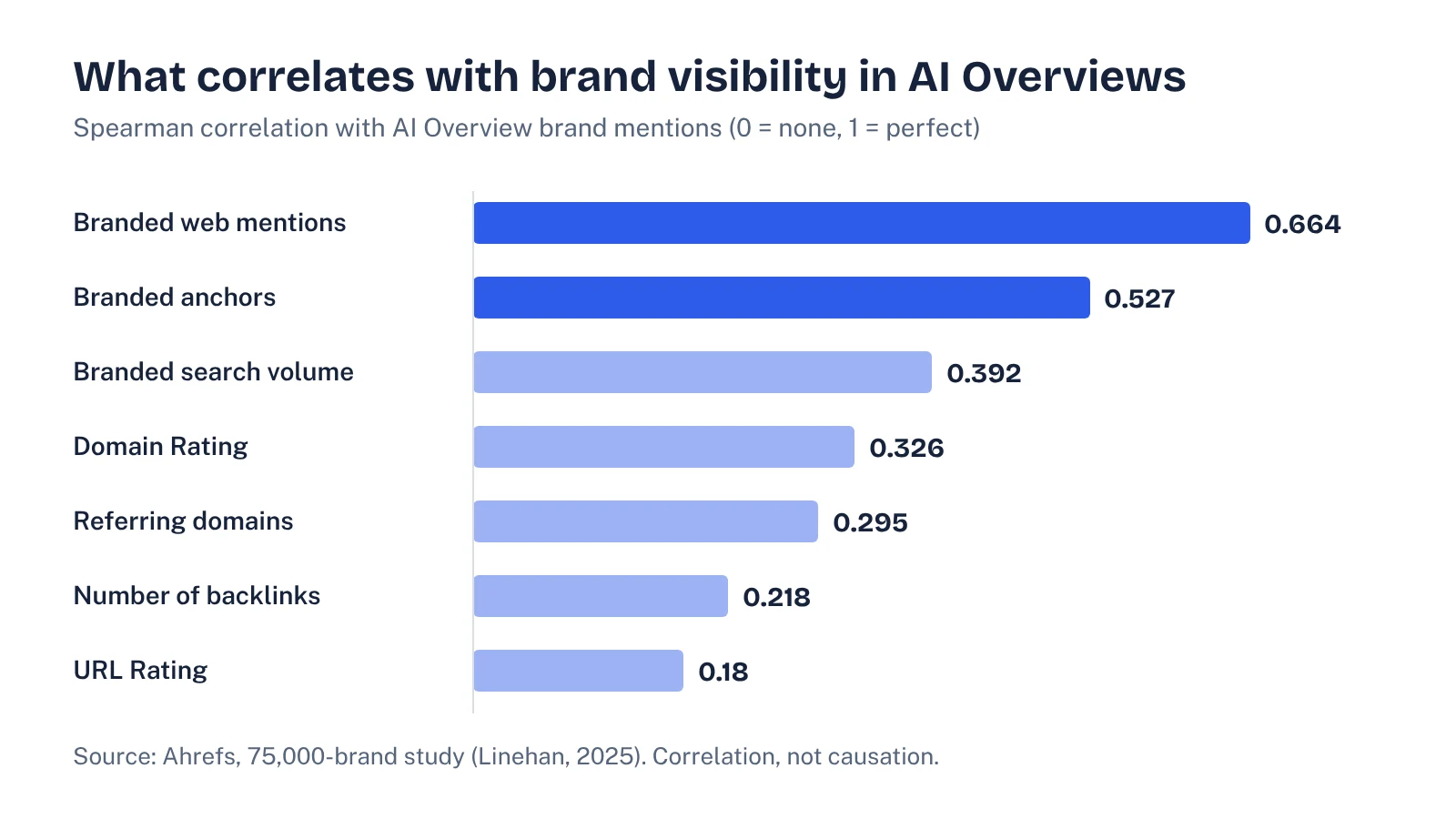
Three moves fit into 30 days for most SaaS teams:
- Refresh review profiles. Update descriptions, categories and screenshots on G2, Capterra or the review sites your buyers use, and ask recent customers for reviews.
- Get onto the lists assistants cite. Check which pages your engines cite for your category prompts. Pitch the authors of 3 to 5 of those roundups with accurate product details.
- Show up where practitioners talk. Founder posts, podcasts and community answers create the kind of branded mentions the Ahrefs data points to.
In the last week, re-run the exact prompt set from day one, the same number of times per engine. Compare mention rate, citation rate and accuracy against the baseline. If you also track competitors, our guide to AI share of voice shows how to calculate it and read the margin of error.
The 90-day scorecard
Keep the reporting simple. One table, three columns of dates, the same measures each time.
| Measure | How to calculate it | Why it matters |
|---|---|---|
| Mention rate | Answers naming you ÷ total answers, across all runs | The most stable signal of whether you're in the conversation |
| Citation rate | Answers linking one of your pages ÷ total answers | Shows whether your own content is being used as a source |
| Accuracy | Answers with correct pricing, category and features ÷ answers that mention you | Wrong facts cost deals even when you're visible |
| Comparison presence | Mention rate on comparison and "alternatives" prompts only | Closest to buying intent |
| AI feature impressions | Search Console generative AI report, if available | Google's own first-party view of AI Overviews and AI Mode |
| AI referral visits | Sessions from chatgpt.com, perplexity.ai and similar in analytics | Connects visibility to site visits and pipeline |
Expect uneven movement. Accuracy usually improves first, because you control the facts. Mention rate on category prompts moves slowest, because it depends on what the wider web says about you.
Common mistakes that waste the quarter
- Changing the prompt set midway. Then you can't tell whether the number moved or the question did.
- Buying a tool before writing prompts. A tool measures whatever prompts you give it. Bad prompts give precise numbers about the wrong questions.
- Chasing files and markup. llms.txt and extra schema are cheap to add and fine to keep, but Google says neither is needed for its AI features.
- Ignoring off-site sources. If every cited source for your category is a third-party list, rewriting your homepage alone won't change much.
- Trusting tools that promise rankings. Google's guide notes that "no third-party tool has access to our internal ranking or AI systems."
The bottom line
AI visibility optimization is mostly good SEO and good PR, done in the right order and measured properly. Spend the first month learning where you stand and removing blockers. Spend the second making your key pages easy to quote. Spend the third on what others say about you, then re-measure the same prompts. At day 90 you'll have a baseline, a before-and-after comparison, and a clear list of what to do next quarter.
FAQ
What is AI visibility optimization?
It's the practice of improving how often and how accurately AI assistants such as ChatGPT, Perplexity, Gemini and Google's AI Overviews mention and cite your brand. In practice it combines SEO fundamentals, clear and original content, accurate facts across the web, and earning third-party mentions. It is measured with a fixed prompt set rather than keyword rankings.
How long does AI visibility optimization take to show results?
Accuracy fixes can show up within weeks, because you control the facts on your site and profiles. Mention rate on broad category prompts tends to move more slowly because it depends on what other sites say about you. A 90-day cycle gives you a baseline, changes, and a fair re-measurement.
Do I need llms.txt or special schema for AI visibility?
Not for Google. Its guide says you don't need new machine-readable files, AI text files or special markup to appear in its AI features, and structured data isn't required. Keeping schema accurate is still good SEO practice.
How do I measure AI visibility optimization?
Freeze a set of buyer prompts, run each several times per engine, and record mention rate, citation rate and accuracy. Add Google's Search Console generative AI report if your site has it, plus AI referral visits in analytics. Compare every re-run against your day-one baseline.
Sources
- Google Search Central: Guide to optimizing for generative AI features on Google Search
- OpenAI: Overview of OpenAI crawlers
- Ahrefs: An analysis of AI Overview brand visibility factors (75K brands studied)
- Google Search Central Blog: Introducing Search generative AI performance reports in Search Console
- PPC Land: Google gives Search Console its own generative AI visibility reports
- Ahrefs Keywords Explorer, US data pulled October 15, 2026