SaaS marketing strategy when buyers ask AI first: a stage-by-stage plan for B2B teams
A SaaS marketing strategy is the plan for how buyers find you, shortlist you and choose you, and which channels you fund at each step. In 2026 that plan has to start earlier than your website: G2 found 82% of software buyers sourced recommendations from an AI chatbot in the past two years. This guide gives you a stage-by-channel plan, the metrics to watch and a 90-day rollout.
- Plan by buying stage, not by channel: discovery, shortlist, evaluation, decision and expansion each need different assets and metrics.
- AI assistants and review sites now shape the shortlist. In G2's 2026 survey, review sites (38%) and AI chatbots (37%) were the top two sources deciding which vendors make it.
- Evaluation is now the longest buying stage, and finance sits in on 46% of software decisions, so security, pricing and ROI content is marketing work.
- Measure the shortlist stage directly: AI mention rate on buyer prompts, review profile health and branded search, next to pipeline and CAC payback.
- Roll it out in 90 days: baseline first, fix shortlist gaps second, then build evaluation assets and a monthly review.
What changed in how SaaS buyers buy
Most SaaS marketing strategy guides still describe the same journey: a buyer searches Google, lands on your blog, downloads something, books a demo. That journey still exists, but it now starts somewhere else for a large share of buyers.
G2's surveys of more than 1,000 B2B software buyers show how fast this moved:
- In August 2025, half of buyers said they now start the buying journey in an AI chatbot instead of Google Search, and 87% said AI chatbots are changing how they research.
- In the 2026 Buyer Behavior Report, 82% of buyers had sourced software recommendations from an AI chatbot in the last 24 months. Half of them said AI had the most impact when narrowing and comparing options.
- The same 2026 report found review sites (38%) became the top source shaping which vendors make a shortlist, just ahead of AI chatbots (37%).
Two caveats. G2 sells review and AI visibility products, so it has an interest in these findings. And "sourced a recommendation" does not mean "bought what the chatbot said." Still, the direction is consistent with what you can see in your own pipeline: buyers arrive later, with a shortlist already formed, and often say "ChatGPT mentioned you" on the first call.
The practical consequence is simple. If you are not on the shortlist when it forms, the rest of your funnel never gets a chance to work.
What most SaaS marketing strategy guides miss
We read the pages that rank on Google's first page for "saas marketing strategy" in the US today (Ahrefs SERP overview, November 21, 2026). They cover the classics well: freemium, referrals, content, SEO, paid social, retention. Three gaps came up again and again:
- AI assistants as a channel. Of the four guides we read in full, only one discussed AI assistants as a buyer research channel, and only briefly. None explained how to measure or improve how assistants describe you.
- Stage-by-channel planning. Most list tactics without saying which buying stage each one serves, so teams fund a long list of channels and cannot tell which stage is leaking.
- The evaluation stage. Security reviews, finance sign-off and pricing clarity are treated as sales problems. The buyer data says they are now where deals stall.
Ironically, the Google results page for this exact keyword shows an AI Overview at the top, per Ahrefs. Even buyers who search the old way get an AI summary first.
Build the strategy around five buying stages
Instead of starting with channels, start with the stages your buyer goes through and the question they are answering at each one. Then pick channels that answer that question best.
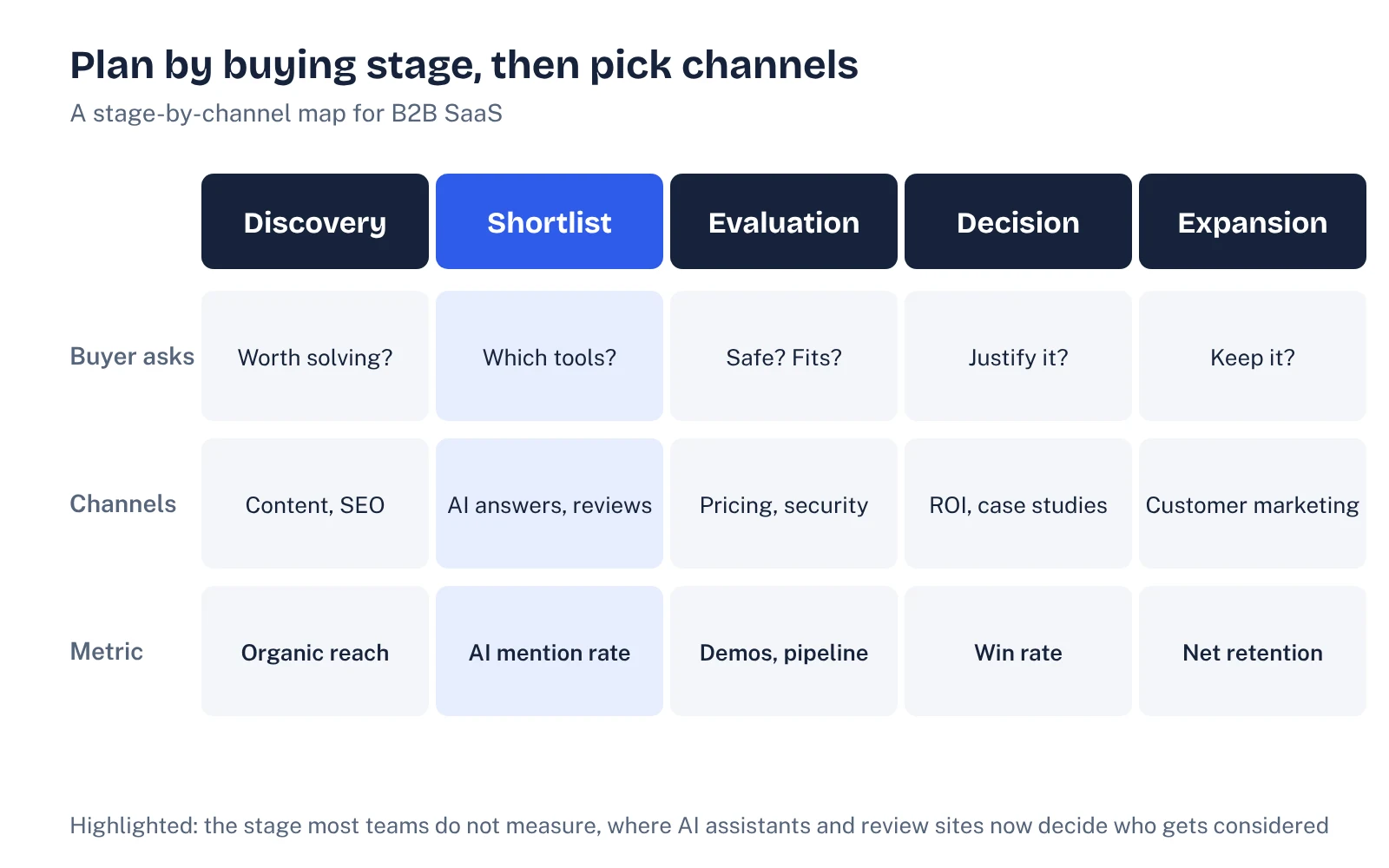
| Stage | Buyer question | Channels and assets that answer it | Metric to watch |
|---|---|---|---|
| Discovery | "Is this problem worth solving, and how do others solve it?" | Problem-led content, SEO, thought leadership, podcasts, LinkedIn | Non-branded organic traffic, engaged reach |
| Shortlist | "Which tools should I look at?" | AI assistant answers, review sites, comparison and "best X" pages, communities | AI mention rate on buyer prompts, review profile health, branded search |
| Evaluation | "Will this work for us, and is it safe?" | Product pages, pricing page, security and trust center, integrations, demos, trials | Demo or trial starts, sales-accepted pipeline |
| Decision | "Can I justify this to finance and my team?" | ROI calculators, business case templates, case studies, references | Win rate, sales cycle length |
| Expansion | "Should we keep it and roll it out further?" | Onboarding, customer marketing, product education, advocacy | Net revenue retention, reviews written by customers |
Notice that the shortlist row is the one most teams do not measure at all. It is also the one that changed most.
Win the shortlist: AI answers, reviews and comparisons
AI assistants assemble shortlists from what the web already says about you. That means your own site, but also review platforms, comparison articles, community threads and press. Winning here is less about clever prompts and more about being described clearly and consistently in the places assistants read.
- Write down the one-sentence description you want repeated. Category, who it is for, and the main difference. Use the same wording on your homepage, review profiles and LinkedIn page.
- List 20 to 50 buyer prompts. The questions a buyer would ask an assistant before they know your name, such as "best onboarding software for a 50-person SaaS company." Our guide to prompt research shows how to build the list.
- Check where you stand. Run the prompts in ChatGPT, Perplexity, Gemini and Google AI Mode, and note whether you are named, how you are described and which sources get cited. Our AI visibility audit guide has a free template for logging this.
- Fix the review layer. Complete and refresh your G2 and Capterra profiles and ask recent happy customers for reviews. See how B2B review sites shape AI answers.
- Earn mentions on comparison pages. Pitch accurate information to the authors of "best X tools" articles that assistants already cite for your category, and publish honest comparison pages of your own.
Support evaluation and decision, where deals now stall
G2's 2026 report has two findings that should change how you staff marketing:
- Evaluation is now the longest stage of the buying journey, longer than research for the first time. IT security review was the biggest source of delay, cited by 39% of buyers and 50% of enterprise buyers.
- Finance involvement jumped from 31% to 46% of software decisions in a single year, and nearly half of buyers said their CFO vetoed an approved deal in the last year.
Marketing can shorten both. A public security and trust page, a clear pricing page with what each plan includes, integration docs that answer "does it work with our stack," and a business case template a champion can forward to finance are all marketing assets. They also help AI assistants describe you accurately when a buyer asks "does X have SOC 2?" or "how much does X cost?"
Thought leadership matters here too. In the 2026 Edelman and LinkedIn study, as reported by ContentGrip, 59% of final decision-makers said poor or absent thought leadership contributed to a vendor being removed from consideration, and 84% had used AI to summarize thought leadership during vendor evaluation. Our thought leadership strategy guide covers what makes it useful to a buying group.
See your own AI visibility, free
Get a one-page audit of how ChatGPT, Perplexity and Gemini treat your brand against up to three competitors, plus your biggest gap. In your inbox within 48 hours.
Get my free auditWhere the search demand sits
Search still matters, both as a channel and because assistants often lean on pages that rank. We pulled US monthly search volume for the main SaaS marketing terms in Ahrefs Keywords Explorer on November 21, 2026:
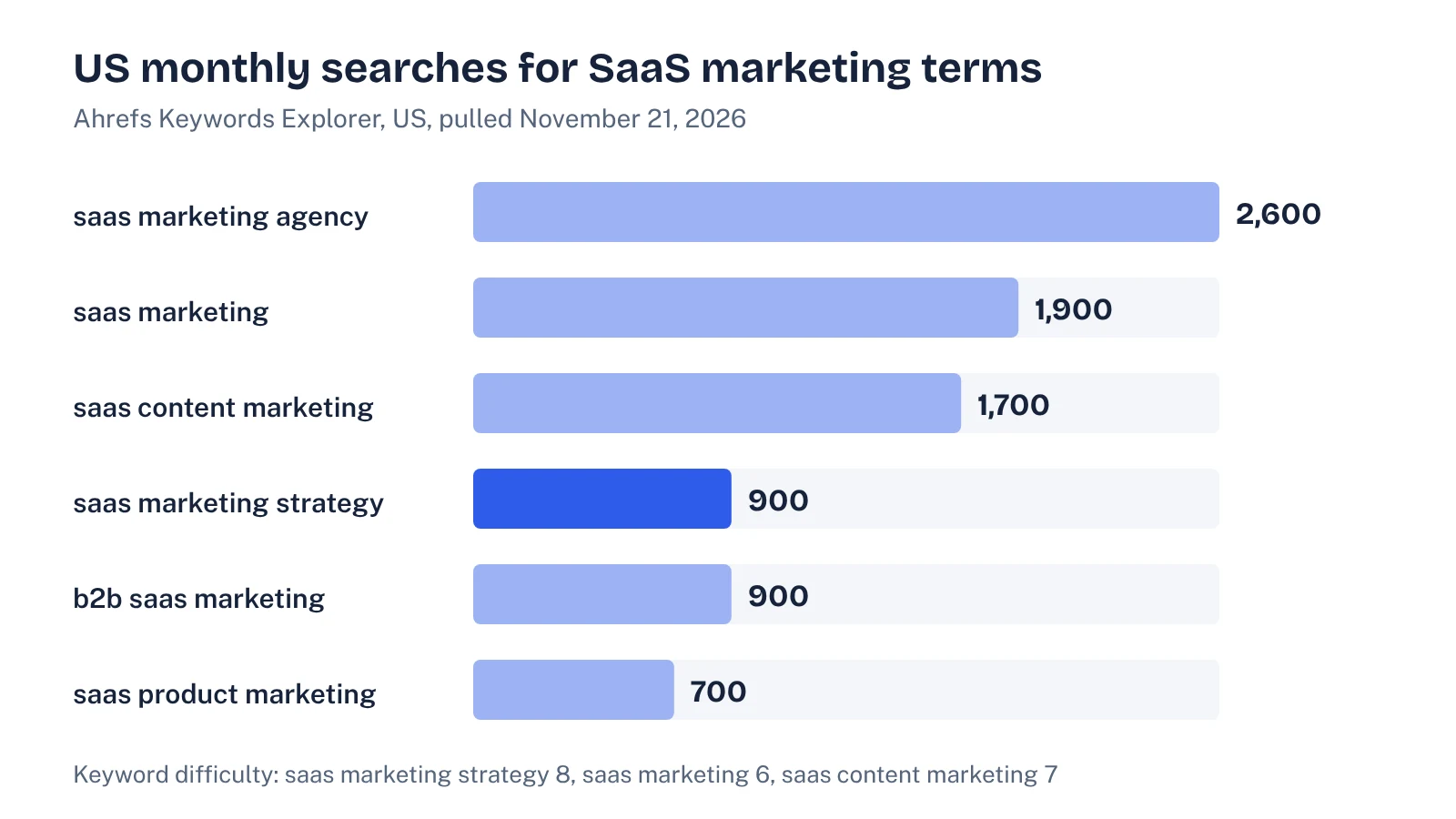
Two things stand out. Difficulty is low across the board: "saas marketing strategy" has a keyword difficulty of 8, and "b2b saas marketing strategy" (400 searches a month) has a difficulty of 2. And every strategy-type query we checked shows an AI Overview. If you sell to marketers, the lesson carries over to your own category: look at which buyer queries trigger AI answers, because those are the ones where being cited matters as much as ranking. Our guides to SaaS SEO and SaaS content marketing go deeper on the organic side.
The metrics that tell you the strategy is working
Keep one or two metrics per stage, reviewed monthly. More than that and nobody reads the report.
- Shortlist: AI mention rate across your buyer prompts, AI share of voice against three to six competitors, review count and recency, and share of search.
- Traffic from AI: referral sessions from ChatGPT, Perplexity and others in GA4. They undercount, because many buyers copy your name and visit directly, so read them as a floor. See how to track AI traffic.
- Pipeline: sales-accepted opportunities and the self-reported "how did you hear about us" answers.
- Efficiency: CAC payback and LTV to CAC. Factors cites the common rule of thumb of LTV:CAC of 3:1 or better and payback under 12 months; treat that as a starting point, not a law.
- Expansion: net revenue retention and how many customers leave reviews.
On budget: we have not found a credible benchmark that tells a B2B SaaS company what share to spend per channel, and published figures vary widely. Fund the stage with the biggest leak first. If buyers who reach a demo convert well but too few reach it, your problem is discovery or shortlist, not sales enablement.
A 90-day plan to put it in place
- Days 1 to 15, baseline. Map your current spend and assets to the five stages. Run your buyer prompts in two or three assistants. Pull review counts, branded search and GA4 AI referrals. Add the "how did you hear about us" question to your CRM.
- Days 16 to 45, fix the shortlist. Align your one-sentence description everywhere. Refresh review profiles and start a steady review request. Fix or publish two or three comparison pages. Pitch corrections to the most-cited third-party pages in your category.
- Days 46 to 75, build evaluation assets. Publish or improve the pricing page, a security and trust page, top integration pages and a business case template. Brief sales on where they live.
- Days 76 to 90, review and reallocate. Rerun the same prompts and compare with your baseline. Check pipeline by self-reported source. Move budget from the stage that improved least to the one with the clearest return, and set a monthly review.
AI answers vary from run to run, so do not judge the shortlist work on a single screenshot. Use the same prompts, the same assistants and several runs each time, and look at the trend over months.
Common mistakes to avoid
- Treating AI visibility as a separate project. It is the shortlist stage of your funnel. Give it an owner and a metric next to pipeline, not a side experiment.
- Funding channels nobody can tie to a stage. If you cannot say which buyer question a channel answers, it is the first candidate to cut.
- Leaving evaluation to sales. Security, pricing and ROI questions are asked to assistants long before they reach your sales team.
- Changing the prompt set every month. You lose the ability to compare. Freeze it for a quarter.
FAQ
What is a SaaS marketing strategy?
It is the plan for how your ideal buyers discover, shortlist, evaluate and choose your software, and which channels and assets you fund at each of those stages. A good one names the buyer, the stages, the channel mix per stage and the metrics that tell you whether each stage is working.
What is the best way to market a SaaS product?
Start where your buyers form their shortlist, then work outward. For most B2B SaaS that now means AI assistants, review sites and comparison content, backed by a site that answers evaluation questions on pricing, security and integrations. Paid and outbound work best once those foundations are in place.
How is B2B SaaS marketing different from other B2B marketing?
Revenue is recurring, so retention and expansion matter as much as acquisition. Buyers also expect to try or see the product early, and they compare many similar tools, which makes review sites, comparison pages and AI recommendations unusually important.
How much should a SaaS company spend on marketing?
There is no single right percentage, and published benchmarks vary widely by stage and growth target. A more useful approach is to fund the buying stage where you lose the most buyers first, and to keep CAC payback within the range your finance team can support.
Do AI assistants replace SEO in a SaaS marketing plan?
No. Assistants often draw on pages that already rank and on third-party sites like review platforms. Treat AI visibility as a layer on top of SEO and digital PR, measured separately with a fixed set of buyer prompts.
Sources
- G2: New G2 research, AI is reshaping how B2B software deals are won and lost (2026 Buyer Behavior Report, July 22, 2026)
- G2 Learn: How AI chat is rewriting B2B software buying, insights from 1,000+ decision makers (Tim Sanders, October 6, 2025)
- ContentGrip: Edelman finds 84% of B2B buyers use AI to summarize thought leadership (Lena Marlowe, November 11, 2026)
- Factors.ai: SaaS marketing strategy, a 2026 playbook for B2B SaaS
- Ahrefs Keywords Explorer and SERP overview, US data pulled November 21, 2026 (The Reframe)