SaaS content marketing when buyers ask AI first: what to publish, what to stop, and how to measure it
SaaS content marketing now has two audiences: the buyer, and the AI system that summarizes your category for that buyer. The programs that work publish fewer generic explainers and more decision pages with facts only you can supply, then measure mentions and pipeline instead of traffic alone. This guide gives you the page mix, a six-step plan and a measurement setup.
- Clicks from informational content are shrinking: Ahrefs measured a 58% lower click-through rate for the top result when an AI Overview shows (February 2026).
- Of the two highest-traffic guides we read for "saas content marketing", one never mentions AI answers and the other covers them only at a high level.
- Shift effort toward decision pages (comparison, pricing, integration, use case, security) and original data, and away from commodity explainers.
- Google's July 2026 guide says to write non-commodity content and warns against mass-producing pages to target AI fan-out queries.
- Measure three layers: AI mentions and citations on a fixed prompt set, branded and direct demand, and content-influenced pipeline.
What changed for SaaS content marketing
The classic SaaS content playbook was a click funnel. You wrote posts that ranked for problem keywords, readers clicked through, and some of them converted on a gated resource or a trial. Most of the top-ranking guides still teach that model, and for good reasons: it worked for a decade.
Two things now sit between your content and your buyer.
The first is the AI Overview. Ahrefs' February 2026 study of 300,000 keywords found that when an AI Overview appears, the top-ranking page gets a 58% lower click-through rate than it would be expected to without one. Position 1 CTR on those queries fell from 7.3% in December 2023 to 1.6% in December 2025. The study looked at informational queries, the bread and butter of most SaaS blogs.
The second is the assistant. Buyers ask ChatGPT, Gemini, Claude or Perplexity to suggest tools, compare two vendors or explain pricing. According to Similarweb data reported by The Next Web (July 2026), generative AI sites drew about 9.5 billion monthly visits worldwide, up 70% in a year, and 95% of ChatGPT users also use Google. Your buyers use both, often for the same purchase.
So your content now has two audiences. The buyer still reads it. But an AI system also reads it, decides whether to use it, and summarizes your category with or without you. A SaaS content marketing strategy that ignores the second reader will keep producing traffic reports that look worse every quarter, while the shortlist gets decided elsewhere.
What the search demand says
We pulled these numbers from Ahrefs Keywords Explorer this morning (US, November 14, 2026):
| Query | US monthly searches | Keyword difficulty |
|---|---|---|
| saas content marketing | 1,700 | 7 |
| aeo content structure for b2b saas platforms | 1,400 | 5 |
| content marketing for saas | 700 | 3 |
| saas content marketing agency | 600 | 3 |
| saas content marketing strategy | 400 | 19 |
| b2b saas content marketing | 350 | 9 |
| saas content strategy | 250 | 17 |
| content audit for saas | 250 | 0 |
| how to measure saas content marketing | 150 | 3 |
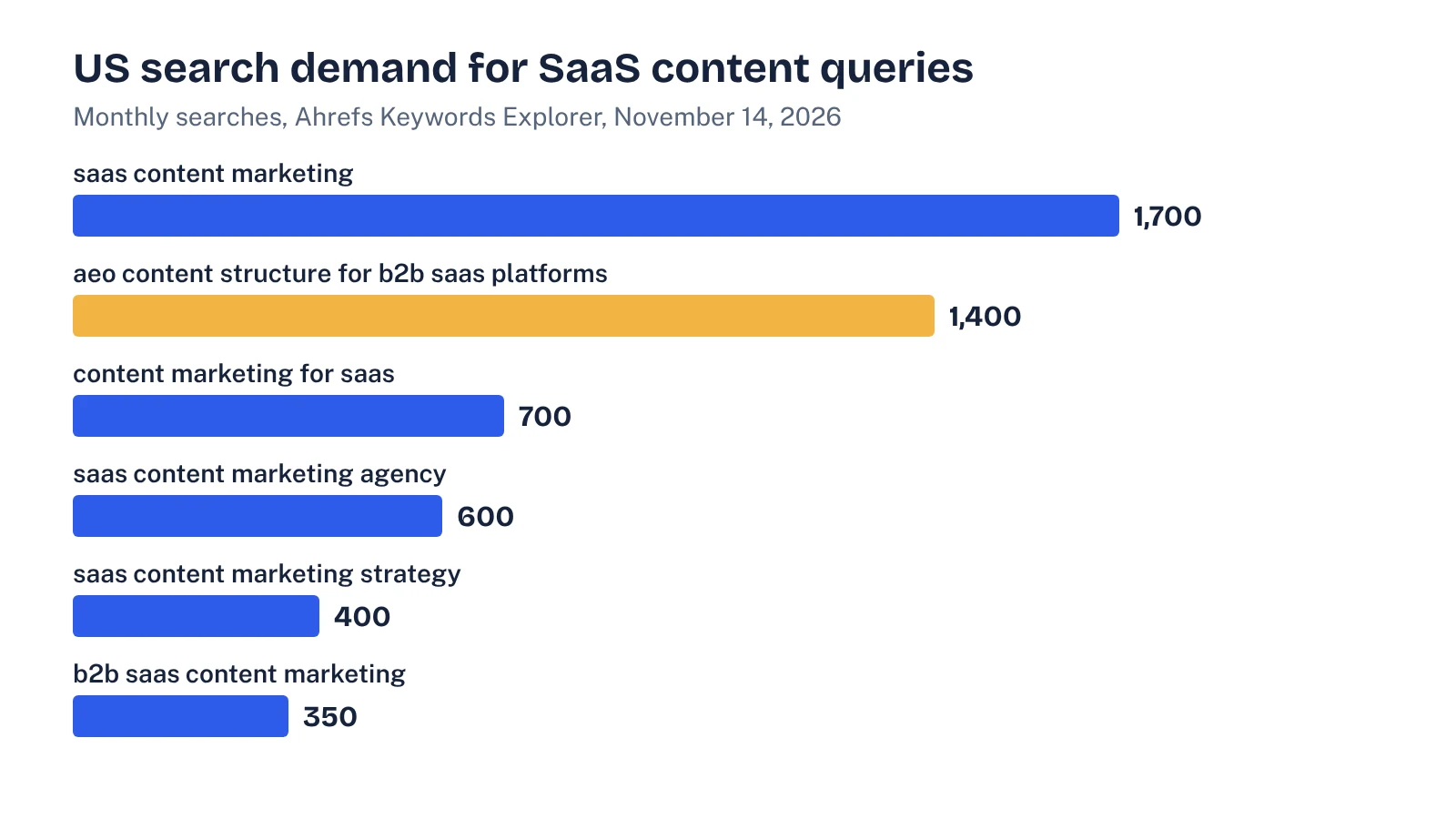
Two things stand out. First, the second-largest query containing "saas content" is about structuring content for answer engines. Teams are already asking how AI changes the job. Second, difficulty is low across the board, but the results page carries an AI Overview with eight sitelinks, three of them YouTube videos. Even for this query, a large part of the answer is given before anyone scrolls.
We read the two highest-traffic guides in the top five. Marketer Milk's 11-step guide is solid on bottom-up planning, use case pages and "vs" pages, but it never mentions AI answers and tells readers to assume buyers find content through Google. Directive's guide argues well for revenue-first content and names AI assistants as a discovery channel, but stays high level on what to change. What neither gives you is a page-by-page mix for the AI-answer era and a way to measure it when clicks fall.
The page mix: what to publish more of, and less of
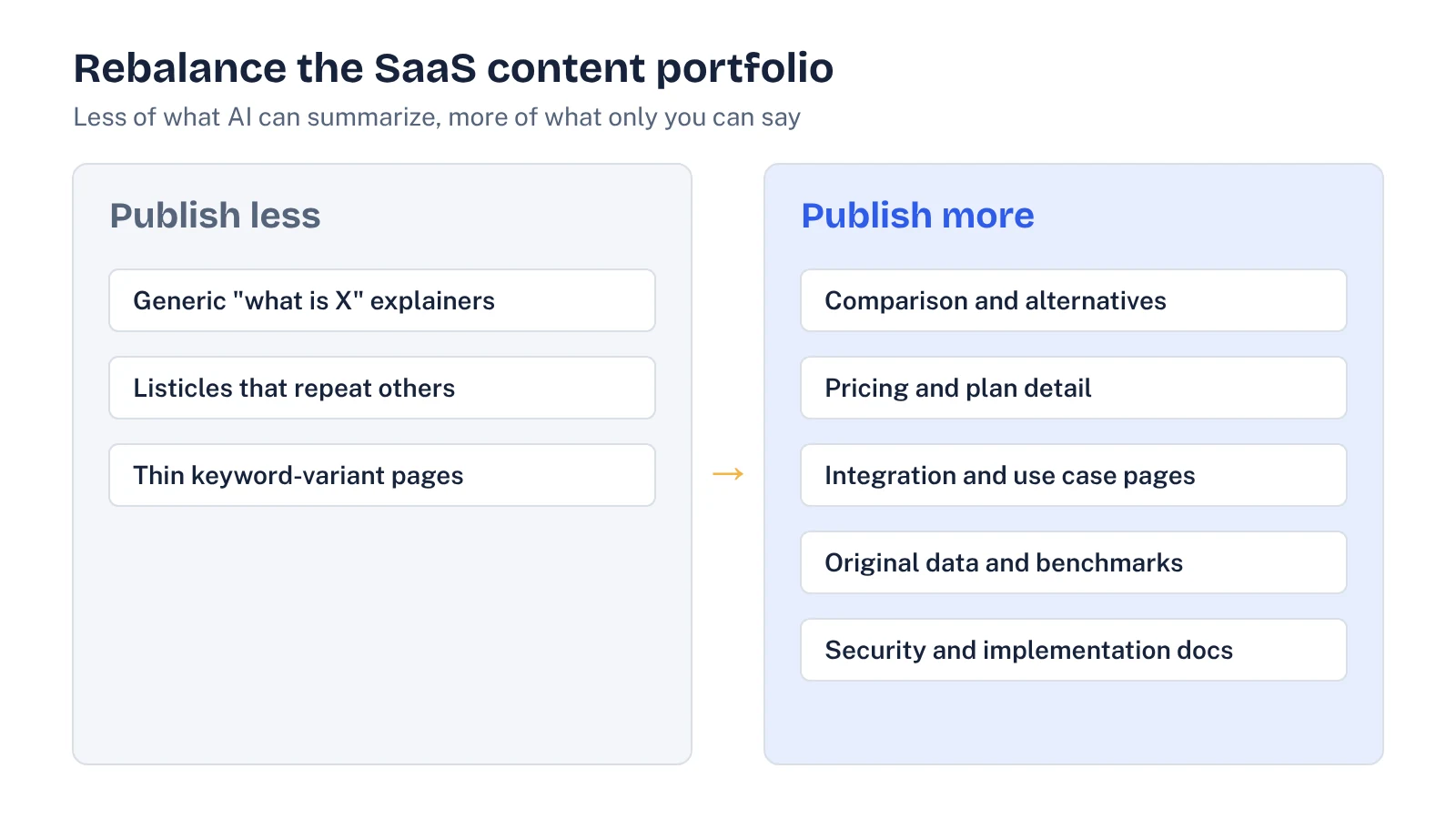
Think of your content as a portfolio with three jobs. Some pages get you found, some get you cited inside answers, and some get you chosen once a buyer is comparing. AI answers squeeze the first job hardest, because a generic explainer is exactly what an AI Overview can summarize without sending a click.
| Page type | Job | Why it matters in AI answers | Direction |
|---|---|---|---|
| Comparison and alternatives pages | Get chosen | Assistants are asked "X vs Y" and "alternatives to X" all the time; a clear, fair page gives them facts to use | More |
| Pricing and plan detail | Get chosen | Buyers ask assistants what a tool costs; if your page is vague or out of date, the answer comes from someone else's page | More, and keep current |
| Integration and use case pages | Get cited | Answer specific "does it work with" and "best tool for [team]" prompts | More |
| Original data, benchmarks, templates | Get cited | Non-commodity content is what Google's guide asks for; others link to it and assistants quote it | More |
| Security, implementation, migration docs | Get chosen | Late-stage buyers and procurement ask assistants these questions; public docs are what answers draw on | Make public where possible |
| Generic "what is X" explainers | Get found | Easy for AI Overviews to answer without a click | Fewer, deeper |
| Thin keyword-variant pages | Get found | Google warns that mass-producing pages for AI queries can be scaled content abuse | Stop |
This is not "stop blogging". Educational posts still build authority, earn links and rank for questions where people do click. The change is in proportion. If 80% of your calendar is top-of-funnel explainers, move a chunk of that effort to the pages buyers and assistants use when a decision is close. For a deeper look at reworking existing pages, see our guide to AI content optimization for SaaS pages.
What Google says about content for AI features
Google published a guide to optimizing for generative AI features in Search (last updated July 10, 2026). Three points matter for a SaaS content plan:
- Write non-commodity content. Google asks for original content with a unique viewpoint, such as first-hand experience, rather than summaries of what is already out there.
- Don't mass-produce pages for AI queries. It warns that creating large numbers of pages to target fan-out queries or AI responses can violate its scaled content abuse policy.
- No special AI format is required. Google says there's no ideal page length, content doesn't need to be chunked for AI, and new AI-specific files or markup aren't needed for Google Search.
For SaaS teams this is useful cover. You don't need to rebuild your site for robots. You need pages that say something specific, true and current about your product and your buyers' problems. That is also what the other assistants tend to reward.
A six-step SaaS content marketing plan for the AI-answer era
Content is one part of the bigger plan. If you are mapping every channel to a buying stage, start with our SaaS marketing strategy guide for buyers who ask AI first.
- List the buyer questions that decide deals. Pull them from sales call notes, demo forms, support tickets and lost-deal reasons. Aim for 30 to 50 questions across problem, comparison, pricing, integration and security.
- Baseline how AI answers them today. Run each question in ChatGPT, Gemini, Perplexity and Google (AI Overviews and AI Mode). Log whether you're mentioned, which pages are cited, which competitors appear and what's wrong. Our step-by-step AI visibility audit guide has a free template for this.
- Fix the facts first. Update pricing, plan limits, integrations and feature names on your own pages, then on review sites and directories that show up in answers. Wrong facts cost more than missing content.
- Fill the decision-page gaps. For each question where a competitor or a third-party page gets cited and you don't, decide which page should answer it. Usually that's an existing page that needs a direct answer and proof, not a new post.
- Publish one original asset a month. A benchmark from your product data, a survey of your customers, a teardown, a calculator or a template. This is the content others cite and AI systems repeat.
- Distribute where answers are formed. Share the asset on LinkedIn, in communities where your buyers compare tools, and with partners. AI answers draw on third-party pages as well as yours, so being discussed elsewhere matters.
The order matters. Teams often jump to step 5 because it's the most fun. But if an assistant still quotes last year's pricing, a new benchmark won't fix the shortlist. When you do get to original research, plan it as part of a thought leadership strategy with one clear claim to prove, not a one-off report.
See your own AI visibility, free
Get a one-page audit of how ChatGPT, Perplexity and Gemini treat your brand against up to three competitors, plus your biggest gap. In your inbox within 48 hours.
Get my free auditHow to measure SaaS content marketing when buyers don't click
Traffic is now a partial signal. A page can lose clicks and still be doing its job if it's cited in the answer that put you on the shortlist. Measure three layers and read them together.
| Layer | What to track | Where | Cadence |
|---|---|---|---|
| Visibility | Rankings; mentions, citations and accuracy on your fixed prompt set | Search Console, rank tracker, manual runs or an AI visibility tool | Monthly |
| Demand | Branded search, direct traffic, AI referral sessions, "how did you hear about us" answers | Search Console, analytics, demo form field | Monthly |
| Revenue | Pipeline and wins where content was viewed or mentioned | CRM | Quarterly |
Two practical notes. Add a free-text "how did you hear about us?" field to your demo form; buyers often name an assistant that your analytics can't attribute. And don't expect AI referrals to land on the post that earned the citation. In the same Similarweb data, 58.8% of AI referrals landed on homepages, so a citation on a comparison page can show up as a homepage visit.
For setting up the analytics side, see how to track AI traffic in GA4. For the broader channel picture, our SaaS SEO guide for the AI search era covers what to keep and what to change in search work.
Common mistakes to avoid
- Treating AI as a new channel with its own content. Assistants read the same pages buyers do. Separate "AI content" usually becomes thin duplicate content.
- Publishing volume to "feed the models". Google explicitly warns against mass-producing pages for AI queries, and generic pages rarely get cited anyway.
- Leaving decision pages stale. A two-year-old comparison page with a competitor's old pricing will be quoted, or replaced by someone else's newer page about you.
- Gating everything. If your best implementation guide sits behind a form, neither buyers nor assistants can use it to answer the question.
- Reporting only traffic. Leadership will cut a content program that looks like it's shrinking. Show mentions, branded demand and pipeline next to sessions.
Where to start this week
Pick your ten most important buyer questions. Run them in ChatGPT and Google today and write down who gets named and which pages are cited. Then compare that list with your content calendar for the next month. If the calendar is mostly explainers and the answers are mostly about comparisons, pricing and integrations, you know what to change first.
If your blog already has years of posts, run a SaaS content audit before adding more: it tells you which existing pages to keep, fix, merge or cut.
FAQ
What is SaaS content marketing?
It is the practice of creating content that helps software buyers understand a problem, compare options and choose a product, and that brings them to your site or your sales team. For SaaS it leans heavily on product-specific pages such as comparisons, integrations and use cases, because buyers research tools in detail before they talk to sales.
Is SaaS content marketing still worth it if AI answers reduce clicks?
Yes, but the return shows up differently. AI assistants and AI Overviews build their answers from pages they can find and trust, so your content still shapes the shortlist even when fewer people click. The work shifts toward pages that carry facts assistants need, and measurement shifts toward mentions, branded demand and pipeline.
How do you measure SaaS content marketing?
Track three layers: visibility (rankings plus mentions and citations on a fixed set of buyer prompts in ChatGPT, Gemini, Perplexity and AI Overviews), demand (branded search, direct traffic and self-reported attribution on demo forms), and revenue (pipeline and wins where content was touched). Review monthly and compare against a baseline.
How many blog posts should a SaaS company publish?
There is no reliable magic number. A small team usually gets more from keeping 20 to 40 decision pages accurate and adding one strong original piece a week than from publishing many generic posts. Google also warns that mass-producing pages to target AI queries can count as scaled content abuse.
Sources
- Ahrefs: Update: AI Overviews reduce clicks by 58% (February 4, 2026)
- Google Search Central: Optimizing your website for generative AI features on Google Search (updated July 10, 2026)
- The Next Web: Similarweb's 2026 generative AI landscape report (July 31, 2026)
- Marketer Milk: SaaS content marketing strategy guide
- Directive: A guide to content marketing for B2B SaaS
- Ahrefs Keywords Explorer and SERP overview, US data pulled November 14, 2026