Content audit for SaaS: which pages to keep, fix, merge or cut when AI answers take the clicks
A content audit for SaaS is a page-by-page review of everything you've published, ending in one decision per URL: keep, fix, merge or cut. In 2026 it also has to ask a new question: does this page still earn clicks or citations when an AI answer sits above it? This guide gives you the inventory, the signals, a decision tree and a safe rollout plan.
- Ahrefs found the #1 result gets about 58% fewer clicks when an AI Overview shows, so judge pages on clicks, conversions and citations, not rankings alone.
- Decide in a fixed order: product fit, business value, AI citation value, then performance. One outcome per URL.
- Merge and redirect before you delete. Google says removing old content isn't a ranking tactic in itself.
- Map every merged or cut URL to its most relevant replacement, never to the home page.
- Re-check results four to eight weeks later against the same baseline you started with.
What a SaaS content audit is, and why the rules changed
A content audit is an inventory of every page you've published, scored against a few signals, with one decision per URL. For a SaaS company that usually means the blog, comparison and alternatives pages, integration pages, use-case pages, glossary entries and old launch posts.
The classic version asked one question: is this page getting organic traffic? That question is now incomplete. When Google shows an AI Overview, a page can hold position one and still lose most of its clicks. In Ahrefs' February 2026 study of 300,000 keywords, click-through rate for the top result was about 58% lower on keywords with an AI Overview than Ahrefs' forecast without one. The drop was 50.8% at position two and 19.4% at position ten. Ahrefs calls it a correlation, not proof of cause, but the direction is clear.
At the same time, some pages now do work that never shows up as a click: ChatGPT, Gemini, Perplexity and AI Overviews cite them when buyers ask for a shortlist. A content audit for SaaS in 2026 has to see both effects, or it will cut pages that are quietly feeding AI answers and keep pages that rank but no longer earn anything.
What people search for, and what the top results miss
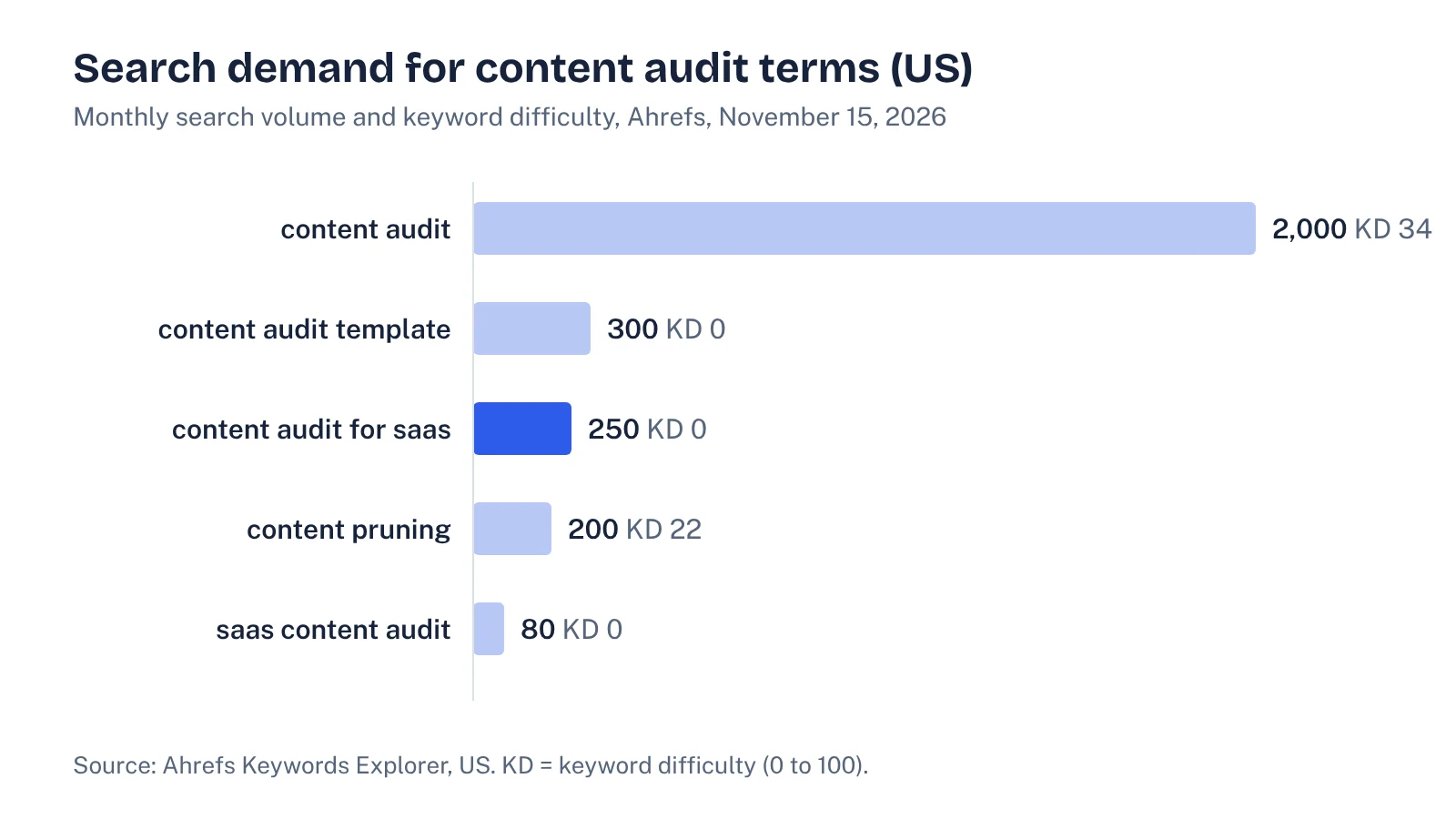
We pulled US data from Ahrefs Keywords Explorer on November 15, 2026. The head term is broad and competitive; the SaaS-specific terms are small but almost uncontested.
| Keyword (US) | Monthly volume | Keyword difficulty | AI Overview on the SERP? |
|---|---|---|---|
| content audit | 2,000 | 34 | Yes |
| content audit template | 300 | 0 | Yes |
| content audit for saas | 250 | 0 | Yes |
| content pruning | 200 | 22 | Yes |
| saas content audit | 80 | 0 | No (People Also Ask instead) |
Four of the five queries already trigger an AI Overview. For "content audit for saas", the Overview links to most of the top organic results, plus a Reddit thread and two YouTube videos. The ranking pages are mostly agency guides with a four-outcome framework and a template. Good ones mention AI search, usually as a manual spot check in ChatGPT or Perplexity. What we didn't find: a fixed decision order that puts AI citation value ahead of raw traffic, clear rules for redirect targets, or a way to compare results before and after against the same baseline.
Step 1: Build the inventory
Start with a complete list of indexable URLs. Your XML sitemap is a decent first pass; a crawler export is better because it also finds orphaned pages and stray parameters. Put one URL per row in a spreadsheet and add these columns:
- Page type: blog, comparison, alternatives, integration, use case, glossary, docs, landing page.
- Topic and target query: the one question the page exists to answer.
- Funnel stage: problem-aware, solution-aware, vendor comparison, customer.
- Owner: who can approve changes. Product marketing usually owns comparisons; the content team owns the blog.
- Last meaningful update: not the date in the CMS, the date the facts last changed.
Group rows by target query as you go. Two or more pages chasing the same question is the most common finding in SaaS audits, and it is where merges come from.
Step 2: Pull the signals that actually decide
Keep the signal set small. Every column you add is a column someone has to fill for hundreds of rows.
| Signal | Where it comes from | What it tells you |
|---|---|---|
| Clicks, last 3 months vs same period last year | Google Search Console | Whether demand for the page is growing or decaying |
| Average position and top query | Google Search Console | Whether it ranks for what it was written for |
| AI Overview on the top query | Ahrefs or Semrush SERP features, or a manual check | Whether low clicks reflect the page or the SERP |
| Cited by AI assistants | AI visibility tool or a fixed prompt set checked by hand | Value that never shows up as a click |
| Conversions and assisted conversions | GA4 or your CRM | Business value: demo requests, trials, sign-ups |
| Referring domains | Ahrefs, Semrush or similar | What you'd lose by cutting without a redirect |
| Used by sales | Ask the sales team | Value that analytics won't show |
The AI columns matter most for SaaS. A comparison page with flat organic clicks may be one of the pages ChatGPT cites when someone asks "X vs Y for a 20-person team". If you only look at Search Console, it looks like a candidate to cut. For a method to log citations consistently, see our guide to LLM citation tracking.
Step 3: Decide keep, fix, merge or cut
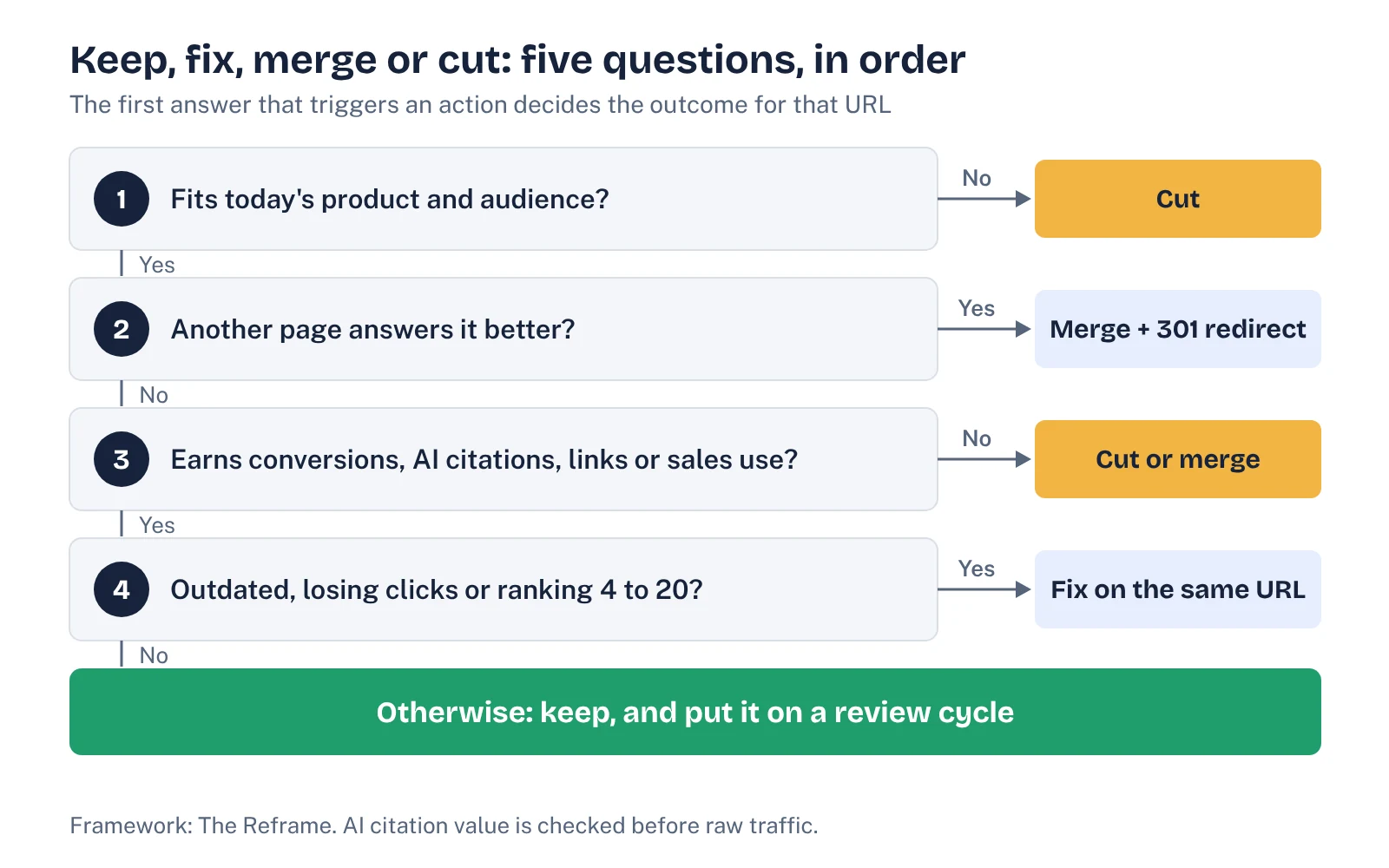
Ask the same questions in the same order for every URL. The first "no" decides the outcome, which keeps the audit consistent when several people are scoring pages.
- Does the page fit the product and audience you serve today? If it promotes a retired feature, a market you left, or a topic your buyers never search, it is a cut candidate.
- Does another page answer the same question better? If yes, merge this one into it and redirect.
- Does it earn something: conversions, AI citations, backlinks, or sales use? If none of these, and clicks are falling, cut or merge.
- Is it outdated, losing clicks, or ranking between positions 4 and 20? If yes, fix it on the same URL.
- Otherwise, keep it and put it on a review cycle.
Note the order. AI citation value comes before raw performance, so a cited page with weak traffic lands in "fix" or "keep", not "cut". And a page whose top query now shows an AI Overview gets judged on conversions and citations, because its click ceiling dropped for reasons that have nothing to do with the page.
How to carry out each decision safely
Fix
Update the page where it lives. Correct facts, answer the target question in the first two or three sentences, add what the current top results cover that you don't, and add something they lack, such as your own data. Freshness from maintenance matters for AI answers: in Seer Interactive's 2026 recency study, 72% of 4,124 AI-cited pages had been updated in the past year, but only 42% were first published in that window. Our content refresh guide covers what counts as a real update and how to prioritize the fix list.
Merge
Pick the strongest URL as the survivor: usually the one with the most referring domains, conversions or citations. Move the best unique material from the other pages into it, then add permanent (301) redirects from the old URLs to the survivor. Update internal links so they point straight at the survivor instead of through a redirect.
Cut
Cutting means a redirect to the most relevant remaining page, or a 404/410 when nothing relevant exists. Google's site move documentation recommends server-side permanent redirects mapped to the most relevant new URL, and warns: "Don't redirect many old URLs to one irrelevant single URL destination, such as the home page." The same logic applies inside one site.
Don't cut for age alone. When CNET deleted thousands of old pages, Google's Search Liaison responded: "Are you deleting content from your site because you somehow believe Google doesn't like 'old' content? That's not a thing!" He added that removal may help very large sites get other pages crawled. Most SaaS blogs are not that large, so for them cutting is about focus and accuracy, not a ranking trick.
See your own AI visibility, free
Get a one-page audit of how ChatGPT, Perplexity and Gemini treat your brand against up to three competitors, plus your biggest gap. In your inbox within 48 hours.
Get my free auditStep 4: Roll out in batches and measure against a baseline
Changing 200 URLs in one week makes it impossible to tell what worked. Ship in batches and record the baseline before each one.
- Snapshot clicks, impressions, average position and conversions for every URL in the batch, plus citations from your prompt set.
- Ship merges and redirects first, then fixes. Cuts last, after you've confirmed nothing valuable points at them.
- Check redirects return a single 301 hop to a live 200 page. Remove cut and redirected URLs from the XML sitemap.
- Re-measure four to eight weeks later with the same date length and the same prompts. Compare the batch as a group, not page by page, because small pages swing a lot.
- Write down what you changed and when, so the next audit starts from facts rather than memory.
If your audit also needs to show leadership how often assistants recommend you versus competitors, that's a different measurement. Our guide to running an AI visibility audit covers prompt sets, share of voice and a free template you can pair with this content inventory.
How often to audit, and who should own it
For most SaaS blogs under a few hundred posts, one full audit a year is enough. Run a lighter quarterly pass on the pages closest to revenue: pricing, comparisons, alternatives, integrations and the handful of posts that drive demo requests. Re-audit sooner after a pricing change, a rebrand, a big product launch or a sharp traffic drop.
Give the audit one owner, usually the head of content or SEO lead, and give product marketing a veto on comparison and pricing pages. The common failure isn't a bad decision on one URL. It's a spreadsheet that gets scored and never shipped.
SaaS content audit checklist
- Full URL inventory from a crawl, with page type, target query, funnel stage and owner.
- Duplicate target queries grouped, with one survivor chosen per group.
- Search Console clicks year over year, average position and top query per URL.
- AI Overview presence noted for each top query.
- AI citations logged from a fixed prompt set.
- Conversions, referring domains and sales usage added.
- One decision per URL using the five questions, in order.
- Redirect map: every merged or cut URL points to its most relevant replacement.
- Baseline snapshot saved before each batch; re-check scheduled four to eight weeks out.
FAQ
How often should a SaaS company run a content audit?
A full audit once a year is enough for most SaaS blogs under a few hundred posts. In between, run a lighter quarterly check on your highest-value pages: pricing, comparisons, integrations and the posts that drive demo requests.
Should I delete old blog posts to improve SEO?
Not by default. Google's Search Liaison has said deleting content because it is old is 'not a thing' Google rewards. Cut pages that no longer fit your product or audience, and merge overlapping ones into a stronger page with a 301 redirect.
What is the difference between a content audit and a content refresh?
An audit is the diagnosis: you review every page and decide what happens to it. A refresh is one of the treatments, used on pages marked 'fix'. Merging, redirecting and cutting are the others.
Do I need paid tools for a SaaS content audit?
No. A crawler export or sitemap, Google Search Console, GA4 and a spreadsheet cover the basics. Paid SEO and AI visibility tools save time on backlinks, keyword overlap and citation tracking, especially past a few hundred URLs.
Is a content audit the same as an AI visibility audit?
No. A content audit judges your own pages. An AI visibility audit measures how often assistants like ChatGPT, Gemini and Perplexity mention and cite your brand across a set of buyer prompts, including on third-party sites.
Sources
- Ahrefs: Update: AI Overviews reduce clicks by 58% (Ryan Law and Xibeijia Guan, February 4, 2026)
- Search Engine Land: Google warns against content pruning as CNET deletes thousands of pages (quotes Google's Search Liaison)
- Google Search Central: How to move a site (URL mapping and permanent redirects)
- Seer Interactive: Study: Content recency's impact on AI visibility in 2026 (July 24, 2026)
- Ahrefs Keywords Explorer and SERP overview, US data pulled November 15, 2026