Content refresh for AI search: which B2B SaaS pages to update first and how to prove it worked

A content refresh is a substantial update to a page that already exists: new facts, current screenshots and prices, better answers, and an honest new last-updated date. In AI search it matters because assistants mostly cite pages that were updated recently, even when they were first published years ago. This guide shows which B2B SaaS pages to refresh first, what counts as a real update, and how to prove it worked.
- In Seer Interactive's 2026 study, 72% of AI-cited pages had been updated in the past year, but only 42% were first published in that time. Freshness comes from maintenance.
- ChatGPT, Gemini and Perplexity lean fresher than classic Google results. Google's AI Overviews do not, per Ahrefs' 17-million-citation study.
- Prioritize by business value times decay signals: pricing, comparison, integration and best-of pages usually come first.
- Only change the date when the content has substantially changed. Google lists fake freshness as a warning sign.
- Measure each refresh against a fixed prompt set and Search Console baseline taken before you edit.
What a content refresh is (and what it isn't)
A content refresh is a substantial update to a page you already have. You correct facts that have gone stale, add what the page was missing, tighten the answer to the question it targets, and then change the last-updated date because the page really is different.
It is not a new post on the same topic, a cosmetic rewrite, or a date bump. It is also not Google's Refresh Outdated Content tool, which ranks second for "content refresh" in the US. Google says that tool is for people who don't own a page and want old search results updated after the page was removed or changed. Site owners use Search Console, and the tool can't be used to request a recrawl.
For B2B SaaS teams the stakes are higher than a traffic graph. Buyers now ask ChatGPT, Gemini and Perplexity which tools fit their team. The answers lean on pages that were updated recently. If your pricing page, comparison pages and integration docs describe last year's product, assistants either repeat old facts or cite someone else's newer page about you.
What the data says about freshness and AI citations
Two large studies point in the same direction, with one important exception.
Seer Interactive's 2026 study looked at 7,683 dated pages that earned 47,097 citations in non-branded ChatGPT, Gemini and Perplexity answers between March and June 2026. 75% of the cited pages had been updated within the past year and 88% within two years. The more useful finding came from a subset of 4,124 pages where both dates were readable: 72% looked fresh by last update, but only 42% had been first published in the past year. In Seer's words, "The freshness LLMs reward is being manufactured by updates, not by new publishing."
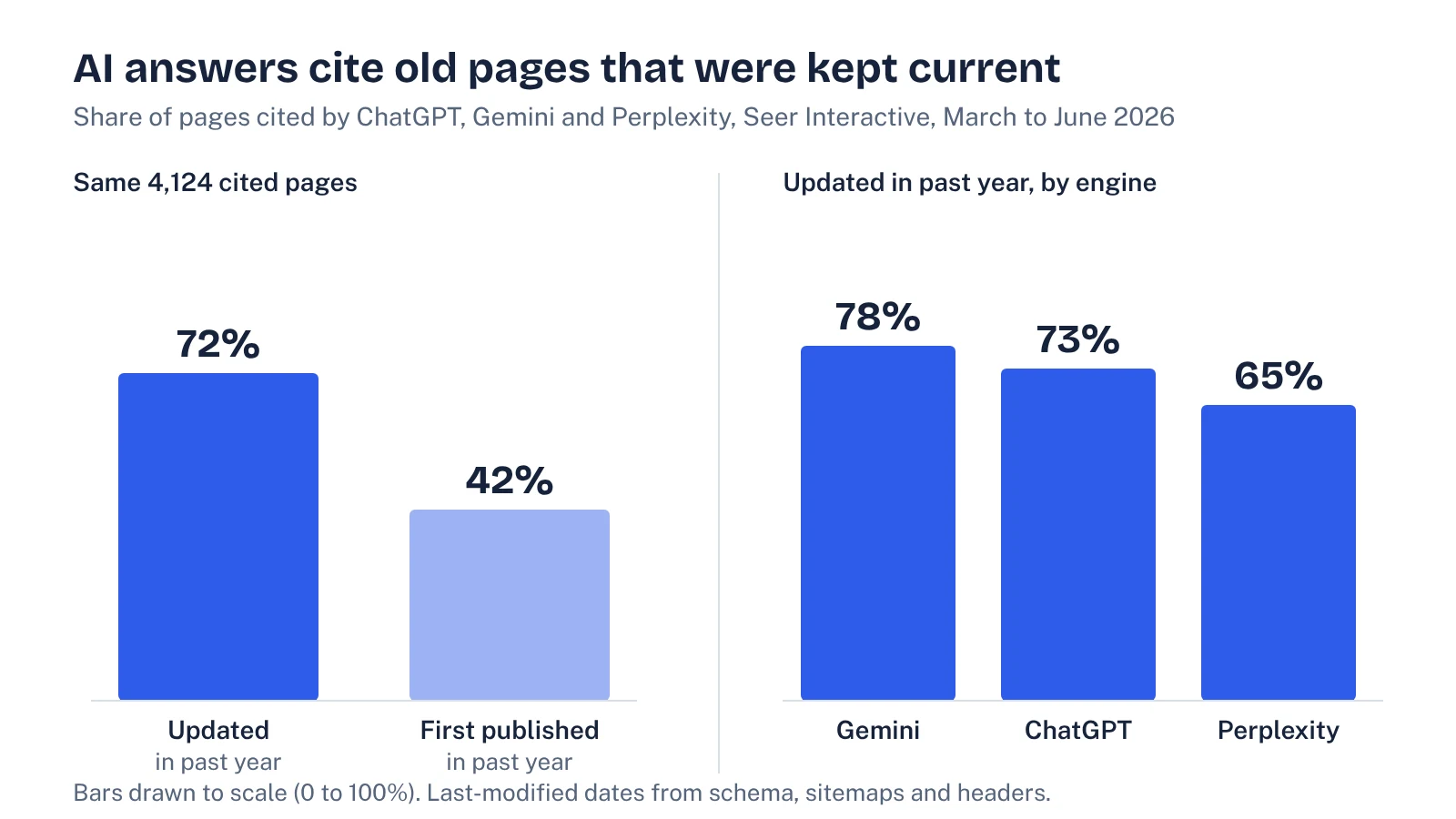
The engines differ. Gemini cited the freshest set (78% updated within a year), then ChatGPT (73%) and Perplexity (65%), which cites more older reference material. Seer also found that pages cited in all four months of the study had a median update age of about half a year, while pages that spiked for a single month were much newer. Steady citations come from established pages that are maintained.
Ahrefs' study of about 17 million citations (July 2025) found the same pattern against a classic search baseline: pages cited by AI assistants were on average 25.7% newer than pages ranking in organic Google results. ChatGPT showed the strongest preference for newer content. The exception was Google's AI Overviews, which cited slightly older content than the organic results. So freshness helps most in the standalone assistants, and less in Google's own AI features, where normal ranking signals still dominate.
What people search for, and what the top results miss
We pulled these numbers from Ahrefs Keywords Explorer this morning (US, November 12, 2026):
| Query | US monthly searches | Keyword difficulty |
|---|---|---|
| content freshness seo | 450 | 16 |
| content refresh | 300 | 9 |
| content decay | 150 | 2 |
| refresh content | 150 | 5 |
| content refresh seo | 100 | not yet scored |
| content refresh ai | 100 | not yet scored |
| content refresh strategy | 90 | 8 |
The results page for "content refresh" shows an AI Overview, a People Also Ask box and a mix of agency and tool vendor guides. The best of them, like Animalz's refresh strategy guide, already track SEO decay and AI citations side by side. What they mostly skip is how to rank pages by business value rather than traffic, what counts as a real update, and how to measure the result in AI answers instead of saying "track citations". That is the focus here.
Which B2B SaaS pages to refresh first
Traffic is a weak guide for SaaS. Your highest-traffic posts are often top-of-funnel explainers, while the pages that shape buying decisions get modest traffic and heavy AI use. Score each candidate on two things.
Business value (1 to 3)
How close is the page to a buying decision? Pricing, comparison, alternatives, integration, security and "best tools for X" pages score 3. Use-case and solution pages score 2. General educational posts score 1.
Decay signals (count them)
- A fact on the page is now wrong: price, plan limits, feature names, screenshots, integrations, competitors' offers.
- Last real update is more than 12 months ago (Seer's data suggests most cited pages fall inside that window).
- Search Console clicks fell by a fifth or more over 90 days while impressions held or fell.
- The page lost AI mentions or citations on the prompts it should win.
- Assistants describe your product with outdated or wrong details that trace back to this page.
Multiply value by the number of signals and sort. A pricing page with two signals (score 6) goes ahead of a popular glossary post with three (score 3).
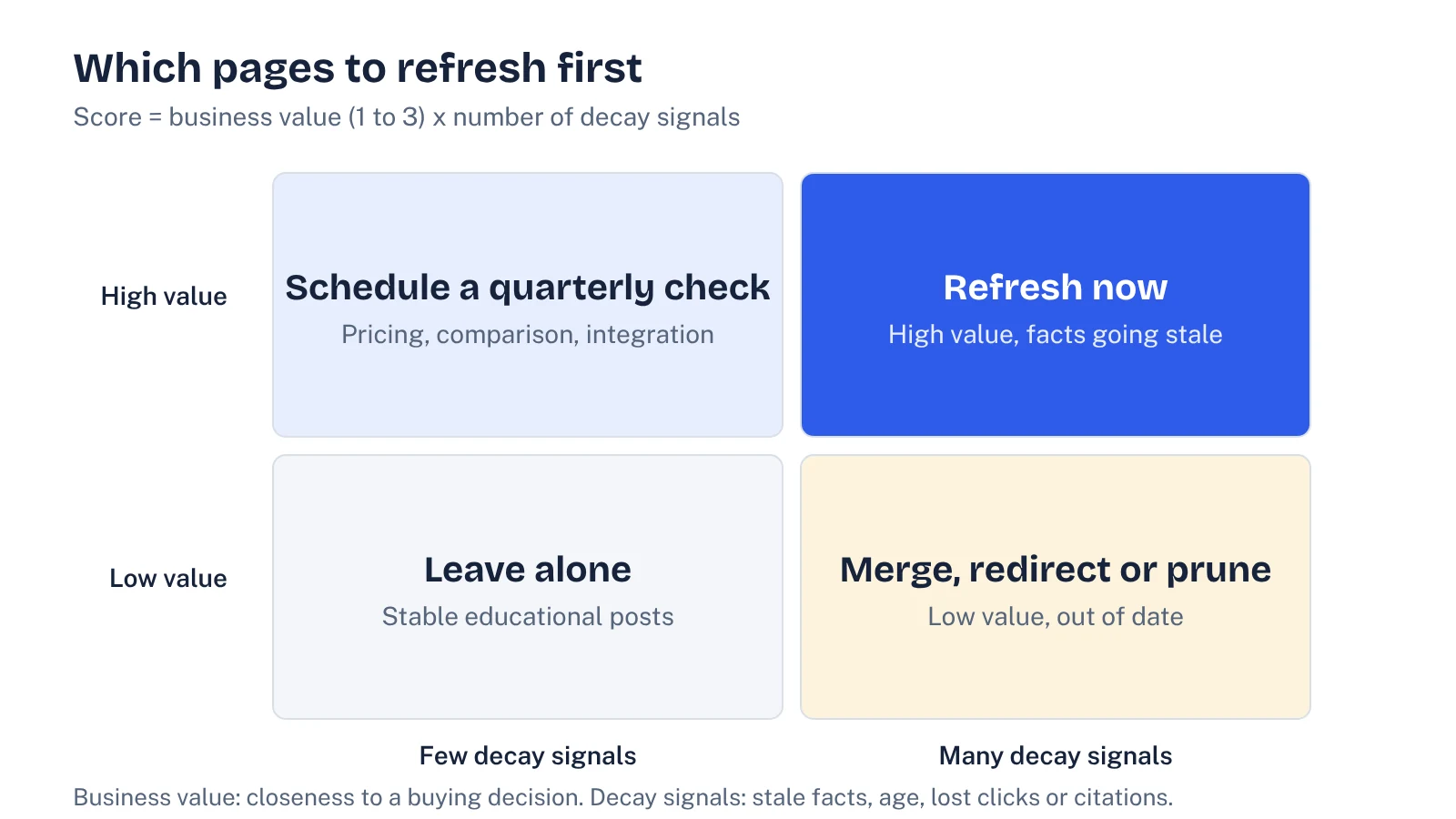
If you need a baseline for the "lost citations" signal, start with a fixed set of buyer prompts and run them before you change anything. Our guide to running an AI visibility audit includes a free template for exactly this.
Pages in the "merge, redirect or prune" corner need a different process from a refresh. Our content audit for SaaS walks through how to decide keep, fix, merge or cut for every URL and how to redirect safely.
What counts as a real update
Google is explicit on one point. Its helpful content guidance, quoted here by Search Engine Journal, asks: "Are you changing the date of pages to make them seem fresh when the content has not substantially changed?" A date bump without real changes is a warning sign, and assistants that compare your page to others gain nothing from it either.
| Change | Real update? | Change the date? |
|---|---|---|
| Fix typos, swap a stock image, reword a sentence | No | No |
| Update prices, plan limits or feature names | Yes | Yes |
| Add a new section that answers a question buyers now ask | Yes | Yes |
| Replace outdated screenshots and steps after a product release | Yes | Yes |
| Add current first-party data, examples or customer-facing specifics | Yes | Yes |
| Change the year in the title and nothing else | No | No |
When you do change the date, follow Google's publication date guidance: show a labeled date on the page (for example "Last updated"), mark it up with datePublished and dateModified on an Article or BlogPosting type, and make sure the visible date and the markup match. Google also suggests removing competing dates if it picks the wrong one. Our post on schema markup for AI search covers the markup side.
A seven-step content refresh process
- Baseline first. Before editing, record Search Console clicks and impressions for the page (last 28 days), and run 5 to 10 buyer prompts in ChatGPT, Gemini and Perplexity. Note whether you are mentioned, cited and described correctly. Run each prompt more than once, since answers vary.
- Check the facts. List every claim on the page that can change: prices, limits, integrations, competitor details, dates, statistics. Verify each against the source of truth (product, pricing page, the original study).
- Read today's answers. Look at what assistants say for your prompts and which pages they cite. The gaps between their answer and your page tell you what to add.
- Fix the opening. Make the first two or three sentences answer the page's main question directly with current specifics. This is the part answers lift most easily. Our AI content optimization guide shows a before-and-after rewrite.
- Add what's new. New features, new use cases, a current example, fresh data you own. Remove sections that no longer apply rather than leaving them to contradict the rest.
- Update dates and links. Change the visible date and
dateModifiedtogether. Update internal links that point to retired pages, and add a link from one or two related pages to the refreshed one. - Request recrawl and log it. Use URL Inspection in Search Console to request indexing, and log the refresh date, what changed and the baseline in one sheet.
See your own AI visibility, free
Get a one-page audit of how ChatGPT, Perplexity and Gemini treat your brand against up to three competitors, plus your biggest gap. In your inbox within 48 hours.
Get my free auditHow to prove a refresh worked
Most refresh guides stop at "monitor results". For AI search you need a before-and-after comparison on the same prompts, because answers shift from run to run.
| Metric | Where | When to compare |
|---|---|---|
| Mentions and citations on your fixed prompt set | Manual runs or a prompt tracker | Weekly for 6 to 8 weeks after the refresh |
| Accuracy of how assistants describe you | Same prompt runs, scored right or wrong per fact | Same as above |
| Clicks, impressions and position | Search Console page report | 28 days before vs 28 days after recrawl |
| AI referral visits and conversions | Analytics, segmented by assistant referrer | Monthly |
Keep the prompts, engines and run count identical between baseline and follow-up, or the comparison means nothing. If you track at scale, our guides to LLM citation tracking and tracking AI traffic in analytics cover the setup.
Expect noise. One refreshed page rarely moves totals on its own, and Google has to recrawl before anything changes. Judge your refresh program on a batch of pages over a quarter, not one page over a week.
A refresh cadence that fits a small team
- Monthly (1 to 2 hours): scan Search Console for pages with falling clicks and run your core prompts. Add anything flagged to the backlog.
- Quarterly: check every page with a value score of 3. Prices, plans and competitor details change fastest.
- Annually: review every page that still earns traffic or citations. Refresh, merge or retire it.
- On every product release: list the pages that mention the changed feature and update them in the same sprint.
The point of the cadence is the same as Seer's conclusion: "Publish and forget loses. Publish and maintain wins." For most SaaS sites, keeping 20 decision pages current does more for AI visibility than publishing 20 new posts.
Content refresh checklist
- Baseline recorded (Search Console plus prompt runs).
- Every changeable fact verified against its source.
- Opening answers the main question with current specifics.
- New sections added, outdated ones removed.
- Visible date and
dateModifiedupdated together, only for a substantial change. - Internal links checked, one or two new links pointing in.
- Recrawl requested and the refresh logged with a follow-up date.
FAQ
What is a content refresh?
A content refresh is a meaningful update to an existing page rather than publishing a new one. It usually means correcting outdated facts, adding new information or examples, improving how clearly the page answers its main question, and updating the visible last-updated date and dateModified markup to match.
How often should you refresh content for AI search?
There is no fixed rule. In Seer Interactive's 2026 study, 75% of pages cited by ChatGPT, Gemini and Perplexity had been updated within a year, so an annual review is a sensible minimum for pages that matter. Pricing, comparison and best-of pages often need a quarterly check because the facts on them change faster.
Does changing the date on a page help it get cited?
Not on its own, and it can backfire. Google's helpful content guidance asks whether you are changing dates to make pages seem fresh when the content has not substantially changed. Update the date when you have made a real change, and keep the visible date and structured data consistent.
What is content decay?
Content decay is the gradual loss of traffic, rankings or citations on a page over time. It happens when competitors publish better pages, search intent shifts, or the page's facts go out of date. In AI search, decay can also show up as fewer mentions or citations in assistant answers while Google rankings stay flat.
Is Google's Refresh Outdated Content tool for updating my own pages?
No. Google says that tool is for people who do not own a page and want search results updated after the page was removed or significantly changed. Site owners should use Search Console instead, and the tool cannot be used just to request a recrawl.
Sources
- Seer Interactive: Study: Content recency's impact on AI visibility in 2026 (July 24, 2026)
- Ahrefs: New study: AI assistants prefer to cite fresher content (17 million citations analyzed)
- Google Search Central: Influence your publication dates in Google Search
- Search Engine Journal: Google clarifies how the helpful content system works (quotes Google's date guidance)
- Google Search Help: Refresh Outdated Content tool
- Animalz: Content refresh strategy
- Ahrefs Keywords Explorer and SERP overview, US data pulled November 12, 2026