Thought leadership strategy for B2B SaaS: how to build ideas buyers and AI assistants quote

A thought leadership strategy is a plan for owning a few clear, evidence-backed points of view that your buyers act on. For B2B SaaS in 2026 that means original data and named experts, packaged so AI assistants can quote you, because most buyers now read thought leadership through an AI summary first. This guide covers the new buyer data, a five-part framework, the formats that get cited and how to measure it.
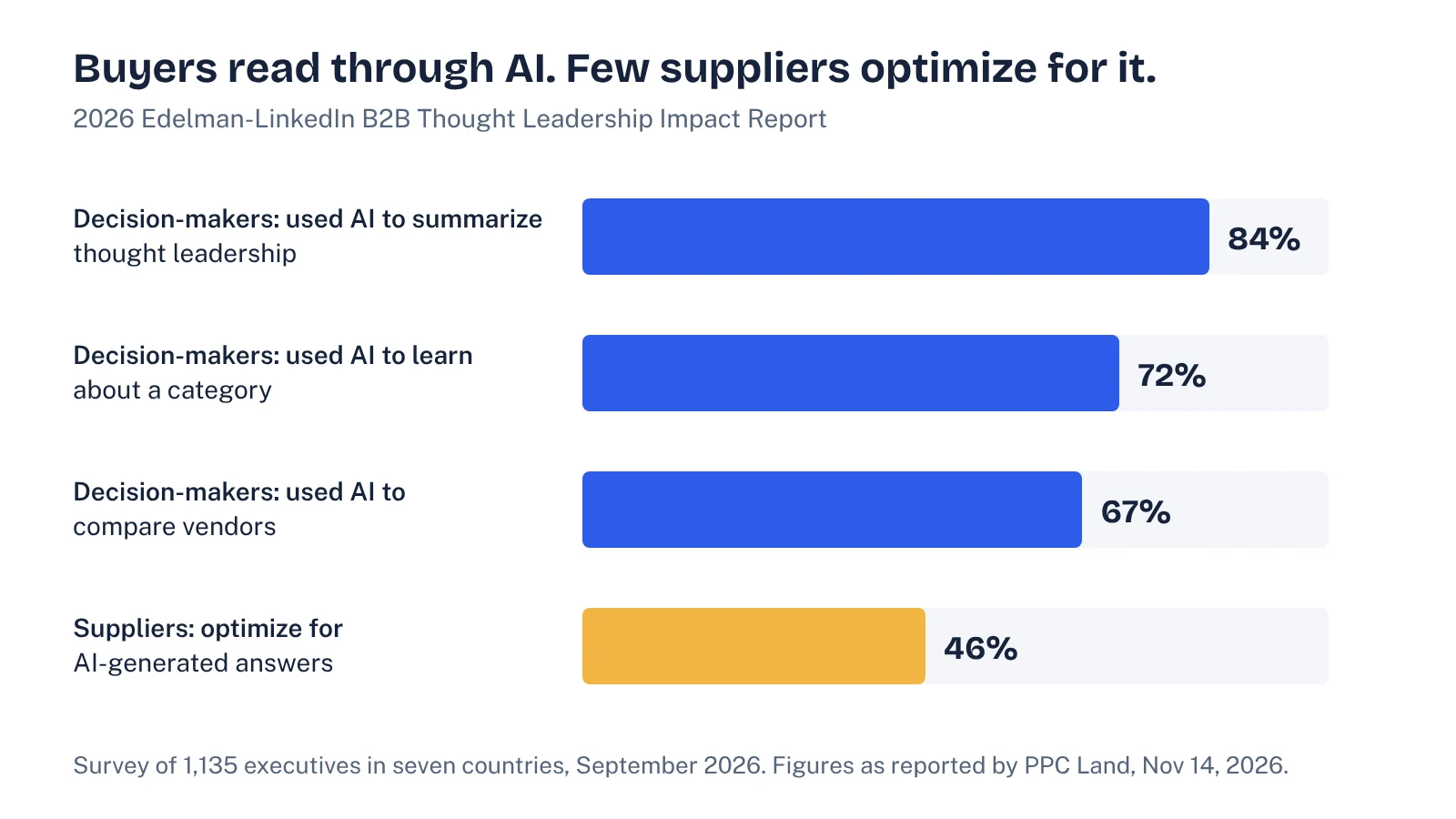
- In the 2026 Edelman-LinkedIn report, 84% of B2B decision-makers said they used AI to summarize thought leadership, and 59% of final decision-makers said weak or missing thought leadership helped get a vendor removed.
- Only 46% of thought leadership suppliers in the same study said they optimize for AI-generated answers, so there is a real gap to close.
- Build the strategy around two or three points of view, each backed by proof you own: original data, customer evidence or a named expert's method.
- Package every idea as a citable page: a one-sentence claim, the number, the method and the date, so an assistant can lift it accurately.
- Measure it with a fixed prompt set (are you named and cited?), branded search, sales conversations and shares, not page views alone.
What a thought leadership strategy is, and what AI changed
A thought leadership strategy answers four questions: which ideas you want to be known for, what evidence makes those ideas believable, who says them, and where buyers will run into them. Everything else, from the editorial calendar to the LinkedIn cadence, follows from those answers.
Most B2B SaaS teams skip the first two. They publish opinions on whatever is trending, attach the CEO's name and call it thought leadership. Buyers have always been able to tell the difference. Now AI assistants can too, and they sit between your content and a growing share of your buyers.
That last part is the real change. A buyer used to find your report, read it, and maybe forward it. Today the same buyer is likely to ask ChatGPT, Perplexity or Google's AI Mode to summarize what the market thinks about a problem. The assistant reads dozens of pages and repeats a handful of claims. If your idea is one of them, with your name attached, you have done the job. If your article was 2,000 words of agreeable opinion with no claim worth repeating, it disappears into the summary.
So a thought leadership strategy for 2026 has to work for two readers: the human expert who decides whether you are credible, and the machine that decides whether you are quotable.
What the 2026 buyer data says
The 2026 Edelman-LinkedIn B2B Thought Leadership Impact Report, published this month, is the eighth edition of the study. It surveyed 1,135 executives across seven countries in September 2026. The headline numbers below come from PPC Land's breakdown of the report; the 84% and 59% figures are also confirmed in ContentGrip's coverage.
| Finding (2026 Edelman-LinkedIn report) | Share | What it means for your strategy |
|---|---|---|
| Used an AI assistant or AI search to summarize thought leadership | 84% | Your ideas get read through a summary first. Make the core claim easy to lift. |
| Used AI to compare vendors or approaches | 67% | Assistants are now part of the shortlist. Being cited is a sales outcome. |
| Researched the company when AI cited its thought leadership | 78% | A citation sends people to you. It is worth tracking like a referral. |
| Final decision-makers who said weak or missing thought leadership helped remove a vendor | 59% | Silence is not neutral. It can cost you a place on the list. |
| Named original research or data as thought leadership's most important role | 57% | Proof beats opinion. Plan the data before the content. |
| Thought leadership suppliers who optimize for AI-generated answers | 46% | Fewer than half of your competitors are doing this on purpose. |
The gap between the first row and the last row is the opportunity. Buyers have moved to AI-assisted reading. Most publishers have not adjusted what they produce.
Two caveats. These are self-reported survey answers, not measured behavior, and the report gives seven-country averages without a country breakdown. Treat them as a strong signal about direction, not a precise forecast for your market.
What people search for, and what the top results miss
We pulled US data from Ahrefs Keywords Explorer on November 19, 2026. Demand is spread across many phrasings, difficulty is low to moderate, and Google shows an AI Overview for most of the strategy and content terms.
| Keyword (US) | Monthly volume | Keyword difficulty | AI Overview on SERP |
|---|---|---|---|
| what is thought leadership | 1,400 | 14 | n/a |
| thought leadership strategy | 700 | 10 | Yes |
| thought leadership content | 600 | 18 | Yes |
| thought leadership marketing | 450 | 26 | Yes |
| b2b thought leadership | 200 | 16 | Yes |
| b2b thought leadership marketing | 150 | 24 | No |
| how to measure thought leadership | 70 | 2 | n/a |
The pages ranking for "thought leadership strategy" today are mostly agency and publisher guides with sensible steps: define your audience, find your expertise, pick channels, be consistent. What they rarely cover is how buyers now consume the content through AI, how to structure an idea so it survives summarization, and how to measure anything beyond engagement. That is what the rest of this guide focuses on.
A five-part thought leadership strategy
This framework works for a SaaS company of almost any size. A seed-stage team might run one point of view a year. A growth-stage team might run three. The parts are the same.
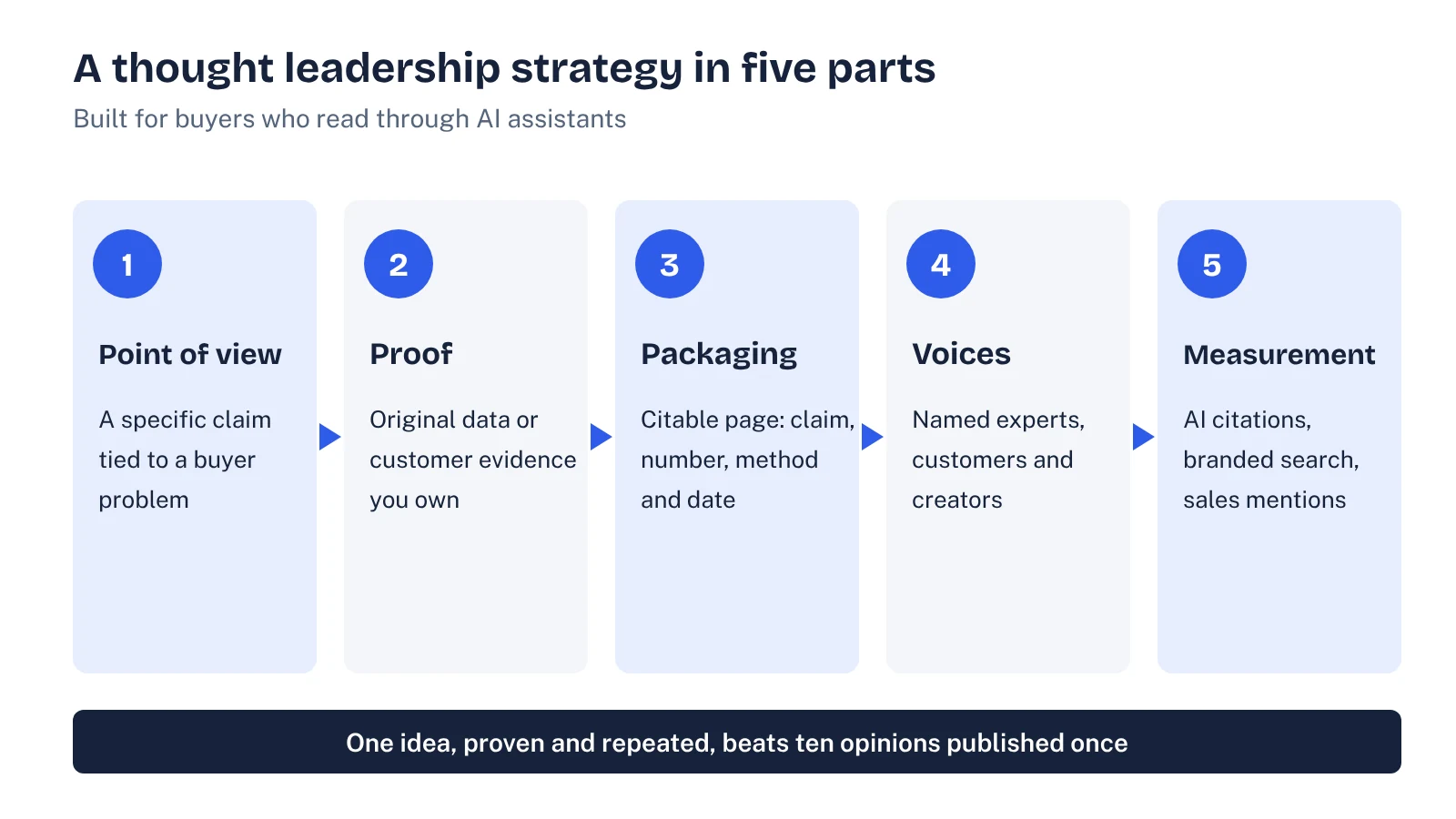
- Point of view. Pick two or three claims tied to problems your product solves. A good claim is specific and arguable: "Most SaaS onboarding emails are sent too early" is a point of view; "Onboarding matters" is not. The 2026 Edelman-LinkedIn report found that content showing an understanding of buyers' challenges was the top trust driver, chosen by 56%, far ahead of product strength at 14%.
- Proof. Decide what evidence you own. For SaaS this is usually aggregate product data, a survey of your users or category, customer outcomes you can name, or a method your team has used many times. Google's own helpful content guidance opens its quality questions with: "Does the content provide original information, reporting, research, or analysis?"
- Packaging. Turn each idea into a hub page that states the claim in one sentence near the top, gives the number, explains how you got it and shows the date. Then derive the smaller pieces: a LinkedIn post, a carousel, a talk, a sales one-pager. One idea, many formats.
- Voices. Decide who says it. Name a real expert as author, with a bio that explains why they know. Then get the idea repeated by people buyers trust more than vendors: customers, independent creators and analysts. In the same report, 81% said trusted outside amplification strongly increases their view of a company's credibility.
- Measurement. Agree on the signals before you publish (more on this below), so the program is judged on whether buyers and assistants start repeating your idea, not on likes.
If you already have a content program, this does not replace it. It sits on top. Your SaaS content marketing still handles demand capture with comparison, integration and how-to pages. Thought leadership is the smaller set of pieces that make people remember why your company exists.
Formats AI assistants cite, and formats they skip
AI assistants assemble answers from passages. A passage gets used when it states something clearly, can be attributed, and adds something the other sources do not. The research behind generative engine optimization, Aggarwal and colleagues' GEO paper, reported that content changes could raise a source's visibility in generative engine answers by up to 40% on its benchmark, with results varying by domain. The practical lesson for thought leadership is to make every piece contain at least one passage that is worth quoting.
| Format | Why it gets cited (or doesn't) | Verdict |
|---|---|---|
| Original benchmark or survey with a method section | Unique numbers, clear attribution, easy to quote with a date | Build first |
| Named framework or method with defined steps | Gives assistants a structure to describe, tied to your name | Build first |
| Data-backed contrarian essay | Adds a distinct angle the consensus sources lack | Build selectively |
| Expert commentary on fresh news | Useful while the story is live; fades fast | Build selectively |
| Gated PDF with no public summary | Crawlers and assistants cannot read what is behind the form | Fix: publish a summary page |
| Opinion piece with no evidence | Repeats what everyone says; nothing to attribute | Skip |
Gating deserves a special note. Many B2B teams lock their best research behind a form. Keep the form if you need the leads, but publish an ungated page with the key findings, the method and three or four charts. That page is what assistants, journalists and other bloggers will cite, and it is where your brand mentions in AI answers start.
See your own AI visibility, free
Get a one-page audit of how ChatGPT, Perplexity and Gemini treat your brand against up to three competitors, plus your biggest gap. In your inbox within 48 hours.
Get my free auditHow to measure thought leadership
"How to measure thought leadership" has almost no competition in Ahrefs (KD 2), which tells you how rarely anyone writes about it seriously. Page views undercount impact, because a buyer who reads an AI summary of your report never visits it. Use four signals instead.
- AI citations on a fixed prompt set. Write 20 to 30 buyer questions related to your points of view, run them monthly in ChatGPT, Perplexity, Gemini and Google AI Mode, and record whether you are named and which page is cited. Our prompt research guide shows how to choose the questions, and the free AI visibility audit template gives you a sheet to log the results.
- Branded search. Track branded search demand and searches for the name of your framework or report. In Ahrefs' study of 75,000 brands, branded web mentions (0.664) and branded search volume (0.392) correlated more closely with AI Overview visibility than Domain Rating (0.326). Correlation, not causation, but they move together.
- Sales mentions. Add a field to your CRM or call notes: did the prospect mention a piece of our content? Ask in discovery calls where they first heard about you. This is the closest thing to attribution you will get.
- Shares and citations. Count other publishers that cite your data, plus shares by people in your target accounts. The Edelman-LinkedIn report found the top reason buyers share thought leadership internally is useful data or research (73%).
Set a baseline before you publish. Without one, you will not be able to tell whether a citation in month three is new or was already there. If you want a fuller view of how authority builds over time, our guide to brand authority for B2B SaaS covers the longer-term signals.
A 90-day plan for one point of view
| Weeks | Work | Output |
|---|---|---|
| 1 to 2 | Pick the claim. List buyer questions. Run your baseline prompt set. Check what data you already have. | One-sentence point of view, baseline sheet |
| 3 to 6 | Collect or analyze the proof: product data, a short survey, or five to ten customer interviews. | Dataset with a written method |
| 7 to 8 | Publish the hub page with the claim, numbers, charts, method and named author. | Ungated, citable hub page |
| 9 to 12 | Derive LinkedIn posts, a carousel, a webinar or podcast slot, and pitch the data to two or three trade publications and creators. | Derivative assets, outside mentions |
| 13 | Rerun the prompt set. Compare branded search and sales mentions with the baseline. | Before-and-after report |
Common mistakes to avoid
- Too many ideas. Ten points of view means none of them sticks. Start with one, prove it, then add the next.
- Ghostwritten with no real expert. If the named author could not defend the piece on a sales call, buyers will notice. Interview the expert and keep their wording.
- Data with no method. A number without a sample size and date is hard for a journalist to cite and easy for a buyer to dismiss.
- Publishing once. Thought leadership compounds when you repeat the same idea with new evidence. Plan an annual update of your best data piece.
- Measuring likes. Engagement tells you a post was interesting. It does not tell you a buyer or an assistant now associates the idea with you.
The short version: pick fewer ideas, back each one with proof only you have, make the key claim easy to quote, and measure whether the market repeats it. That is a thought leadership strategy that works for human buyers and the AI assistants they now read through.
FAQ
What is a thought leadership strategy?
It is a plan for which ideas your company will be known for, what evidence backs them, who says them and where. A good one picks two or three points of view tied to the problems your product solves, and commits to proving them over time rather than publishing opinions at random.
How do you build a thought leadership strategy for B2B SaaS?
Start from the buyer problems your product is closest to, then choose a point of view you can defend with evidence you own, such as product data, survey results or customer outcomes. Package each idea as a page with a clear claim, number and method, distribute it through people buyers trust, and track whether buyers and AI assistants start repeating it.
How do you measure thought leadership?
Combine four signals: how often AI assistants name and cite you on a fixed set of buyer prompts, branded search demand, mentions of your content in sales calls and deal notes, and shares or citations by other publishers. Page views alone undercount it, because many buyers now read a summary from an AI assistant instead of visiting the page.
Does thought leadership help with AI search visibility?
It can. In Ahrefs' study of 75,000 brands, branded web mentions were the factor most closely correlated with appearing in AI Overviews, and original research is one of the most reliable ways to earn those mentions. That is a correlation, not a guarantee, so treat it as a reason to measure, not a promise.
What are examples of thought leadership content?
Original research reports and benchmarks, a named framework or method, a contrarian essay backed by data, teardown analyses of how a process works, and expert commentary on industry news. For SaaS, product usage benchmarks and anonymized aggregate data are often the strongest because nobody else has them.
Sources
- Edelman and LinkedIn: 2026 B2B Thought Leadership Impact Report (1,135 executives in seven countries, fieldwork September 2026)
- PPC Land: 82% of B2B buyers value thought leadership more as AI spreads, Edelman finds (Luis Rijo, November 14, 2026)
- ContentGrip: Edelman finds 84% of B2B buyers use AI to summarize thought leadership (Lena Marlowe, November 11, 2026)
- Ahrefs: An analysis of AI Overview brand visibility factors (75K brands studied), Louise Linehan
- Google Search Central: Creating helpful, reliable, people-first content
- Aggarwal et al.: GEO: Generative Engine Optimization (arXiv 2311.09735, KDD 2024)
- Ahrefs Keywords Explorer and SERP overview, US data pulled November 19, 2026