Brand authority for B2B SaaS: how to build it and measure it when AI assistants pick the shortlist
Brand authority is how much buyers, publishers and machines trust your brand as a credible answer in your category. In AI search it shows up as one thing: whether ChatGPT, Gemini and AI Overviews name you when buyers ask for options. This guide covers the signals that track it most closely, a build plan, and a scorecard to measure it.
- In Ahrefs' study of 75,000 brands, branded web mentions correlated with AI visibility far more strongly (0.66 to 0.71) than Domain Rating (0.27 to 0.33).
- Brand authority is not one metric. Treat it as four layers: clear identity, third-party mentions, proof, and being chosen in AI answers.
- Earn mentions where your buyers already read: review sites, YouTube, communities, partner pages and industry press.
- Measure it with a fixed prompt set, a mention count and branded search demand, checked on the same dates every quarter.
- Domain authority predicts ranking potential. Brand authority predicts whether you get named.
What brand authority means for a SaaS company
Brand authority is the trust your brand has earned as a credible answer in its category. It lives in other people's heads and other people's pages: the analyst who names you in a roundup, the Reddit thread where a customer recommends you, the G2 grid, the YouTube review, the buyer who types your name straight into Google.
For a long time marketers treated it as a soft, hard-to-measure idea that sat next to SEO. That changed when AI assistants started writing the shortlist. When a buyer asks ChatGPT or Google's AI Mode "what are the best tools for X", the answer is built from what the web says about each brand. If the web rarely mentions you, you are rarely named, however well your own pages rank.
So in 2026 a useful working definition for a SaaS team is simple: brand authority is the likelihood that a buyer, a journalist or an AI system names you when your category comes up.
What people search for, and what the top results miss
We pulled US data from Ahrefs Keywords Explorer on November 16, 2026. The head term is modest and not very competitive, and a cluster of SEO and AI variants has appeared around it.
| Keyword (US) | Monthly volume | Keyword difficulty |
|---|---|---|
| brand authority | 900 | 19 |
| building brand authority seo | 350 | 0 |
| what is brand authority | 150 | 9 |
| brand authority seo | 150 | not yet rated |
| what are brand authority signals? | 150 | not yet rated |
| how to measure brand authority | 100 | 11 |
| ai brand authority | 100 | 2 |
Google already shows an AI Overview for "brand authority". Below it, the organic top 10 is led by Moz, Forbes, Mailchimp, the Digital Marketing Institute and Shopify. The Forbes piece dates from 2017. Most of these pages define the idea and list general tactics like "publish thought leadership" and "be consistent". Very few connect brand authority to the signals AI assistants respond to, and almost none explain how a B2B team should measure it from one quarter to the next. That is the gap this guide fills.
Which signals track AI visibility most closely
The best public data on this comes from Ahrefs' study of 75,000 brands, published in December 2025. Ahrefs compared how often each brand was mentioned in ChatGPT, AI Mode and AI Overviews responses with a range of brand and SEO metrics, using Spearman correlation.
The pattern was consistent across all three platforms. Branded web mentions correlated with AI visibility at between 0.656 and 0.709, highest for AI Mode. Branded anchor text was next. Domain Rating, the closest thing in the study to a classic authority score, sat between 0.266 and 0.326. Backlinks and URL rating on their own were weak. For ChatGPT, even branded search volume came in at only 0.352. That does not make links useless; it changes which ones to chase. Our SaaS link building guide shows how to pick placements that name your brand as well as pass link value.
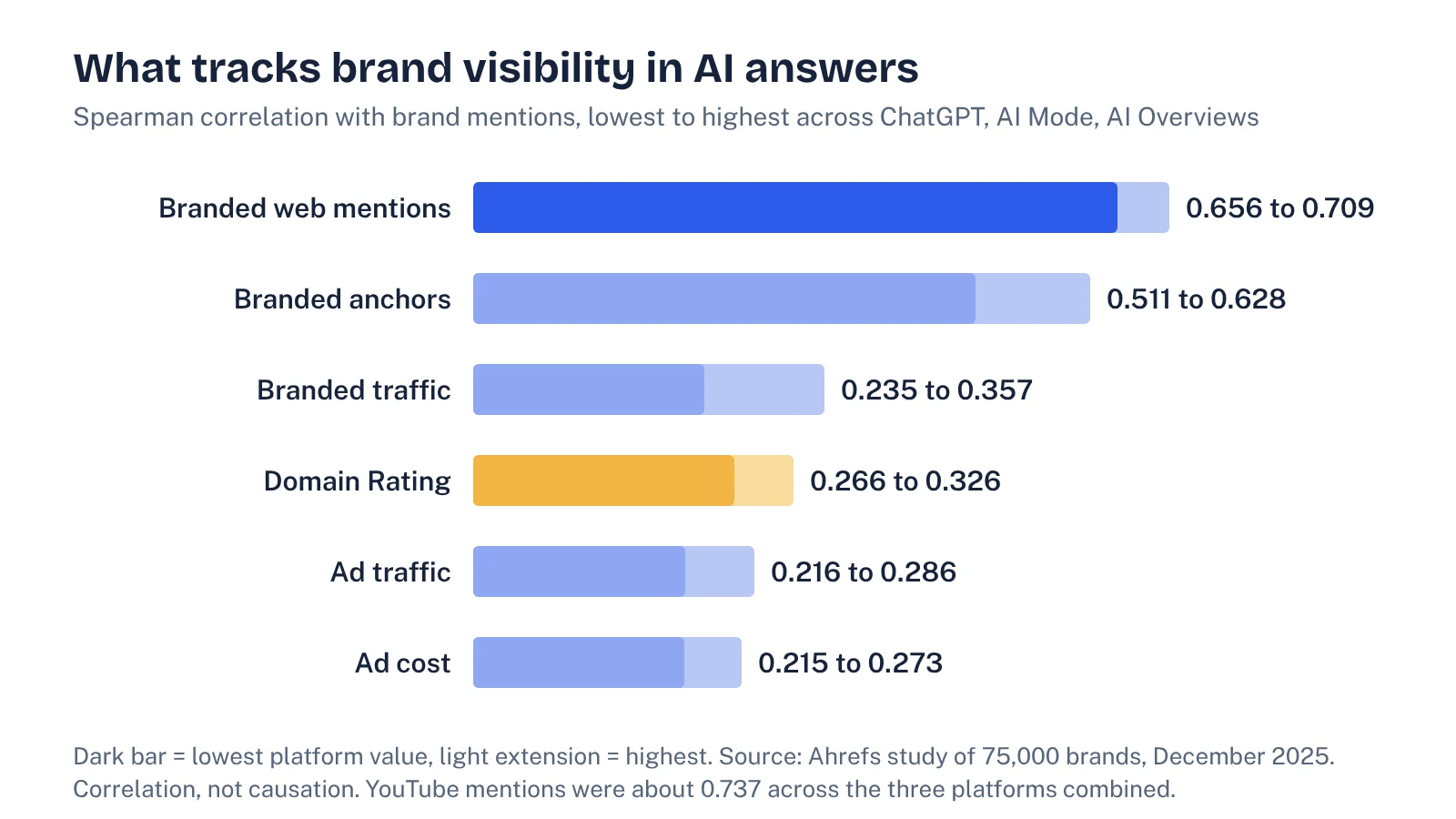
YouTube stood out too. Ahrefs found YouTube mentions correlated at about 0.737 with AI visibility across the three platforms combined, the strongest single signal in the study. The company repeated that finding in its Q1 2026 AI Search Benchmark Report.
Two cautions. First, this is correlation. Big, well-known brands get mentioned more and get named more, and part of that is simply size. Second, the useful lesson is not "buy mentions". It is that AI assistants reflect the web's consensus about you, so brand authority has to be built where that consensus forms. We cover the mention side in more depth in our guide to earning AI brand mentions.
Brand authority vs domain authority
Teams often mix the two up, partly because several SEO tools publish a score for each. They answer different questions.
| Domain authority (DA, DR and similar) | Brand authority | |
|---|---|---|
| Question it answers | How likely is this site to rank? | How likely is this brand to be named and trusted? |
| Built mainly from | Backlinks to your domain | Mentions, reviews, branded search, expertise, consistent facts |
| Where it shows up | Organic rankings | AI answers, shortlists, analyst lists, word of mouth |
| Correlation with AI visibility (Ahrefs) | 0.27 to 0.33 (Domain Rating) | 0.66 to 0.71 (branded web mentions) |
| Who owns it | SEO team | Marketing, product marketing, PR, customer teams |
Tony Patrick of Intero Digital made the same point in Advertising Week in April 2026: AI search rewards the brand that is most believable, not the one that publishes the most. You still want strong rankings. They feed AI Overviews and they send the clicks that convert. But a high domain score with few independent mentions leaves you exposed when the shortlist is written by an assistant.
The four layers of brand authority
"Build brand authority" is too vague to plan against. We split it into four layers that stack. Each one depends on the one below it.
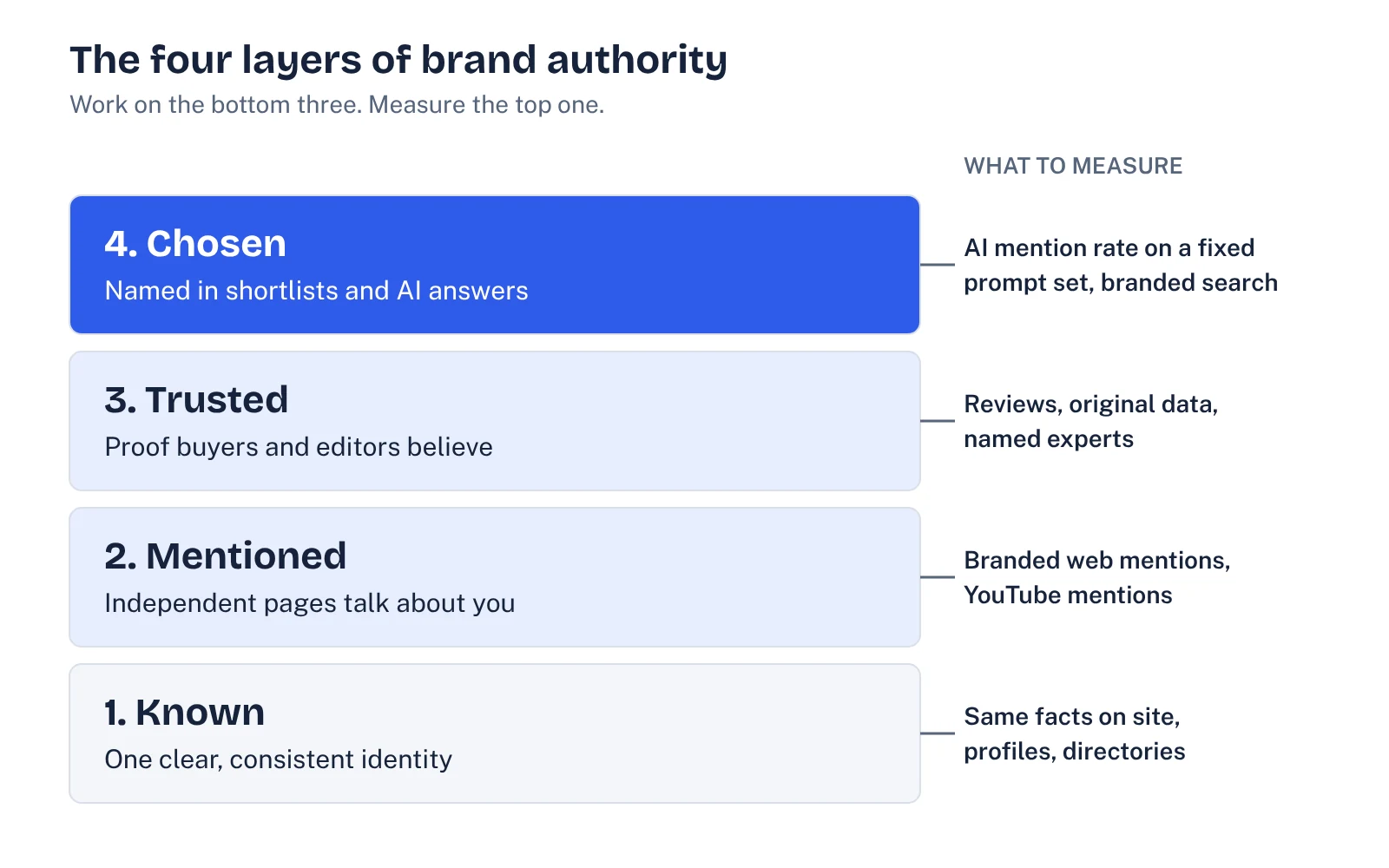
1. Known: one clear identity
Assistants can only recommend you correctly if they understand what you are. Your category, who you serve, your pricing model and your main integrations should read the same on your site, LinkedIn, Crunchbase, G2, Capterra and partner directories. Our entity SEO guide for SaaS walks through this consistency audit.
2. Mentioned: independent pages talk about you
This is the layer the Ahrefs data points to most directly. It covers roundups and comparison articles, review sites, community threads, podcasts, YouTube reviews and integration partners' pages. The goal is not volume for its own sake. It is being present on the pages that rank for, and get cited for, your buyers' questions.
3. Trusted: proof people believe
Mentions without substance fade. Proof is what makes editors, reviewers and customers repeat your name: original data, honest product documentation, named experts, case results customers agree to share, and reviews. Google says trust is the most important part of E-E-A-T, while being clear that E-E-A-T is not a ranking factor in itself.
4. Chosen: named when it counts
The top layer is the outcome. Buyers search for you by name, analysts include you, and AI assistants list you when someone asks for options in your category. This is the layer you measure. The three below it are the ones you work on.
How to build brand authority: a 90-day plan
This is the order we would work in for a B2B SaaS brand starting from a typical position: decent rankings, a handful of reviews, few independent mentions.
- Write down your category sentence. One line that says what you are, for whom, and how you differ. Use it word for word on your home page, About page, social profiles and directory listings.
- Fix the facts. Run your top 20 buyer prompts in ChatGPT, Gemini, Perplexity and AI Mode. Note every wrong price, outdated feature or wrong category. Correct the source pages, then the profiles assistants cite.
- Map where your category is discussed. For your main buyer questions, list the pages that rank and the pages AI answers cite. These are your mention targets: roundups, review grids, threads, videos.
- Close the review gap. Pick the one or two review sites that show up most in those answers and ask happy customers for honest reviews there, using each site's own guidelines.
- Publish one asset others will want to cite. A benchmark from your own product data, a survey, or a detailed teardown. One strong asset a quarter beats weekly opinion posts.
- Get on video and in conversations. Given how strongly YouTube mentions tracked AI visibility, pitch partner webinars, customer interviews and podcast spots, and publish your own demo and how-to videos.
- Show up as people, not only as a logo. Named experts who post useful, specific takes on LinkedIn and in communities give buyers a reason to trust the brand behind them.
The Edelman and LinkedIn 2025 B2B Thought Leadership Impact Report, based on nearly 2,000 professionals, adds a useful angle for SaaS teams: "hidden buyers" in the buying group read and judge thought leadership much like the main buyer does, and strong content can lead them to back lesser-known vendors. Authority is built with the whole buying committee, not just the champion. The 2026 edition adds AI to the picture; our thought leadership strategy guide covers what changed and how to plan for it.
See your own AI visibility, free
Get a one-page audit of how ChatGPT, Perplexity and Gemini treat your brand against up to three competitors, plus your biggest gap. In your inbox within 48 hours.
Get my free auditHow to measure brand authority
No single score captures it, and no public score is what AI assistants use. Instead, track a small scorecard on the same dates every quarter so you can see the direction.
| Layer | What to track | Where to get it |
|---|---|---|
| Known | Number of key profiles with consistent category, pricing and positioning | Manual check of site, LinkedIn, review sites and directories |
| Mentioned | Branded web mentions and YouTube mentions per quarter | Ahrefs, Semrush, a media monitoring tool, or Google Alerts |
| Trusted | Review count and rating on the sites AI answers cite; pages that earn citations | Review site dashboards, citation tracking |
| Chosen | AI mention rate across a fixed prompt set; branded search volume | Manual prompt runs or an AI visibility tool; Search Console and Keywords Explorer |
To turn branded search volume into a competitive number, see our guide to share of search.
The "Chosen" row is the one leadership will ask about. Build a set of 30 to 50 buyer prompts, run each several times on each assistant, and record whether you are mentioned, where you appear in the list, and which sources are cited. AI answers vary from run to run, so treat single runs as noise and look at rates. If you want a ready-made structure, our AI visibility audit guide includes a free template, and our post on AI share of voice shows how to turn mentions into a number you can compare with competitors.
Moz also publishes its own Brand Authority score with a free checker, and it can be a handy outside reference. Just remember it is one tool's model, not what Google or ChatGPT uses.
Common mistakes
- Treating a domain score as brand authority. It measures links, and links were among the weakest signals in the Ahrefs study.
- Chasing mention volume. Ten mentions on pages your buyers never see are worth less than one in the roundup that AI Overviews cite for your category.
- Inconsistent positioning. If your site says "revenue intelligence" and G2 says "sales engagement", assistants may file you in the wrong category.
- Measuring once. A single prompt run is a snapshot. Fixed prompts, fixed dates and repeated runs are what make the trend real.
- Leaving it all to SEO. Reviews, PR, partner marketing and customer success create most of the signals. Give someone ownership across teams.
The bottom line
Brand authority used to be something you assumed would follow good marketing. Now it decides whether you appear in the answer a buyer reads before they ever visit your site. Build it in layers: be clear about who you are, get mentioned where your category is discussed, back it with proof, and measure how often you are chosen. Check the same scorecard every quarter, and fix wrong facts first.
FAQ
What is brand authority?
Brand authority is the degree to which your audience, publishers and search systems treat your brand as a trusted source in its category. It is built through expertise, consistent positioning and third-party validation, and it shows up as branded searches, unprompted mentions, and being recommended.
How do you measure brand authority?
There is no single official score. Combine a few signals you can track over time: branded search volume, the number of branded web mentions, review volume and rating, and how often AI assistants mention you across a fixed set of buyer prompts. Some SEO tools, such as Moz, also publish their own brand authority metric.
Is brand authority the same as domain authority?
No. Domain authority style metrics estimate a site's ranking potential from its backlink profile. Brand authority is about how often and how favorably your brand is talked about. In Ahrefs' 75,000-brand study, branded mentions tracked AI visibility much more closely than Domain Rating did.
How long does it take to build brand authority?
Expect quarters, not weeks. Fixing inconsistent facts about your brand can show up in AI answers within weeks, but growing third-party mentions, reviews and branded demand usually takes two to four quarters of steady work.
Does brand authority affect SEO rankings?
Indirectly. Google says E-E-A-T is not a ranking factor in itself, but the signals behind brand authority, like expertise, reputation and trust, are things its systems try to reward. In AI answers, the link is more visible: brands that are mentioned more across the web get named more.
Sources
- Ahrefs: Top brand visibility factors in ChatGPT, AI Mode and AI Overviews (75k brands studied), Louise Linehan, December 12, 2025
- Business Wire: Across 75,000 brands, YouTube mentions are the strongest signal of AI visibility (Ahrefs Q1 2026 AI Search Benchmark Report, May 2026)
- Advertising Week AW360: The new battleground is being cited, not clicked: brand authority vs domain authority (Tony Patrick, April 24, 2026)
- Search Engine Land: An SEO guide to understanding E-E-A-T
- Edelman and LinkedIn: 2025 B2B Thought Leadership Impact Report
- Ahrefs Keywords Explorer and SERP overview, US data pulled November 16, 2026