Entity SEO for B2B SaaS: how to make your brand one clear entity for Google and LLMs
Entity SEO is the work of making sure search engines and AI assistants recognize your company, product and category as clearly defined things, and connect them correctly. For a B2B SaaS brand that means one authoritative entity home, structured data that points to your real profiles, and the same description everywhere you're mentioned. This guide shows how to find your entities, check how Google sees you, and fix the gaps.
- An entity is a uniquely identifiable thing (your company, your product, your category) with attributes and relationships. Keywords are just the words people use to find it.
- Pick one entity home, usually your About page, and make every profile and piece of markup point back to it.
- Organization schema with sameAs links helps Google connect your site to your other profiles. Google says it belongs on the home page or one About page, not every page.
- The biggest lever is off your site: consistent third-party descriptions. In Ahrefs' 75,000-brand study, branded web mentions correlated more strongly with AI Overview visibility than any link metric.
- Check your work with free tools: the Knowledge Graph Search API, Google's Natural Language demo, and a manual description audit across your top 10 profiles.
What entity SEO means for a SaaS company
Search engines stopped matching only strings a long time ago. Google's Knowledge Graph, announced in 2012, stores things: people, companies, products, places and concepts, each with an ID, a type, attributes and relationships to other things. When Google reads your page, it tries to link the words on it to those things.
An entity, then, is a uniquely identifiable thing. "Acme" is a string. Acme, the company founded in 2019 that makes contract management software for legal teams, headquartered in Austin, is an entity. Entity SEO is the work of making sure search engines and AI assistants can tell which Acme you are, what you make, and what category you belong to.
For a B2B SaaS brand there are usually three kinds of entity to get right:
- Your organization. The company: name, legal name, founders, location, website, logo, profiles.
- Your product. Often the same name as the company, sometimes not. Plans, integrations and the job it does.
- Your category and the problems you solve. The concepts you want to be associated with, such as "contract lifecycle management" or "SOC 2 automation".
The goal isn't a knowledge panel for its own sake. It's that when someone asks Google or an assistant "what is Acme" or "best CLM tools for in-house legal teams", the system already has a clean, consistent picture of you to draw from.
Why entities matter more in AI search
Classic rankings reward the page that best matches a query. AI answers work differently: the system assembles a response about a topic and decides which brands belong in it. To do that, it needs to know that your brand exists, what it is, and how it relates to the category in the question.
That knowledge comes mostly from what the rest of the web says about you. Ahrefs studied 75,000 brands and the factors linked to AI Overview mentions. Branded web mentions had the strongest correlation (Spearman 0.664), ahead of branded anchors (0.527), branded search volume (0.392) and Domain Rating (0.326). The raw number of backlinks came in at 0.218. Ahrefs is clear that this is correlation, not proof of cause, but the direction is useful: being talked about, consistently and in context, looks more important than link counts.
That's an entity problem. If ten sites describe you ten different ways, or confuse you with a company of the same name, the model's picture of you is blurry. Our guide to fixing what AI gets wrong about your brand covers the symptoms. Entity SEO is the prevention.
What people search for when they search "entity SEO"
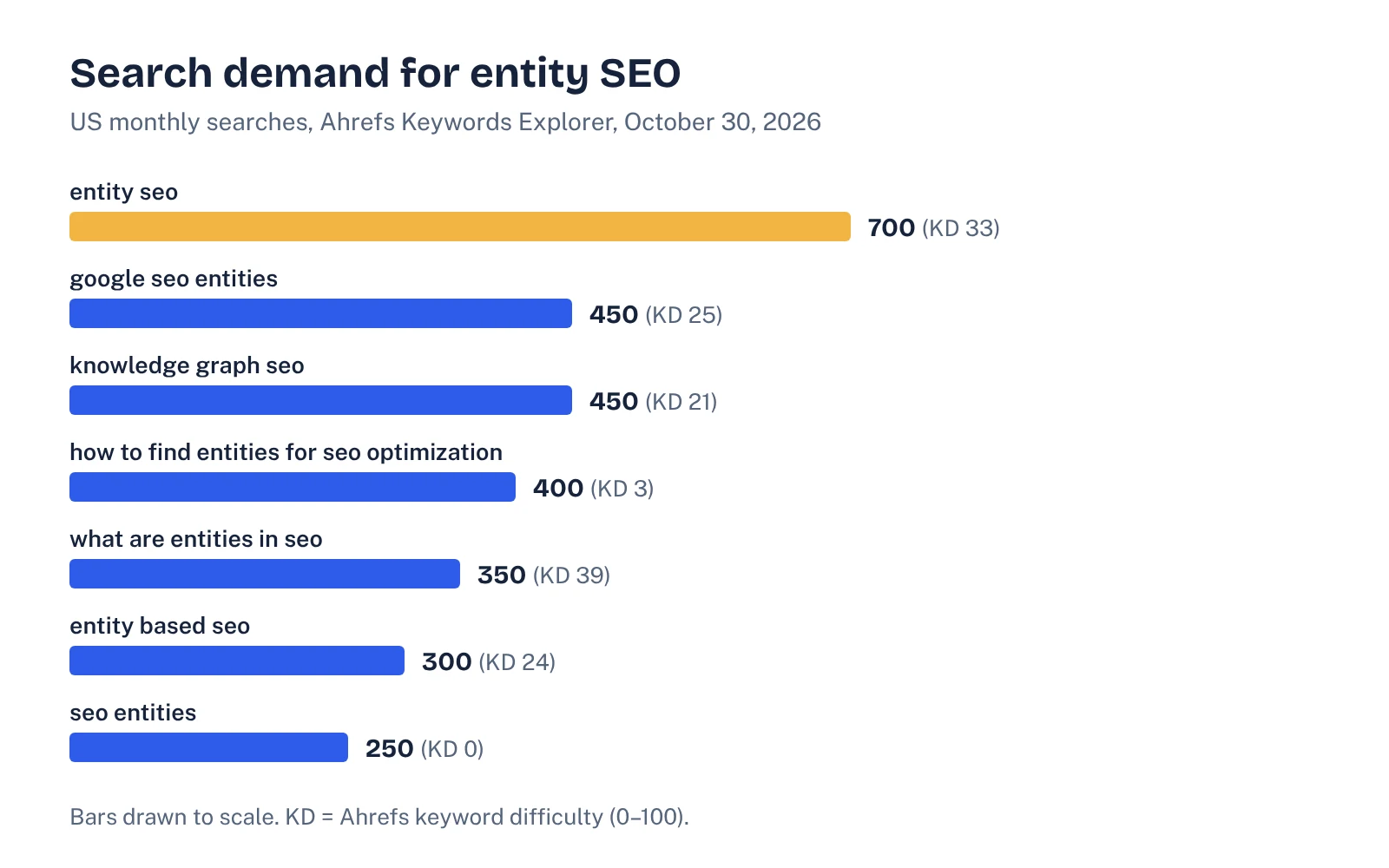
We pulled the main phrasings from Ahrefs Keywords Explorer this morning (US, October 30, 2026). "Entity SEO" gets about 700 searches a month with a keyword difficulty of 33. The more interesting cluster is practical: four variations of "how to find entities for SEO" each show around 400 searches with difficulty between 0 and 3.
The top ten results for "entity SEO" are mostly definitions and theory: how Google's Knowledge Graph works, how entity retrieval models compare, what Freebase was. Useful background, but they rarely tell a SaaS marketer what to do on Monday, and almost none cover how entities affect AI assistants. That's the gap this guide fills.
How to find your entities (and the ones you're missing)
Start by seeing what search engines already detect, on your pages and in their knowledge base.
1. Check whether Google holds an entity for you
Google's Knowledge Graph Search API lets you look up entities by name. Each result has an ID (in the form kg:/m/… or kg:/g/…), a list of schema.org types and a relevance score. Search for your brand name. If you appear with the right type (Organization or Corporation) and description, Google already has a node for you. If you don't, or a different company with your name does, you know where to start. Note that Google says the API isn't meant for production-critical use and is moving to Cloud Enterprise Knowledge Graph, so treat it as a diagnostic.
2. Extract entities from your key pages
Google's Natural Language API returns the entities it finds in a block of text, with a type, the mentions, and a salience score (how central each entity is to the text). Paste in your home page, your main product page and your category page. Then do the same for the top three ranking pages for your category term.
You're looking for three things:
- Is your brand the most salient entity on your own home page? If a generic term outranks it, your copy is vague about who you are.
- Does your category appear as an entity at all? If your product page never names the category plainly, machines can't connect you to it.
- Which related concepts do competitors cover that you don't? For a CLM product, that might be "redlining", "clause library" or "e-signature". Add them only where they reflect what your product really does.
3. List where you're described
Search your brand name and collect the ten or so profiles that describe you: LinkedIn, Crunchbase, G2, Capterra, your app marketplace listings, GitHub, Wikipedia or Wikidata if you have them, and any analyst or press pages. Copy the one-line description each uses into a sheet. You'll use it in the audit below.
Build one entity home and connect everything to it
An entity home is the single page you treat as the authoritative source about your company. For most SaaS brands that's the About page (or the home page if the About page is thin). It should state plainly:
- Your name, legal name, and any former names
- What you make, in one sentence that names the category
- Who it's for
- Founders and leadership, with links to their profiles
- Founding year and headquarters
- Links out to your official profiles
Then add Organization structured data. Google's Organization markup documentation lists properties including name, alternateName, legalName, description, url, logo, foundingDate, contactPoint and sameAs, the last being links to your other profiles. Google says it helps it understand your organization's details and that you should place it on the home page or a single page about the organization; it doesn't need to be on every page.
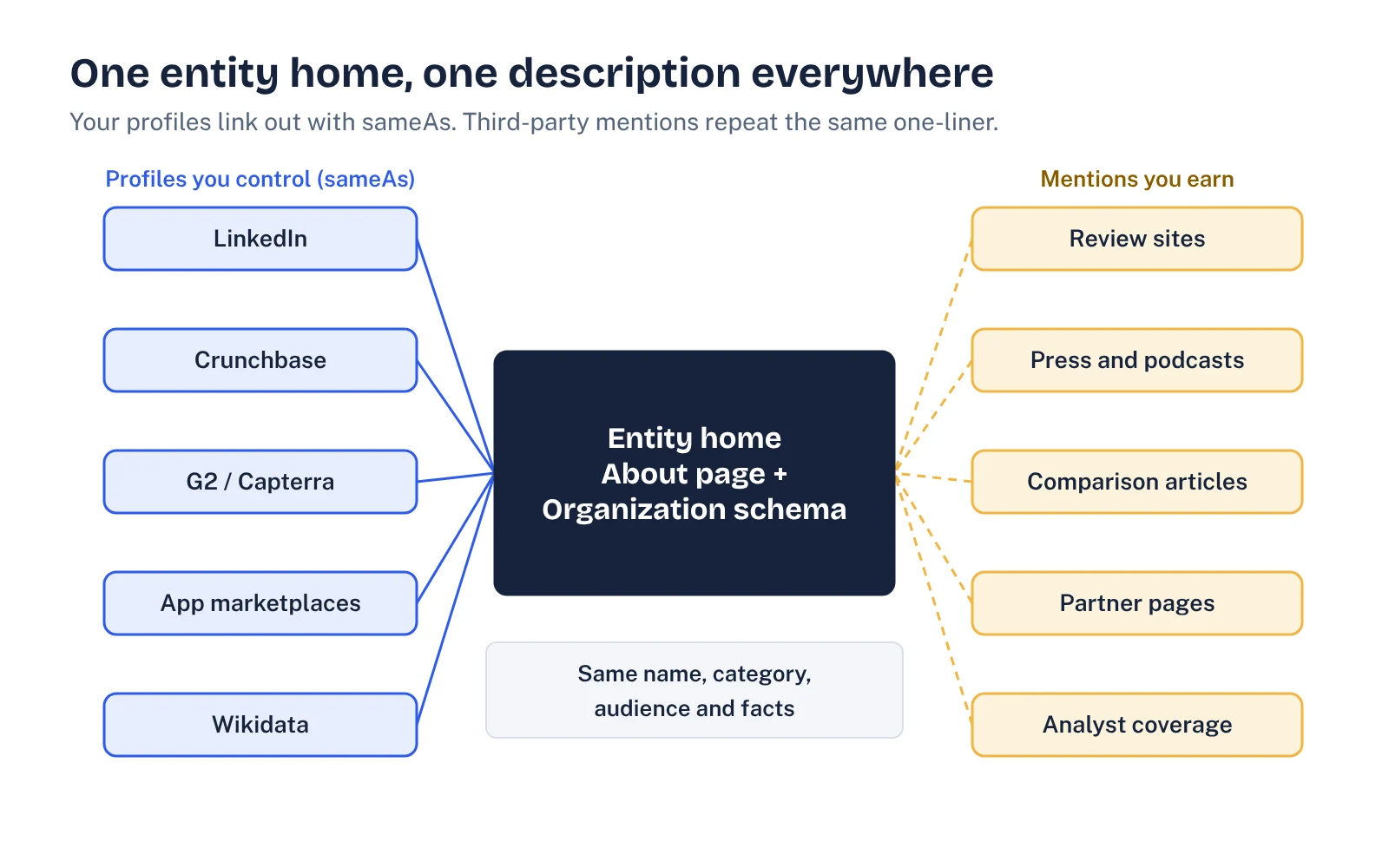
Two practical rules keep this clean. First, sameAs should only list profiles you control or that are definitely about you. Second, the description in your markup should match the one-line description on the page and, ideally, on your profiles. Our post on schema markup for AI search covers which other types are worth keeping and which have little effect.
See your own AI visibility, free
Get a one-page audit of how ChatGPT, Perplexity and Gemini treat your brand against up to three competitors, plus your biggest gap. In your inbox within 48 hours.
Get my free auditThe entity consistency audit
This is the part most guides skip, and it's where B2B SaaS brands usually have the most to gain. Take the sheet of profile descriptions you collected and score each one.
| Check | Pass looks like | Common failure |
|---|---|---|
| Name | Same brand name and spelling everywhere | Old name on Crunchbase, "Inc." on some profiles only |
| Category | Same category phrase in every description | "Legal tech platform" here, "workflow tool" there |
| Audience | Same buyer named (e.g. in-house legal teams) | Old positioning from a pivot still live on G2 |
| Facts | Founding year, HQ, founders and pricing model agree | Different founding years, outdated free plan |
| Links | Each profile links to your site; your site links back | Marketplace listing links to a dead page |
| Disambiguation | Nothing confuses you with a same-name company | Assistants mix you up with an older brand |
Fix the profiles you control first, starting with the ones that rank for your brand name. Then work on the ones you don't control: ask partners, integration directories and review sites to update outdated descriptions. Give them the exact sentence you want used.
Grow the right mentions, not just more mentions
Once the basics agree, the work shifts to earning third-party descriptions that tie your brand to your category. Good sources for a SaaS company are integration partner pages, comparison and "best tools" articles, review platforms, podcasts and guest posts by your team, and analyst or community coverage. What matters is that the mention places you in the right context: your name next to your category and the problems you solve.
A practical checklist for each new mention:
- Does it use your current one-line description, or close to it?
- Does it name your category in the same terms your buyers use?
- Does it link to your site or entity home?
- Is it on a page that assistants and Google can crawl and actually cite?
If you want a way to see which mentions AI assistants are picking up, our guide to tracking AI brand mentions walks through a monthly process.
How to tell if it's working
Entity work is slow, and there's no single score for it. Track a few signals each quarter:
- Knowledge Graph presence. Does the API return you, with the right type and description?
- Branded search results. Does a search for your name show your own profiles and accurate descriptions, with no same-name confusion?
- Assistant descriptions. Ask ChatGPT, Perplexity and Gemini "What is [brand]?" and "What category is [brand] in?" a few times each. Log whether the answer names the right category and facts.
- Category prompts. For your core category questions, are you mentioned, and is the description accurate?
Expect profile fixes to show up in branded results within weeks, and in assistant answers more slowly, since some of that knowledge comes from model training and some from live search.
The bottom line
Entity SEO sounds technical, but for a SaaS brand most of it is discipline: one clear sentence about what you are, one page that owns it, markup that points to your real profiles, and a steady effort to get everyone else to describe you the same way. The theory in the top-ranking guides is worth knowing. The consistency audit is what moves things.
FAQ
What are entities in SEO?
An entity is a specific, uniquely identifiable thing such as a company, product, person or concept, along with its attributes and relationships to other things. Search engines store entities in knowledge bases like Google's Knowledge Graph and use them to understand what a page is about beyond its exact words.
How do I find entities for SEO optimization?
Run your key pages and the top-ranking pages for your target query through an entity extractor such as Google's Natural Language API demo. Compare which entities each page mentions and how salient they are, then add the missing concepts your page should genuinely cover. Also search your brand in the Knowledge Graph Search API to see whether Google already holds an entity for you.
Is entity SEO different from schema markup?
Yes. Schema markup is one tool inside entity SEO. It labels facts on your own pages, but Google and AI assistants also rely on what other sites say about you, so entity SEO includes your profiles, directories, reviews and press coverage.
Does entity SEO help with ChatGPT and other LLMs?
Indirectly, yes. LLMs learn about your brand from the same web text search engines index, and assistants with search pull from live results. A consistent, well-linked description of who you are and what category you're in makes it more likely they describe you correctly. No one can guarantee a mention.
Sources
- Google Search Central: Organization structured data
- Google Knowledge Graph Search API
- Google Cloud Natural Language API: analyzeEntities
- Ahrefs: An Analysis of AI Overview Brand Visibility Factors (75K Brands Studied)
- Search Engine Land: Entity SEO, the definitive guide
- Ahrefs Keywords Explorer and SERP overview, US, pulled October 30, 2026