SaaS link building in the AI search era: how to earn links that also get you named in AI answers
SaaS link building is earning links from relevant sites to the pages that win customers: comparison, integration, category and data pages. In 2026 the best links do two jobs. They help those pages rank in Google, and they put your brand name on the pages AI assistants read when they build a shortlist. This guide shows which links do both, how to score them and a 90-day plan.
- Point links at five to ten revenue pages (comparison, alternatives, integration, category, original data), not at the homepage or random blog posts.
- In Ahrefs' study of 75,000 brands, branded web mentions (0.66 to 0.71) and branded anchors (0.51 to 0.63) correlated with AI visibility far more than Domain Rating (0.27 to 0.33).
- Prioritize placements that name you in context: best-tools roundups, integration partner pages, original data cited by trade press, and expert contributions.
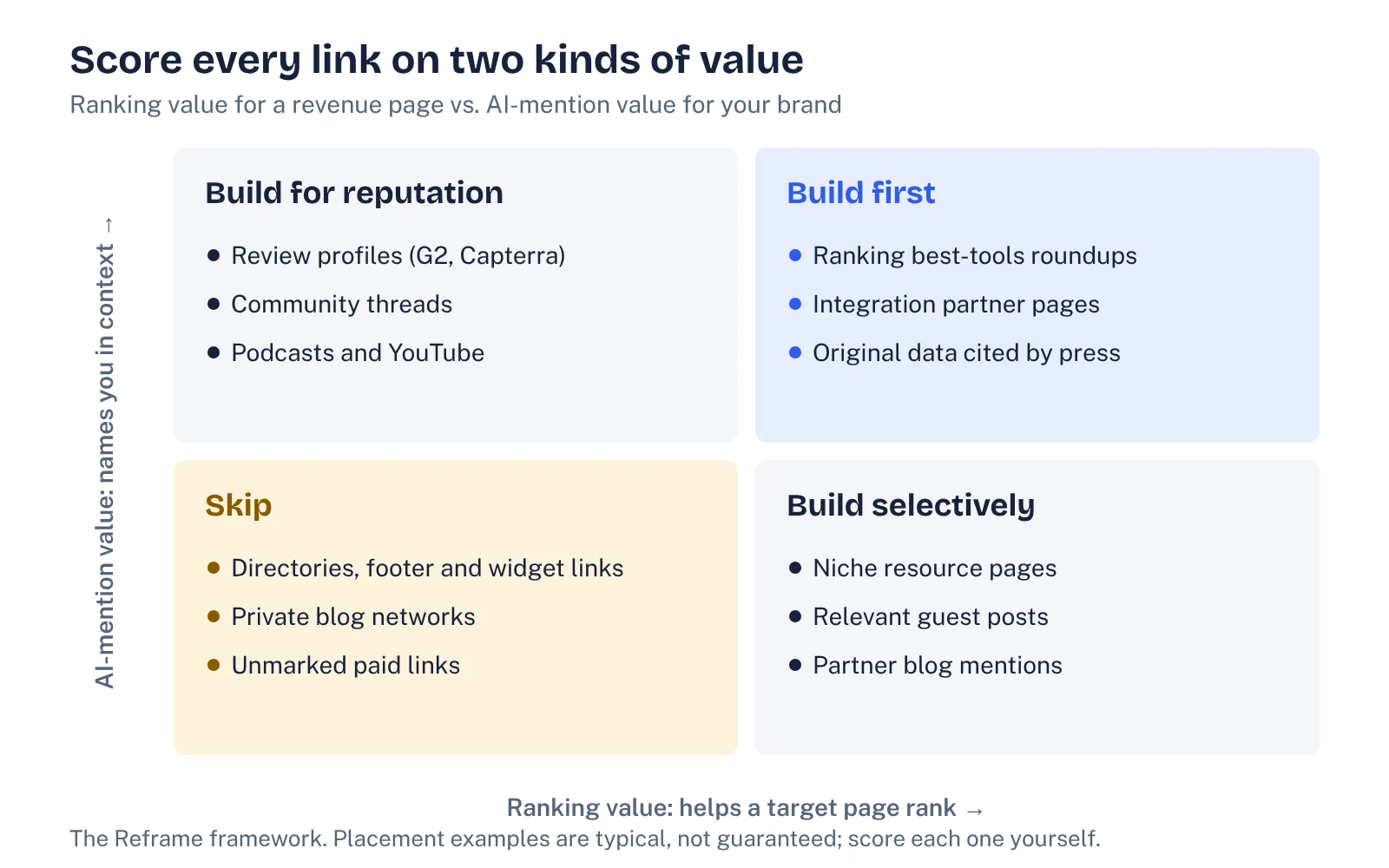
- Score every opportunity on ranking value and AI-mention value before you pitch or pay. Skip anything that is only a DR number.
- Paid placements must be marked rel="sponsored" or nofollow under Google's spam policies. They can still earn mentions, but they should not be your link strategy.
What changed about SaaS link building
For years, SaaS link building meant one thing: get more referring domains with a high Domain Rating, point them anywhere on the site, and watch rankings climb. Agencies sold link counts. Reports showed DR.
Two things have shifted since AI assistants started answering buyer questions.
First, links still matter for Google, including its AI features. Google's own documentation says there are no additional requirements to appear in AI Overviews or AI Mode beyond being indexed and eligible for a snippet, and that these features use "query fan-out", running several related searches to build one answer. Pages that rank for those sub-queries are the pages that get read.
Second, what an AI assistant says about your brand depends on what the web says about it. In Ahrefs' study of 75,000 brands (December 2025), branded web mentions correlated with brand visibility in AI answers at 0.66 to 0.71 across ChatGPT, AI Mode and AI Overviews. Branded anchors (links whose anchor text is your brand) came in at 0.51 to 0.63. Domain Rating came in at 0.27 to 0.33. The authors are clear that this is correlation, not causation, and the sample only included sites with DR above 40. But the direction is hard to ignore.
Put together, a good SaaS link in 2026 does two jobs: it helps a revenue page rank, and it puts your brand name, in context, on a page buyers and assistants read. A link that does neither is a cost.
What people search for, and what the top results miss
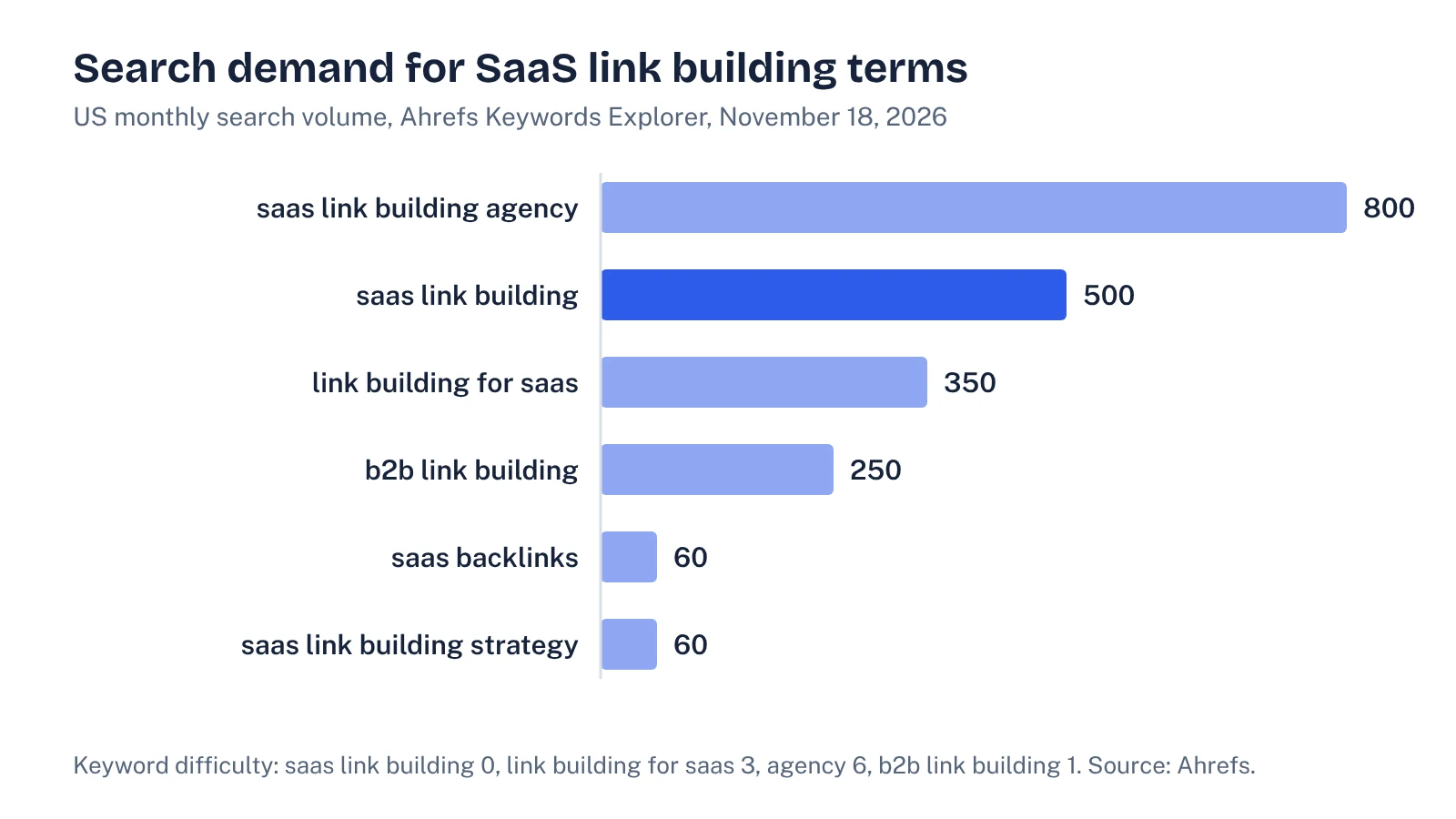
We pulled US data from Ahrefs Keywords Explorer on November 18, 2026. Demand is modest, competition is low, and most of it has commercial intent: people looking for help or an agency.
| Keyword (US) | Monthly volume | Keyword difficulty | Traffic potential |
|---|---|---|---|
| saas link building agency | 800 | 6 | 350 |
| saas link building | 500 | 0 | 300 |
| link building for saas | 350 | 3 | 400 |
| b2b link building | 250 | 1 | 30 |
| saas backlinks | 60 | 0 | 20 |
| saas link building strategy | 60 | n/a | n/a |
The SERP for "saas link building" shows an AI Overview, two YouTube videos, a Reddit thread asking for agency reviews, and a set of agency pages and "best agencies" lists. The better guides already cover which pages to target and the classic link types. What they mostly skip: a way to judge a placement on both ranking value and AI-mention value before you spend money on it, and a way to measure whether the links changed what AI assistants say. That is what the rest of this guide adds.
Choose the pages your links should lift
The most common mistake is pointing links at the homepage or at whatever blog post an editor happens to like. Start from the pages that decide deals instead.
- Comparison and alternatives pages. "You vs Competitor" and "Competitor alternatives" pages sit right where buyers and assistants compare vendors.
- Integration pages. One page per major integration, with real detail on what syncs and how. These earn partner links naturally.
- Category and use-case pages. The page that should rank for "[category] software" or "[category] for [industry]".
- Original data. A benchmark or survey others can cite. This is your easiest page to earn links to, and it can pass authority to the others through internal links.
Pick five to ten. Prefer pages already ranking in positions 5 to 20, where a handful of good links can move them onto page one. Before you build a single link, check that each page actually answers the buyer's question in crawlable text: pricing model, who it is for, integrations, proof. A link to a weak page wastes the link.
The link types that also earn AI mentions
Not every link carries your brand name into the places assistants read. These five usually do.
1. Best-tools roundups and comparison posts
Getting added to the "best [category] tools" articles that already rank is the highest-value placement in most SaaS categories. These pages rank for the head terms, they get retrieved for fan-out queries, and they name you next to your competitors. The DerivateX analysis of ChatGPT software recommendations (June 2026, 40 B2B SaaS categories, 188 cited recommendations) found the single most common vendor-owned citation was a "best tools" post on a vendor's own blog. Independent and niche sites made up another 22.9% of citations. Pitch with a short, factual blurb the editor can paste: what you do, who it's for, pricing model and one proof point.
2. Integration and partner pages
Every integration partner has a directory or marketplace listing, and many publish co-marketing posts. These links are relevant by definition and describe exactly what you do. Ask for a listing with a descriptive paragraph, not just a logo.
3. Original data that trade press cites
A small, honest dataset from your product or a survey of your buyers gives journalists and bloggers something to quote. The coverage usually names you as the source, which is the branded mention, and links to the study, which is the link. Publish the method and sample size so people can cite it with confidence.
4. Expert contributions on sites your buyers read
Guest articles and expert quotes on real industry publications, written by a named person at your company. Skip "write for us" sites that exist to sell posts. The test is simple: would your buyer read this site if you weren't on it?
5. Community and review profiles
Review sites and community threads rarely pass much link value, and the DerivateX sample found almost no review-aggregator citations in ChatGPT's software answers (2 of 188). But they shape Google results and other assistants, as we covered in our look at how much G2 and Capterra matter to AI answers. Keep profiles complete and consistent with your site; treat them as reputation, not link building.
Score each opportunity before you pitch
Use a simple scoring sheet so the team stops chasing DR alone. Give each opportunity 0 to 2 points on six questions; build anything that scores 8 or more, and be wary of anything under 5.
| Question | 0 points | 1 point | 2 points |
|---|---|---|---|
| Does the page rank or get traffic for a query your buyers use? | No | Some, page 2 or below | Page 1 for a buyer query |
| Is it cited in AI answers for your buyer prompts? | Never seen | Once or twice | Cited repeatedly |
| Will it name your brand with a sentence of context? | Logo or bare URL | Name only | Name plus what you do |
| Does it link to one of your target pages? | No link | Homepage | A target page |
| Is the site relevant to your category and audience? | Unrelated | Adjacent | Core audience |
| Is it editorial (not paid or exchanged)? | Paid, unmarked | Paid, marked sponsored | Earned |
The AI question takes the most effort, but it is also the one most teams skip. Keep a list of 20 to 30 buyer prompts and record which pages each assistant cites. Our guide to LLM citation tracking shows how to set that up without a paid tool.
See your own AI visibility, free
Get a one-page audit of how ChatGPT, Perplexity and Gemini treat your brand against up to three competitors, plus your biggest gap. In your inbox within 48 hours.
Get my free auditA 90-day SaaS link building plan
- Weeks 1 to 2: baseline. Pick your five to ten target pages. Record their rankings, referring domains and conversions. Run your buyer prompts in four assistants and record how often you are named and which pages are cited. If you have never done this, our step-by-step AI visibility audit guide has a free template for it.
- Weeks 2 to 3: fix the targets. Make sure each page answers the buyer's question in plain text, with pricing model, integrations and proof. Add internal links from related posts.
- Weeks 3 to 6: roundups and partners. List every ranking or cited "best tools" article in your category and pitch the editors. Ask every integration partner for a descriptive listing.
- Weeks 4 to 10: one data asset. Publish one original dataset with a clear method. Pitch it to five to ten trade publications and newsletters your buyers read.
- Ongoing: expert contributions. One or two guest pieces or expert quotes a month on publications that pass the "would our buyer read this?" test.
- Week 12: measure. Re-run the same prompts on the same assistants, several times each. Compare mention rate, cited pages, rankings for the target pages, referral traffic and pipeline from those pages.
Expect rankings to move before AI mentions do. Assistants also vary a lot from one run to the next, so judge mention rate across many runs, not a single screenshot.
Paid links, agencies and what to avoid
Buying links is common in SaaS, and prices are not small. BuzzStream's pricing analysis (updated October 2026) puts the average link insertion at about $179, guest posts bought through a vendor at about $461, and digital PR at $1,250 to $1,500 per link. The agency retainers it collected from published pricing mostly run $2,500 to $10,000 a month.
Google's spam policies treat buying or selling links that pass ranking credit as link spam. That includes paid guest posts with optimized anchors, excessive link exchanges, low-quality directories and widely distributed footer or widget links. Paid placements are allowed if the link is marked rel="sponsored" or rel="nofollow". A sponsored listing in a well-read roundup can still be worth it for the brand mention and the referral traffic. Just budget for it as advertising, not as link building.
If you hire a SaaS link building agency, ask:
- Which of our pages will you build links to first, and why?
- How do you choose sites? Can we see examples before they go live?
- Are any placements paid? Will they be marked sponsored?
- What does the monthly report show besides DR and link count: rankings, referral traffic, AI mentions?
Walk away from guaranteed link counts, private blog networks and reports that only list Domain Rating.
How to measure whether it worked
Measure the pages, not the links. For each target page, track Google rankings for its main queries, referral traffic from new links, and the trials or demos it produces. For the brand, track AI mention rate on your fixed prompt set, which pages assistants cite, and branded search demand. Our guide to building and measuring brand authority covers those brand-level metrics in more detail, and how to track AI brand mentions covers the mention side.
If rankings rise but AI mentions don't, look at the placements: they probably link to you without describing you. If mentions rise but rankings don't, the links may be pointing at the wrong pages. Adjust the next quarter's list accordingly.
FAQ
Does link building still work for SaaS in 2026?
Yes. Google says its AI Overviews and AI Mode use the same core ranking systems and have no extra requirements, so links that help pages rank still matter. What changed is which links are worth the effort: links that name your brand on pages buyers and AI assistants read are worth more than anonymous links from high-DR sites.
How much does SaaS link building cost?
BuzzStream's 2026 pricing analysis puts the average link insertion at about $179 and the average guest post bought through a vendor at about $461, with digital PR at $1,250 to $1,500 per link. Agency retainers it collected from published pricing mostly run $2,500 to $10,000 a month. Remember that paid links must be marked sponsored or nofollow.
Which pages should SaaS backlinks point to?
Pages close to revenue: comparison and alternatives pages, integration pages, category or use-case pages, and original research. Pick five to ten, ideally ones already ranking on page one or two, and build links to them steadily rather than spreading links across the whole site.
Do backlinks help you show up in ChatGPT and AI Overviews?
Indirectly. Pages that rank well are more likely to be retrieved, and links from pages that also mention your brand add to the branded web mentions that correlated most with AI visibility in Ahrefs' 75,000-brand study. That study shows correlation, not causation, so measure your own AI mention rate before and after.
Should I hire a SaaS link building agency?
Hire one if you lack the time for outreach and can hold them to outcomes: which pages they will lift, how they choose sites, and a report that shows rankings, referral traffic and AI mentions, not just DR. Avoid guaranteed link counts and private networks.
Sources
- Ahrefs: Top brand visibility factors in ChatGPT, AI Mode and AI Overviews (75k brands studied), Louise Linehan, December 12, 2025
- DerivateX Research: The Authority Inversion, how ChatGPT decides which software to recommend (June 18, 2026)
- Google Search Central: Spam policies for Google web search (link spam)
- Google Search Central: AI features and your website
- BuzzStream: Link building pricing and costs (updated October 20, 2026)
- Ahrefs Keywords Explorer and SERP overview, US data pulled November 18, 2026