B2B review sites and AI visibility: how much G2 and Capterra really matter to AI answers
B2B review sites like G2, Capterra and Gartner Peer Insights matter to AI answers, but less evenly than vendor claims suggest. Independent 2026 studies put review platforms at roughly 1% to 9% of the sources AI assistants cite for software questions, with Perplexity leaning on G2 far more than ChatGPT. This guide compares the data, shows where each assistant draws from, and gives you a five-step plan for your profiles.
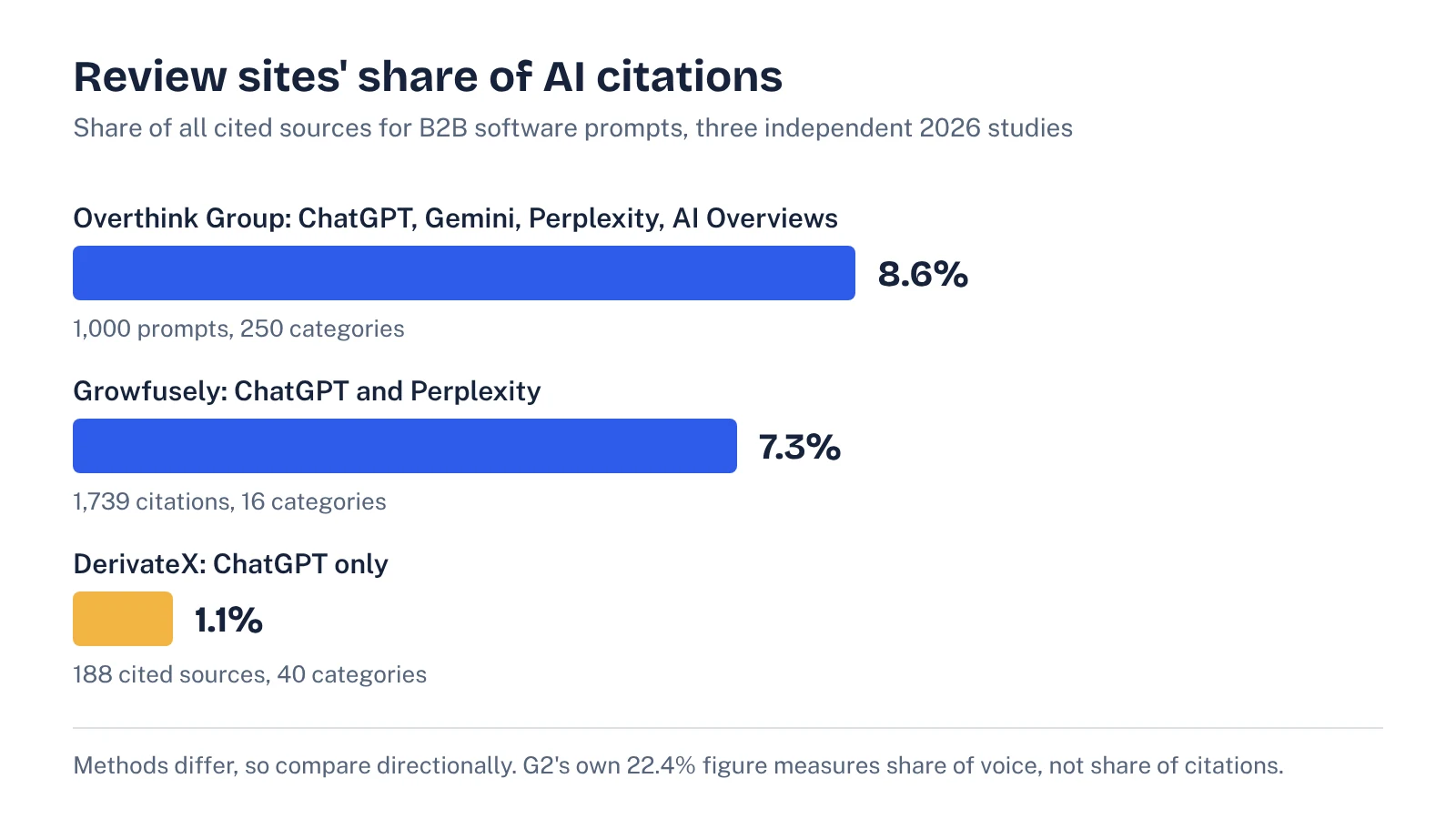
- Review platforms made up 8.6% of AI citations in Overthink Group's 1,000-prompt B2B study, 7.3% in Growfusely's 1,739-citation study and 1.1% in DerivateX's ChatGPT-only study.
- The assistant matters more than the average: in Overthink's data, more than 71% of G2's citations came from Perplexity.
- Listicles and vendor pages dominate AI citations. Review profiles are one input among several, not the main lever.
- Treat your G2 or Capterra profile as a source document: accurate category, current description, recent reviews that name use cases and buyer types.
- Measure before you invest: check which review domains actually appear in answers for your own category prompts.
Why B2B review sites come up in AI visibility conversations
Ask a B2B SaaS marketer what feeds ChatGPT's software recommendations and "G2" is usually one of the first answers. It makes sense on paper. Review sites hold millions of structured opinions about software, organized by category, with comparison pages for almost every pair of competitors. That is exactly the kind of material an assistant needs when someone asks "what's the best help desk software for a 50-person team?"
The question is how much weight to give it. Review programs cost money and time: paid profiles, review campaigns, someone to keep the listing current. If review sites drive a large share of AI answers in your category, that budget is well spent. If they drive a small share, the same hours might do more on comparison content, partner pages or earning brand mentions elsewhere.
So we went through the published 2026 data, pulled today's search data from Ahrefs, and put the numbers side by side.
What the 2026 studies actually show
Four sources are worth reading. They measure different things, which is the main reason their headline numbers disagree.
| Study | Sample | Assistants | Review sites' share |
|---|---|---|---|
| Overthink Group, July 2026 | 1,000 prompts across 250 niche B2B categories, run for a week in June 2026 | ChatGPT, Gemini, Perplexity, AI Overviews | 8.6% of all citations (review aggregators combined); G2.com alone 5.8%, the most-cited domain overall |
| Growfusely, July 2026 | 128 buying queries in 16 categories, 1,739 citations | Perplexity (Sonar API), ChatGPT (web-search API) | 7.3% of citations; G2 had 41 citations across 13 categories |
| DerivateX, June 2026 | 40 categories, one buyer prompt each, 188 cited sources | ChatGPT with web search | 1.1% (2 citations, both Gartner Peer Insights); G2 and Capterra: 0 |
| G2's own roundup, November 2025 | Third-party tool data collected by G2 | ChatGPT, Perplexity, AI Overviews, others | 22.4% share of voice for software queries (Radix and Kevin Indig, as reported by G2) |
A few things jump out.
The independent studies cluster around 7–9%. Overthink and Growfusely used different prompts, categories and methods, and still landed close together. Growfusely also cites an SE Ranking figure of 8.5% for review platforms in Google AI Overview citations, which fits the same range.
ChatGPT on its own looks very different. DerivateX ran one buyer prompt per category in ChatGPT and got no G2 or Capterra citations at all. It is a small sample (40 prompts), so treat it as a warning, not a rule. But it lines up with the next point.
G2's 22.4% is a different metric. Share of voice among software-related answers is not the same as share of all citations. It's also reported by G2 about G2. That doesn't make it wrong, but it is the number with the most reason to be generous.
Which assistants lean on review sites
The average hides the most useful finding. Review sites are not equally important across assistants.
- Perplexity leans on G2 heavily. In Overthink's data, more than 71% of all G2 citations came from Perplexity. Profound, quoted in G2's roundup, puts G2 at "closer to 75%" of Perplexity's review-site citations, against about a third on ChatGPT and AI Overviews.
- ChatGPT leans on independent content and vendor pages. Growfusely found independent content plus vendor pages made up nearly 79% of citations. Overthink found that about three-quarters of the top cited domains in ChatGPT and Perplexity were not vendors, and most were listicle-style pages.
- Google's surfaces lean on vendors. In Overthink's data, about three-quarters of the top domains in AI Overviews and Gemini were vendor sites.
- Category matters. Growfusely saw review-platform share rise to 13–16% in applicant tracking, DevOps and HR software.
The practical reading: if Perplexity matters to your buyers, your G2 profile is close to a primary input. Our guide on how to rank in Perplexity covers the rest of that picture. If ChatGPT is where your buyers start, review profiles are a supporting signal, and the "best X tools" articles and comparison pages that ChatGPT retrieves carry more weight. We cover those in how to rank in ChatGPT.
What buyers search for (Ahrefs, October 31, 2026)
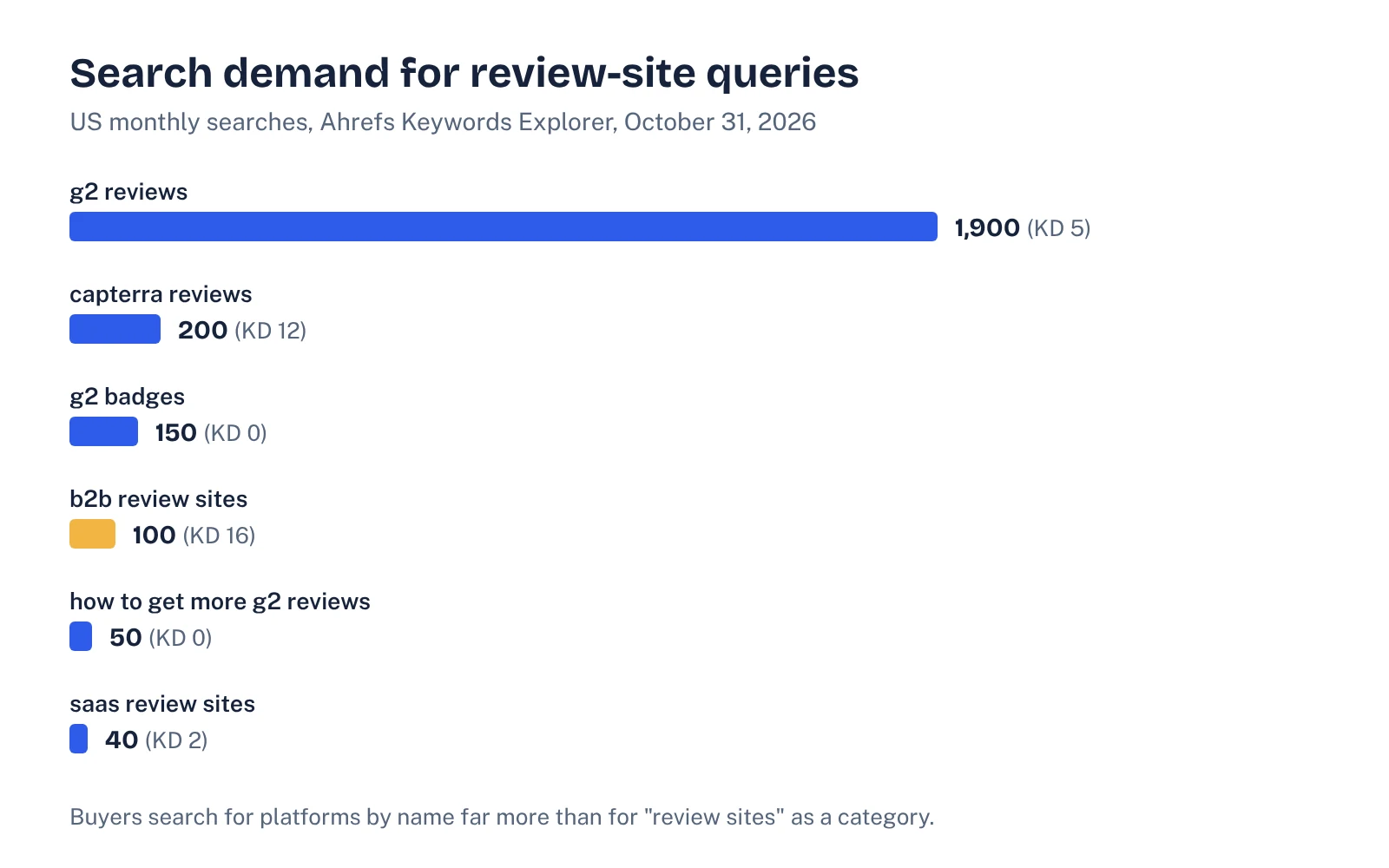
Search data shows the same thing from the other side: buyers look for review platforms by name, not as a category. In Ahrefs Keywords Explorer (US), "g2 reviews" gets about 1,900 searches a month (KD 5), while the generic "b2b review sites" gets about 100 (KD 16) and "saas review sites" about 40. "capterra reviews" sits at about 200 (KD 12) and "g2 badges" at about 150.
The Google results for "b2b review sites" are telling too. Of the top results Ahrefs returned today, two are Reddit threads and two are Quora answers, and the title of Trustpilot's business page now reads "Build Trust & AI Visibility". Review platforms are already selling AI visibility as part of the package. That is a reason to check the claim against your own category, not to dismiss it.
What an assistant can actually take from your profile
When an assistant cites a review page, it usually pulls one of three things: the category the product is listed in, a short description of what it does, and patterns in what reviewers say (who uses it, what they like, what they complain about). Star ratings matter less than you'd expect, because a 4.6 and a 4.7 look the same in a sentence.
That suggests where to focus:
- Category placement. If you're listed under the wrong or a too-broad category, you won't appear on the pages assistants retrieve for your buyers' questions.
- Your description. Make it the same one-line description you use on your site and other profiles. Inconsistent descriptions blur how assistants classify you.
- Review content. Reviews that say "we're a 40-person RevOps team and use it to route inbound leads" give an assistant something to match against a prompt. "Great tool, love it" gives it nothing.
- Recency. Overthink found that 51.6% of all citations went to listicles with "2026" in the title. Assistants favor fresh material. A profile whose newest review is from 2024 looks stale next to a competitor with reviews from last month.
On volume: G2 reports an analysis by Kevin Indig in which a 10% increase in reviews corresponded to roughly a 2% increase in citations, with reviews explaining only a small share of the variance. That's a weak link. More reviews help a little; better reviews in the right category probably help more.
See your own AI visibility, free
Get a one-page audit of how ChatGPT, Perplexity and Gemini treat your brand against up to three competitors, plus your biggest gap. In your inbox within 48 hours.
Get my free auditA five-step plan for your review profiles
This is the order we'd work in for a B2B SaaS company with limited time. It takes about a day to set up and an hour a month to maintain.
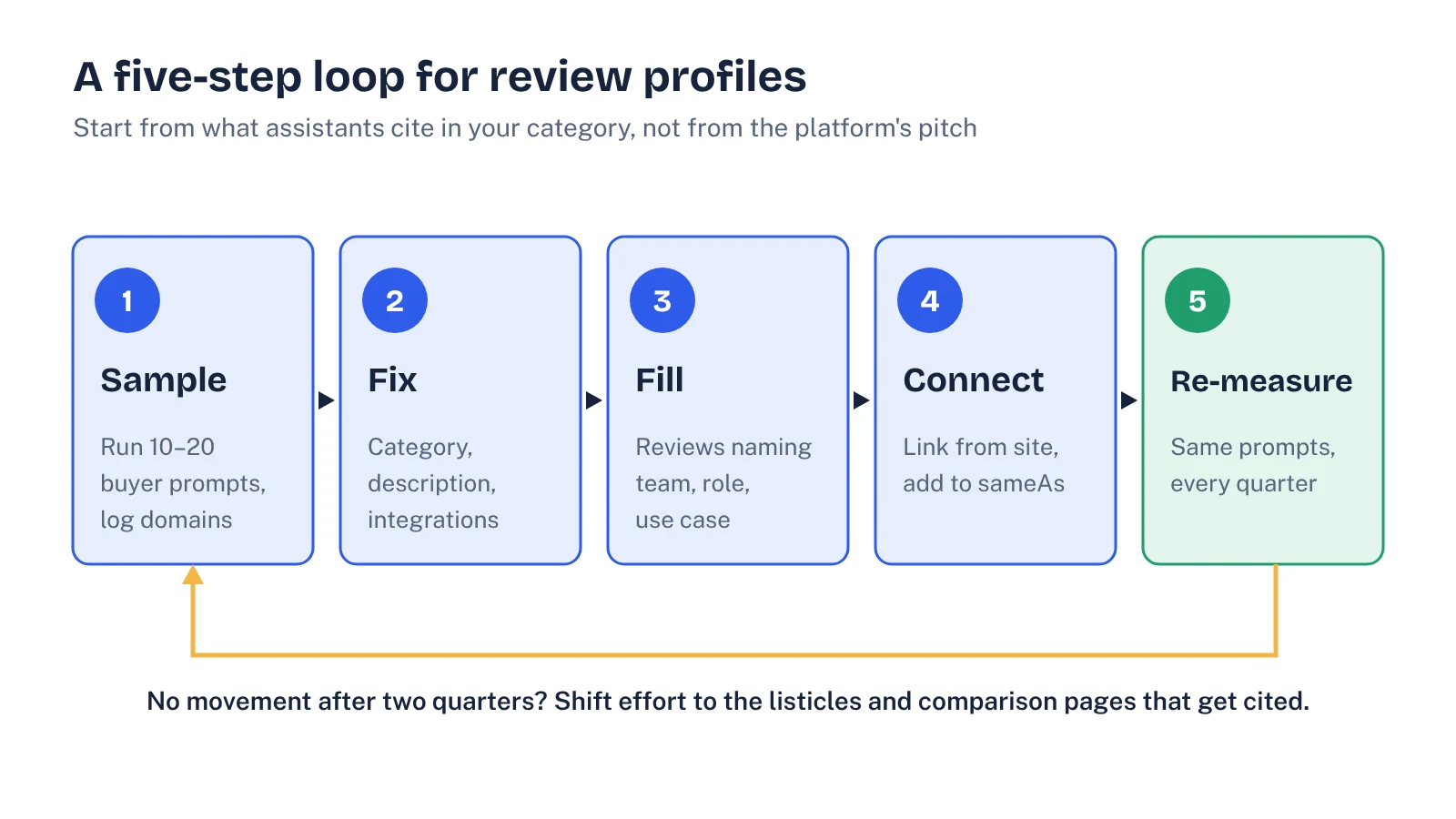
- Sample your category. Run 10–20 buyer prompts ("best [category] for [team type]", "[you] vs [competitor]", "[category] alternatives to [market leader]") in ChatGPT, Perplexity and Google AI Mode. Log every cited domain. Note which review sites appear and which of their pages (category pages, comparison pages, product profiles).
- Fix the profiles that appear. On the sites that showed up, check category placement, product description, screenshots, pricing information and integrations. Match the description to your site word for word.
- Fill the gaps in review content. Ask customers from your target segments for reviews, and ask them to mention their team size, role and use case. Spread requests over the year so the profile stays current.
- Connect the profile to your other assets. Link to it from your site where it's natural, and include it in your Organization schema
sameAsif it's an official profile. Our entity SEO guide covers how that fits together. - Re-measure quarterly. Re-run the same prompt set. Track whether the review domains, and your profile pages specifically, appear more often. If they don't move after two quarters, shift effort toward the listicles and comparison pages that do get cited.
G2 vs Capterra for AI visibility
If you can only maintain one profile well, the 2026 data points to G2. It was the most-cited review domain in both independent studies with a meaningful number of review-site citations (Overthink and Growfusely), and Growfusely reports that Capterra and GetApp "barely showed".
Two caveats. First, Capterra, GetApp and Software Advice are one network, so a strong Capterra listing feeds three sites, and Overthink counted the combined G2 and Capterra families at 8.0% of all citations. Second, Gartner showed up as the second most-cited domain overall in Overthink's data, and DerivateX's only review citations were Gartner Peer Insights pages. If your buyers are enterprise IT, Peer Insights deserves a look.
Mistakes to avoid
- Treating a vendor's AI visibility claim as your category's reality. Every review platform has a reason to say it drives AI answers. Your prompt sample is the tie-breaker.
- Chasing review count over review content. A burst of short five-star reviews adds little that an assistant can quote.
- Buying or incentivizing reviews against platform rules. Beyond the obvious risk to the profile, Overthink found that known spam sites made up 8.6% of total citations. Assistants are already noisy; don't add to it.
- Ignoring the pages that outrank review sites. Listicles made up 70.8% of citations in Overthink's study. If you're missing from the top "best [category]" articles, a polished G2 profile won't make up for it.
The bottom line
B2B review sites are a real input to AI answers, but a mid-sized one: roughly 7–9% of citations in the independent 2026 studies, concentrated in Perplexity and in a handful of categories. Keep your main profiles accurate, current and full of specific reviews. Then check your own category's prompts to decide whether review sites deserve more of your budget than that.
FAQ
Which B2B review sites matter most for AI visibility?
In the 2026 studies we reviewed, G2 was the most-cited review domain by a wide margin, followed by Gartner (mostly Peer Insights). Capterra, GetApp and Software Advice appeared far less often. Check your own category, because the mix varies by software category and by assistant.
G2 vs Capterra: which should a B2B SaaS company focus on?
For AI visibility, the published data favors G2: it was the top review domain in every independent study we found, while Capterra 'barely showed' in Growfusely's sample. That said, Capterra, GetApp and Software Advice share one network, so a complete Capterra profile still feeds several sites. Start with whichever platform your buyers and competitors already use.
Do more reviews mean more AI citations?
Only weakly, as far as the public data shows. G2 reports an analysis by Kevin Indig in which a 10% increase in reviews corresponded to about a 2% increase in citations, and reviews explained only a small share of the variance. Review quality, recency and what reviewers actually say are likely to matter as much as the count.
How do I get more G2 reviews without breaking the rules?
Ask real customers at natural moments, such as after onboarding or a successful renewal, and link them straight to your review page. Follow G2's own review guidelines on incentives and never write or buy reviews. Ask reviewers to describe their use case and team, because that detail is what makes a review useful as a source.
Sources
- Overthink Group: We analyzed 1,260 prompts to see who's winning AEO in B2B SaaS (July 2026)
- Growfusely: I analyzed 1,739 AI citations. Here's what ChatGPT and Perplexity actually cite (2026)
- DerivateX: Where ChatGPT gets software recommendations, 2026 study
- G2 Learn: Does G2 get ranked in AI LLM search? (November 2025)
- Ahrefs Keywords Explorer and SERP overview, US, pulled October 31, 2026