Prompt research: how to find the prompts your buyers ask AI (and what prompt volume really means)
Prompt research is the work of finding the questions your buyers ask AI assistants before they shortlist software, so you know which answers to show up in. No AI platform publishes prompt data, so every "prompt volume" figure is an estimate. This guide shows where those estimates come from, where to find real prompts, and how to turn keyword data into a prompt set you can trust.
- Prompt research decides which questions you measure. Prompt tracking then measures them. Get the first step wrong and every visibility number after it is off.
- No AI platform publishes query volumes. Semrush, Profound and Ahrefs each estimate prompt volume a different way, so compare numbers only within one tool.
- Your best prompts come from your own buyers: sales calls, long Search Console queries and forum threads, then keyword question data for coverage.
- Turn keywords into prompts by adding the buyer's situation and constraints. Constraints are what push an assistant from explaining to recommending brands.
- Start with 30 to 40 prompts across a few intent clusters, test each one before keeping it, and keep the set stable once tracking starts.
What prompt research is, and what it is not
Keyword research tells you what people type into Google. Prompt research tells you what they ask ChatGPT, Gemini, Perplexity or Google's AI Mode, and which of those questions matter to your business.
For a B2B SaaS company, the prompts that matter are the ones where an assistant might recommend software: "which CRM works for a 20-person sales team", "alternatives to [competitor] for agencies", "is [your product] worth it for startups". The output of prompt research is a prompt set: a list of these questions, grouped by intent and product, that you will measure every month.
It helps to separate three jobs that often get blurred:
- Prompt research decides which questions to measure. This post.
- Prompt tracking runs those questions on a schedule and records mentions, citations and competitors. Our guide to AI prompt tracking covers sample sizes, run counts and settings.
- Optimization changes your content and off-site presence so the answers improve.
Prompt research comes first, and it is the step most teams rush. If your prompt set is full of questions no buyer asks, or questions that never return brand names, every visibility score you calculate afterward describes the wrong thing.
What people search for, and what the results miss
We pulled the related queries from Ahrefs Keywords Explorer this morning (US, November 10, 2026). The demand is spread across many small variants rather than one big head term:
| Query | US monthly searches | Keyword difficulty |
|---|---|---|
| prompt research | 200 | not yet scored |
| prompt volume data | 200 | not yet scored |
| ai prompt research | 150 | 0 |
| prompt volume | 150 | not yet scored |
| ai prompt volume | 150 | not yet scored |
| prompt research tool | 100 | 0 |
| what is prompt volume in ai visibility or seo | 100 | 1 |
| keyword research for ai search | 100 | not yet scored |
Ahrefs also lists more than a dozen phrasings at 80 to 90 searches each, such as "how to do prompt research for ai seo" and "geo prompt research", plus vendor-specific queries like "semrush ai visibility products prompt volume". Long, near-identical variants at similar volumes can partly reflect tools checking results pages, so read the totals as a rough signal. The direction is clear, though: marketers want to know where prompts come from and whether prompt volume numbers can be trusted.
The current results for "ai prompt research" don't answer that well. The top 10 mixes a university guide to prompt engineering, sales prospecting prompts on LinkedIn, Reddit threads about deep research, and a few vendor feature pages. The most useful page in the set is OtterlyAI's onboarding article, which explains how to build a prompt set in its own tool. None of them explain how the different vendors estimate prompt volume, or show a worked example of turning keyword data into prompts. Those are the two gaps this guide fills.
What "prompt volume" really means
Start with the uncomfortable fact: OpenAI, Google, Perplexity and Anthropic don't publish how often people ask their assistants about a topic. There is no equivalent of Google Ads keyword data for prompts. Ahrefs' own prompt guide says the same: AI platforms don't share query volumes, so any estimate is directional.
So when a tool shows "prompt volume" or "AI volume", it has been modeled. The three best-known approaches start from very different data:
| Tool | Starting data | Platforms covered | What the vendor says about the method |
|---|---|---|---|
| Semrush Prompt Research | A prompt database of "317M+ AI queries", described as informed by clickstream data | AI Overviews, AI Mode, Gemini, ChatGPT | "AI Volume" is an estimate of monthly AI search activity for a topic. The help article doesn't explain how it is calculated. Data refreshes daily. |
| Profound Prompt Volumes | Licensed conversations between users and AI answer engines, cleaned and run through "probabilistic modeling" | ChatGPT, Gemini, Perplexity (coverage varies by country) | US data goes back to January 2025, other regions to January 2026. Panel size and update frequency aren't stated. |
| Ahrefs Brand Radar | Prompts generated from Google's People Also Ask corpus and Ahrefs' keyword database, expanded into sub-questions | ChatGPT, Perplexity, Gemini, Copilot, AI Overviews, AI Mode | Estimated impressions weight mentions by Google search volume. Ahrefs says it doesn't claim a validated link between Google volume and how often a question is asked inside an AI tool. |
Sources: Semrush Prompt Research report, Profound Prompt Volumes docs, Ahrefs Brand Radar methodology, all checked November 10, 2026.
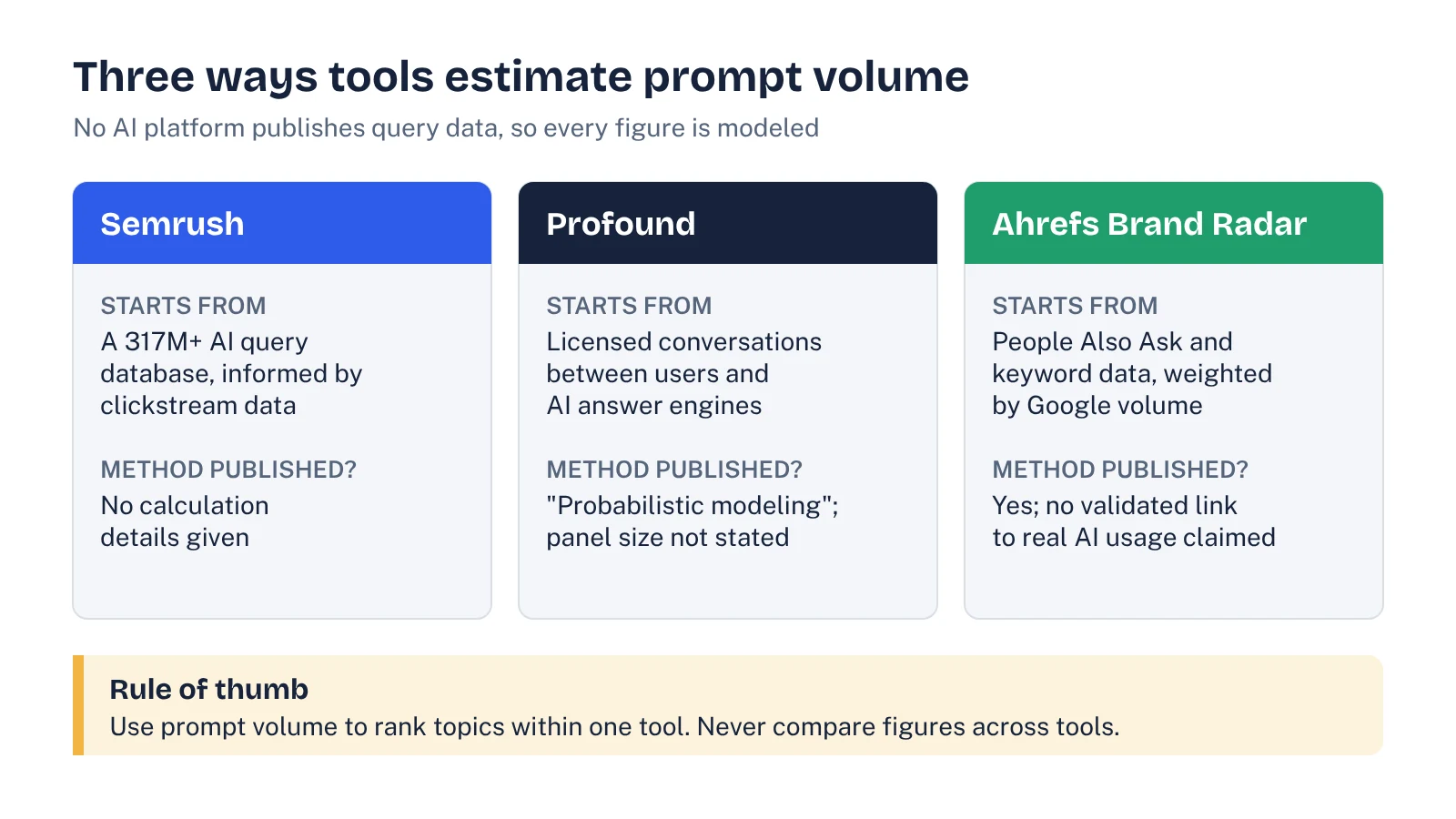
What this means in practice:
- Use prompt volume to rank, not to forecast. It is good for telling you that "CRM for real estate teams" is asked more than "CRM with Zapier integration". It is not good for predicting traffic.
- Never mix tools. A Semrush AI Volume of 5,000 and a Profound volume of 5,000 are not the same thing. Pick one tool as your volume reference.
- Expect long-tail prompts to show nothing. Real buyer prompts are long and specific. Most will have no measurable volume in any tool, and that doesn't make them unimportant.
If you want a sense of scale, Ahrefs' prompt guide cites an estimate that search-like use of ChatGPT is about 12% of Google's volume. OpenAI's own analysis of 1.5 million conversations found that 49% of messages were people asking for information or advice, as opposed to having ChatGPT do a task (OpenAI, September 2025). Plenty of buyers ask. You just can't count them precisely.
Where real buyer prompts come from
Because volume data is weak, the quality of your prompt set depends on where you find prompts. Here are the sources we use, in order of how much we trust them:
| Source | What it gives you | Watch out for |
|---|---|---|
| Sales and demo call notes | The exact words buyers use, including their constraints and the competitors they compared | Small samples; skewed to people who already found you |
| Long Search Console queries | Real conversational queries. Ahrefs suggests filtering for queries of six or more words with the regex ^(\S+\s+){5}\S+ | Only shows queries you already appear for |
| Forums and Reddit threads | First-hand questions with context, like team size, budget and tools already used | Phrasing can be niche; check it matches your buyer |
| Keyword tool question data | Coverage and relative demand for the topics behind prompts | Short, search-style phrasing that needs rewriting |
| People Also Ask and AI follow-up questions | How Google and assistants expand a topic | Machine-generated; not proof anyone asked |
| Prompt research tools | Speed, scale across markets, and a rough volume signal | Modeled volumes; prompts may be generated rather than observed |
Glen Allsopp's guide to choosing prompts at Ahrefs lists 11 sources in total, including pages that already get AI referral traffic and queries where competitors are cited and you are not. It's worth reading in full. The point we'd add: weight your own customer data above everything else, because it is the only source that tells you a real buyer asked.
How to turn keywords into prompts: a worked example
Keyword data is still your best map of what a market cares about. The trick is to treat keywords as raw material for wording, not as the prompts themselves. Semrush's prompt research guide makes the same point: constraints in a persona are what push an assistant from explaining to recommending.
Here is an example using a category most readers know, project management software, with Ahrefs US data pulled today:
| Keyword (US monthly searches) | What it tells you | Prompt you might track |
|---|---|---|
| project management software (401,000) | Huge head term, too broad to act on | Don't track as-is |
| how to choose project management software (500) | Buyers want selection criteria | "We're a 15-person design agency that bills by the hour. How should we choose project management software, and which tools fit?" |
| project management software for agencies (200) | A segment with its own needs | "What's the best project management tool for a small creative agency that needs time tracking and client approvals?" |
| asana alternatives (1,200) | Switching intent, competitor named | "We've outgrown Asana's free plan. What are good alternatives for a 30-person marketing team under $15 per user?" |
| monday.com vs asana (400) | Head-to-head evaluation | "Monday.com or Asana for a remote software team that runs two-week sprints?" |
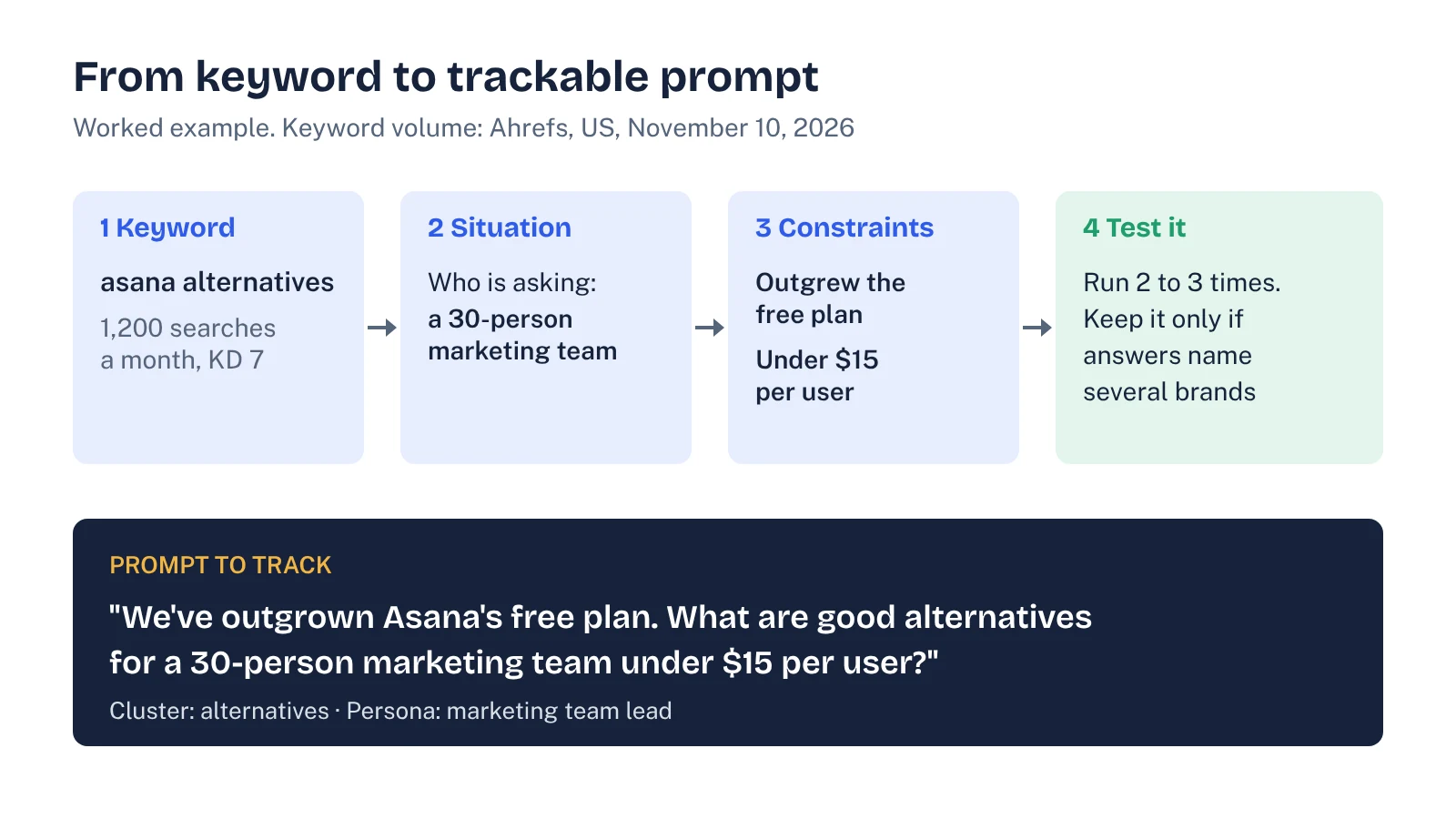
Notice what changed. Each prompt adds who is asking, what they need, and a limit such as budget or team size. That is how buyers actually talk to assistants, and it is why assistants answer with named products. It also means one keyword can produce several prompts, one per persona. If you want to understand why assistants break these long prompts into several searches behind the scenes, see our explainer on query fan-out.
See your own AI visibility, free
Get a one-page audit of how ChatGPT, Perplexity and Gemini treat your brand against up to three competitors, plus your biggest gap. In your inbox within 48 hours.
Get my free auditA six-step prompt research process
- List your products and two or three buyer personas. For each persona, write down their situation, main constraint (budget, team size, compliance, integrations) and the competitors they compare you with.
- Collect raw questions from your own data. Pull 20 to 30 questions from sales calls, demo forms, support tickets and long Search Console queries. Keep the buyer's wording.
- Fill gaps with keyword and forum data. Use your keyword tool's question report and category threads to cover topics your own data misses: alternatives, comparisons, pricing, "best for" segments.
- Rewrite into prompts. Add the persona's situation and constraint to each one. Aim for natural questions of roughly one or two sentences. Remove your brand name from non-branded prompts.
- Test before you keep. Run each candidate two or three times in the assistants you care about. Keep it only if the answers name several brands or cite sources. A prompt that returns a definition every time won't tell you anything about visibility.
- Group, tag and freeze. Sort the keepers into intent clusters (category, comparison, alternatives, pricing, problem), tag each by product and persona, and freeze the set before tracking starts. Add new prompts as a new version rather than editing old ones.
How many prompts?
Vendors don't agree. Semrush's guide suggests about 10 well-chosen prompts per product. Ahrefs says a few dozen on a narrow set of topics is enough to start. OtterlyAI recommends about 100 per country, language and product category, with 50 as a minimum.
For a B2B SaaS company in one market, 30 to 40 tested prompts across five clusters is a workable first baseline. It is small enough to review by hand and large enough that one odd answer doesn't swing your numbers, as long as you run each prompt several times. Grow it once you know which clusters move. When you're ready to turn the set into a full baseline across assistants, our guide to running an AI visibility audit includes a free template.
Common prompt research mistakes
- Tracking keywords instead of prompts. "CRM software" in ChatGPT behaves nothing like a buyer's two-sentence question. Short prompts get generic answers.
- Treating prompt volume as fact. It is modeled differently in every tool. Use it to prioritize clusters, not to justify budgets.
- Only top-of-funnel definitions. "What is a CRM?" rarely returns brand recommendations. Weight the set toward comparisons, alternatives and "best for" questions.
- Skipping the test step. Every prompt that never returns brands dilutes your share of voice and wastes tracking budget.
- Changing the set every month. Edits break trend lines. Version the set and add, don't rewrite.
- Writing prompts with your own product's language. Buyers describe problems, not your feature names. If a prompt only makes sense to your team, rewrite it.
Do you need a prompt research tool?
Not to start. Your own call notes, Search Console, a keyword tool and an afternoon of testing will get you a solid first set. A dedicated tool earns its cost when you need to cover several products, countries or languages, or when you want a consistent relative-demand signal across hundreds of topics. If you are comparing options, our roundup of the best AI visibility tools compares the main trackers; check whether each one offers prompt discovery or only tracks prompts you supply.
Whichever route you take, hold on to the principle behind this guide: real buyer language first, volume estimates second, and a test run before any prompt earns a place in your set.
FAQ
What is prompt research?
Prompt research is finding and choosing the questions people ask AI assistants about your category, so you can measure and improve how you appear in the answers. It's the AI-search counterpart to keyword research. Its output is a prompt set, usually grouped by intent, that you then track over time.
What is prompt volume in AI visibility?
Prompt volume is an estimate of how often people ask an AI assistant about a topic or prompt. AI platforms don't publish this data, so tools model it from licensed conversation data, clickstream panels or Google search volume. Treat it as a directional signal and only compare figures from the same tool.
How is prompt research different from keyword research?
Keyword research measures short queries people type into search engines, with reliable volume data. Prompt research looks for longer, conversational questions that include context and constraints, and the volume data is modeled rather than observed. Keyword research is still a useful input: it shows the words buyers use.
Do I need a prompt research tool?
Not to start. Sales call notes, Search Console, forums and a keyword tool's question data are enough to build a first set of 30 to 40 prompts. A prompt research tool helps when you need to cover many products, markets or languages, or want a rough sense of which topics get asked most.
How many prompts should I research and track?
Vendors disagree. Semrush suggests about 10 well-chosen prompts per product, Ahrefs says a few dozen on a narrow topic is enough to start, and OtterlyAI recommends about 100 per country, language and category. For most B2B SaaS teams, 30 to 40 prompts in one market, run several times each, is a workable first baseline.
Sources
- Semrush Knowledge Base: Prompt Research report (AI Visibility Toolkit)
- Semrush: How to do prompt research for AI SEO (Sergei Rogulin, August 17, 2026)
- Profound Docs: About Prompt Volumes
- Ahrefs: Brand Radar Methodology, how we collect and model AI visibility data (updated February 26, 2026)
- Ahrefs: How to Choose the Best Prompts to Monitor Your AI Search Visibility (Glen Allsopp, February 2026)
- OtterlyAI Help Center: Mastering Prompt Research for Effective Brand Monitoring
- OpenAI: How people are using ChatGPT (September 15, 2025)
- Ahrefs Keywords Explorer and SERP overview, US data pulled November 10, 2026