Query fan-out: how AI search splits your buyer's question, and how B2B SaaS pages get picked

Query fan-out is how AI search engines answer one prompt by quietly running several narrower searches, then building the answer from the pages those searches return. For B2B SaaS, it means a buyer's single question gets judged against your pricing, security, integration and comparison pages at once. This guide covers what the 2026 studies show, where to see real fan-out queries, and how to audit your coverage.
- AI Mode, ChatGPT search and Copilot break a prompt into sub-queries, retrieve results for each, and merge them. Your page competes on the sub-queries, not only the prompt.
- Studies disagree on how many sub-queries run (from about 1.6 to 11 per prompt) because engines, models and logged-in status differ. Treat any single number with care.
- Ranking for sub-queries correlates with being cited, but most cited pages don't rank top 10 for any of them. Cover the intent across your domain instead of chasing exact strings.
- ChatGPT's fan-outs increasingly include the current year, "official", "price" and site: searches aimed at brand sites. Your own pricing, security and docs pages need to answer those directly.
- Bing Webmaster Tools shows real grounding queries and, since October 2026, opportunity queries where competitors are cited and you aren't. Start there.
What query fan-out is
When a buyer asks an AI search engine a real question, the engine rarely runs that exact question as one search. It splits it into narrower sub-queries, runs them in parallel, and writes the answer from what comes back. That process is called query fan-out.
Google gave it the name when it launched AI Mode. Its May 2025 announcement said AI Mode uses a "query fan-out technique, breaking down your question into subtopics" and "issuing a multitude of queries simultaneously on your behalf." Deep Search takes it further and "can issue hundreds of searches." OpenAI, Microsoft and Perplexity don't use the term, but ChatGPT search, Copilot and Perplexity work in a similar way: they search the web with their own rewritten queries before answering.
For a B2B SaaS team, the practical consequence is simple. Your page isn't only competing for the prompt a buyer typed. It's competing for each hidden sub-query, and the pages that keep showing up across those sub-queries are the ones that end up cited.
How fan-out works, step by step
The engines don't publish their pipelines in detail, but the public descriptions and the studies below agree on the broad shape:
- Read the prompt. The model works out intent, how complex the question is, and what kind of answer is needed.
- Decompose it. It writes several sub-queries, each covering one angle: a definition, a comparison, the price, a constraint the buyer mentioned, the current year.
- Retrieve in parallel. Each sub-query runs against a search index (Google's for AI Mode, Bing and others for ChatGPT and Copilot).
- Merge and score. Results are combined. Ahrefs describes methods like reciprocal rank fusion, which reward documents that appear in several result lists.
- Write the answer. The model synthesizes from the top-scored pages and cites some of them.
Here is what that can look like for a typical B2B buying prompt. The sub-queries below are illustrative, written to show the common patterns, not captured from a specific engine.
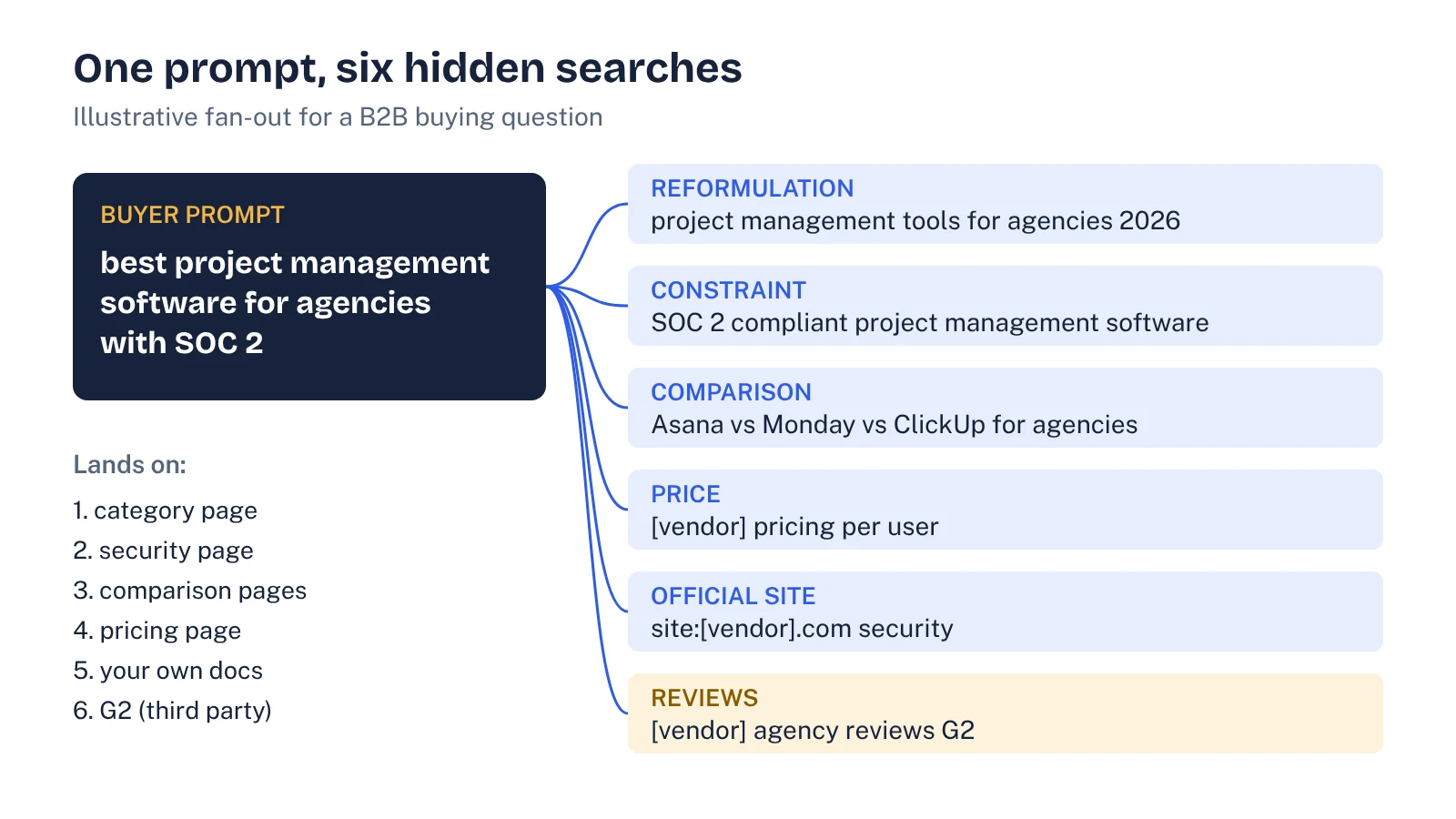
Notice which of your pages each branch would land on. The constraint check hits your security page. The price check hits your pricing page. The site: search goes straight to your own domain. The reviews branch lands on G2, not on you. A single prompt quietly tests five or six pages, and most teams have only optimized one of them.
How many sub-queries actually run? The studies disagree
You'll see confident numbers quoted for fan-out volume. They vary a lot, because each study looked at a different engine, model version and account state. Here's what the main 2025–2026 studies found:
| Study | What was measured | Sub-queries per prompt |
|---|---|---|
| Ahrefs (Aug–Sep 2026 data) | 66.6M free, logged-out ChatGPT responses | 14.4% of responses contained fan-outs, averaging about 1.6 each |
| Peec AI (Oct 2025–Jan 2026) | 20M+ ChatGPT fan-outs across five countries | 2.3 to 2.8, roughly flat; average length doubled from about 6 to about 12 words |
| Grow and Convert (published Mar 2026) | 100 buying-intent prompts in the ChatGPT browser UI | 2 to 4 when search ran; 83 of 100 prompts triggered search |
| Seer Interactive and Nectiv (as reported by Ahrefs) | Fan-out prompts studied | 9 to 11 on average; 59% triggered 5 to 11 searches |
| Google (May 2025) | AI Mode and Deep Search | "A multitude"; Deep Search "hundreds" |
The lesson isn't the exact count. It's that fan-out behavior shifts with every model update, and that ChatGPT's sub-queries are getting longer and more specific even when the count holds steady. A 12-word sub-query is a narrow question. Pages that answer narrow questions plainly have a better chance of matching it.
Does ranking for sub-queries get you cited?
Two 2026 studies looked at this from different angles, and together they give a useful answer.
Surfer took 10,000 keywords, generated 33,000 fan-out queries with Gemini, and compared rankings with Google AI Overview citations across 173,902 URLs. The more sub-queries a page ranked for, the more likely it was cited (Spearman correlation of 0.77). Of cited pages that ranked, 51.2% ranked for the main query plus at least one fan-out, against 19.6% for the main query alone. But 67.82% of cited pages didn't rank in the top 10 for the query or any of its fan-outs.
Grow and Convert checked whether the URLs ChatGPT cited ranked for the fan-out queries it ran. Only 27% ranked on Google and 23% on Bing for those exact queries, about 40% combined across the first 10 pages. When they counted any page from the cited domain, the match rose to about 50%.
Read together: ranking across a cluster of related queries helps, and the domain matters more than the exact URL. Neither study supports building a page for each sub-query. Both point toward covering an intent well across your site, so that whichever sub-query the engine writes today, one of your pages is a strong match. Our guide on how to rank in AI Overviews covers the Google side of this in more depth.
The fan-out patterns that matter for B2B SaaS
The Ahrefs study of 15 million ChatGPT fan-outs tracked which words became more common between August and September 2026. The shifts line up closely with what B2B buyers ask before a demo:
- Fan-outs containing "2026" rose from 17.6% to 22.9%.
- "Official" rose from 10.1% to 13.1%, and "price" from 6.0% to 8.9%.
- "Reviews" rose from 2.7% to 3.6%.
- 6.8% of fan-outs used the site: operator, and 75.9% of the most common site: searches pointed at brand sites.
That last point deserves attention. When ChatGPT wants an official fact, it often searches your own domain for it. If your pricing is "contact sales" with nothing else on the page, or your security details sit in a PDF behind a form, that branch of the fan-out comes back empty and the answer gets built from a review site or a competitor's comparison page instead.
Here's how the common patterns map to the pages a SaaS site should have ready:
| Fan-out pattern | B2B sub-query shape | Page that should answer it |
|---|---|---|
| Reformulation + recency | [category] software for [segment] 2026 | Category or use-case landing page, with a visible updated date |
| Constraint check | [category] with SOC 2 / SSO / HIPAA | Security or trust page in plain HTML |
| Price check | [vendor] pricing per user, free plan | Pricing page with real numbers or clear starting prices |
| Official site check | site:[vendor].com integrations / API | Integrations directory and public docs |
| Comparison | [vendor] vs [competitor] for [use case] | Honest comparison pages |
| Trust signals | [vendor] reviews, [vendor] G2 | Third-party profiles (G2, Capterra, Reddit threads) |
The last row is the one you can't fix on your own site. Our post on B2B review sites and AI visibility looks at how much those profiles actually get cited.
How to find the fan-out queries behind your buyers' prompts
There are three kinds of source, and they differ in how much you can trust them.
- Bing Webmaster Tools (real, free). The AI Performance report lists grounding queries, the searches Copilot ran when it cited your pages. On October 13, 2026 Bing added a Topics Portfolio beta that groups those queries into themes and lists opportunity queries, where other sites are cited and yours isn't. Bing calls the figures directional and notes that smaller sites may see few topics, but it's the closest thing to a free list of real fan-outs.
- AI visibility trackers (real, paid). Some tools capture the sub-queries behind the prompts they monitor. Ahrefs Brand Radar, for example, shows fan-outs for ChatGPT and Perplexity responses. If you already run a fixed prompt set, as described in our guide to AI prompt tracking, check whether your tool stores them.
- Fan-out generators (simulated, free). Tools like queryfanout.io, or simply asking a model to break a prompt into the searches it would run, produce plausible sub-queries. They're good for brainstorming, but they are a model's guess, not a log of what any engine ran.
Add a fourth source that no tool has: your sales calls. The questions prospects ask in the first discovery call (does it integrate with X, is it SOC 2, what does it cost for 40 seats) are the same constraints they type into the prompt, and the same ones the engine fans out on.
See your own AI visibility, free
Get a one-page audit of how ChatGPT, Perplexity and Gemini treat your brand against up to three competitors, plus your biggest gap. In your inbox within 48 hours.
Get my free auditA fan-out coverage audit you can run this week
This takes a marketer and a spreadsheet about half a day for 10 prompts.
- Pick 10 money prompts. The questions a buyer asks when shortlisting tools in your category, written the way they'd type them, constraints included.
- Collect sub-queries. Pull real grounding queries from Bing where you have them, add tracker fan-outs if you have a tool, and fill gaps with a generator. Aim for 5 to 10 per prompt.
- Group them into intents. Use the six patterns in the table above. Most B2B prompts land in four or five of them.
- Map each intent to one URL. Write down the page on your site that should answer it. If nothing fits, mark it as a gap.
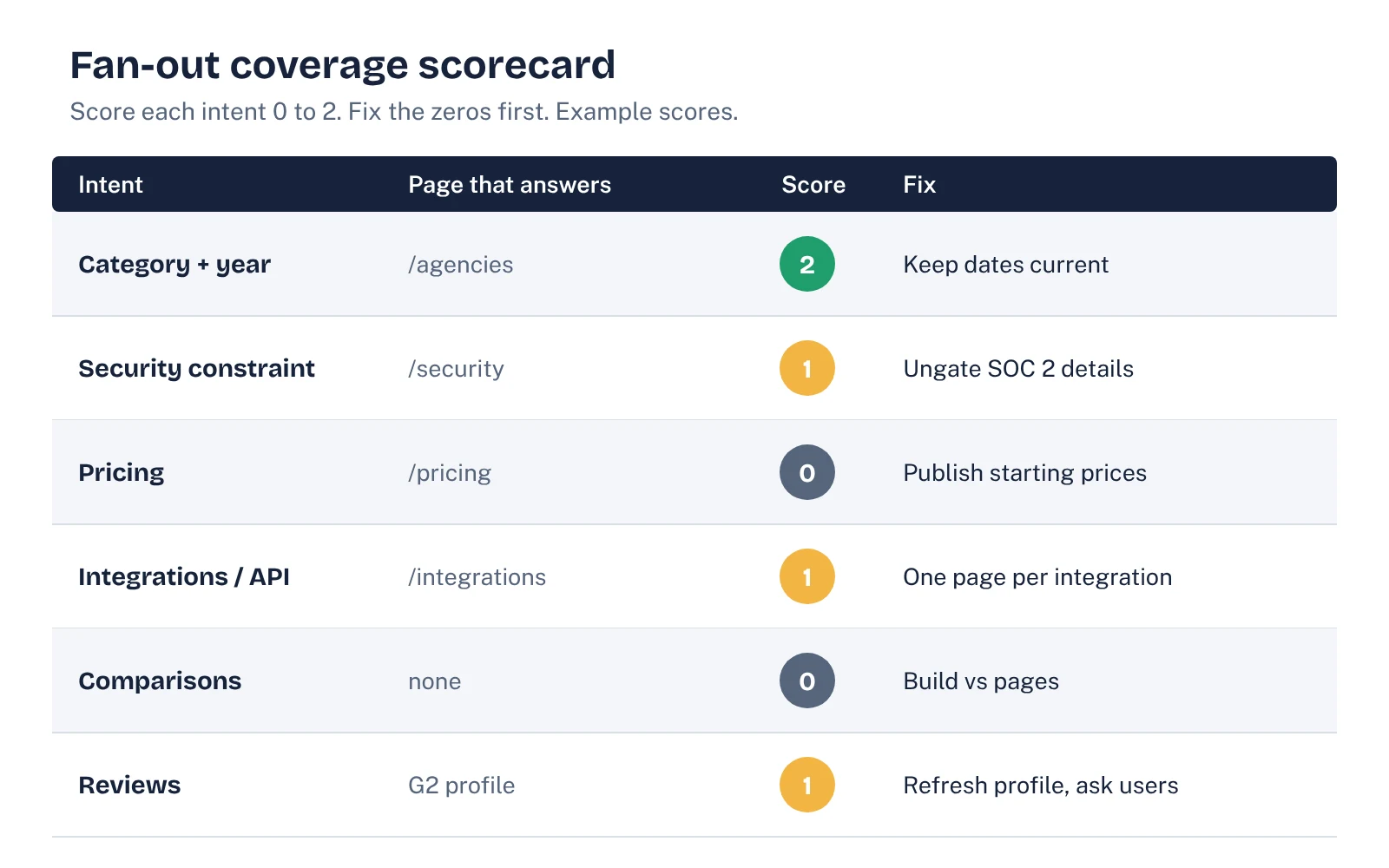
- Score each page 0, 1 or 2. 0 = no page or the answer is missing. 1 = the answer exists but is buried, gated or vague. 2 = the answer is in the first lines of a section, in plain text, with specifics (numbers, names, dates).
- Fix the zeros on your own site first. Usually that means publishing pricing ranges, moving security details out of a gated PDF, and adding an integrations page per major integration.
- List the third-party gaps. For trust and comparison intents, note which outside pages get cited and decide whether to update a profile, pitch an inclusion, or build your own comparison page.
Re-run the prompts a month later and check citations, not just mentions. Our guide to LLM citation tracking shows how to log which URLs get cited so you can see whether a fixed page starts showing up.
What not to do
- Don't build a page per sub-query. Fan-outs change between runs and almost none have recurring search volume. Seer Interactive found that over 95% get no recurring searches, as reported by Ahrefs. A page per string creates thin content that ranks for nothing.
- Don't stuff the year into every title. The rise of "2026" in fan-outs is a freshness signal. Answer it with real updates and visible dates, not a changed number in a stale page.
- Don't trust one tool's sub-queries as fact. Generated fan-outs are a model's estimate. Weight real grounding queries above them.
- Don't ignore the domain. Grow and Convert's match rate doubled when they counted any page on the cited domain. Strong, interlinked pages on one topic help each other get picked.
Why marketers are searching for this now
We pulled the main phrasings from Ahrefs Keywords Explorer this morning (US data, November 1, 2026). "Query fan out" gets about 600 searches a month with a keyword difficulty of 40. Tool and example queries follow: "query fan out tool" (400), "query fan out examples" (350, KD 34) and "query fan-out content-cluster" (350, KD 11). "Query fan out seo" has 200 searches and a KD of 0.
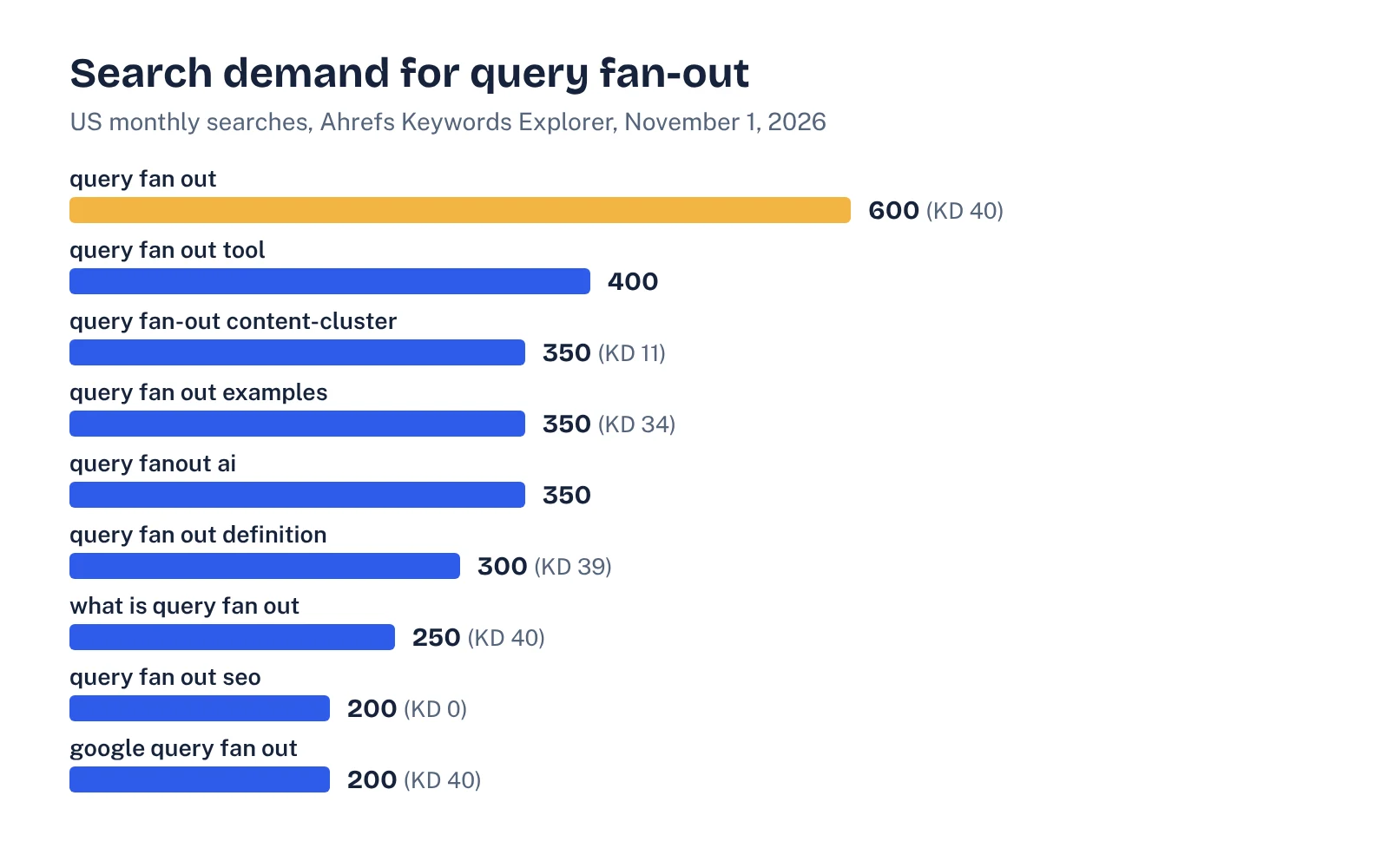
The mix says people want to see examples and get a tool, then decide what to do with the output. The top-ranking explainers cover the definition well but use consumer examples like phone cases and gardening. For a SaaS team, the useful part is the mapping from sub-query to page, and the audit above is the fastest way to do it. If you want to go further, our page-level playbook for getting cited by ChatGPT covers how to write each of those pages.
FAQ
What is query fan-out in simple terms?
It's when an AI search engine turns your one question into several smaller searches, runs them at the same time, and writes an answer from the combined results. Google introduced the term for AI Mode in May 2025, and ChatGPT, Copilot and Perplexity work in a similar way.
How do I find the fan-out queries for my topic?
The most reliable free source is the grounding queries list in Bing Webmaster Tools' AI Performance report, which shows the searches Copilot ran when it cited you. Paid trackers such as Ahrefs Brand Radar show fan-outs for ChatGPT and Perplexity prompts. Free generators simulate fan-outs with a language model, which is useful for brainstorming but not proof of what an engine actually ran.
Should I create a page for every fan-out query?
No. Fan-out queries change between runs and almost none have recurring search volume. Group them into intents (pricing, security, integrations, comparisons, use cases) and make sure one strong page answers each intent clearly.
Does query fan-out make traditional SEO irrelevant?
No. The engines still retrieve from search indexes, and studies find that pages ranking for the main query and its sub-queries are more likely to be cited. What changes is the unit of competition: a cluster of related questions rather than one keyword.
Sources
- Google: AI in Search, going beyond information to intelligence (May 20, 2025)
- Ahrefs: How ChatGPT does query fan-out (15 million queries studied), October 2026
- Ahrefs: What is query fan-out? Understanding the hidden queries driving AI search
- Peec AI research: ChatGPT fan-out length trend (February 2026)
- Surfer: Query fan-out and AI Overview citations (173,902 URLs studied)
- Grow and Convert: Do ChatGPT's cited sources rank for its fan-out queries? (March 30, 2026)
- Bing Webmaster Blog: Introducing Topics Portfolio (beta) in AI Performance (October 13, 2026)
- Semrush: What is query fan-out? How to find and optimize for subqueries
- Ahrefs Keywords Explorer (US data pulled November 1, 2026)