How to rank in AI Overviews and AI Mode: what Google says and what studies show
To rank in AI Overviews, your page must be indexed and eligible for a snippet; Google says nothing more is required. In practice, cited pages usually rank in the top 10, answer the sub-questions Google searches behind the scenes, and come from brands mentioned widely online. Here's how to rank in AI Overviews and AI Mode.
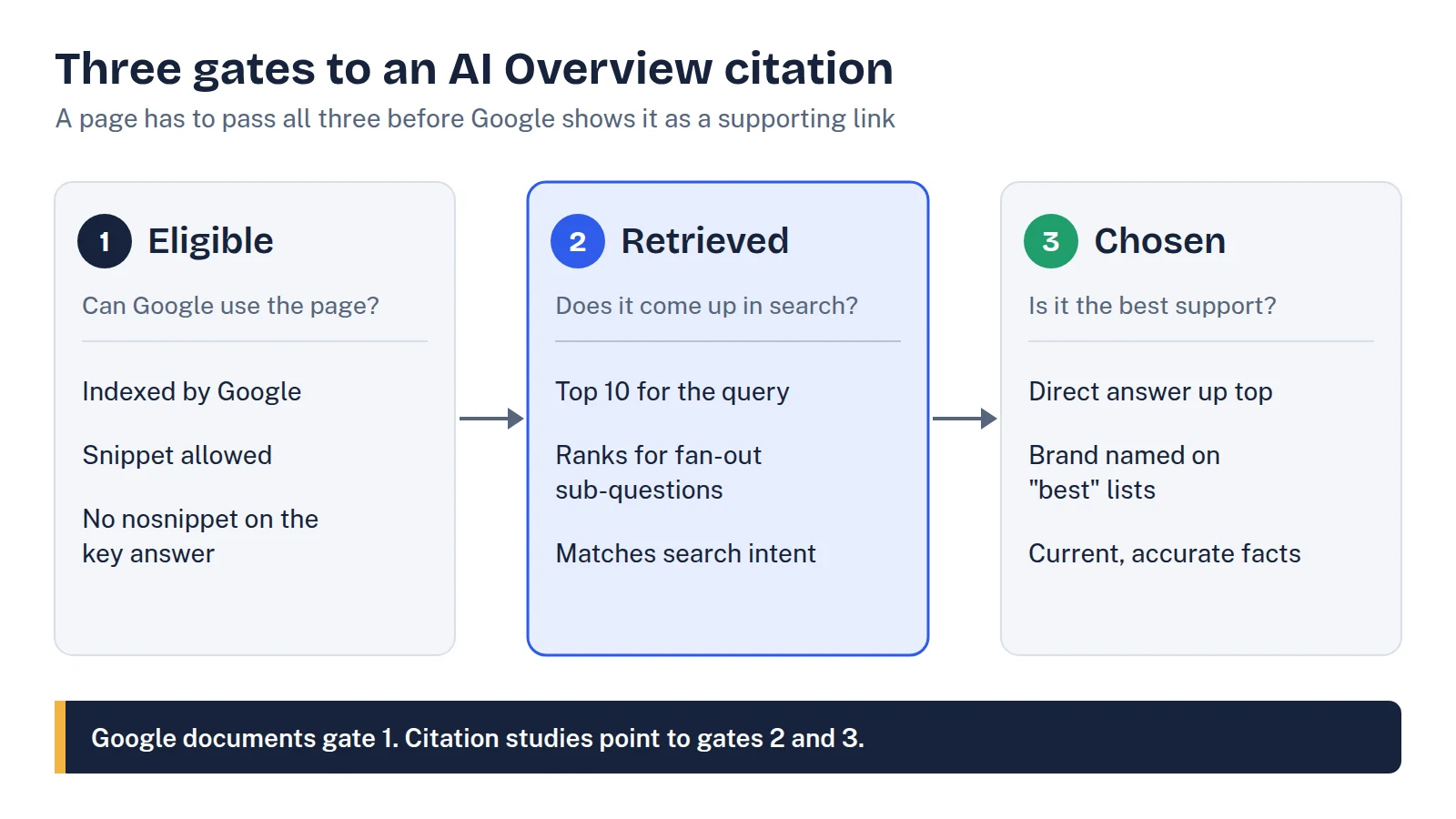
- Google says there's no special optimization or schema for AI Overviews or AI Mode. Pages must be indexed and snippet-eligible.
- Top-10 rankings explain fewer citations than before (about 38% in Ahrefs' March 2026 study, down from 76%); ranking for fan-out sub-queries matters more.
- In our Ahrefs check of 28 B2B SaaS keywords, 27 showed an AI Overview, including 'best X software' and 'X vs Y' searches.
- Brand mentions across the web, including on 'best' lists and YouTube, correlate strongly with being named.
- Search Console doesn't separate AI Overview traffic, so track target queries and citations directly.
How AI Overviews and AI Mode pick their sources
AI Overviews are the generated summaries at the top of many Google results. AI Mode is the separate, conversational search tab that answers follow-up questions. Both write an answer and show supporting links next to it. Getting one of those links, or getting your brand named in the text, is what "ranking" in AI Overviews means.
Google's documentation, AI features and your website, describes the key mechanism. Both features may use "query fan-out," which means "issuing multiple related searches across subtopics and data sources" to build the answer. So when someone searches "best help desk software for startups," Google may also search for pricing, integrations, ease of setup and alternatives, then pull supporting pages from all of those result sets.
Two consequences follow for anyone trying to rank in AI Overviews:
- Pages come from Google's normal index, so classic rankings still matter a lot.
- Ranking for the sub-questions around your main query matters too, not only for the query itself.
What Google says (and doesn't say)
Google's guidance is short and worth reading in full. The main points:
- "There are no additional requirements to appear in AI Overviews or AI Mode, nor other special optimizations necessary."
- To be shown as a supporting link, "a page must be indexed and eligible to be shown in Google Search with a snippet."
- "There's also no special schema.org structured data that you need to add."
- You control what's shown with the usual tools:
nosnippet,data-nosnippet,max-snippetandnoindex. - Traffic from AI features is counted inside Search Console's Performance report under the "Web" search type. It isn't broken out separately.
That leaves a gap between what Google documents and what the industry recommends. The table below sorts the common advice.
| Common advice | Google's position | What the evidence suggests |
|---|---|---|
| Rank in the top 10 | Normal Search eligibility applies | Strongly supported: most citations come from top-ranking pages |
| Cover related sub-questions | Describes query fan-out | Strongly supported by citation studies |
| Earn brand mentions elsewhere | Not addressed directly | Strong correlation with brand visibility |
| Add special AI schema | Not required | No proof of a direct effect; standard structured data is still good practice |
| Write longer content | Not addressed | Near-zero correlation between word count and citations |
Do AI Overviews show up for B2B SaaS searches?
Across all keywords, AI Overviews are far from universal. Ahrefs' analysis of 146 million SERPs found them on about 21% of keywords, rising to 57.9% for question-style queries.
B2B software searches look different. We checked 32 typical B2B SaaS keywords in Ahrefs (US, September 2026): definitions, how-to questions, "best X software" lists and "X vs Y" or "alternatives" searches. Four long-tail how-to terms had no SERP data and were excluded. Of the remaining 28, 27 showed an AI Overview in the latest SERP check, including high-intent searches like "best crm software" (14,000 monthly searches), "hubspot vs salesforce" (4,800) and "mailchimp alternatives" (3,600).
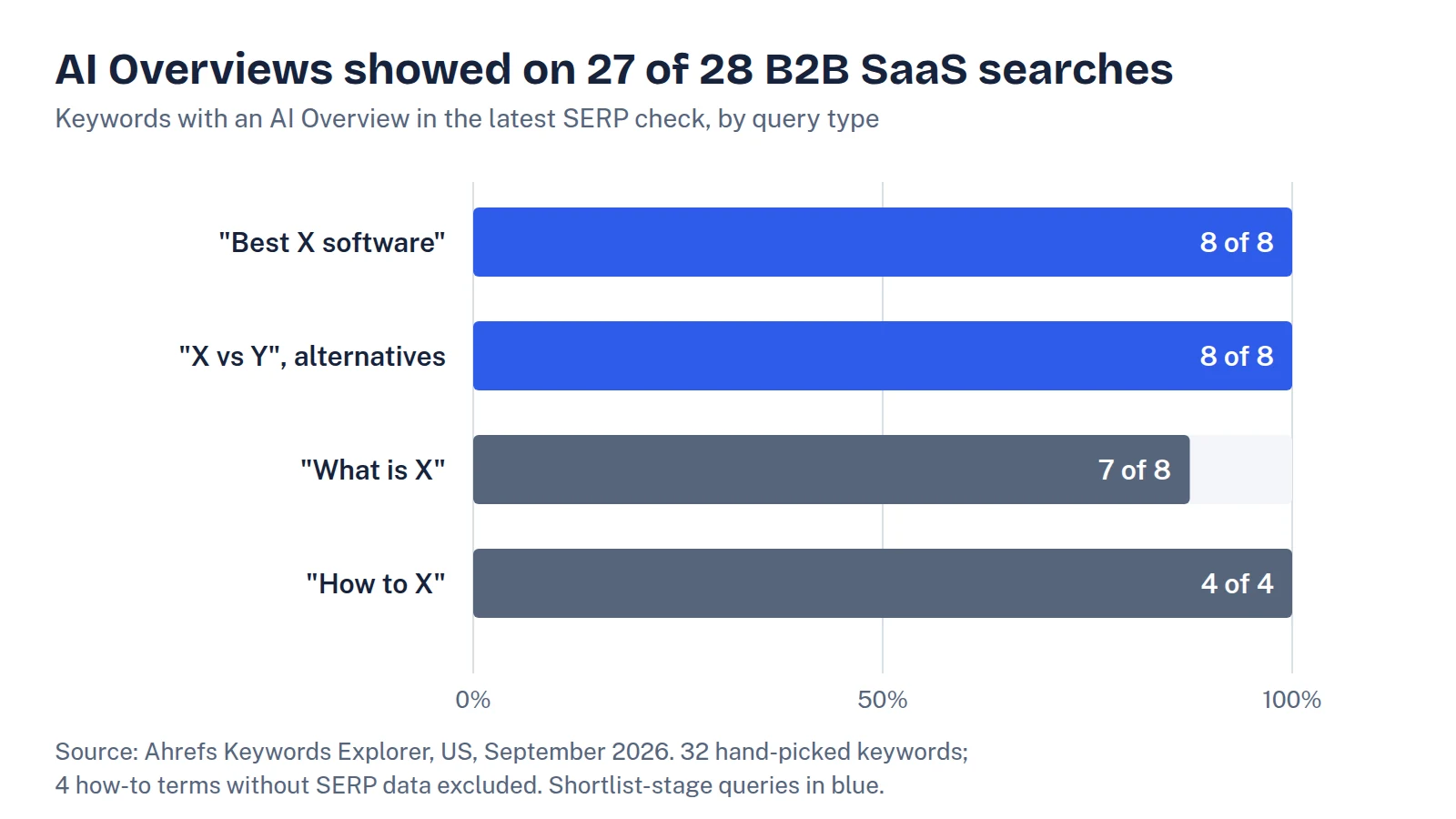
This is a small, hand-picked sample, not a census, and SERP features change between checks. But the direction is clear: if your buyers search Google for software, many of them now see a generated answer before any organic result. The shortlist in that answer is the new page one.
What studies say drives AI Overview citations
Google doesn't publish ranking factors for AI features, so the best evidence comes from large correlation studies. The most useful findings from Ahrefs' research:
- Rankings matter, but less than they did. In Ahrefs' July 2025 analysis about 76% of cited URLs also ranked in the top 10. Its March 2026 follow-up of 863,000 SERPs put that figure at 37.9%, as Google leans more on query fan-out. Ranking still helps; it is no longer the whole story.
- Fan-out coverage matters more. The correlation between ranking for fan-out queries and being cited was 0.77, and pages ranking across fan-out queries were 161% more likely to be cited.
- Brand mentions matter for being named. In a study of 75,000 brands, branded web mentions had the strongest correlation with AI Overview brand visibility (0.664), far above backlinks (0.218). 26% of brands had no AI Overview mentions at all.
- "Best" lists carry weight. In an analysis cited in the same Ahrefs guide, "best" list posts made up 48.9% of AI Overview citations, a higher share than in ChatGPT, Perplexity or AI Mode.
- Length doesn't. Word count had a near-zero correlation with citations (about 0.04). Focused pages did as well as long ones.
Correlation isn't causation, and these studies measure the average across many topics. Still, they point to the same work: rank well, cover the surrounding questions, and get your brand named on the pages Google trusts for your category.
How to rank in AI Overviews: a 7-step process
- List your money queries. Pick 20 to 40 searches that lead to pipeline: category, "best X for Y", comparisons and alternatives.
- Check which ones trigger an AI Overview. Use a keyword tool's SERP features filter or search them yourself in a clean browser. Note who gets cited and which brands are named.
- Confirm eligibility. Each target page must be indexed and snippet-eligible. Check for stray
noindex, overly strictmax-snippetvalues, ordata-nosnippetwrapped around your key answer. - Close ranking gaps. If your page isn't in the top 10 for the main query, fix that first with normal SEO: intent match, internal links and backlinks.
- Map and answer the fan-out questions. For each query, list the likely sub-questions (pricing, integrations, setup time, who it's for, alternatives). Answer each one directly on the page or on a closely linked page.
- Get onto the cited roundups. If the AI Overview cites three "best tools" articles and you're in none of them, that's your outreach list. Pitch facts, not adjectives.
- Measure monthly. Recheck the same queries, track citations and brand mentions, and compare with Search Console clicks.
Worked example: mapping fan-out for one query
Take a hypothetical help desk tool targeting "best help desk software for startups." Before touching any page, write down the questions a careful buyer would also ask, because these are the searches Google is likely to run behind the scenes:
- What does help desk software cost for a team of three to ten agents?
- Which tools have a free plan or a cheap starter tier?
- Which ones integrate with Slack, Shopify or the CRM the team already uses?
- How long does setup take without a dedicated admin?
- What are the main alternatives to the market leader for small teams?
Then check each one. Search it, note whether an AI Overview appears, and see which pages rank. You'll usually find that your main product page covers one or two of these at best. The fix is rarely one giant page. It's a clear pricing page, an integrations page that lists real integrations in text, a short setup guide, and an honest alternatives page, all linked to each other and to the main page. Each of those can rank for its own sub-question, which is exactly the fan-out coverage the studies reward.
See your own AI visibility, free
Get a one-page audit of how ChatGPT, Perplexity and Gemini treat your brand against up to three competitors, plus your biggest gap. In your inbox within 48 hours.
Get my free auditWhat's different about AI Mode
AI Mode uses the same eligibility rules, but the experience is conversational. Buyers ask longer questions and follow-ups, so there are more sub-queries and more chances to be cited, or skipped.
Brand strength seems to matter even more there. In Ahrefs' later study of 75,000 brands across ChatGPT, AI Mode and AI Overviews, AI Mode visibility correlated most strongly with branded anchors (0.628) and branded search volume (0.466). Across all three platforms, YouTube mentions were the strongest single signal. In practice, the brands people already search for and talk about are the ones AI Mode reaches for.
ChatGPT works differently again, with its own crawler and far less overlap with Google's top 10. We cover that in how to rank in ChatGPT, and the off-site side in how to earn AI brand mentions.
How to track AI Overview visibility
Search Console won't show AI Overview clicks separately, so you need two views. First, keep watching Search Console clicks and impressions for your target queries; a query whose impressions hold while clicks fall is often one where an AI Overview now answers the question. Second, track the AI Overviews directly. A simple monthly sheet works, with one row per query and these columns:
- Query and query type (category, best-of, comparison, alternatives, problem).
- Whether an AI Overview appeared, and whether AI Mode names you for the same question.
- Whether your page is cited as a supporting link, and which URL.
- Whether your brand is named in the answer text, and in what position.
- Which competitors are named, and which third-party pages are cited.
Because answers vary between checks, look at the trend across the whole set rather than any single query. The "cited third-party pages" column doubles as your outreach list for the next month.
Demand for this is growing. In Ahrefs (US, September 2026), "how to rank in ai overviews" gets about 1,000 searches a month and "how to track ai overviews rankings" about 700. Our guide to AI visibility tracking covers building the prompt set, choosing a cadence and reporting results to leadership.
FAQ
Do I need special schema to appear in AI Overviews?
No. Google's documentation says there's no special schema.org structured data you need to add for AI Overviews or AI Mode. Standard structured data is still useful for regular search features.
Can I rank in AI Overviews if I'm not on page one?
It's possible, because Google pulls supporting links from related fan-out searches too. But most cited pages also rank in the top 10, so improving your organic ranking is usually the most reliable first step.
How do I see AI Overview traffic in Search Console?
You can't isolate it. Google includes clicks and impressions from AI features in the Performance report under the Web search type, alongside regular results. Use a separate tracker or manual checks to see whether you're cited.
How do I stop Google using my content in AI Overviews?
Google points to the same controls as regular snippets: nosnippet, data-nosnippet, max-snippet and noindex. Be careful, because these also limit how your page appears in normal search results.
Is optimizing for AI Mode different from AI Overviews?
The eligibility rules are the same. AI Mode handles longer, conversational questions with more follow-ups, and Ahrefs data suggests brand strength signals like branded search volume matter more there.
Sources
- Google Search Central: AI features and your website
- Ahrefs: How to rank in AI Overviews, what actually works
- Ahrefs: An analysis of AI Overview brand visibility factors (75K brands studied)
- Ahrefs: Top brand visibility factors in ChatGPT, AI Mode and AI Overviews (75k brands studied)
- Ahrefs: AI Overview citations and top-10 rankings (March 2026)