AI search optimization: a prioritized checklist for B2B SaaS teams
AI search optimization means making your brand easy for AI Overviews, AI Mode, ChatGPT, Perplexity and Copilot to find, trust and repeat. In practice it's three jobs: let AI crawlers reach your pages, answer buyers' follow-up questions plainly, and get named on the pages these systems cite. Below is a 17-step checklist in priority order, sorted by how strong the evidence is.
- Google says optimizing for its AI features "is still SEO": pages must be indexed and snippet-eligible, with no special markup or llms.txt needed.
- Blocking OAI-SearchBot keeps you out of ChatGPT search answers. Check robots.txt and your CDN first.
- Only 37.9% of URLs cited in AI Overviews ranked top 10 for the query in Ahrefs' March 2026 study, so answer the follow-up questions too.
- Web mentions correlated with AI Overview visibility far more than backlinks (0.664 vs 0.218) across 75,000 brands.
- AI answers vary run to run. Measure mention rates across repeated prompts, not screenshots.
What AI search optimization actually is
AI search optimization is the work of making your brand easy for AI systems to find, trust and repeat. The systems that matter for most B2B SaaS teams are Google's AI Overviews and AI Mode, ChatGPT search, Perplexity, Gemini and Copilot.
You'll also see it called GEO, AEO, LLM SEO or AI SEO. The labels differ, the job is the same. We compared the terms in GEO vs SEO, so this guide skips the vocabulary and goes straight to the work.
One idea shapes everything below. AI answers are built from retrieved web pages. Google calls this grounding: its ranking systems fetch current pages, and the model writes an answer that links to them. ChatGPT search works in a similar way: OpenAI's help page says it "typically rewrites your query into one or more targeted queries" and sends them to search providers. So the question is never "how do I optimize for the model?" It's "which pages does the system retrieve for my buyers' questions, and what do those pages say about me?"
Why this is on your roadmap now
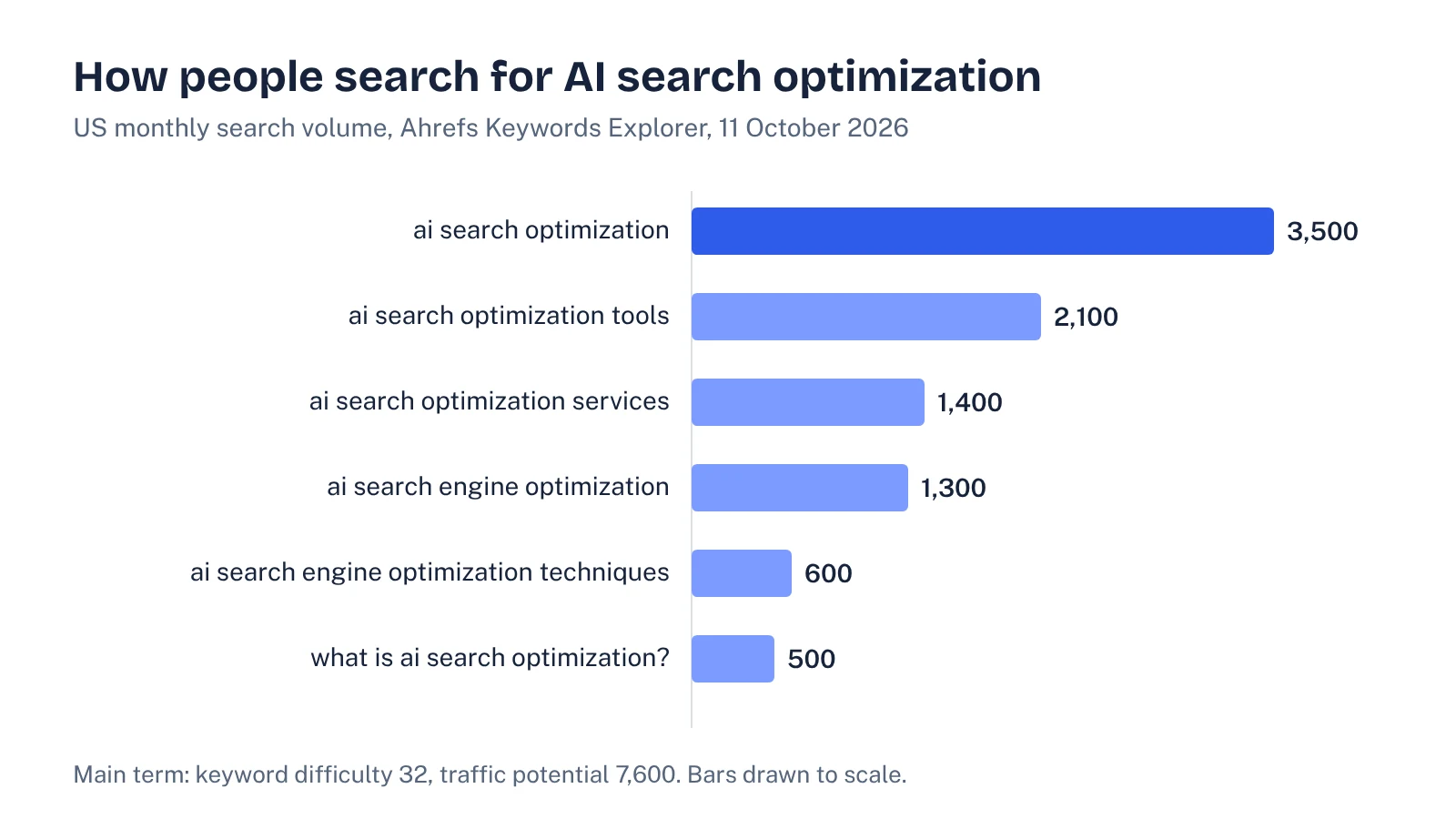
We pulled US search demand for the topic in Ahrefs Keywords Explorer this morning. "AI search optimization" gets about 3,500 searches a month, with a keyword difficulty of 32. Searches for tools (2,100) and services (1,400) are close behind, which tells you many people have moved past the definition and are now looking to buy help or software.
The search results page for that keyword is itself a good example of the shift. When we checked it in Ahrefs, it opened with an AI Overview, and Google's own guide to generative AI features ranked second organically. The rest of page one mixed agency service pages, tool vendor blogs, YouTube videos and a large block of recent Reddit and LinkedIn discussion.
Most of the ranking guides give you a long list of tactics with equal weight. What they rarely do is separate what the platforms have confirmed from what is a reasonable bet and from what is noise. That separation is the most useful thing you can bring to a planning meeting, so it's where we start.
What's confirmed, what's likely, what's myth
Google rewrote its guide to optimizing for generative AI features in July 2026. Its core position is that AI Overviews and AI Mode run on the same ranking and quality systems as regular Search, so optimizing for them "is still SEO." OpenAI's crawler documentation is equally plain about access. Add the best independent studies and you get this picture:
| Claim | Status | Evidence |
|---|---|---|
| Pages must be indexed and eligible for a snippet to appear in Google's AI features | Confirmed | Google's AI optimization guide |
| Blocking OAI-SearchBot keeps you out of ChatGPT search answers | Confirmed | OpenAI bots documentation |
| AI systems run several related searches behind one question (query fan-out) | Confirmed | Google's guide; OpenAI help docs |
| Brand mentions across the web track with AI Overview visibility | Likely (correlation) | Ahrefs, 75,000 brands: branded web mentions 0.664, backlinks 0.218 |
| Ranking top 10 for the query gets you cited | Weakening | Ahrefs: 76% overlap in July 2025, 37.9% in March 2026 |
| You need llms.txt, special markup or Markdown copies | Myth for Google | Google says Search ignores them |
| You should split pages into small "chunks" | Myth for Google | Google: "no ideal page length" |
| Schema markup is required for AI answers | Myth | Google: not required, still useful for rich results |
Two of those rows deserve a closer look. Ahrefs found that only 37.9% of URLs cited in AI Overviews also ranked in the top 10 for the same query, across 863,000 SERPs. Its likely explanation is fan-out: the pages that win the sub-query results get cited. And in Ahrefs' study of 75,000 brands, how often a brand is mentioned across the web correlated far more strongly with AI Overview visibility than how many backlinks it had. Correlation isn't causation, but both findings point the same way: your own rankings are only part of the picture.
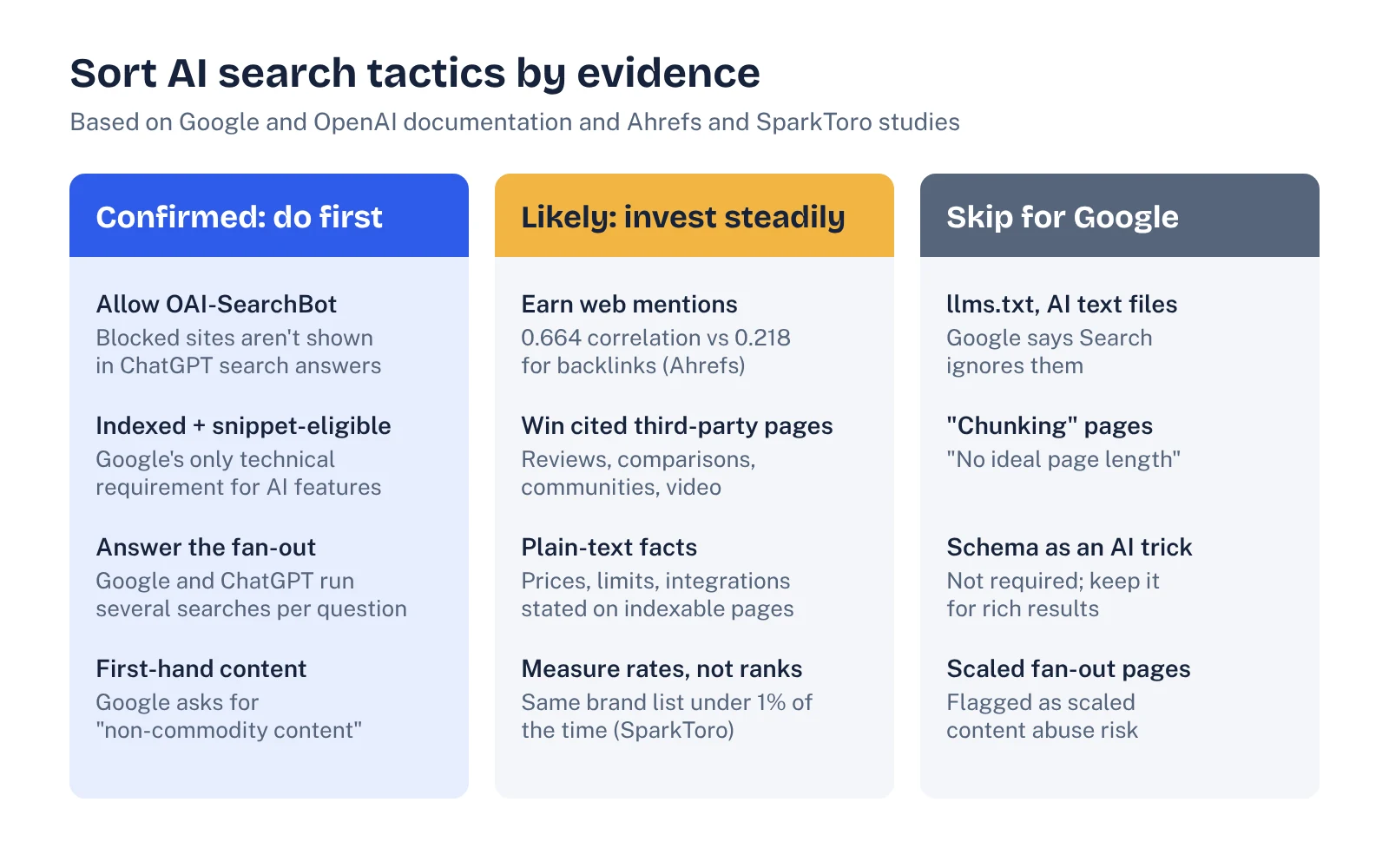
The AI search optimization checklist, in priority order
Work top to bottom. Each block depends on the one before it: there's no point rewriting pages an AI crawler can't reach, and no point measuring before you've fixed the basics.
1. Access (one afternoon)
- Check robots.txt for OAI-SearchBot. OpenAI says sites that opt out "will not be shown in ChatGPT search answers." GPTBot is the training crawler and is a separate decision. Changes take about 24 hours to apply. See which AI crawlers to allow for the full list.
- Check your CDN and firewall. Bot protection rules can block AI crawlers even when robots.txt allows them. Ask whoever manages Cloudflare or your WAF.
- Confirm indexing and snippet eligibility for your key pages in Google Search Console. Google's AI features documentation says the usual preview controls (
nosnippet,data-nosnippet,max-snippet) also limit what AI Overviews and AI Mode can show. - Make sure core content renders without heavy JavaScript. Pricing tables and feature lists hidden behind tabs or client-side scripts are a common gap.
- Verify your site in Bing Webmaster Tools. Its AI Performance report shows which of your pages are cited in Microsoft Copilot and Bing's AI summaries, plus the "grounding queries" used to find them. Many SaaS teams have never set it up.
2. Your own pages (two to four weeks)
- Map buyer questions by stage. List 20 to 50 prompts across discovery ("best X for Y"), comparison ("X vs Y", "alternatives to X"), evaluation (pricing, integrations, security) and branded questions.
- List the follow-up questions an AI system would need answered for each prompt. This is your fan-out map.
- Answer each one plainly, early, on a real page. Lead with the fact: who it's for, what it costs, what it integrates with. Google warns against mass-producing thin pages for fan-out queries, so improve existing pages first.
- Publish prices and plan limits as text, not only in images or "contact sales" forms. If you don't state them, the AI answer will use someone else's version.
- Add first-hand detail. Google's guide asks for "non-commodity content" with a unique point of view. Your product data, customer patterns and honest limitations are things no competitor can copy.
3. Off-site coverage (ongoing)
- Find the pages AI answers cite for your category. Run your top prompts and record the cited domains. Expect review sites, comparison articles, Reddit threads and YouTube videos.
- Fix your review profiles. Same positioning, same prices, same category as your site.
- Earn real mentions on the roundups and comparisons that rank for your fan-out queries. Pitch them with data, not just a request. Google is clear that inauthentic mentions don't help.
- Show up where buyers talk. Have product people answer questions in the communities your buyers use, under their own names.
4. Measurement (monthly)
- Fix a prompt set and run each prompt several times across the assistants your buyers use.
- Report rates, not snapshots: mention rate, share of voice against named competitors, cited domains, and accuracy of how you're described.
- Open the generative AI report in Search Console to see which pages Google already shows in AI features.
See your own AI visibility, free
Get a one-page audit of how ChatGPT, Perplexity and Gemini treat your brand against up to three competitors, plus your biggest gap. In your inbox within 48 hours.
Get my free auditA worked example for a B2B SaaS team
Take a hypothetical SOC 2 compliance platform selling to startups. Its head prompt is "best SOC 2 compliance software for a 50-person startup." Here is how the checklist plays out.
Access: robots.txt allows OAI-SearchBot, but the pricing page loads its plans through a script. That's fixed first.
Fan-out map: the team lists the sub-questions an assistant would likely research: how long a SOC 2 audit takes, what it costs, which auditors the platform works with, what integrations it supports, and how it compares with the two best-known rivals. The site answers two of six clearly.
Pages: rather than writing six new articles, they add a plain-text pricing summary, a "timeline" section to the product page, an integrations list as text, and an honest comparison page.
Off-site: running the head prompt ten times shows the same three listicles and one Reddit thread cited repeatedly. Two of the listicles don't mention the platform. That becomes the outreach list.
Measurement: 30 prompts, three assistants, five runs each, every month. The headline number is mention rate on discovery prompts, tracked against two competitors.
Nothing in that plan is exotic. It's ordinary SEO and PR work, sequenced around how AI systems retrieve sources.
What to skip (or deprioritize)
A lot of AI search optimization advice is busywork. Based on what Google states directly, these are low priority for Google's AI features:
- llms.txt and AI text files. Google says Search doesn't use them. They can help developer documentation used by coding agents, but they won't change AI Overviews. We covered the evidence in our llms.txt guide.
- Rewriting pages into tiny chunks. Google says there is no ideal page length and its systems understand synonyms. Write for the reader.
- Schema as an AI trick. Structured data remains useful for rich results. Google says no special markup is needed for its AI features. Our guide to schema markup for AI search covers which types are still worth keeping.
- Scaled pages for every long-tail variant. Google names this as a scaled content abuse risk, including pages made for fan-out queries.
- Tools promising "internal" access. Google says no third-party tool has access to its ranking or AI systems.
Some of these may matter more for other assistants. But none deserves a place above the access, page and off-site work in the checklist.
How to measure AI search optimization honestly
AI answers vary from run to run, and that changes how you measure. SparkToro had 600 volunteers run 12 prompts through ChatGPT, Claude and Google's AI tools. ChatGPT and Google's AI returned the same brand list less than 1% of the time. Position within a list was even less stable.
So treat a single screenshot as an anecdote. What holds up is how often you appear across many runs of a fixed prompt set. That's the approach in our AI visibility tracking guide, and you can start by hand with the method in how to check your AI visibility for free.
Match each metric to a decision. Mention rate tells you whether you're on the shortlist. Cited domains tell you where to spend outreach time. Accuracy tells you whether your positioning is landing. If a number doesn't change what you do next month, drop it from the report.
For Google specifically, pair your own tracking with the Search Console report. For ChatGPT, see our notes on how ChatGPT picks which brands to name, and for Google's features, our guide to ranking in AI Overviews and AI Mode.
FAQ
What is AI search optimization called?
You'll see it called generative engine optimization (GEO), answer engine optimization (AEO), LLM SEO or AI SEO. They describe the same goal: being found, cited and recommended in AI-generated answers. Google's own position is that optimizing for its AI features is still SEO.
Is SEO still worth it with AI search?
Yes. Google's AI Overviews and AI Mode use its core ranking systems, and a page must be indexed and eligible for a snippet to be cited. What changes is the scope: you also need to answer follow-up questions and earn mentions on the third-party pages AI answers draw from.
Do I need schema markup or llms.txt for AI search?
Not for Google. Its July 2026 guide says no special schema or AI text files are needed and that Search ignores llms.txt. Structured data is still worth having for rich results, and llms.txt can help developer docs read by coding agents.
How long does AI search optimization take to show results?
Access fixes can apply quickly. OpenAI says robots.txt changes for search take about 24 hours. Page improvements depend on recrawling, and off-site mentions build over months, so measure monthly with a fixed prompt set and judge trends over a quarter.
Can a tool guarantee AI search visibility?
No. Google states that no third-party tool has access to its internal ranking or AI systems. Tools are useful for running prompts at scale and tracking mention rates, but treat any guarantee of placement as a red flag.
Sources
- Google Search Central: Optimizing for generative AI features (updated July 2026)
- Google Search Central: AI features and your website
- OpenAI: Overview of OpenAI crawlers
- OpenAI Help Center: ChatGPT search
- Ahrefs: Only 38% of AI Overview citations rank in the top 10 (March 2026)
- Ahrefs: What correlates with brand visibility in AI Overviews (75,000 brands)
- SparkToro: AIs are highly inconsistent when recommending brands
- Practical Ecommerce: Bing's improved AI Performance section
- Ahrefs Keywords Explorer (US data pulled 11 October 2026)