AI Overview tracking: how to measure your share of Google's AI answers
AI Overview tracking means measuring how often Google's AI Overviews cite your pages or name your brand for the searches your buyers make, and what that does to your clicks. Search Console now shows AI impressions by page, but not which queries triggered them. This guide gives you a three-layer method that fills the gaps.
- Search Console's generative AI reports (launched June 2026) show impressions by page, country and device, but no queries and no clicks.
- AI Overviews change constantly: Ahrefs found a 70% chance an overview changes between checks, and only 54.5% of cited URLs carry over.
- Because of that volatility, track a citation rate across repeated checks, not a single yes or no per keyword.
- Track three layers: Google's own data, SERP-level citations and brand mentions, and the click impact on your traffic.
- In our Ahrefs check, every pricing, best-of and comparison keyword in a B2B SaaS sample showed an AI Overview.
What AI Overview tracking is, and why rank tracking isn't enough
AI Overview tracking is how you find out whether Google's AI answers recommend you. For each search that matters to your pipeline, you want to know three things: does an AI Overview appear, does it cite one of your pages, and does it name your brand in the text. Then you want to know what the overview is doing to your clicks.
A classic rank tracker answers none of these well. It tells you your page sits in position three. It doesn't tell you that the AI Overview above it names two competitors and cites a G2 category page instead of you. For B2B SaaS, that overview is often the shortlist a buyer reads first.
The data also says rankings and citations have drifted apart. In March 2026, Ahrefs analyzed 863,000 keyword SERPs and found only 37.9% of URLs cited in AI Overviews also ranked in the top 10, down from about 76% in their July 2025 study. You can rank well and still be missing from the answer, or be cited without ranking at all.
If you want the bigger picture across ChatGPT, Perplexity and Gemini too, our guide to AI visibility tracking covers the full program. This post goes deep on Google's AI Overviews specifically.
What Google's own data shows now (and what it still hides)
For two years, the standard answer was "Search Console doesn't separate AI Overviews." That changed in June 2026, when Google introduced generative AI performance reports in Search Console. According to coverage of the launch, the reports show impressions within AI Overviews, AI Mode and generative AI features in Discover, with breakdowns by page, country, device and date. Google released them to a subset of sites first.
That's useful, but read the limits carefully:
| Question you need answered | Search Console AI report | Regular Performance report | SERP-level tracking |
|---|---|---|---|
| Which pages appear in AI features? | Yes (impressions by page) | No, blended into "Web" | Yes, for tracked keywords |
| Which queries trigger those appearances? | No | No | Yes |
| Clicks from AI Overviews | No | Counted, but not separated | No |
| Is your brand named in the answer text? | No | No | Yes |
| Which competitors and third-party pages are cited? | No | No | Yes |
Two counting rules from Google's Search Console documentation matter when you read the regular Performance report. An AI Overview occupies a single position, and every link inside it is assigned that same position. Clicking an external link in the overview counts as a click. And Google confirms AI feature traffic is reported inside the "Web" search type, mixed with everything else.
So Google's data tells you that you're appearing and on which pages. It can't tell you for which searches, or whether you're being recommended or merely linked. For that, you need your own tracking.
Why one check per keyword will mislead you
Most people start by searching their top keywords once and writing down what they see. The problem is that AI Overviews barely sit still.
Ahrefs tracked 43,000 keywords and found an AI Overview has a 70% chance of changing from one observation to the next, with content persisting about 2.15 days on average. Between consecutive responses, only 54.5% of cited URLs overlapped. The meaning stayed stable, but the specific sources and brands rotated.
That has a direct consequence for measurement. If you check a keyword once and you're not cited, you might be cited tomorrow. If you are cited, you might be gone next week. A single snapshot is closer to a coin flip than a measurement.
The fix is to treat each keyword as a sample, not a fact. Check each one several times over the reporting period and record a citation rate: the share of checks where your domain appears. A keyword where you're cited in 4 of 5 checks is a strength. One where you're cited in 1 of 5 is an opportunity, not a win.
A three-layer method for AI Overview tracking
Good AI Overview tracking combines three views, each answering a different question. None of them is complete alone.
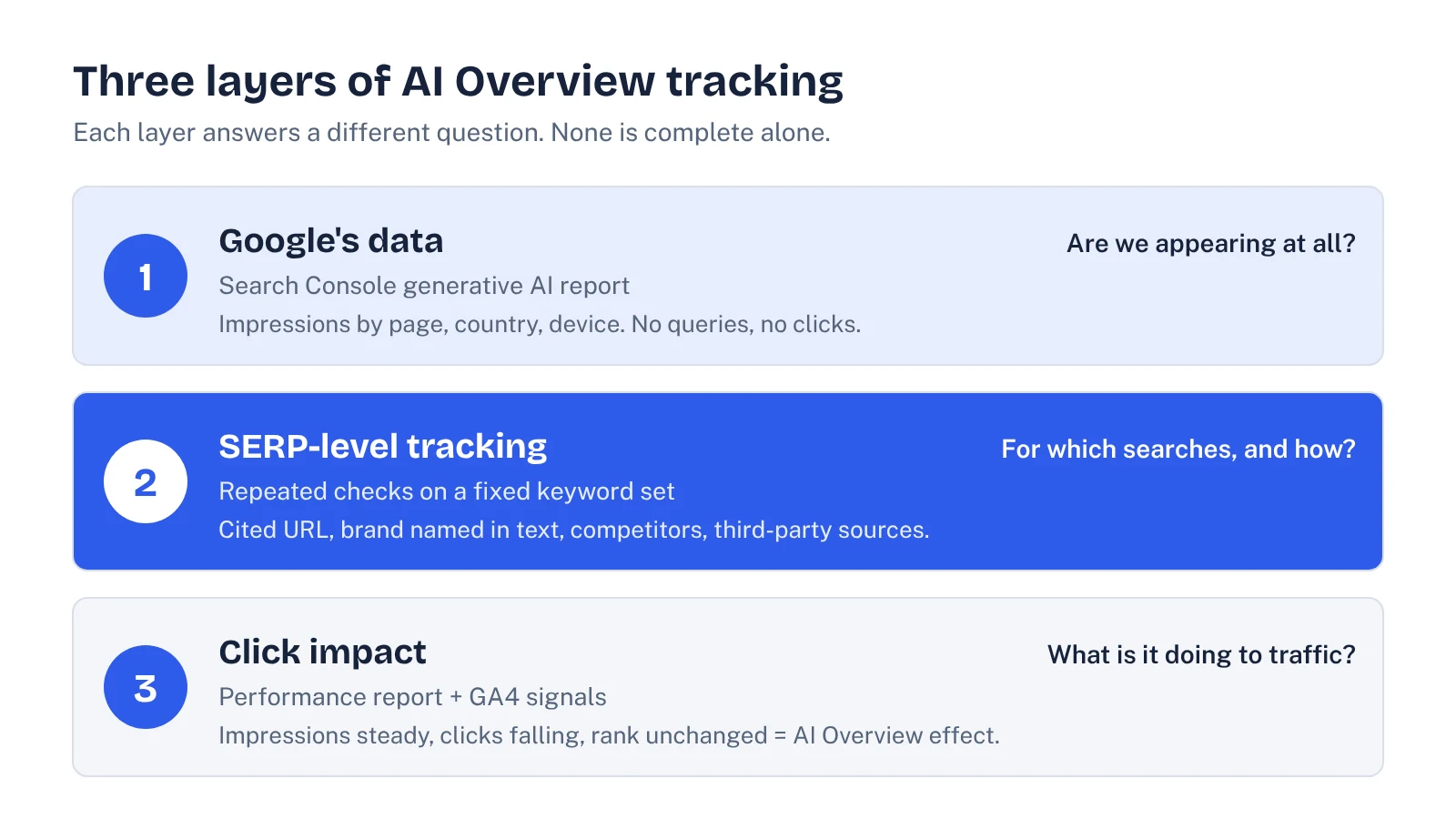
Layer 1: Google's data (are we appearing at all?)
Use the Search Console generative AI report to see which pages earn AI impressions and how that trends by week. Export it monthly. Pages with rising AI impressions are the ones Google already trusts for some fan-out queries, so they're your best candidates for strengthening. Pages that matter commercially but show no AI impressions are your gap list.
Layer 2: SERP-level tracking (for which searches, and how?)
This is the core of the work. For a fixed keyword set, record on every check:
- Whether an AI Overview appeared.
- Whether your domain is cited, and which URL.
- Whether your brand is named in the answer text, separately from being linked.
- Which competitors are named and which third-party domains are cited.
Keep "cited" and "named" apart. A link at the bottom of the overview and a sentence that says your product is a good fit for mid-market teams are very different outcomes. For a buyer skimming the answer, the named mention is usually worth more.
Layer 3: Click impact (what is it doing to traffic?)
AI Overviews change how many clicks a ranking earns. Ahrefs compared 300,000 keywords using Search Console data from December 2023 and December 2025 and estimated AI Overviews reduce clicks to the top-ranking page by 58%. Position-one CTR on keywords with an overview fell from 0.073 to 0.016.
You can't isolate those clicks in Search Console, but you can see the pattern. In the regular Performance report, filter to queries where your Layer 2 data shows an AI Overview, then compare clicks and impressions over time. Impressions holding steady while clicks fall, with no ranking change, is the typical signature. Ahrefs also suggests looking for #:~:text= fragments in landing page URLs in GA4, since Google sometimes links to highlighted passages from AI features. Treat that as a partial signal, not a complete count.
How common AI Overviews are on B2B SaaS buying searches
Before you build a tracker, it helps to know how much of your keyword set is affected. We pulled SERP features for 20 typical B2B SaaS searches in Ahrefs (US, 2 October 2026), across best-of lists, comparisons, alternatives, pricing, definitions and how-to questions. Two returned no SERP data or volume and were excluded.
Of the remaining 18, 17 showed an AI Overview in the latest SERP check. The one exception was "what is customer success software", which gets about 30 searches a month. Every pricing keyword we checked had one, including "zendesk pricing" (16,000 monthly searches), "mailchimp pricing" (11,000) and "crm pricing" (2,800). So did every best-of, comparison and alternatives search.
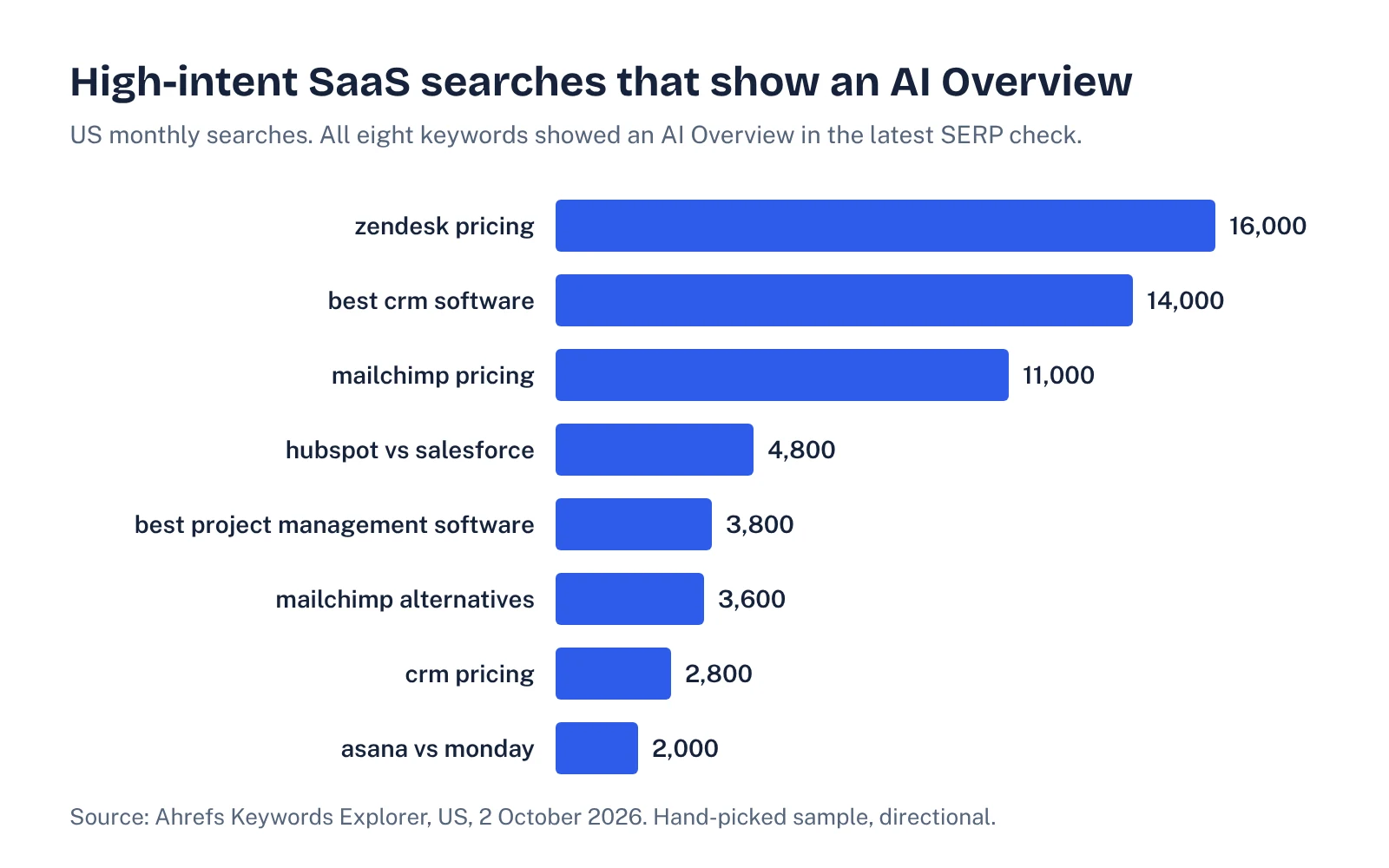
This is a small, hand-picked sample and SERP features change between checks, so read it as directional. Pricing pages are the new finding compared with our earlier AI Overviews analysis: buyers who search your pricing may now read a generated summary of it before they reach your page. If that summary is out of date, you'll want to know.
Demand for tracking reflects this. In the same pull, "ai overview tracking" and "ai overview tracker" each showed about 2,000 US searches a month, and "ai overview rank tracking" about 900.
See your own AI visibility, free
Get a one-page audit of how ChatGPT, Perplexity and Gemini treat your brand against up to three competitors, plus your biggest gap. In your inbox within 48 hours.
Get my free auditHow to set up AI Overview tracking in a week
Here's a setup you can run with a spreadsheet before committing to a tool.
- Pick 30 to 100 keywords. Start with the searches closest to revenue: best-of, comparisons, alternatives, pricing and the problem queries your product solves. Tag each with its intent so you can report by group.
- Confirm which ones show an AI Overview. Use your SEO tool's SERP features data, or check by hand in a clean browser session. Drop keywords that never trigger one, or keep them in a separate watch list.
- Set a fixed check schedule. Two checks a week per keyword gives you eight or nine samples a month, enough to calculate a rate you can trust.
- Record cited, named and competitors on every check. One row per keyword per check. Note the cited URLs, not just domains.
- Export the Search Console AI report monthly. Line it up with your keyword data by page.
- Calculate four numbers per intent group. AI Overview presence rate, your citation rate, your mention rate and your share of named brands versus competitors.
- Turn the cited third-party pages into a to-do list. The review sites, comparison articles and community threads cited for your keywords are the places to earn a mention next.
The metrics worth reporting
| Metric | How to calculate | What it tells you |
|---|---|---|
| AI Overview presence | Checks with an overview ÷ all checks | How much of your keyword set is exposed |
| Citation rate | Checks citing your domain ÷ checks with an overview | Whether Google trusts your pages as sources |
| Mention rate | Checks naming your brand ÷ checks with an overview | Whether you're recommended, not just linked |
| Share of named brands | Your mentions ÷ all brand mentions in the set | Your position against competitors |
| AI impressions by page | Search Console generative AI report | Which pages Google uses, across all queries |
Report these by intent group, monthly, with the trend. A single blended number hides the story. Being named in 60% of "what is" overviews and 5% of "best X software" overviews calls for a very different plan than the reverse.
Do you need an AI Overview tracker tool?
Not on day one. A spreadsheet and a fixed schedule will teach you which keywords matter and what the overviews say about you. Once you're past 50 keywords or want competitor data, manual checks get slow and inconsistent, and a tool pays for itself in time.
When you compare tools, ask four questions. Does it check each keyword more than once per period? Does it record named brands separately from cited URLs? Can you export raw rows, not just a score? Does it cover AI Mode as well as AI Overviews? Our comparison of AI visibility tools goes through the main options with those criteria in mind.
Whichever route you take, keep the method the same month to month. A consistent, slightly imperfect measurement beats a perfect one you change every quarter.
FAQ
What is Google AI Overview tracking?
It's the practice of monitoring which of your target searches show an AI Overview, whether the overview cites your pages or names your brand, and how that affects your organic clicks. Because overviews change often, good tracking reports a rate across repeated checks rather than a single snapshot.
Can I see AI Overview data in Google Search Console?
Partly. Since June 2026, Search Console has generative AI performance reports that show impressions in AI Overviews, AI Mode and Discover's AI features, broken down by page, country, device and date. They don't show the queries behind those impressions or clicks from them, so you still need SERP-level tracking for keywords.
What are the best AI Overview tracking tools?
Most SEO platforms now flag AI Overviews in rank tracking, and dedicated AI visibility tools add brand mention and competitor reporting. Pick one that checks each keyword repeatedly, records cited URLs and named brands separately, and lets you export raw data. A spreadsheet works for the first month while you learn which queries matter.
How often should I check AI Overviews?
For a core set of 30 to 100 buying keywords, run checks at least weekly and report monthly. Ahrefs found AI Overviews have a 70% chance of changing between observations, so a single monthly check can mislead you in either direction.
Sources
- Google Search Central Blog: Introducing Search generative AI performance reports in Search Console (June 2026)
- PinMeTo: Search Console adds generative AI performance reports (June 2026)
- Google Search Central: AI features and your website
- Search Console Help: Performance report metrics (how AI Overview position and clicks are counted)
- Ahrefs: AI Overviews change 70% of the time (Linehan and Guan, November 2025)
- Ahrefs: Update: AI Overviews reduce clicks by 58% (Law and Guan, February 2026)
- Ahrefs: Only 38% of AI Overview citations come from the top 10 (Linehan, March 2026)
- Ahrefs: How to track AI Overviews (Linehan, January 2026)
- Ahrefs Keywords Explorer and SERP overview, US, pulled 2 October 2026