B2B SEO: a strategy for winning the shortlist before buyers call
B2B SEO is the work of getting your company found and chosen when other businesses research a purchase. Because most B2B buyers rank their shortlist before talking to sales, the goal is to be on that list, in Google results and in the AI answers buyers now read. This guide covers what changes, a six-step strategy, and how to measure it.
- In 6sense's 2025 survey, 94% of B2B buyers ranked their shortlist before contacting sellers, and 95% of winning vendors were on the Day-One shortlist.
- Half of B2B software buyers in a G2 survey now start research in an AI chatbot, so B2B SEO has to cover AI answers as well as rankings.
- Comparison, integration, security and pricing pages do more for pipeline than broad blog posts.
- Ahrefs found branded web mentions correlate more strongly with AI Overview visibility than backlinks do.
- Measure organic pipeline and AI share of voice, not just traffic.
What is B2B SEO?
B2B SEO is the work of getting your company found, and chosen, when other businesses research a purchase. The mechanics are the same as any SEO: crawlable pages, useful content, links and mentions from sites people trust. What changes is the buyer.
A B2B purchase involves several people, takes weeks or months, and usually ends in a contract rather than a checkout. The people searching are often not the person who signs. And many of the searches that matter most have tiny volume: a head of RevOps comparing two data tools might be one of forty people a month typing that exact question.
That last point trips up teams that bring a consumer SEO playbook into B2B. They chase volume, publish broad top-of-funnel posts, and wonder why traffic grows while pipeline doesn't.
| B2B SEO | B2C SEO | |
|---|---|---|
| Who searches | A buying group: users, managers, IT, finance, procurement | Usually one person |
| Typical volume | Low. Many high-value queries get under 100 searches a month | Often high, with big head terms |
| Cycle length | Weeks to months, many visits before contact | Minutes to days |
| What converts | Demo, trial, sales conversation, being on the shortlist | Purchase or sign-up |
| Content that wins | Comparisons, integrations, security, pricing, proof | Product pages, reviews, guides |
| What to measure | Pipeline, shortlist presence, AI answer share | Revenue, conversion rate |
The real target: the Day-One shortlist
The most useful number in B2B SEO right now isn't a ranking. It's how early buyers make up their minds.
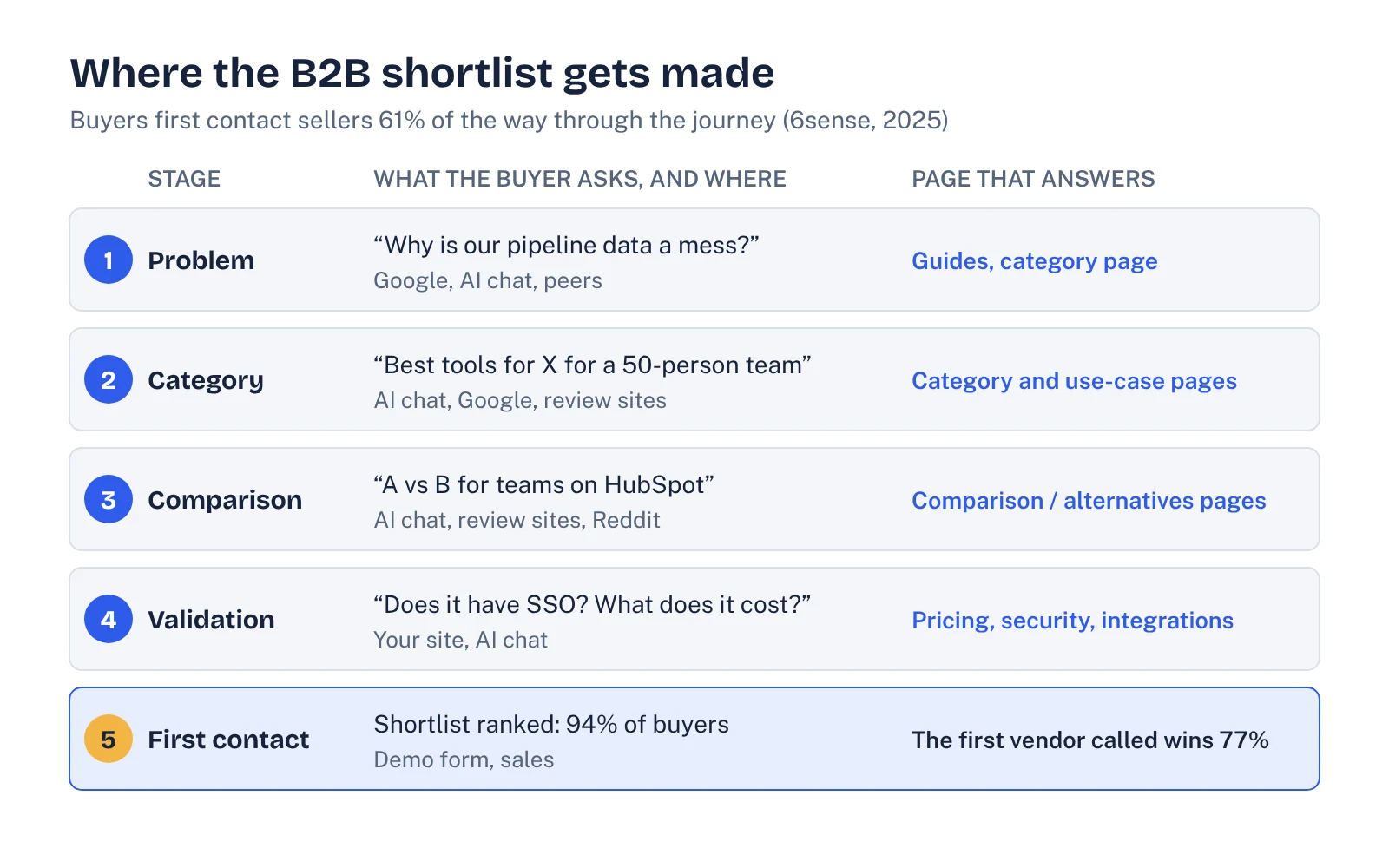
6sense surveyed nearly 4,000 B2B buyers for its 2025 Buyer Experience Report. Buyers first contacted sellers 61% of the way through their journey, earlier than the roughly 69% of the two previous years but still well past the midpoint. 94% had ranked their shortlist before talking to a seller. 95% of winning vendors were already on the buyer's Day-One shortlist, and the first vendor a buyer spoke to won 77% of the time.
Put simply: most B2B deals are decided before anyone fills in your demo form. Your website and everything written about you elsewhere do the selling in the part of the journey you can't see.
That research increasingly happens in AI chat as well as Google. In a G2 survey of more than 1,000 B2B software buyers, half said they now start the buying journey in an AI chatbot instead of Google Search, and AI chat was the top source for building a shortlist, ahead of review sites and vendor websites. 6sense found 94% of buyers use LLMs somewhere in the buying process.
So modern B2B SEO has two jobs. Rank for the searches your buyers run, and make sure the AI answers they read put you on the list. The good news is that the same work feeds both. If you want the longer version of that argument, our comparison of GEO and SEO covers where they overlap and where they don't.
What the search demand tells you
We pulled the "b2b seo" keyword family from Ahrefs Keywords Explorer (US) on October 20, 2026. Three things stand out.
First, the head term is easy to rank for relative to its size. "b2b seo" gets about 3,900 searches a month with a keyword difficulty of 3. "b2b seo strategy" gets 1,800 at KD 16.
Second, the largest single query in the family is "b2b seo agency" at 4,200 a month, and service terms ("services", "company", "agencies", "consultant") add several thousand more. A big share of people searching this topic want to hire help, not learn the method.
Third, the results page itself has changed. Ahrefs showed an AI Overview at the top of the "b2b seo" results. The pages linked from it included a Reddit thread ("Anyone doing B2B SEO?") next to Search Engine Land and Semrush, and a second Reddit thread ranked fifth. People want practitioner answers, and Google is surfacing them.
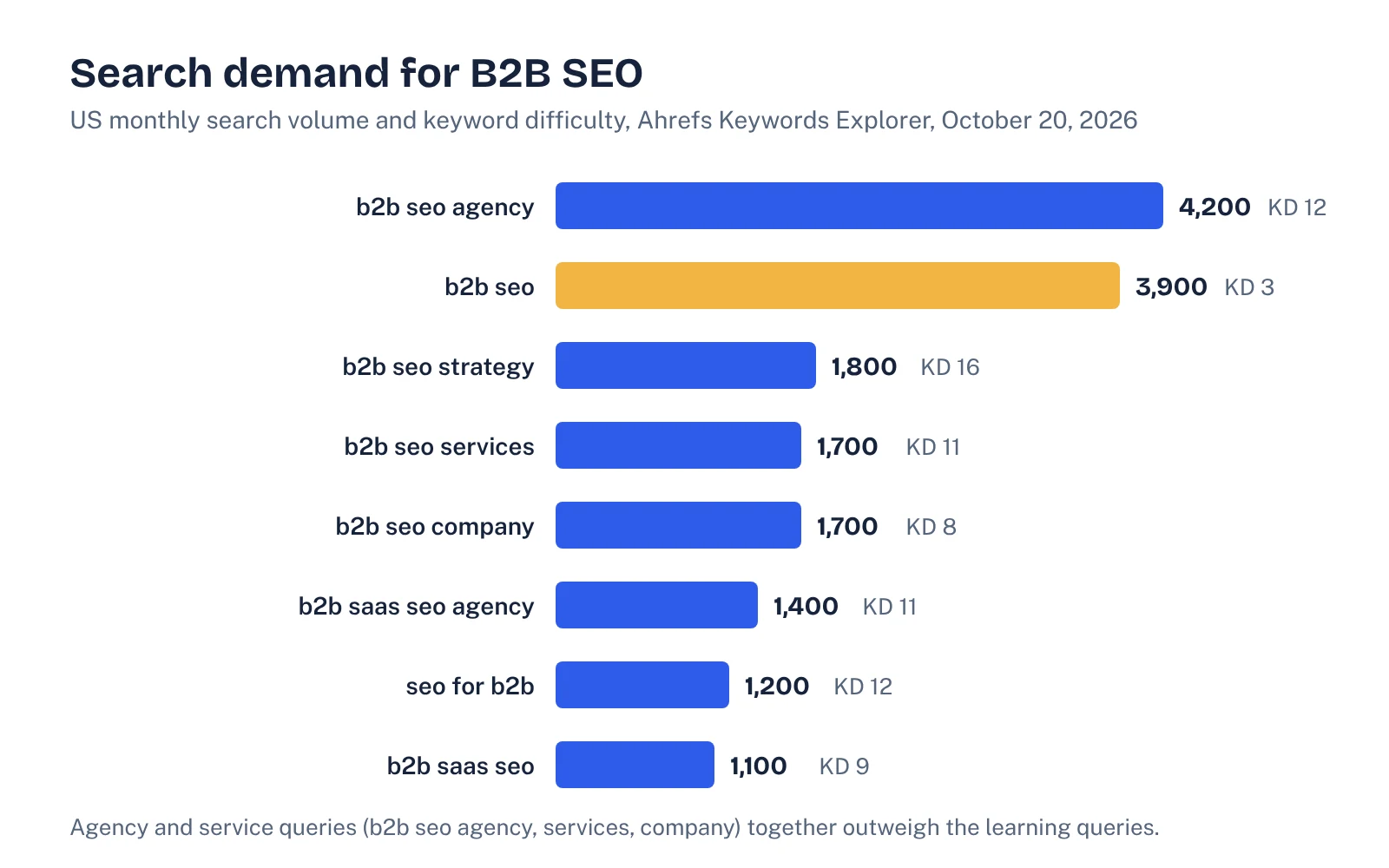
The lesson carries over to your own market. Pull your category's keyword family and sort it by intent before you sort it by volume. The query with 40 searches from people comparing vendors is usually worth more than the one with 4,000 from students.
A B2B SEO strategy in six steps
Most published B2B SEO strategies stop at personas, keywords, content and links. Those still matter. This version adds the two steps that decide whether you make the shortlist: off-site mentions and measuring AI answers.
- Map the buying group, not one persona. List who touches the decision: the user with the problem, their manager, IT or security, finance, procurement. Write down the question each one needs answered before they'd say yes. Sales and customer success can tell you in an hour.
- Research queries by buying stage. Group keywords into problem, category, comparison and validation. Then write the same questions as buyers would type them into ChatGPT: longer, more specific, often with a constraint ("for a 50-person team", "that integrates with HubSpot"). Volume tools miss most of these, so use sales call notes too.
- Build the pages that answer shortlist questions. Category pages, comparison and alternatives pages, integration pages, security and compliance pages, pricing, and use cases. These convert better than blog posts and they're what AI answers tend to pull from when someone asks "which tool should I use for X". The table below lists them.
- Fix eligibility first. Google's guidance on AI features and your website says there are "no additional requirements" to appear in AI Overviews or AI Mode. A page needs to be indexed and eligible for a snippet. That means the basics decide whether you're in the running at all: crawling allowed in robots.txt and at your CDN, internal links to important pages, key content in text rather than images or scripts, and structured data that matches the visible page.
- Earn mentions, not just links. Ahrefs studied 75,000 brands and found branded web mentions had the strongest correlation with appearing in AI Overviews (0.664), well ahead of backlink count (0.218) and Domain Rating (0.326). Correlation isn't proof, but it matches what we see in B2B: review profiles, comparison articles, community threads and analyst roundups shape which names an assistant lists. Our guide to AI brand mentions covers how to track and grow them.
- Measure rankings and the shortlist. Track rankings and organic pipeline as usual. Add a fixed set of 20 to 50 buyer prompts and check monthly how often you're named against your main competitors. That's your AI share of voice, and it's the closest proxy you have to "are we on the Day-One shortlist".
The page types B2B buyers actually use
If you only build one thing this quarter, make it the pages buyers use to decide between vendors. Most B2B sites have a blog with fifty posts and no page that honestly compares them to their main competitor.
| Page type | Buyer question it answers | Stage | What makes it work |
|---|---|---|---|
| Category page | "What is the best way to solve X?" | Category | A clear definition, who it's for, and when you are not the right fit |
| Comparison / alternatives | "How does A compare with B?" | Comparison | A fair table, dated, with the cases where the competitor is better |
| Integration pages | "Does it work with our stack?" | Validation | One page per major integration, with what syncs and setup time |
| Security and compliance | "Will IT approve this?" | Validation | Certifications, data residency, SSO, a contact for security reviews |
| Pricing | "Can we afford it and what's included?" | Validation | Visible prices or ranges in plain text, plan limits, what triggers a sales call |
| Use cases by role or industry | "Is this built for teams like ours?" | Category | Specific workflows and real outcomes you can show |
Write these pages so a sentence can be lifted and still make sense on its own. Assistants and AI Overviews quote short, self-contained answers. A pricing page that says "Plans start at $49 per user per month, billed annually" is quotable. One that says "Contact us" is not.
See your own AI visibility, free
Get a one-page audit of how ChatGPT, Perplexity and Gemini treat your brand against up to three competitors, plus your biggest gap. In your inbox within 48 hours.
Get my free auditHow to measure B2B SEO when buyers don't click
B2B SEO has always been hard to attribute because the buying group visits on different devices over weeks. AI answers make it harder: a buyer can read your name in ChatGPT, search your brand later, and show up as direct or branded organic traffic.
Use a short scorecard instead of one number:
- Organic pipeline: opportunities where the first or a key touch was organic search, from your CRM.
- Branded search demand: growth in searches for your brand name, which often rises when you start appearing in AI answers.
- Non-branded rankings for your comparison, category and integration pages.
- AI share of voice across your buyer prompt set, by assistant.
- AI referral traffic in GA4. It undercounts, so read our notes on tracking AI traffic before you trust the trend line.
- Self-reported attribution: add "an AI assistant (ChatGPT, Perplexity, etc.)" as an option to "How did you hear about us?" on your demo form.
Common B2B SEO mistakes
- Chasing volume. Ranking for a broad definition query brings readers, not buyers. Weight your plan toward comparison and validation queries.
- Hiding the facts buyers need. Gated pricing, PDF-only security docs and integration lists inside an app are invisible to crawlers and to the assistants that rely on them.
- One-sided comparisons. Buyers and models both discount pages that never admit a weakness. A fair page gets read and cited.
- Ignoring third-party pages. If a review site or a roundup is what ranks for "best X for Y", your job is to be on that page with accurate information, not only to outrank it.
- Measuring only traffic. Traffic can fall while shortlist presence rises. Report pipeline and share of voice next to sessions.
Where to start this week
You don't need a six-month plan to begin. Do these five things in order:
- List your top three competitors and the comparison page you have, or don't have, for each.
- Check that your pricing, integration and security pages are indexable and state their key facts in plain text.
- Write 20 buyer prompts and run them in ChatGPT, Perplexity and Google AI Mode. Note who gets named.
- Find the five third-party pages that appear most often in those answers and in the top results for your category.
- Pick the one gap that costs you most and fix it first, usually a missing comparison page or an outdated review profile.
If you sell software specifically, our SaaS SEO guide goes deeper on the 90-day plan.
FAQ
What is B2B SEO?
B2B SEO is search engine optimization for companies that sell to other businesses. It uses the same foundations as any SEO, but targets a buying group, long sales cycles and low-volume, high-intent queries such as comparisons, integrations and pricing.
Why is SEO important for B2B?
B2B buyers do most of their research before contacting a vendor. 6sense found buyers first reach out 61% of the way through their journey, with a ranked shortlist already in hand. If you are not visible in search and AI answers during that research, you are often not considered at all.
Is SEO dead for B2B now that buyers use AI?
No. Google says pages need to be indexed and eligible for a snippet to appear in AI Overviews and AI Mode, and assistants like ChatGPT and Perplexity draw on web pages too. What changes is the target: you optimize to be named in answers and on shortlists, not only to earn clicks.
How long does B2B SEO take to work?
Fixes to crawlability and existing pages can show up within weeks. New comparison and category pages usually need two to four months to rank, and off-site mentions build over quarters. Track AI share of voice monthly so you can see progress before pipeline catches up.
Should I hire a B2B SEO agency?
It depends on your team. An agency helps if you lack technical SEO skills or content capacity. Ask any agency how they measure pipeline and AI visibility, not just rankings and traffic, and ask to see the comparison and validation pages they have built for other B2B clients.
Sources
- 6sense: 2025 B2B Buyer Experience Report
- G2: How AI chat is rewriting B2B software buying (survey of 1,000+ buyers, Oct 2025)
- Google Search Central: AI features and your website
- Ahrefs: An analysis of AI Overview brand visibility factors (75K brands studied)
- Semrush: B2B SEO, a complete strategy
- Ahrefs Keywords Explorer and SERP overview, US data pulled October 20, 2026