SaaS SEO in the AI search era: what to keep, what to change, what to add
SaaS SEO is the work of earning organic visibility for the searches your buyers make, from problem research to pricing checks. The fundamentals still work, but AI answers now sit on top of most of those searches. This guide shows what to keep, what to change and what to add, with Ahrefs data we pulled today.
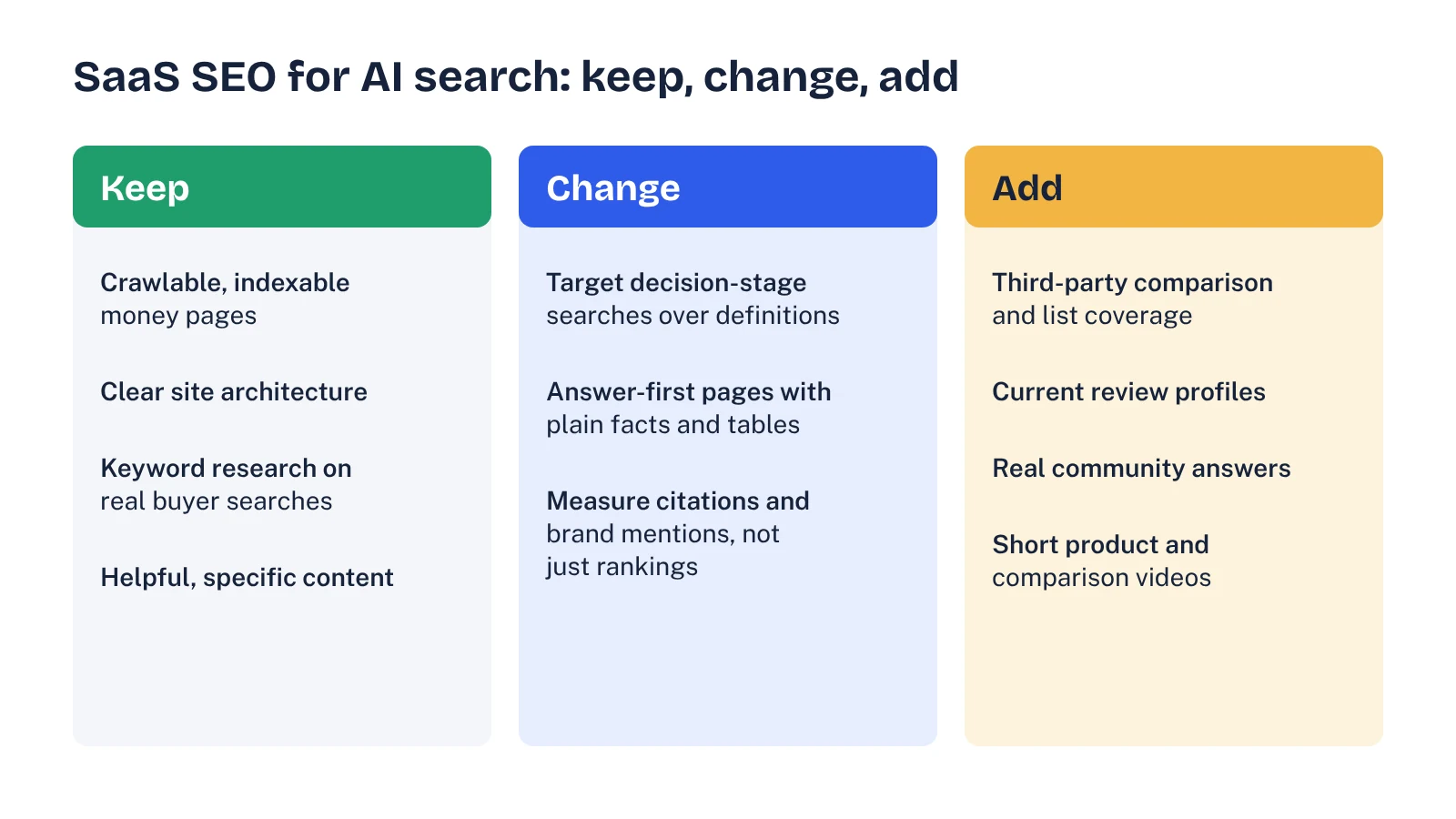
- In our Ahrefs check of 16 B2B SaaS buying searches, all 16 showed a Google AI Overview, from problem questions to pricing pages.
- Google says there are no special requirements for AI Overviews: a page must be indexed and eligible for a snippet. Technical SEO still matters.
- Rankings and AI citations have drifted apart: Ahrefs found only about 38% of AI Overview citations rank in the top 10 for the query.
- Change how you measure: track citations, brand mentions and pipeline, not just rankings and sessions.
- Add work outside your site: comparison coverage, review profiles, communities and video all feed AI answers.
What changed for SaaS SEO, in one picture
For most of the last decade, SaaS SEO followed a stable script. Fix the technical basics, build product and comparison pages, publish blog content for problem searches, earn links, and watch trials grow. That script still works. What's changed is what sits between your ranking and your buyer.
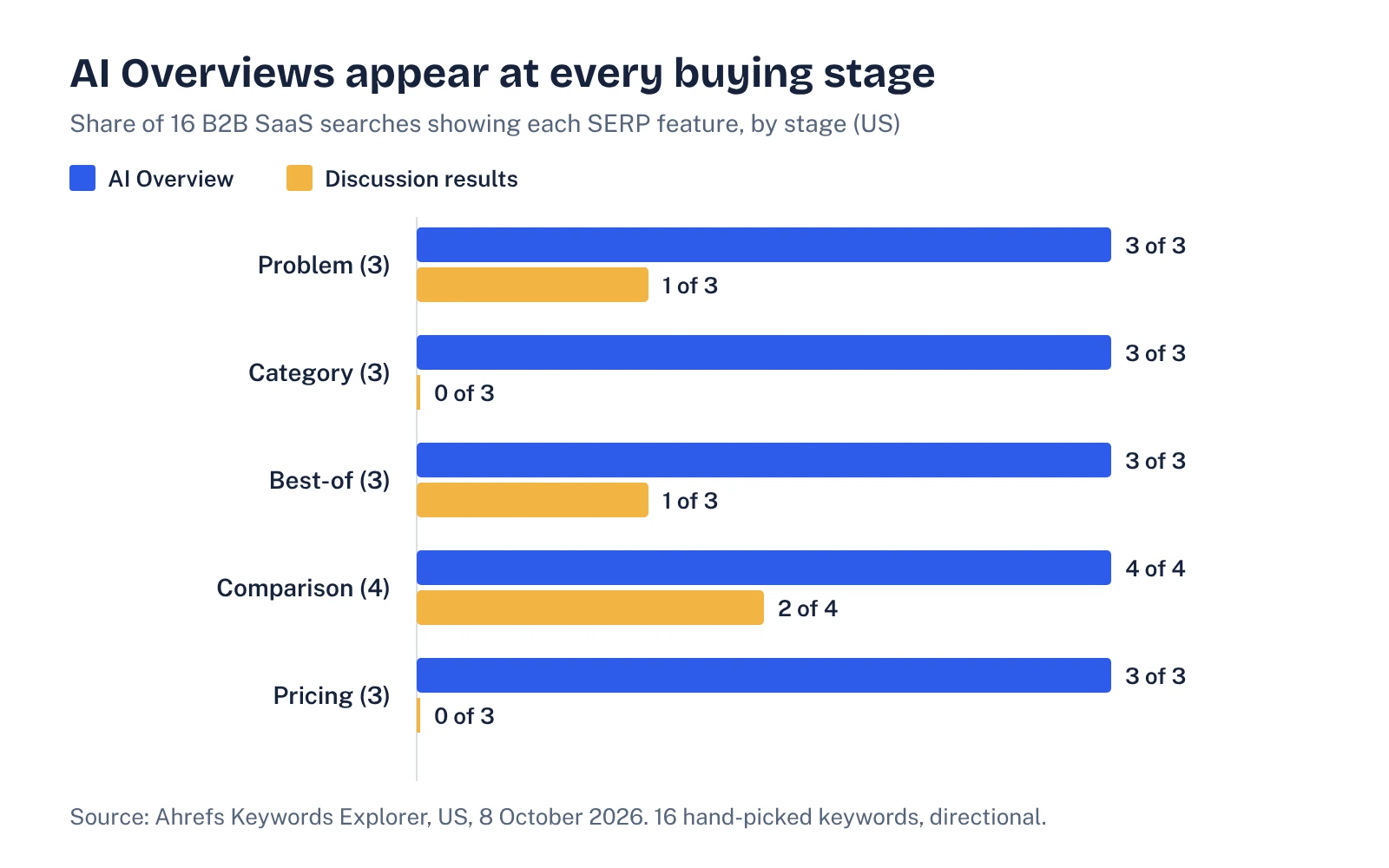
On 8 October 2026 we checked 16 typical B2B SaaS buying searches in Ahrefs Keywords Explorer (US), spread across five stages of the journey: problem questions, category searches, "best" lists, comparisons and alternatives, and pricing. Every one of the 16 showed a Google AI Overview in its latest SERP check. That includes searches you might expect to be safe, like salesforce pricing and hubspot vs salesforce.
That matters for two reasons. First, the overview takes clicks. In February 2026, Ahrefs measured a 58% lower click-through rate for the top-ranking page on keywords with an AI Overview, based on 300,000 keywords. Second, the overview shapes the shortlist. A buyer who reads "the top options are A, B and C" may never scroll to your page, even if it ranks first.
So the question isn't whether SaaS SEO still works. It's which parts of your program still pay off as they are, which need adjusting, and what's new.
What to keep: the fundamentals still decide eligibility
There's a temptation to treat AI search as a separate discipline. Google's own guidance pushes back on that. Its documentation on AI features says there are "no additional requirements to appear in AI Overviews or AI Mode, nor other special optimizations necessary." To be shown as a supporting link, a page has to be "indexed and eligible to be shown in Google Search with a snippet."
In practice, that means the boring work still comes first:
- Crawlable, indexable pages. Pricing, integrations and comparison pages hidden behind scripts, logins or noindex tags can't be cited.
- Clean information architecture. One clear page per product, use case, integration and competitor comparison, linked from your main navigation or hubs.
- Pages built around real buyer searches. Keyword research is still how you learn what buyers ask. AI tools add new phrasing, not a new reason to stop listening.
- Content that answers the question. Helpful, specific pages still win both rankings and citations.
If you've already covered these, good. Nothing about AI search tells you to undo them. For a fuller comparison of what carries over, see our guide to GEO vs SEO.
What to change: targeting, page format and measurement
Rethink which keywords you chase
Classic SaaS SEO playbooks lean heavily on top-of-funnel blog traffic: big "what is" and "how to" searches that bring volume but rarely buyers. Those are the searches where AI Overviews answer the question fully, so the click often never comes.
Shift weight toward searches where the buyer still needs to choose: comparisons, alternatives, "best X for Y", integrations and pricing. In our sample these showed AI Overviews too, but the answer usually names products, which means you can be one of them. Being named in an answer about your category is worth more than ranking for a definition nobody clicks. Our B2B SEO strategy guide lists the shortlist pages buyers use and the questions each one should answer.
Write pages that are easy to quote
AI answers lift short, self-contained statements. Pages that bury the answer under three paragraphs of context are harder to use. A few changes help both humans and machines:
- Answer the page's core question in the first two or three sentences.
- State facts plainly: who the product is for, what it costs, what it integrates with, where it's weaker.
- Use tables for comparisons and pricing tiers instead of images or interactive widgets.
- Keep facts consistent across your site, docs and third-party profiles, so the model doesn't see conflicting versions.
Measure citations, not just rankings
Rankings used to be a decent proxy for visibility. That proxy is weaker now. In March 2026, Ahrefs analyzed 863,000 keyword SERPs and found that only about 38% of URLs cited in AI Overviews also ranked in the top 10 for that query, down from about 76% in mid-2025. You can rank and be absent from the answer, or be cited without ranking.
Keep rank tracking, but add three things to your monthly report: how often AI answers cite your pages, how often they name your brand, and which competitors they name instead. Our guide to ranking in AI Overviews and AI Mode covers what tends to move those numbers.
What to add: work that happens off your site
The biggest change for SaaS teams is that a lot of what shapes AI answers lives on other people's websites. When Google builds an AI Overview, it may use what its documentation calls "query fan-out", issuing multiple related searches across subtopics and data sources. Those sub-searches pull in review sites, comparison articles, community threads and videos, not just vendor pages.
Our sample hints at this. Discussion results (forum and community threads) appeared on 4 of the 16 searches, mostly comparisons and "best" lists, which are exactly the searches where buyers want unfiltered opinions. And in the same March 2026 Ahrefs study, YouTube made up 5.6% of all cited URLs in AI Overviews.
For a B2B SaaS company, the off-site work usually means:
- Comparison and list coverage. Find the third-party "best X" and "X alternatives" articles that rank or get cited for your category, and make sure your product is accurately described in them.
- Review profiles. Keep G2, Capterra and similar profiles current, with the same positioning, pricing and integration facts as your site.
- Community presence. Have real people from your team answer questions where your buyers discuss tools. Don't astroturf; it backfires and moderators notice.
- Video. Short product walkthroughs and comparison videos on YouTube cover searches that text pages miss.
These are the same inputs that drive AI brand mentions in ChatGPT and Perplexity, so the work pays off beyond Google.
See your own AI visibility, free
Get a one-page audit of how ChatGPT, Perplexity and Gemini treat your brand against up to three competitors, plus your biggest gap. In your inbox within 48 hours.
Get my free auditA 90-day SaaS SEO plan for the AI search era
If you're adjusting an existing program, you don't need to rebuild it. Here's a sequence that fits alongside normal SEO work:
- Weeks 1–2: Build your buying-search list. Pick 30–50 searches across the five stages in the chart above, weighted toward comparisons, alternatives, best-of and pricing.
- Weeks 2–3: Baseline. For each search, record your ranking, whether an AI Overview appears, whether it cites you, whether it names you, and who it names instead. Check each search more than once, because AI answers change often.
- Weeks 3–6: Fix eligibility. Make sure every money page is indexable, loads fast and answers its question in the first lines. Move key facts out of images and accordions.
- Weeks 4–8: Fill page gaps. Create or refresh comparison, alternatives and integration pages where you have none, using honest tables.
- Weeks 6–12: Work off-site. Correct outdated third-party descriptions, update review profiles and start a steady habit of community answers and short videos.
- Week 12: Re-measure. Repeat the baseline checks and report the change in citation rate and brand mentions alongside rankings, AI referral sessions and pipeline.
Here's how the targets and metrics shift across a typical program:
| Area | Classic SaaS SEO | SaaS SEO with AI search |
|---|---|---|
| Main keyword focus | High-volume informational topics | Decision-stage searches: comparisons, alternatives, best-of, pricing |
| Page format | Long guides optimized for dwell time | Answer-first pages with plain facts and tables |
| Authority signals | Backlinks | Backlinks plus brand mentions in reviews, lists, communities and video |
| Core metric | Rankings and organic sessions | Rankings, AI citation rate, brand mentions, AI referrals and pipeline |
| Review cadence | Quarterly rank reports | Monthly checks on a fixed set of buying searches |
Is SaaS SEO still worth the investment?
Yes, with adjusted expectations. Clicks per ranking are falling on searches with AI Overviews, so traffic targets based on 2023 click-through rates will disappoint. But the visitors who do arrive from AI answers can be valuable. When Ahrefs looked at its own site in mid-2025, AI search sent 0.5% of visitors but 12.1% of signups. That's one company's data, and the author is clear it isn't a rigorous study, so treat it as a signal to measure, not a benchmark to promise.
The practical takeaway: keep investing in SEO, but judge it on whether buyers see your name when they research your category, not only on sessions. A SaaS company that's cited and named across the five buying stages is in a stronger position than one that ranks well and never appears in the answer.
Where to start this week
Take ten of your most valuable buying searches. Search each one in Google and ChatGPT, and write down who gets named. If your brand is missing from most of them, that list is your roadmap. Our guide on how large language models choose their sources explains what to look at next.
FAQ
What is SaaS SEO?
SaaS SEO is search engine optimization for software companies: earning organic visibility for the searches buyers make while they research a problem, compare tools and check pricing. In 2026 it also means being cited and named in the AI answers that now appear on most of those searches.
Is SEO dead now with AI?
No. Google says pages need to be indexed and eligible for a snippet to appear as AI Overview links, so the basics still decide whether you can be cited at all. What has changed is the payoff: Ahrefs measured a 58% lower click-through rate for top-ranking pages on searches with an AI Overview, so you need to measure citations and mentions as well as clicks.
How do I improve SEO for a SaaS company?
Start with the searches closest to revenue: pricing, comparisons, alternatives and best-of lists. Make sure those pages are indexable, answer the question in the first lines and state facts plainly. Then build coverage on third-party sites buyers trust and track whether AI answers cite or name you.
How long does SaaS SEO take to work?
Technical fixes and updates to existing pages can show up within weeks once Google recrawls them. New content and third-party coverage usually take several months to build rankings and citations. Plan in quarters and review a fixed set of buying searches monthly.
Sources
- Google Search Central: AI features and your website
- Ahrefs: Update: AI Overviews reduce clicks by 58% (Law and Guan, February 2026)
- Ahrefs: Update: 38% of AI Overview citations pull from the top 10 (Linehan, March 2026)
- Ahrefs: Does AI search traffic convert better than traditional search? (Stox, June 2025)
- Ahrefs Keywords Explorer and SERP overview, US, pulled 8 October 2026