ChatGPT ads for B2B SaaS: how they work, what they cost, and what they can't buy you
ChatGPT ads are sponsored units that appear below ChatGPT's answer, labeled and separate from it, for logged-in adults on the Free and Go plans. Advertisers buy them in Ads Manager on CPC or CPM and target conversation topics, not keywords. OpenAI says ads don't change the answer. This guide covers how they work, what we know about cost, and when a B2B SaaS test makes sense.
- Ads show only on ChatGPT's Free and Go plans. Plus, Pro, Business and Enterprise users don't see them, which matters if your buyers use ChatGPT through work.
- OpenAI says ads don't influence answers. An ad sits below a shortlist; it can't put you on it.
- Self-serve Ads Manager opened to all US businesses on May 5, 2026, with CPC bidding, a pixel and a Conversions API. Ads now run in 89 countries.
- From October 29 or 30, 2026, 'creative enhancements' let OpenAI rewrite your headlines, descriptions and destination URLs by default. Decide now whether to keep it on.
- Treat ads as a test alongside organic AI visibility work, not a replacement for it.
What ChatGPT ads are
ChatGPT ads are sponsored units that appear under ChatGPT's answer when OpenAI's system decides a product or service is relevant to the conversation. Each ad carries a "sponsored" label, the advertiser's name and favicon, a short title and description, an image and a landing page link. It sits below the answer, not inside it.
That last point is the one most coverage skips, and it's the one that matters most for B2B SaaS. When OpenAI announced its approach to advertising on January 16, 2026, the first principle it listed was answer independence: "Ads do not influence the answers ChatGPT gives you." If a buyer asks for the best tools in your category and the answer lists three competitors, your ad can appear underneath that list. It can't add you to it.
So ChatGPT ads are a new paid channel with a placement next to AI answers. They are not a way to buy AI visibility. Keep that distinction in mind and the rest of the decision gets simpler.
How we got here: the 2026 rollout
The product moved fast. Here is the timeline as reported by OpenAI and PPC Land's running coverage.
| Date (2026) | What changed |
|---|---|
| Jan 16 | OpenAI announces ad tests for logged-in adult Free and Go users in the US, and publishes its ad principles. |
| Feb 9 | US pilot starts, reportedly at a $60 CPM, with one sponsored unit below an answer. |
| May 5 | Self-serve Ads Manager opens to all US businesses. CPC bidding, a pixel and a Conversions API arrive. |
| Jun 5 | Conversion-optimized campaigns start rolling out. |
| Jun to Sep | Japan, South Korea, the UK, Mexico, Brazil, 31 European markets, India, Southeast Asia and Taiwan go live. |
| Sep 16 | HubSpot and Shopify integrations launch, and a US "Sponsored Agents" test is announced. |
| Oct 21 | 26 more countries added, for 89 in total. OpenAI says over 100,000 advertisers have run campaigns since launch. |
| Oct 29/30 | "Creative enhancements" switch on by default (more on this below). |
A note on that 100,000 figure: PPC Land points out it is cumulative, counting every advertiser that has ever run a campaign. Third-party trackers count far fewer active advertisers in any given week. Adthena counted 12,075 unique advertisers in the week of August 31, and Sensor Tower counted about 1,200 unique US advertisers in August. Different methods, very different numbers. For a B2B team, the takeaway is that the channel is still early and auctions in most niche categories are likely thin.
What marketers are searching for
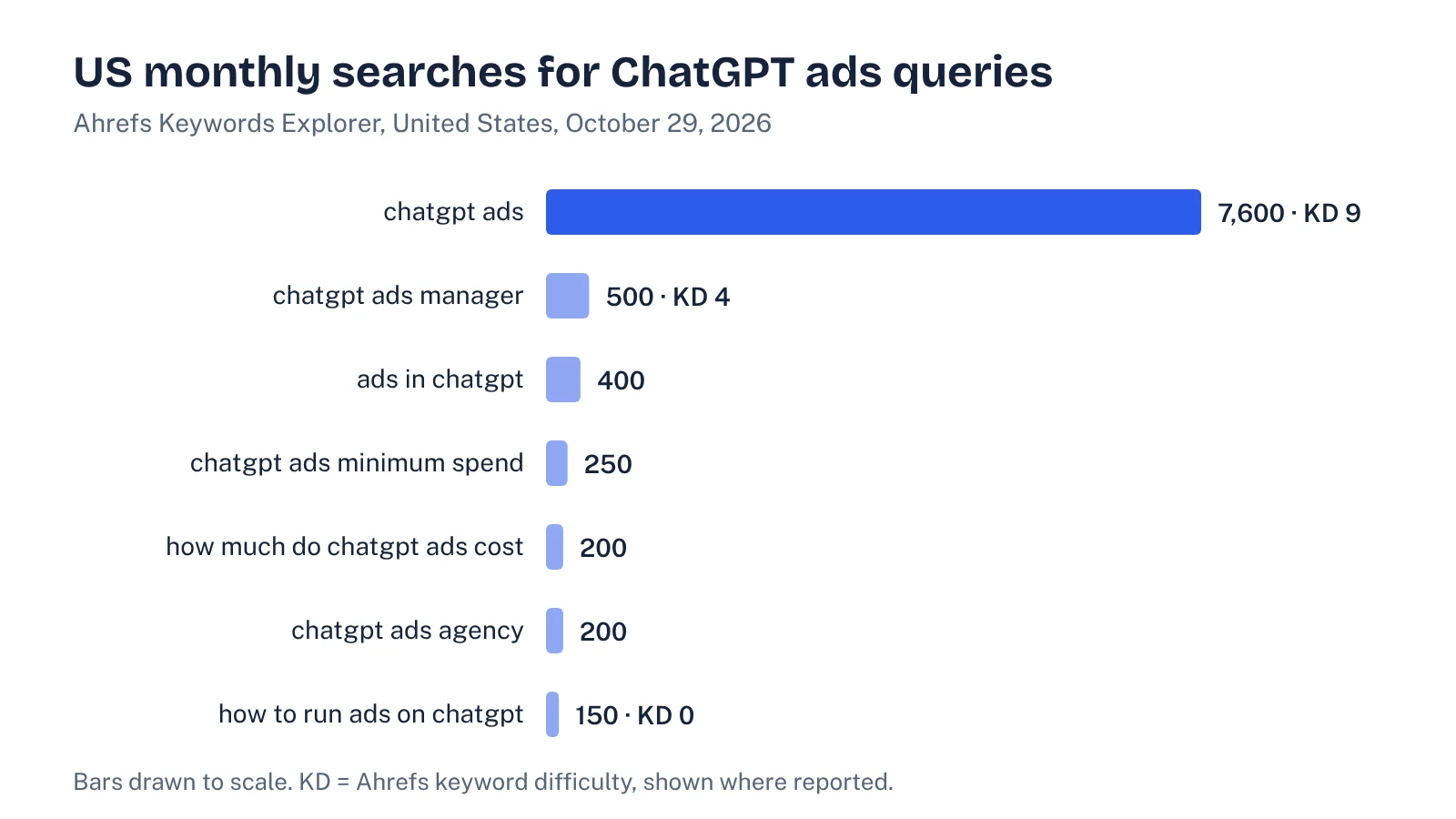
We pulled the main queries from Ahrefs Keywords Explorer this morning (US, October 29, 2026). "ChatGPT ads" gets an estimated 7,600 searches a month with a keyword difficulty of 9, which is very high demand for a product that didn't exist a year ago. The supporting queries show what people actually want to know: how to use Ads Manager, what it costs, and the minimum spend.
The search results for "chatgpt ads" are dominated by OpenAI's own pages, Reddit threads from people who've run campaigns, and news. Google shows an AI Overview at the top. What's mostly missing is the B2B view: who in your buying committee will actually see these ads, and how they fit next to the organic work of getting recommended in the answer itself.
How ChatGPT ads work
Who sees them
Ads appear only for logged-in adults on the Free and Go plans, in markets where ads are live. OpenAI's January post says Plus, Pro, Business and Enterprise plans won't include ads. Accounts that state or are predicted to be under 18 don't see ads, and ads aren't shown near sensitive or regulated topics such as health, mental health and politics. In the EEA and Switzerland, OpenAI said in August that ads would not be personalized at launch.
For B2B SaaS this is a real constraint. Many of the people you sell to use ChatGPT through a company Business or Enterprise workspace, or pay for Plus. Those sessions are ad-free. Your ads reach the same people only when they research on a free personal account. That doesn't kill the channel, but it does mean reach among senior, tool-heavy buyers may be lower than raw ChatGPT usage suggests.
Targeting: context hints, not keywords
There are no exact-match keywords. Campaigns are built from ad groups with "context hints" that describe the conversation topics you want to appear next to. You can restrict campaigns to the iOS app, the Android app or the web. Custom audiences from email or phone lists exist, but PPC Land reported a floor of 25,000 matched users in July, with 100,000 recommended. Most early-stage B2B SaaS customer lists won't reach that.
Formats
The standard unit is small. OpenAI's May documentation recommended a headline of about 16 characters and a description of about 32, according to PPC Land, and StackAdapt's spec lists a 1:1 image at 256 by 256 pixels. That leaves room for a product name and one claim, not a value proposition. In October OpenAI also announced US tests of ads during image generation.
Pricing and minimums
OpenAI doesn't publish a rate card. The US pilot reportedly launched at a $60 CPM. Since May 5 you can bid on CPC as well. PPC Land reported a minimum spend table from August that set daily floors in ten currencies, starting at $25 in US dollars. Prices in an auction move with competition, so treat any number you read, including these, as a starting reference and check Ads Manager for your market.
Measurement
Ads Manager reports impressions, clicks, spend, CTR and attributed conversions. Tracking runs through a pixel and a Conversions API. View-through conversions were added in August on a fixed one-day window, reported separately and kept out of bidding and billing. Advertisers get aggregate data only. OpenAI says they cannot see chats, memories or personal details. For a long B2B sales cycle, that means you'll see clicks and form fills, not the conversation that led to them.
PPC Land's write-up of creative enhancements also notes that reporting doesn't yet separate enhanced versions from your originals, so you can't tell which version drove a result.
The ad slot vs the answer: what each one controls
This is the part that matters for your strategy. A ChatGPT session now has two places your brand can appear, and they're won in completely different ways.
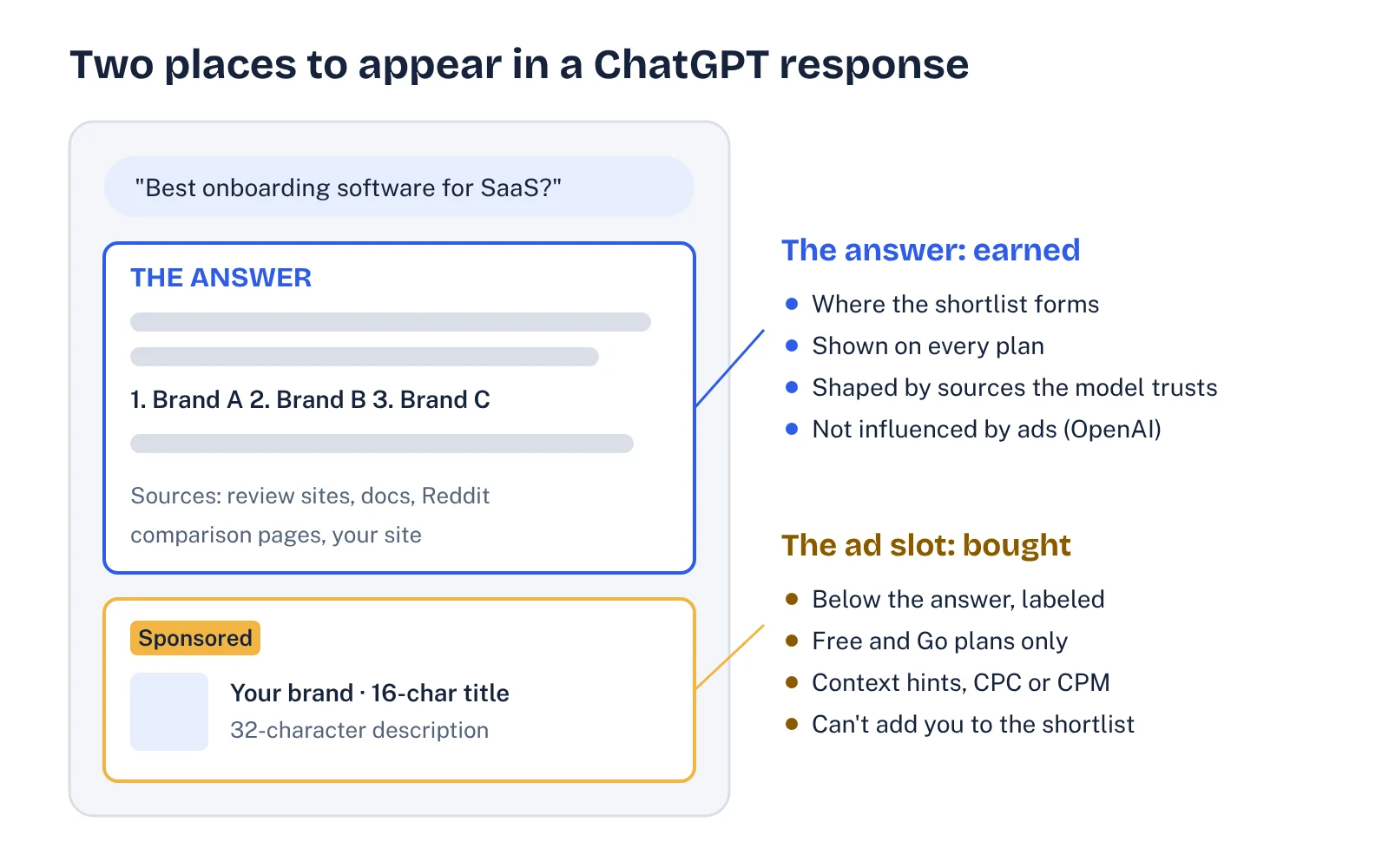
The answer is where buyers form the shortlist. It's shaped by what the model has learned and what it retrieves: your own pages, review sites, comparison articles, Reddit threads and documentation. We cover how to influence it in our guides on how to rank in ChatGPT and how to get cited by ChatGPT. None of that is for sale.
The ad slot is where you can appear on demand. It's useful in a few specific situations:
- You're new or small, and the answer doesn't name you yet. An ad puts your name next to the conversation while the organic work catches up.
- The answer names you but frames you badly (old pricing, wrong category). An ad lets you put your current positioning in front of the same reader.
- A competitor is advertising against your category conversations and you want to know what that costs before deciding whether to respond.
An ad under an answer that already recommends you three times adds little. An ad under an answer that recommends only your competitors may convert poorly, because the reader has just been told what to shortlist. That's why you need to know what the answer says before you spend.
See your own AI visibility, free
Get a one-page audit of how ChatGPT, Perplexity and Gemini treat your brand against up to three competitors, plus your biggest gap. In your inbox within 48 hours.
Get my free auditA four-week ChatGPT ads test for B2B SaaS
If you decide to test, keep it small and measured. Here's the process we'd use.
- Baseline the answer first. Run 20 to 30 buyer prompts for your category in ChatGPT and record which brands are named and which pages are cited. A fixed prompt set makes this repeatable. This tells you which conversations you're missing from organically.
- Write context hints from those prompts. Use the exact problems and comparisons buyers ask about, not product category labels.
- Pick one conversion you can trust. A demo request or trial start tracked through the pixel or Conversions API. Ignore view-throughs for decisions.
- Decide on creative enhancements. If you keep them on, keep a log of what your original copy said so you can compare later.
- Set a fixed budget and window. Four weeks at a daily budget you'd be comfortable losing. Bid CPC so you pay for visits, not impressions.
- Tag the landing page. Use a dedicated page or UTM set so ad clicks don't blur into your organic ChatGPT referrals. Our guide to tracking AI traffic shows how ChatGPT referrals appear in GA4.
- Compare against your organic baseline. At the end, look at cost per qualified lead next to what organic ChatGPT referrals delivered over the same weeks.
When to skip ChatGPT ads (for now)
Some teams should wait. A quick way to decide:
| Your situation | Our view |
|---|---|
| Buyers mostly use ChatGPT through company Business or Enterprise plans | Low reach. Prioritize organic answer visibility. |
| Category conversations touch health, mental health or politics | Ads may not show. Check eligibility before planning. |
| Strict legal review of every ad claim | Turn creative enhancements off before launch, or wait. |
| Not named in ChatGPT answers for core buyer prompts | Worth a small test while you fix the organic gap. |
| Already named in most answers | Low priority. Spend on keeping the facts behind those answers current. |
| Customer list under 25,000 matched contacts | Skip audience targeting. Use context hints only. |
What to watch next
OpenAI has said the next phase will add more formats, objectives, buying options and measurement, without dates. Two developments are worth tracking for B2B. The first is "Sponsored Agents", announced as a US test in September, which could move ads from a static unit to something a buyer interacts with. The second is OpenAI's January note that users may be able to ask follow-up questions directly from an ad. Both would make the ad slot more useful for complex products, where one 32-character line can't carry the message.
Whatever happens to the ad products, the answer above them stays the bigger prize. It reaches every user on every plan, it's where the shortlist forms, and it can't be bought. If you want to know where you stand there before deciding on ads, start by measuring your AI share of voice for the prompts your buyers actually use.
FAQ
How much do ChatGPT ads cost?
OpenAI doesn't publish a rate card. The US pilot launched in February 2026 at a reported $60 CPM, and CPC bidding was added when self-serve Ads Manager opened in May. PPC Land reported daily minimum spend floors from August 2026, starting at $25 in US dollars, so check Ads Manager for your market.
Do ChatGPT ads affect what ChatGPT recommends?
OpenAI says no. Its stated principle is that ads do not influence the answers ChatGPT gives, and ads are labeled and shown separately below the answer. Being recommended inside the answer still depends on the organic sources the model trusts.
Who sees ads in ChatGPT?
Logged-in adults on the Free and Go plans in markets where ads are live. Plus, Pro, Business and Enterprise plans are ad-free, users OpenAI believes are under 18 don't see ads, and ads aren't shown near sensitive topics such as health, mental health and politics.
How do you run ads on ChatGPT?
Through OpenAI's self-serve Ads Manager or a technology partner such as StackAdapt. You create a campaign, set up ad groups with context hints that describe the conversations you want to appear in, write a short headline and description, add an image and landing page, and choose CPC or CPM bidding.
Can advertisers see my ChatGPT conversations?
OpenAI says no. Advertisers receive aggregate performance data such as impressions and clicks, and OpenAI says it keeps conversations private from advertisers and does not sell user data.
Sources
- OpenAI: Our approach to advertising and expanding access (January 16, 2026)
- PPC Land: Advertisers in 26 more countries gain ChatGPT ads, bringing the total to 89 (October 21, 2026)
- PPC Land: OpenAI to rewrite ChatGPT ads by default as advertisers get days to opt out (October 21, 2026)
- PPC Land: StackAdapt lets advertisers retarget ChatGPT ad viewers on CTV and display (October 2026)
- PPC Land: OpenAI finally pulls trigger on ChatGPT ads (January 2026)
- Ahrefs Keywords Explorer and SERP overview, US, pulled October 29, 2026