ChatGPT visibility tracker: how to measure your brand in ChatGPT, and what to ask a tool
A ChatGPT visibility tracker runs a fixed set of buyer prompts through ChatGPT and records whether your brand is named, whether your pages are cited, and who shows up instead. ChatGPT is harder to track than Google or Perplexity: it often answers without searching, rewrites your question, and its API doesn't fully match the app. This guide shows how to measure it properly and what to ask a tool.
- OpenAI offers no visibility report for brands, so ChatGPT visibility has to be sampled with a fixed prompt set.
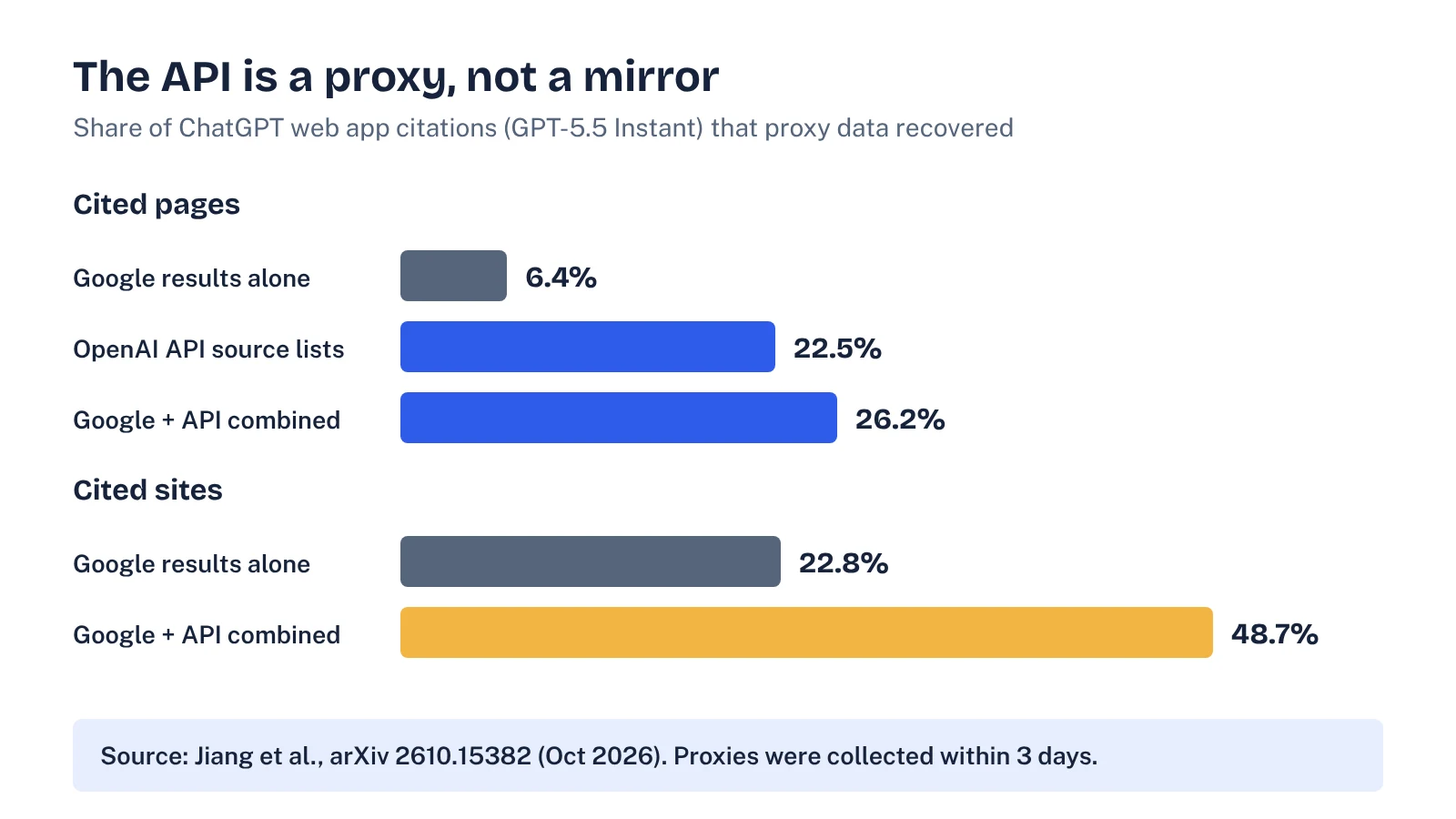
- An October 2026 study found the OpenAI Responses API plus Google results recovered only about 26 to 28% of the pages ChatGPT cited, but about half of the cited sites. Track at site level as well as page level.
- ChatGPT doesn't always search. Ahrefs found 14.4% of free, logged-out responses involved a web search, so calculate citation rate only on answers that searched.
- Fix five settings before you trust any number: account type, search mode, location, model version and runs per prompt.
- Before you buy a tool, ask how it collects answers, whether it records the model, and whether you can export raw answers with sources.
What a ChatGPT visibility tracker measures
When a buyer asks ChatGPT "what's the best tool for [your category]?", one of three things happens. It names you, it names your competitors instead, or it names nobody useful. A ChatGPT visibility tracker turns that into numbers you can follow month to month.
Every tracker, including one you run in a spreadsheet, does the same basic job. It sends a fixed list of prompts to ChatGPT on a schedule, saves each answer, and records:
- Mentions. Is your brand named in the answer?
- Citations. Is one of your URLs among the sources ChatGPT links?
- Competitors. Which other brands appear, and how often?
- Cited domains. Which sites does ChatGPT rely on for your category?
That much is the same as tracking Gemini or Perplexity. What's different is how unstable ChatGPT's answers are, and how many settings change what you see. If you want the "how do I get recommended" side, our guide on how to rank in ChatGPT covers it. This post is about measurement.
What people search for
We pulled the related queries from Ahrefs Keywords Explorer this morning (US, November 9, 2026):
| Query | US monthly searches | Keyword difficulty |
|---|---|---|
| chatgpt visibility tracker | 1,000 | 8 |
| chatgpt visibility tracking | 1,000 | 4 |
| check brand visibility in chatgpt | 1,000 | 7 |
| chatgpt search visibility | 900 | 7 |
| track chatgpt mentions | 700 | not yet scored |
| chatgpt brand monitoring | 350 | 0 |
| chatgpt rank tracker | 200 | 8 |
A caution: Ahrefs shows a dozen "best chatgpt rank tracker" variants at almost exactly the same volume, which suggests part of this demand is tools and bots checking the SERP rather than people. Treat the figures as a rough signal. Difficulty is low across the board.
The results page tells you more. For "chatgpt visibility tracker", an AI Overview sits on top, and most organic results are vendor landing pages. The one guide in the AI Overview's sources explains what a tracker measures but doesn't cover API versus app differences, sample sizes or model changes. Those are the things that decide whether your numbers mean anything.
Why ChatGPT is harder to track than Google
Four things make ChatGPT a moving target. Each one should change how you set up tracking.
1. It often answers without searching
ChatGPT searches the web when it judges that a question would benefit. Otherwise it answers from what the model already knows, with no sources at all. In Ahrefs data reported by Search Engine Journal, only 14.4% of 66.6 million free, logged-out responses involved a web search. Buyer prompts about software probably trigger search more often than average, but you should measure that rather than assume it.
2. It rewrites your question
An October 2026 study by researchers at the National University of Singapore and Xi'an Jiaotong University (Jiang et al., arXiv preprint) ran 80 questions 20 times each through ChatGPT's web app. In runs on GPT-5.3 Instant and GPT-5.5 Instant where the searches were visible, ChatGPT never searched with the exact wording of the question. You can't track ChatGPT like a keyword, because the keyword it searches isn't yours.
3. Answers vary a lot from run to run
In the same study, 44.5% of the distinct pages cited for a question on GPT-5.5 Instant appeared in only one of the 20 runs. A single check per prompt is close to a coin flip for any page that isn't a firm favorite.
4. Citation behavior shifts at platform level
seoClarity reported that ChatGPT citation volume fell 86 to 94% across five markets between February and April 2026, then recovered toward earlier levels in May. Ahrefs found Reddit was cited in 19.1% of US answers in March and 2.3% in September. Swings like these hit every brand at once. If your citation rate halves in the same month as everyone else's, that's ChatGPT, not you. That's why you track competitors alongside yourself.
The API is a proxy, not a mirror
Most tracking tools, and most DIY scripts, collect answers through OpenAI's API, because scraping the ChatGPT app is slow and fragile. The Jiang et al. study is the first public test we've seen of how closely that matches what users see. The short answer: partly.
Three findings matter for tracking:
- Page-level overlap is low. The API's source lists covered about 22 to 23% of the pages ChatGPT's app cited. Adding up to five pages of Google results only lifted that to 26 to 28%.
- Site-level overlap is much better. Combined, the proxies covered about half of the cited sites. If you need to know "does ChatGPT lean on G2 or on our docs?", API data is useful. If you need to know "was this exact page cited?", it's weak.
- Model changes break comparisons. Two of the researchers' collection sessions switched model partway through. The authors recommend recording which model produced each answer and re-checking your method when OpenAI ships a new one.
The study didn't test any commercial tracking tool, so it doesn't tell you which vendor is accurate. It does tell you which questions to ask them.
There's also a display issue. Search Engine Roundtable reported in August 2026 that ChatGPT moved sources behind a menu for some accounts, with the treatment varying by plan and browser. A citation that exists but sits in a side panel gets fewer clicks. Your tracker can count it; it can't tell you anyone saw it.
Five settings to fix before you trust a number
The same prompt can produce different answers depending on who asks and how. Pick one value for each setting, write it down, and keep it constant.
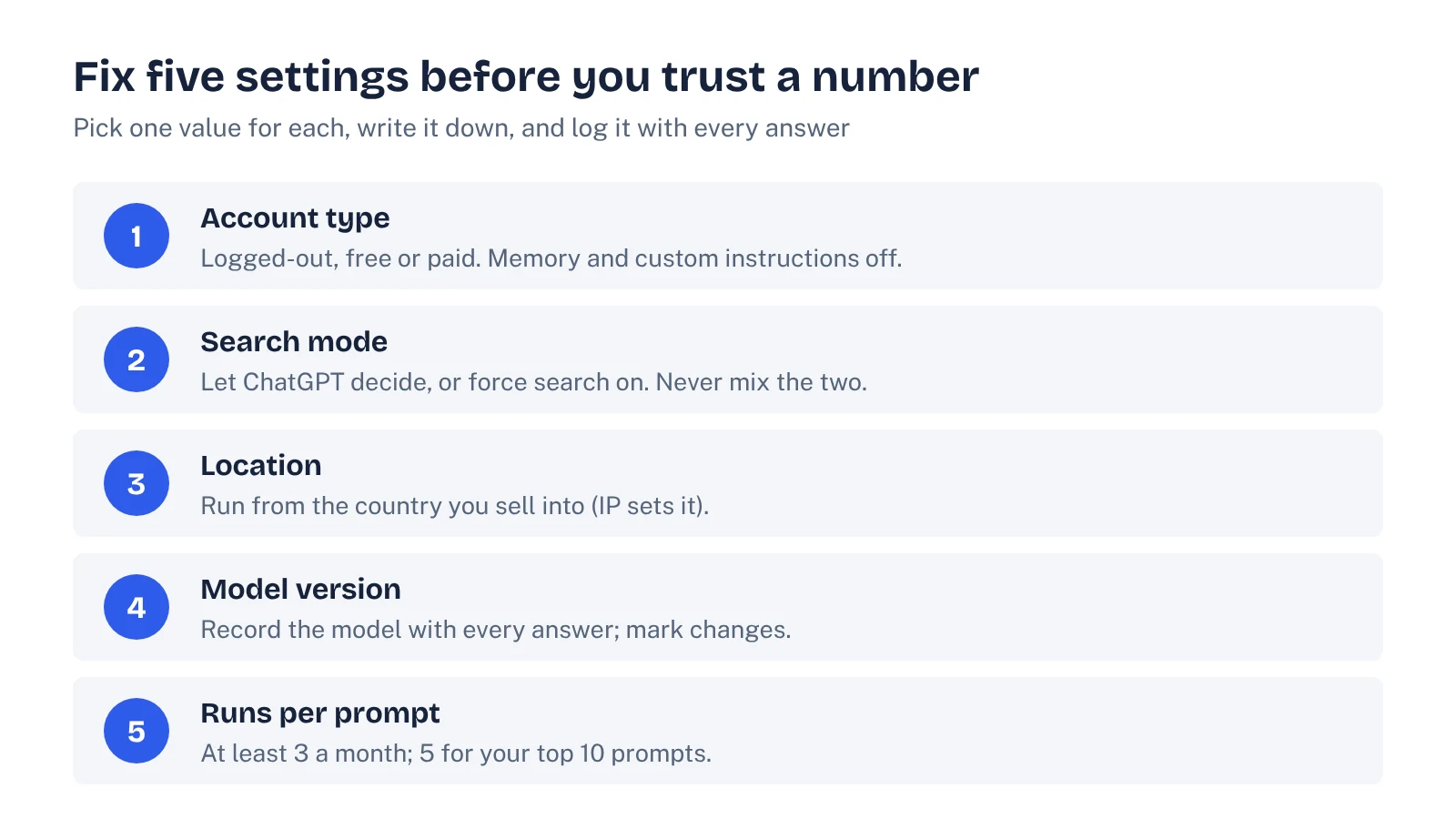
- Account type. Logged-out, free and paid accounts don't always get the same experience. Search Engine Roundtable found sources displayed differently on free and paid accounts, for example. Use a clean account with memory off, or a Temporary Chat, which doesn't use memory or past chats. It does still follow custom instructions, so switch those off.
- Search mode. Decide whether you let ChatGPT choose when to search (closest to real buyers) or force search on (more citations to measure). Don't mix the two in one dataset.
- Location. OpenAI says ChatGPT uses your general location from your IP address to improve search results. Run from the market you sell into, or use a tool that lets you set country.
- Model version. Log the model name with every answer. When it changes, mark a break in your trend line.
- Runs per prompt. Three runs per prompt per month is a sensible minimum. Five is better for your 10 most important prompts.
Set up a ChatGPT tracker in a week
You can run a credible baseline with a spreadsheet before you spend anything on software.
- Day 1: write 30 to 40 prompts. Cover category questions ("best [category] for [segment]"), use cases, comparisons ("[you] vs [competitor]"), alternatives and pricing. Word them the way a buyer would. Our guide to AI prompt tracking has a template for building the set.
- Day 2: pick three to five competitors. The ones you lose deals to, not the biggest names in the market.
- Days 3 to 4: run each prompt three times. Use the fixed settings above. Save the full answer, every cited URL, the search queries if ChatGPT shows them, the model and the date.
- Day 5: tag each answer. Searched or not, you mentioned or not, you cited or not, which competitors appear, which domains are cited.
- Days 6 to 7: calculate and write down the baseline. Then repeat on the same day next month.
If you'd rather start from a ready-made sheet, our AI visibility audit guide and free template covers ChatGPT alongside Gemini, Perplexity and AI Overviews.
See your own AI visibility, free
Get a one-page audit of how ChatGPT, Perplexity and Gemini treat your brand against up to three competitors, plus your biggest gap. In your inbox within 48 hours.
Get my free auditThe metrics worth reporting
| Metric | How to calculate it | What it tells you |
|---|---|---|
| Mention rate | Answers naming you ÷ all answers | Whether ChatGPT knows you belong in the category |
| Search rate | Answers that searched ÷ all answers | How much of your category runs on live web results |
| Citation rate | Searched answers citing your domain ÷ searched answers | Whether your own pages are used as evidence |
| Share of voice | Your mentions ÷ mentions of all tracked brands | Your position against the competitors you named |
| Top cited domains | Count of citations by domain, across all answers | Which third-party sites to earn a place on |
Here's why the search-rate split matters, with simple arithmetic. Say you log 120 answers and 30 of them searched. If 6 of those 30 cite you, your citation rate is 20%, with a 95% margin of error of about ±14 points on a sample that small. Report it as "around 20%, still noisy," not as a precise figure. We cover margin of error in more detail in our Gemini visibility tracker guide; the same math applies here.
For page-level work, our guide to LLM citation tracking shows how to build a ledger of which URLs get cited and why.
Seven questions to ask a ChatGPT tracking tool
Paid tools save time once you track more than about 50 prompts or several markets. Most vendor pages show the dashboard and skip the method. Ask these before you pay:
- How do you collect answers? The ChatGPT app, the API, or both? If API, do you spot-check against the app?
- Which account type do you simulate? Logged-out, free or paid?
- Do you record the model for every answer? And do you flag model changes on charts?
- How many times do you run each prompt? Once a day is not the same as several runs per check.
- Do you separate searched and unsearched answers? Or do they all count toward citation rate?
- Do you report at site level and page level? The research suggests site level is far more stable.
- Can I export raw answers with sources and search queries? If you can't audit the data, you can't trust the trend.
Our roundup of the best AI visibility tools compares the main options. Use these questions to test whichever you shortlist.
Common ChatGPT tracking mistakes
- Checking from your own account. Memory and past chats about your product will flatter the results.
- Reporting one answer as "our ranking." With nearly half of cited pages appearing in only one of 20 runs, one screenshot proves very little.
- Changing prompts every month. New prompts make the trend line meaningless. Add new ones in a separate group.
- Ignoring the denominator. A falling citation count can simply mean ChatGPT searched less that month.
- Treating API data as the app. It's a useful proxy for which sites matter, not proof of which page a buyer saw.
What to do with the first month of data
Start with the top cited domains list. It shows which review sites, publishers, communities and competitor pages ChatGPT trusts for your category. Ahrefs' September data suggests ChatGPT has been shifting toward original sources, so pages with your own data, docs and pricing are worth strengthening. Then look at prompts where competitors are named and you aren't, and read the answers to see what they're credited for.
Fix what you can control first: pages ChatGPT can reach and quote, clear comparison and pricing pages, and accurate profiles on the sites it cites. Our guide on how to get cited by ChatGPT walks through those steps. Then measure again next month, with the same prompts and the same settings, and see whether the numbers moved more than the noise.
FAQ
How do I check my brand visibility in ChatGPT for free?
Write 20 to 40 buyer prompts, run each one three times in a Temporary Chat with search on, and log every brand mention and cited URL in a sheet. Temporary Chat doesn't use memory or past chats, though it still follows custom instructions, so turn those off. Repeat on the same day each month.
Is the OpenAI API the same as ChatGPT for tracking?
No. In an October 2026 study, the Responses API with web search matched only about 22 to 23% of the pages ChatGPT's web app cited. Overlap was much higher at the level of whole sites. Use the API as a cheap proxy for trends, and spot-check it against the app each month.
Why does my ChatGPT visibility change every time I check?
ChatGPT samples its answers, rewrites your question into its own search queries, and changes models over time. In one study, 44.5% of the distinct pages cited for a question appeared in only one of 20 runs. Repeat each prompt several times and report rates, not single answers.
Can I see which search queries ChatGPT used?
Sometimes. When ChatGPT shows its searches you can log them, and the API returns more of this detail. Researchers found ChatGPT almost never searched with the exact wording of the user's question, so tracking a single keyword won't tell you what it looked up.
Sources
- Jiang et al., Understanding ChatGPT Citations: Evidence from Production Web Search Across Model Generations (arXiv, October 2026)
- Search Engine Journal: OpenAI's API Only Partly Matched ChatGPT's Citations, Paper Finds (October 18, 2026)
- Search Engine Journal: ChatGPT's Most-Cited Sites Tilt Toward Primary Sources, Data Shows (Ahrefs data, October 12, 2026)
- seoClarity: Tracking the Decline of ChatGPT's Citations, a Global Trend Analysis (2026)
- Search Engine Roundtable: OpenAI Makes ChatGPT Sources Less Visible (August 2026, updated September 2026)
- OpenAI Help Center: ChatGPT search
- OpenAI Help Center: Temporary Chat FAQ
- Ahrefs Keywords Explorer and SERP overview (US data pulled 9 November 2026)