How to choose a generative engine optimization agency: 12 questions to ask
To choose a generative engine optimization agency, judge how it diagnoses your current AI visibility, what work it will actually do on and off your site, how it measures results across repeated prompts, and what the contract commits you to. Below are 12 questions to ask, the answers to listen for, the red flags, and a scorecard you can use on every proposal.
- Google says optimizing for its generative AI features "is still SEO". A good GEO agency builds on SEO basics instead of selling a separate bag of tricks.
- Ask for a baseline before a plan: a fixed prompt set, run several times, showing where you're mentioned, cited and described wrongly today.
- AI answers change constantly (Ahrefs found a 70% chance an AI Overview changes between checks), so one screenshot proves nothing. Insist on repeated measurement.
- Red flags: guaranteed placements in ChatGPT or AI Overviews, "secret" or "internal" signals, paid or fake mentions, and llms.txt sold as the main fix.
- Score every proposal on diagnosis, method, measurement and terms, and keep ownership of prompts, data and content in the contract.
What you're actually buying from a GEO agency
A generative engine optimization agency is supposed to improve how AI tools talk about you. That means three things: whether ChatGPT, Perplexity, Gemini and Google's AI Overviews mention your product for the questions your buyers ask, whether they describe it correctly, and whether they cite your pages or pages that say good things about you.
The term comes from a 2023 research paper, "GEO: Generative Engine Optimization" by Aggarwal and colleagues, which reported that content changes could raise a source's visibility in generative engine answers by up to 40% on its benchmark. Since then, "GEO agency" has become a crowded label. Some firms built real methods. Many renamed an SEO retainer.
Google has been blunt about the overlap. Its May 2026 guide, Optimizing your website for generative AI features, says optimizing for generative AI search "is optimizing for the search experience, and thus still SEO." That doesn't make GEO a fake category. It means the agency you want builds on solid SEO and then adds the parts SEO programs usually skip: off-site coverage, brand accuracy and measuring answers across several AI tools. If you want the longer version of that distinction, read our GEO vs SEO breakdown.
Why this decision is getting harder
Buyers are searching for this help in volume. We pulled US data from Ahrefs Keywords Explorer on 9 October 2026 for the main ways people phrase it:
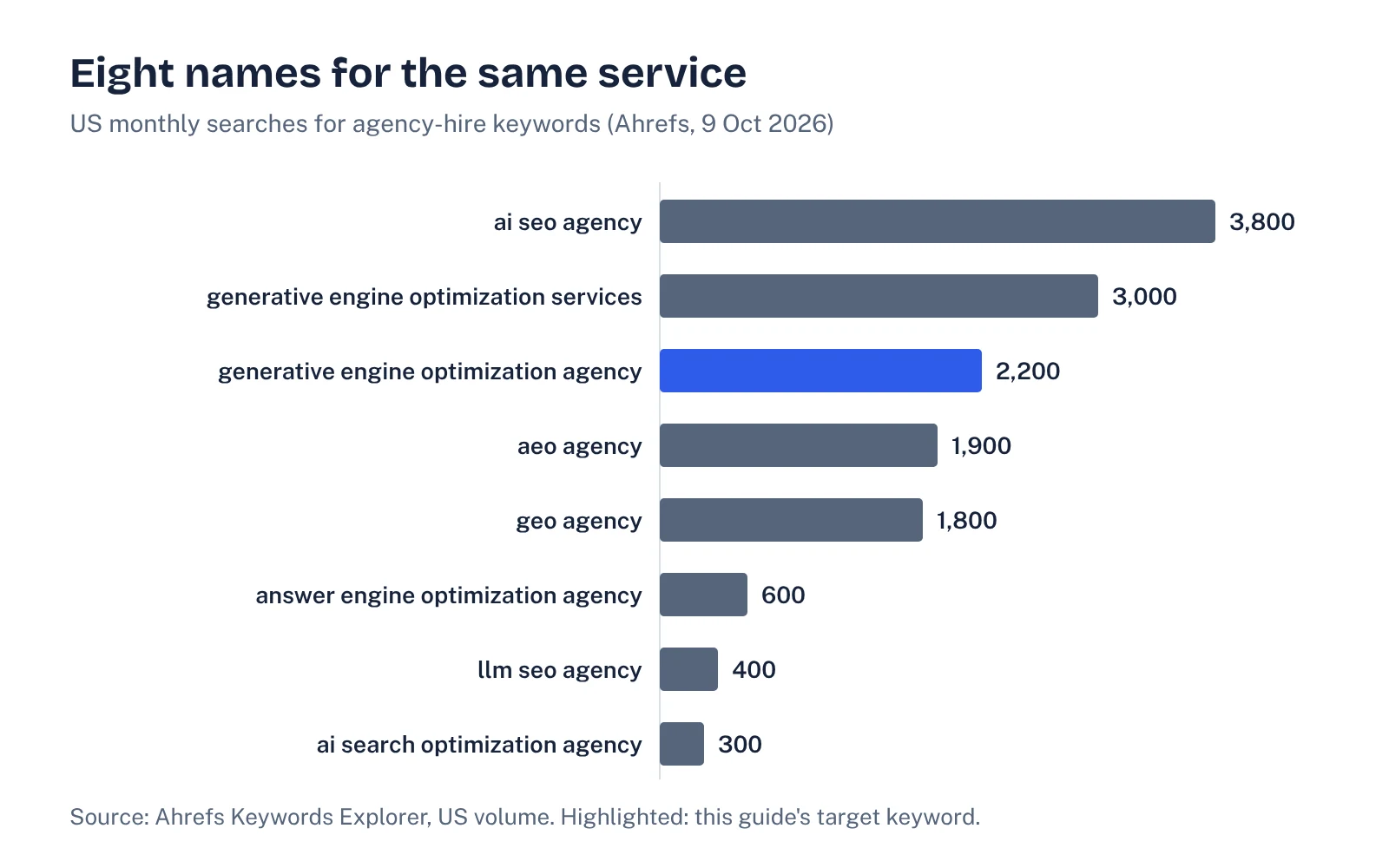
Three things stand out in that data:
- The vocabulary is unsettled. "AI SEO", "GEO", "AEO" and "LLM SEO" agencies are mostly selling the same outcome. Don't let a label decide your shortlist.
- The keywords are commercial and pricey. Ahrefs shows an estimated cost per click of about $25 for "generative engine optimization agency" and $20 for "generative engine optimization services". Agencies are paying to reach you. If you want published price ranges and a six-part scope to compare proposals against, read what AEO services should include and cost.
- The results page is full of agencies ranking agencies. In the Ahrefs SERP overview for "generative engine optimization agency", the top 10 organic results were agency service pages, "best GEO agencies" lists published by agencies, and a Reddit thread. The SERP also showed a Google AI Overview.
We're an agency too, so read this guide with the same skepticism. The point of the questions below is that they work on anyone, including us.
12 questions to ask a generative engine optimization agency
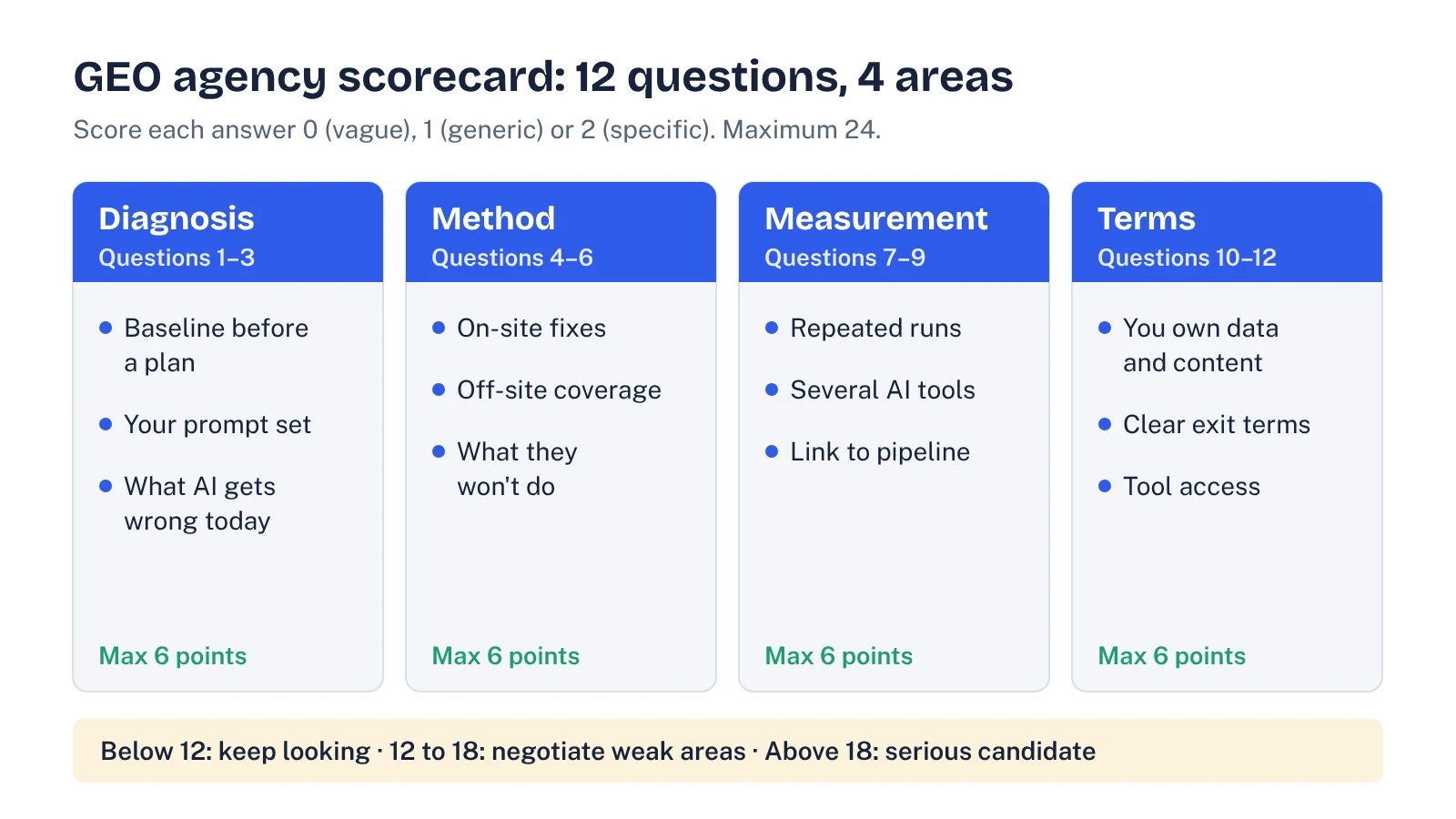
Group the questions into four areas: diagnosis, method, measurement and terms. A strong agency answers all four specifically. A weak one gets vague as soon as you leave the sales deck.
Diagnosis: do they understand where you stand?
- "What will you measure before you recommend anything?" Listen for a fixed set of buyer prompts, run across several AI tools, with mention rate, citations and accuracy recorded. A proposal that arrives with a full plan before any baseline is a template.
- "Which prompts will you track, and where do they come from?" Good answers draw on your sales calls, search data and competitor positioning, and cover problem, category, comparison and pricing questions. Ask to see and edit the list.
- "What do AI tools currently get wrong about us?" Outdated pricing, a retired feature or the wrong ideal customer are common. An agency that has looked will have examples. One that hasn't will talk about "optimizing content".
Method: what work will they actually do?
- "What will you change on our site, and why?" Expect specifics: clearer positioning on the homepage and product pages, current facts on pricing and integration pages, comparison pages, and crawl or indexing fixes. Google says pages must be indexed and eligible for a snippet to appear in its AI features, with no additional technical requirements.
- "What off-site work is included?" AI answers lean on third-party pages: reviews, roundups, community threads and analyst coverage. Ask how they earn genuine coverage there. Our guide to AI brand mentions covers what legitimate work looks like.
- "What won't you do?" This is the most revealing question. You want to hear that they won't buy fake reviews, plant astroturfed Reddit posts or mass-produce thin pages. Google's guide warns that "seeking inauthentic 'mentions' across the web isn't as helpful as it might seem."
Measurement: how will you know it worked?
- "How many times will you run each prompt, and how often?" AI answers move constantly. Ahrefs tracked over 43,000 keywords and found a 70% chance an AI Overview changed between consecutive checks, with only about 54.5% of cited URLs carrying over. One screenshot of your brand in an answer proves almost nothing. Look for repeated runs and trends.
- "Which AI tools will you report on?" Google's AI Overviews and AI Mode, ChatGPT, Perplexity and Gemini pull from different sources. A report that covers one tool is a partial picture. See our guide to AI visibility tracking for a setup you can compare against.
- "How will you connect this to pipeline?" Expect AI referral traffic tagged in analytics, a "how did you hear about us" field that includes AI tools, and a view of demo or trial requests over time. Nobody can attribute every AI-influenced deal, but an agency should try.
See your own AI visibility, free
Get a one-page audit of how ChatGPT, Perplexity and Gemini treat your brand against up to three competitors, plus your biggest gap. In your inbox within 48 hours.
Get my free auditTerms: what are you signing up for?
- "Who owns the prompt set, the tracking data and the content?" You should. If you leave, you need the baseline and history to keep measuring, and the pages they wrote.
- "What is the minimum term, and how do we exit?" A paid audit or a short first phase with a clear re-measurement date is a reasonable start. A 12-month lock-in before any baseline is not.
- "What tools will you use, and will we get access?" Ask which AI visibility tools they run and whether you can see the dashboards directly. Google notes that no third-party tool has access to its internal ranking or AI systems, so treat any claim of "internal" data as a warning. Our comparison of AI visibility tools explains what these tools can and can't see.
Red flags that should end the conversation
Google's long-standing page "Do you need an SEO?" lists warning signs for hiring search help, and most of them carry straight over to GEO. Here is how they show up in AI visibility pitches:
| What you hear | Why it's a problem | What to ask instead |
|---|---|---|
| "We guarantee you'll appear in ChatGPT" or "in the AI Overview" | No outside party controls these answers, and they change from run to run. Google says plainly that no one can guarantee a #1 ranking. | "What baseline and re-measurement date will you commit to?" |
| "We use internal signals" or "special access" | Google says no third-party tool has access to its internal ranking or AI systems. | "Which tools do you use, and can we log in?" |
| "llms.txt is the key fix" | Google says it ignores these files for Search and that they neither help nor harm. See our llms.txt guide for where they do make sense. | "What else is in the first month's plan?" |
| "We'll chunk your content for AI" | Google says there's no requirement to break content into tiny pieces. | "Which pages are unclear today, and how will you fix them?" |
| "We'll get you mentioned on hundreds of sites" | Paid or inauthentic mentions are a reputational risk and, per Google, less helpful than they seem. | "Which specific publications and why do AI tools cite them?" |
| Unsolicited cold email with a scary AI "score" | Google advises caution with firms that contact you out of the blue. | Run your own check first. |
Before you take any meetings, spend an afternoon on a free manual AI visibility check. You'll know your own baseline, which makes every pitch easier to judge.
How to score proposals side by side
Turn the 12 questions into a simple scorecard so you compare agencies on substance, not on who had the nicest deck.
- Send the same brief to every agency. Include your category, three main competitors, your top buyer questions and what you want to change in six months.
- Ask all 12 questions in writing. Written answers are easier to compare and harder to blur.
- Score each answer 0, 1 or 2. 0 = vague or missing, 1 = reasonable but generic, 2 = specific to your company with a named deliverable or metric. The maximum is 24.
- Weight measurement and terms. If two agencies tie, prefer the one with the stronger answers to questions 7 to 12. Those decide whether you can tell if anything worked.
- Check one reference per finalist. Ask a past client what the baseline was, what changed, and how long it took. Treat case-study numbers from the agency's own site as claims until a client confirms them.
- Start with a defined first phase. A baseline audit plus the first round of fixes, with a re-measurement date, tells you more than any pitch.
A rough rule from that scoring: below 12 out of 24, keep looking. Between 12 and 18, negotiate on the weak areas before signing. Above 18, you have a serious candidate.
Do you need an agency at all?
Not always. If you have a capable SEO lead and a content marketer with time, you can run the baseline, fix your key pages and start earning coverage yourselves. Use the same 12 questions as an internal plan.
An agency makes more sense when you need off-site coverage you can't earn alone, when nobody owns AI visibility internally, or when you need an outside view of what AI tools say about you and your competitors. Whichever route you take, the order is the same: measure first, fix the facts AI tools rely on, earn real third-party coverage, then measure again on the same prompts.
FAQ
What does a generative engine optimization agency do?
A GEO agency works to get your brand mentioned, described accurately and cited in AI-generated answers from tools like ChatGPT, Perplexity, Gemini and Google's AI Overviews. In practice that means measuring your current AI visibility, fixing the pages and facts AI systems rely on, and earning genuine coverage on the third-party sites those systems cite.
How do I choose an SEO agency for AEO or GEO visibility?
Ask how they will baseline your visibility, which prompts they will track and how often, what they will change on and off your site, and how they will connect results to pipeline. Prefer agencies that show their method and admit uncertainty over those that promise guaranteed placements.
Is a GEO agency different from an SEO agency?
There is a lot of overlap. Google's own guidance says optimizing for its generative AI features is still SEO. The difference is emphasis: a GEO agency should spend more time on off-site coverage, brand accuracy and measuring answers across several AI tools, not only on rankings and traffic.
Can any agency guarantee my brand will appear in ChatGPT or AI Overviews?
No. AI answers vary from one run to the next, and no outside party controls how Google or OpenAI generate them. Google warns against anyone claiming guaranteed rankings or access to its internal systems, and the same caution applies to AI answers.
How long before GEO work shows results?
Fixes to your own pages can show up within weeks once they are crawled, while earning third-party coverage usually takes longer. Ask any agency to commit to a baseline and a re-measurement date rather than a promised outcome, and judge progress on the trend across repeated runs.
Sources
- Google Search Central: Optimizing your website for generative AI features on Google Search
- Google Search Central: Do you need an SEO?
- Google Search Central: AI features and your website
- Ahrefs: study of how often AI Overviews change, 43,000+ keywords (Linehan and Guan, November 2025)
- Aggarwal et al.: GEO: Generative Engine Optimization (arXiv, 2023/2024)
- Ahrefs Keywords Explorer and SERP overview (US data pulled 9 October 2026)