Answer engine optimization services: what they should include and what they cost
Answer engine optimization services should cover six things: a baseline of how AI tools answer your buyers' questions today, a map of those questions, on-site answer pages, technical access for AI crawlers, off-site coverage, and repeated measurement. Agencies publish ranges of roughly $3,000 to $15,000 a month for ongoing programs. Below: the full scope, published prices, red flags and a checklist to send vendors.
- A complete AEO scope has six workstreams: baseline audit, prompt map, on-site answers, technical access, off-site coverage and measurement.
- Google says there are no special optimizations needed to appear in AI Overviews or AI Mode. Good AEO builds on SEO fundamentals.
- Published agency ranges cluster around $3,000 to $15,000 a month for ongoing programs, with one-time audits from about $1,500. None of these figures come from an independent survey.
- Price depends on how many AI tools are tracked, whether content is written or only advised on, and whether off-site work is included.
- Ask vendors for deliverables as named files with dates, and keep ownership of the prompt set, data and content.
What answer engine optimization services are
Answer engine optimization (AEO) services aim to get your brand mentioned, described correctly and cited when buyers ask AI tools like ChatGPT, Perplexity, Gemini and Google's AI Overviews about your category. The work is part measurement, part on-site fixes, and part earning coverage on the other sites those tools read.
If you need the background first, start with our guide to answer engine optimization. This post is for the next step: you are about to buy AEO help, or justify a budget for it, and you want to know what a proper scope looks like and what the market charges.
One fact is worth keeping in mind before you read any proposal. Google's own documentation on AI features and your website says: "There are no additional requirements to appear in AI Overviews or AI Mode, nor other special optimizations necessary." A good AEO service builds on SEO fundamentals. It doesn't sell a secret layer on top of them.
What buyers are searching for
We pulled US data from Ahrefs Keywords Explorer on 10 October 2026 for the ways people search for this help. "Answer engine optimization services" gets about 1,200 searches a month with a keyword difficulty of 12, and Ahrefs estimates a cost per click of around $17. That CPC tells you advertisers see these searchers as buyers.
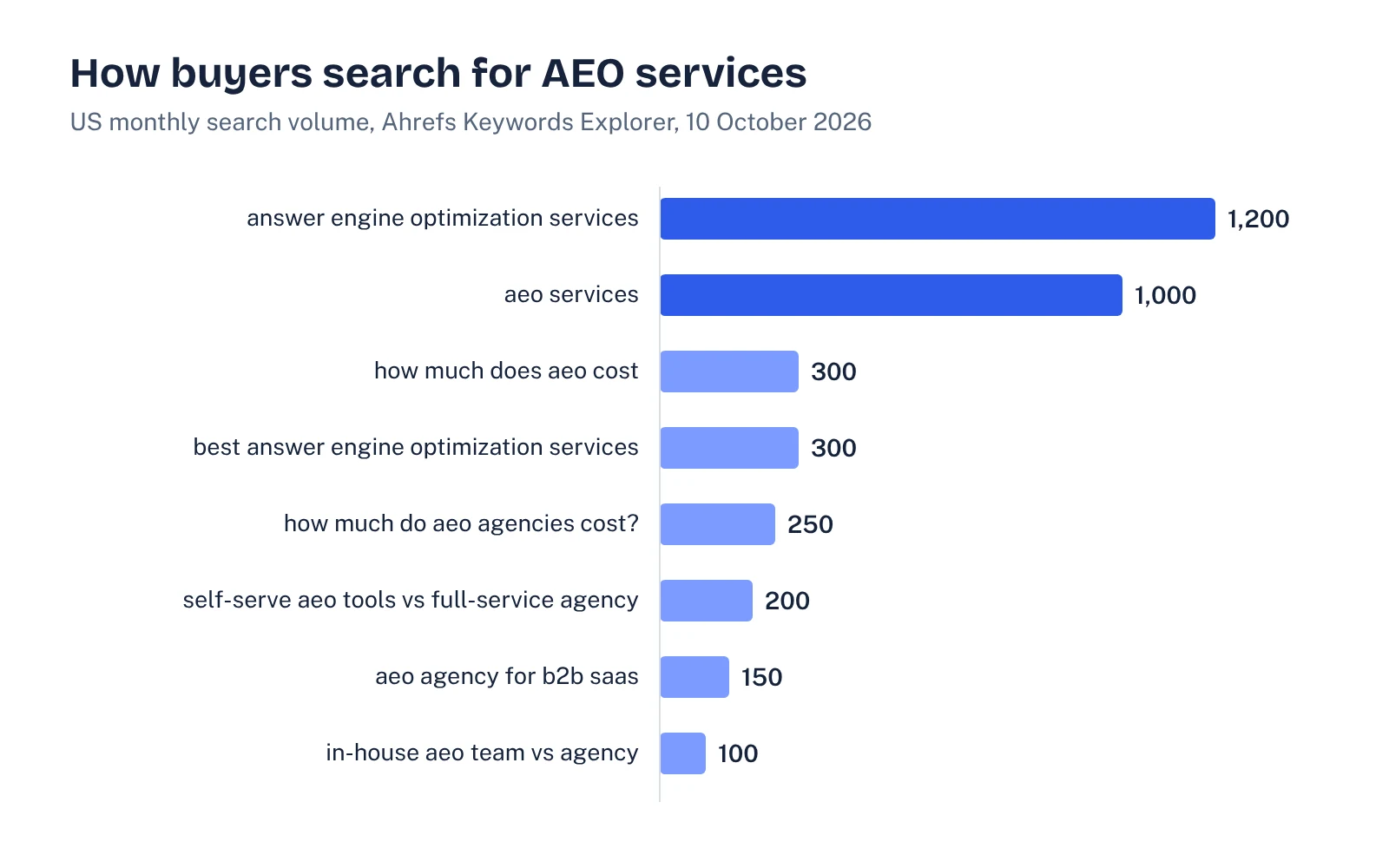
The long tail is the interesting part. People are not only asking who sells AEO. They are asking what it costs, whether a tool can replace an agency, and whether to build the skill in-house. The rest of this post answers those three questions.
We also looked at the top 10 Google results for "answer engine optimization services" the same day. An AI Overview sits at the top. Most organic results are agency service pages or "top AEO companies" lists. In the service pages we read, deliverables were listed in general terms, and none named specific KPIs with targets or published a price.
What AEO services should include: six workstreams
Strip away the labels and a complete AEO engagement has six parts. Smaller budgets cover fewer of them, but you should know which ones you are leaving out.
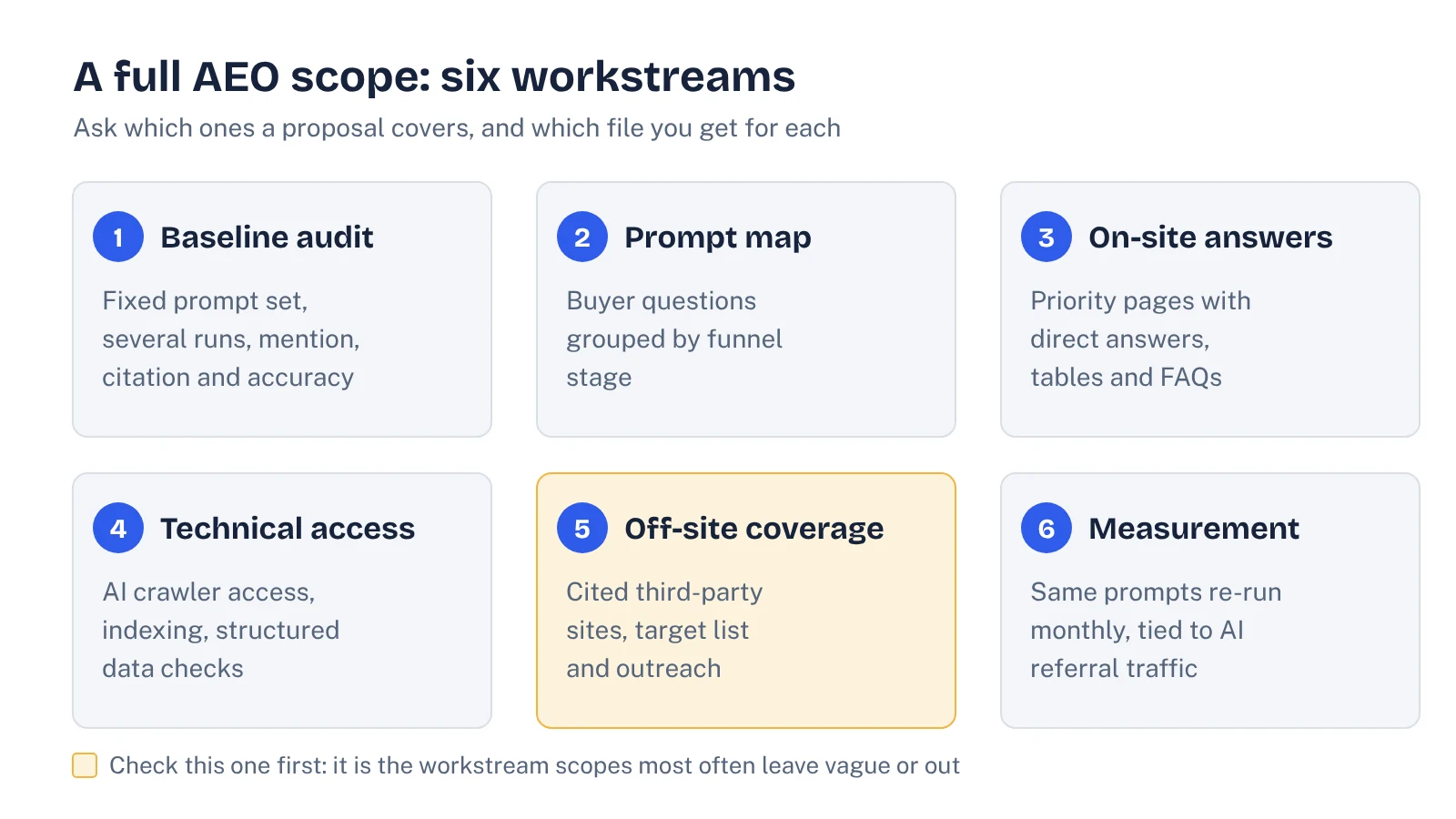
- Baseline audit. A fixed set of buyer prompts, run several times across the AI tools your buyers use, showing where you are mentioned, cited, missing or described wrongly. Without this, nobody can prove progress later. Our AI visibility tracking guide explains how to set one up.
- Prompt and question map. The questions buyers actually ask, grouped by stage: problem, category, comparison, pricing, implementation. This becomes the brief for content and the list you measure against.
- On-site answers. Priority pages rewritten so each section opens with a direct answer, uses clear headings, and puts facts in lists and tables. HubSpot's AEO guide gives similar advice: question-style headings, a short answer first, self-contained sections.
- Technical access. Can the AI crawlers reach and read your pages? OpenAI's crawler documentation says that to appear in ChatGPT search results it recommends allowing OAI-SearchBot in robots.txt. Google's rule is simpler: the page must be indexed and eligible for a snippet. This workstream also covers structured data that matches visible content.
- Off-site coverage. AI answers lean heavily on third-party pages: review sites, comparison articles, community threads, industry press. A real AEO service finds which of those pages get cited for your prompts and works to earn accurate coverage on them. This is where most "relabeled SEO" retainers fall short. See our post on earning AI brand mentions for the tactics.
- Measurement and reporting. The same prompt set, re-run on a schedule, reported as mention rate, citation rate, accuracy and share of voice, plus AI referral traffic and conversions from your analytics.
What AEO services cost
There is no independent pricing survey for AEO services yet, so treat every number you see as an agency describing the market it sells into. Here is what two agencies have published, so you have real reference points instead of guesses.
| Engagement type | Published range | Source |
|---|---|---|
| One-time AEO audit | $1,500–$5,000 (elsewhere on the same page, up to $7,500) | 310 Creative |
| Entry or foundational retainer | $1,000–$3,500 per month | 310 Creative |
| Growth-stage or mid-market retainer | $4,000–$12,000 per month | 310 Creative |
| Enterprise retainer | $15,000–$50,000+ per month | 310 Creative |
| Hourly AEO work | $100–$250 per hour | 310 Creative |
| Managed agency program | $3,000–$15,000+ per month | Lean Labs |
| DIY with tools | $0–$500 per month, mostly tool subscriptions | Lean Labs |
Sources: 310 Creative, AEO Agency Pricing in 2026 (last updated August 2026) and Lean Labs, How much does AEO cost. Neither page cites a survey or dataset behind its ranges.
The two sources broadly agree on a middle band of roughly $3,000 to $15,000 a month for an ongoing program. What moves you up or down that band is predictable:
- How many AI tools are tracked. Four tools with three runs each is twelve times the work of a single check.
- Whether content is written or only advised on. "Recommendations" and "rewritten pages, published" are very different line items.
- Whether off-site work is included. Outreach and digital PR are labor-heavy. Many lower-priced retainers leave this out.
- Who implements technical changes. If your team does the robots.txt, schema and page changes, the agency's cost drops.
See your own AI visibility, free
Get a one-page audit of how ChatGPT, Perplexity and Gemini treat your brand against up to three competitors, plus your biggest gap. In your inbox within 48 hours.
Get my free auditAgency, tools or in-house?
All three can work. The right choice depends on what you already have, not on which sounds most advanced.
| Option | Works best when | Watch out for |
|---|---|---|
| Self-serve tools | You have a content and SEO person with time, and you mainly need measurement. | Tools report the problem. They don't rewrite pages or earn coverage. |
| In-house | You already have strong SEO and content, and AEO is an extension of that team's job. | Off-site coverage and repeated measurement get dropped when the team is busy. |
| Agency | You need the baseline, the method and the off-site work done for you, fast. | Scopes that are SEO retainers with a new name, and contracts without a baseline or exit terms. |
| Audit, then decide | You don't yet know how visible you are, or where the gaps are. | An audit that ends in a sales pitch instead of a prioritized list you could act on yourself. |
If you go the tools route, our comparison of AI visibility tools covers what each one measures. If you go the agency route, use our 12 questions for choosing a GEO agency; they apply equally to AEO firms.
What the first 90 days should look like
A well-run engagement front-loads diagnosis and the fixes you control, then moves to the slower off-site work. A reasonable shape:
- Weeks 1–3: baseline and map. The prompt set is agreed with you, run several times across the agreed tools, and delivered with a list of the pages and third-party sources AI answers currently use for your category.
- Weeks 3–8: on-site and technical fixes. Crawler access confirmed, priority pages rewritten (pricing, comparison, use-case and integration pages are common starting points), and wrong facts about your product corrected at the source.
- Weeks 6–12: off-site work begins. Review profiles completed, outreach to the comparison and list articles that get cited, and community answers where your team has something useful to say.
- Week 12: re-measure. The same prompts, the same tools, the same number of runs, compared with the baseline.
Don't expect the 90-day report to show a dramatic jump. On-site changes only show up after pages are recrawled, and off-site coverage takes longer to earn. What you should see is a clear before-and-after on the prompts tied to fixed pages, plus a prioritized plan for the next quarter. If you want a sense of what moves first, our guide to fixing what AI gets wrong about your brand covers the quick corrections.
Red flags in an AEO proposal
- Guaranteed placement in ChatGPT, Perplexity or AI Overviews. Nobody outside OpenAI or Google controls those answers.
- No baseline. A plan without a "before" measurement can't show an "after".
- Single screenshots as proof. AI answers change from run to run. Results should come from repeated runs of a fixed prompt set.
- Special markup sold as the main fix. Google says no special optimizations are needed for its AI features. Structured data helps when it describes visible content; it isn't a shortcut.
- Fake or paid mentions. Planted reviews and undisclosed paid placements put your brand at risk.
- No ownership terms. You should own the prompt set, the tracking data and the content you paid for.
A scope checklist you can send to vendors
Copy this into your request for proposal. Ask each vendor to answer every line with a deliverable and a date.
- Which AI tools will you track, how many prompts, and how many runs per prompt?
- When will we receive the baseline, and in what format?
- Which pages will you rewrite or create in the first 90 days, and who publishes them?
- What technical checks are included (AI crawler access, indexing, structured data)?
- Which third-party sites will you target for coverage, and how?
- Which metrics will you report monthly, and how do they connect to pipeline?
- What does it cost, what is excluded, and what are the notice and exit terms?
- Who owns the prompt set, data and content if we end the engagement?
Whoever answers these specifically, with files and dates, is offering a real service. Whoever answers with adjectives is offering a retainer.
FAQ
What are answer engine optimization services?
They are services that work to get your brand mentioned, described accurately and cited in AI-generated answers from tools like ChatGPT, Perplexity, Gemini and Google's AI Overviews. A full scope includes a baseline audit, a map of buyer questions, on-site content changes, technical checks, off-site coverage and repeated measurement.
How much does AEO cost?
Agencies that publish prices describe one-time audits from about $1,500 to $5,000 and ongoing programs mostly between $3,000 and $15,000 a month, with enterprise retainers higher. These are agency-published ranges, not survey data, so compare scopes line by line rather than headline prices.
Should I use self-serve AEO tools or a full-service agency?
Tools are enough if you have an SEO or content person with time and mainly need measurement. An agency makes sense when you need the baseline, page rewrites and off-site coverage done for you. If you don't know where you stand yet, an audit first is usually the cheapest way to decide.
Can an AEO agency guarantee my brand appears in ChatGPT?
No. AI answers vary between runs and no outside party controls how OpenAI or Google generate them. Treat guaranteed placements as a red flag and ask for a baseline and a re-measurement date instead.
Sources
- Google Search Central: AI features and your website
- OpenAI: Overview of OpenAI crawlers (OAI-SearchBot)
- HubSpot: Answer engine optimization (AEO) guide
- 310 Creative: AEO Agency Pricing in 2026 (updated August 2026)
- Lean Labs: How much does AEO cost
- Ahrefs Keywords Explorer and SERP overview (US data pulled 10 October 2026)