Answer engine optimization (AEO): what it is, how it differs from SEO, and how to start
Answer engine optimization (AEO) is the practice of getting your brand mentioned, described accurately and cited in the answers that ChatGPT, Perplexity, Gemini and Google's AI features give. It builds on SEO rather than replacing it. This guide explains what changes, how answer engines pick sources, and a six-step way to start.
- AEO aims for mentions, accurate descriptions and citations inside AI answers, not just ranked links.
- Google says optimizing for its AI features is still SEO, so strong SEO is the foundation, not a separate track.
- Answer engines run several searches per question, so off-site mentions and comparison pages matter as much as your own rankings.
- Start with a fixed prompt set and a baseline, fix your own pages, then earn mentions on the sources engines already cite.
- Measure mention rate, share of voice, citations and accuracy monthly; clicks from AI apps are hard to attribute.
What answer engine optimization means
An answer engine is any system that replies to a question with a written answer instead of a list of links. ChatGPT, Perplexity, Gemini, Claude and Google's AI Overviews and AI Mode all work this way. Answer engine optimization (AEO) is the work of making sure those answers include your brand, describe it correctly and, where the engine shows sources, link to your pages or to pages that mention you.
HubSpot's AEO guide defines it as "the practice of improving how often and how accurately your business appears in AI-generated answers." That word "accurately" matters. For a B2B SaaS company, being named in the wrong category or for the wrong buyer can do as much damage as not being named at all.
The term is older than ChatGPT. It was first used for featured snippets and voice assistants, where the goal was to be the one answer read aloud. Today it mostly means getting into large language model answers, and it overlaps heavily with generative engine optimization (GEO) and "AI SEO." The labels differ; the work is largely the same. If you want the wider picture of what you're trying to win, start with our guide to what AI visibility is.
How much people search for AEO and its cousins
Search demand for these terms is a useful proxy for how fast the practice is spreading. Here is what the vocabulary looks like in Ahrefs Keywords Explorer (US, September 2026):
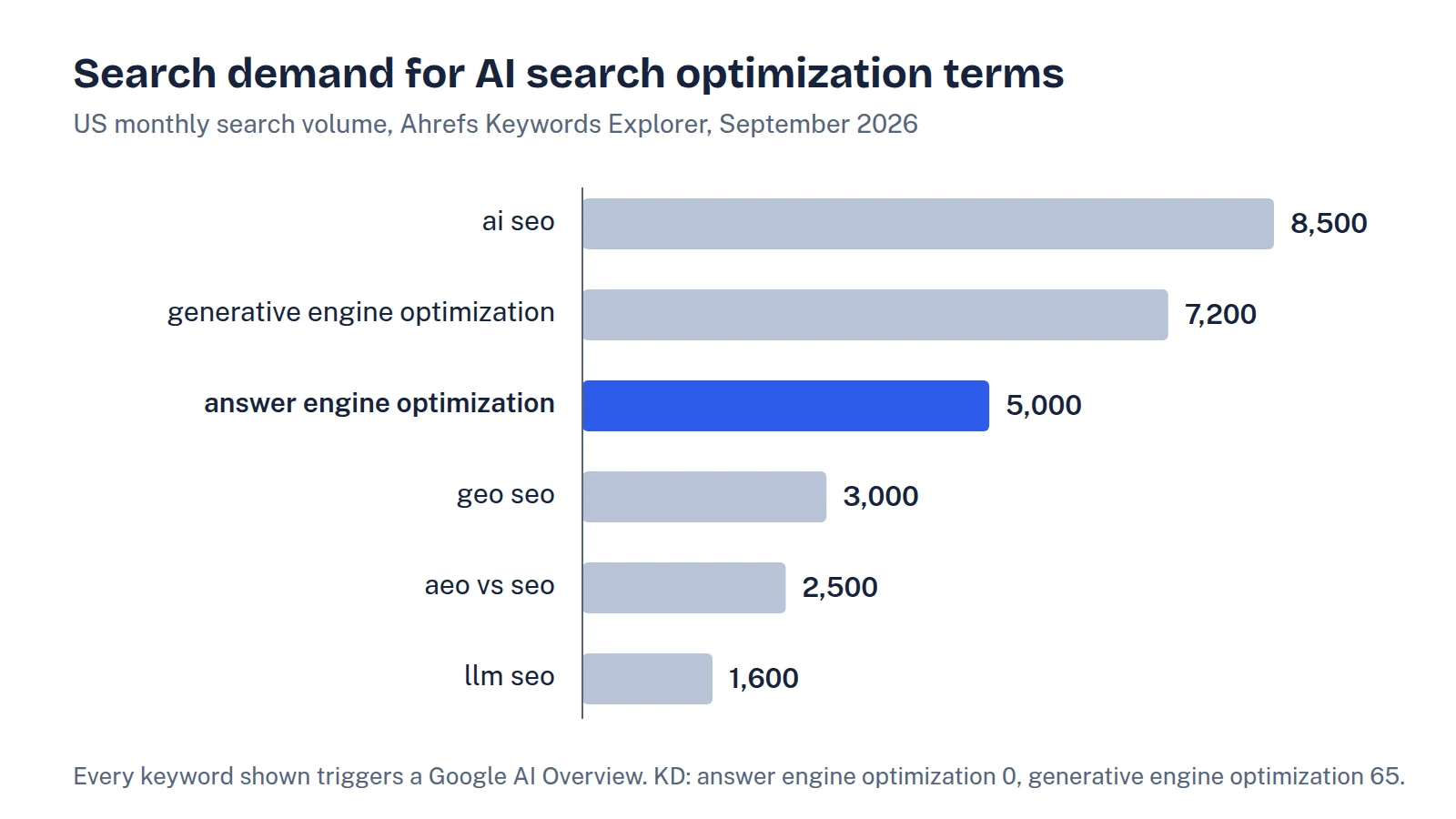
A few things stand out in the data:
- "Answer engine optimization" gets about 5,000 US searches a month with a Keyword Difficulty of 0. Demand is real, but few pages have built strong authority around the exact phrase yet.
- "Generative engine optimization" has more volume (7,200) and a much higher difficulty (65). The GEO label has attracted more competition, largely from SEO software vendors.
- Every one of these keywords shows a Google AI Overview. People researching how to get into AI answers are themselves reading AI answers first.
- "aeo" alone shows 8,200 searches, but Ahrefs flags it as partly branded, since the same letters are a well-known retailer's ticker. Treat that number with caution.
AEO vs SEO: what actually changes
"AEO vs SEO" is searched about 2,500 times a month in the US, which tells you people suspect they need a whole new discipline. Mostly, they don't. Google's own guide to optimizing for generative AI features says it plainly: "From Google Search's perspective, optimizing for generative AI search is optimizing for the search experience, and thus still SEO."
That is true for Google's surfaces. It's less complete for ChatGPT and Perplexity, which have their own crawlers and draw on a broader mix of sources. What changes is less the technique and more the target, the unit of success and where you compete.
| SEO | AEO | |
|---|---|---|
| What you win | A ranked blue link | A mention, recommendation or cited source inside an answer |
| Typical query | Short keyword ("crm software") | A full question with context ("best CRM for a 20-person agency that uses Gmail") |
| Main metric | Rankings, clicks, organic traffic | Mention rate, share of voice, citations, accuracy of description |
| Where you compete | Your pages vs competitor pages | Your pages plus review sites, comparisons, forums, YouTube and press |
| Feedback loop | Search Console, rank trackers | Repeated prompt testing and AI visibility tools; clicks are hard to attribute |
| Foundation | Crawlable, indexable, clearly written pages that answer real questions. This part is shared. | |
If you want the fuller comparison, including how to split budget between the two, read GEO vs SEO. The short version: keep doing SEO well, then add the off-site and measurement work that SEO alone doesn't cover.
How answer engines choose what to say
You can't control a model's output, but you can understand the inputs. Answer engines build responses from two places.
What the model already knows
Models learn from large amounts of web text during training. If your category is discussed widely and your brand is consistently part of that discussion, the model is more likely to associate you with the category. This is slow to change and hard to measure directly.
What it retrieves at answer time
Most assistants now search the web before answering. Google describes a "query fan-out" technique in its AI features documentation: the system runs several related searches across subtopics and then assembles an answer. ChatGPT's search uses OpenAI's own crawler; per OpenAI's crawler documentation, "OAI-SearchBot is used to surface websites in search results in ChatGPT's search features," and sites that block it won't appear in those answers.
Fan-out is why ranking #1 for one keyword isn't enough. An Ahrefs study of 863,000 SERPs (March 2026) found that just 38% of AI Overview citations came from pages ranking in the top 10 for the query, down from 76% a year earlier. The rest came from pages ranking lower or not at all for that exact query.
Off-site signals matter too. In Ahrefs' analysis of 75,000 brands, branded web mentions had the strongest correlation with AI Overview visibility (0.664), well ahead of the number of backlinks (0.218). Correlation isn't causation, but the pattern matches what we see in practice: assistants repeat what the web says about you. Our guide to AI brand mentions covers how to earn more of them.
How to start with AEO: a six-step process
Here's the sequence we'd use for a B2B SaaS team starting from zero. It takes a few weeks of part-time effort to get the first loop done.
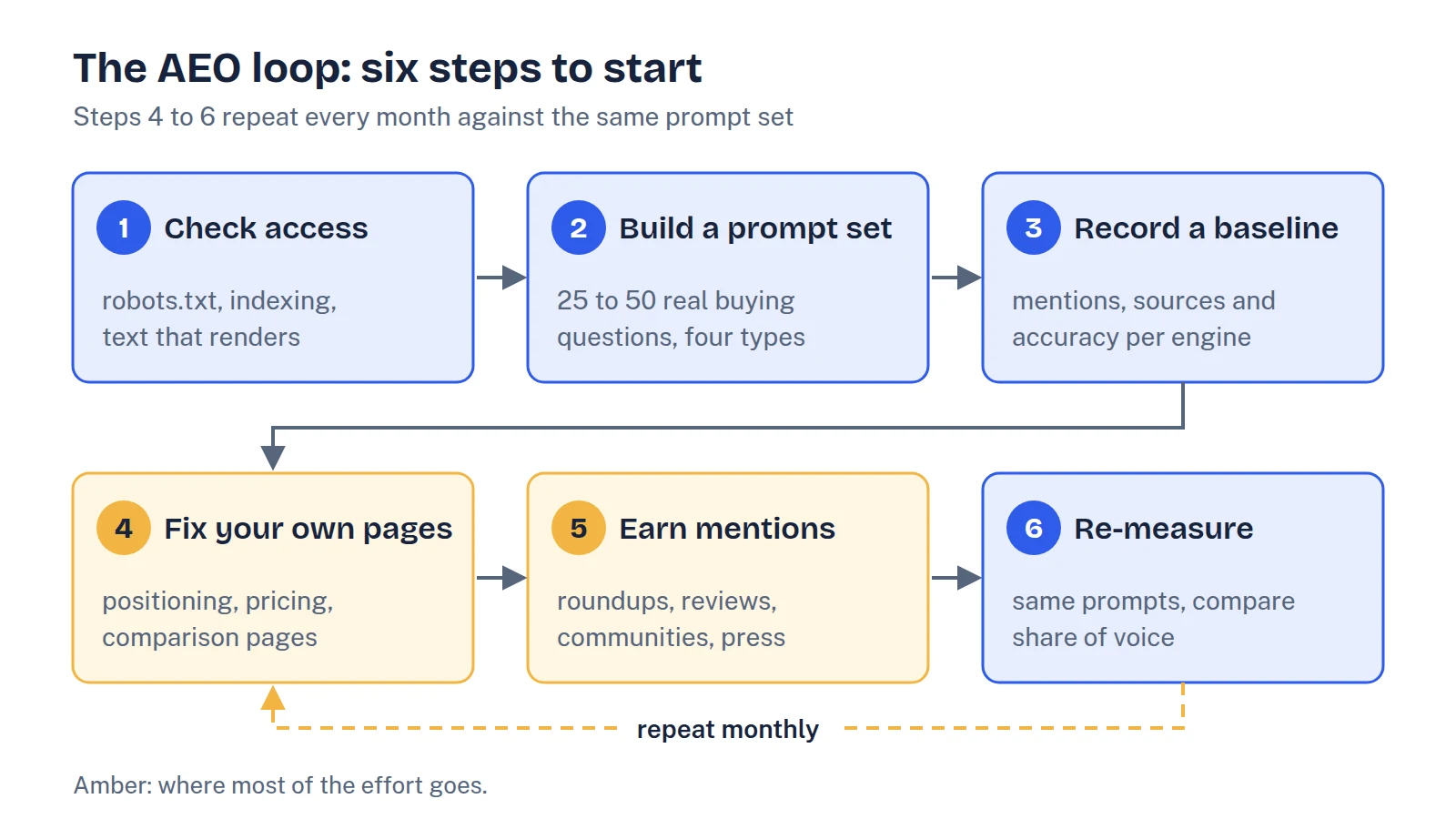
- Check that answer engines can reach you. Confirm your robots.txt allows Googlebot and OAI-SearchBot, and that key pages (homepage, product, pricing, comparison and docs pages) are indexed and render their main content as text. Blocking GPTBot only affects model training, not ChatGPT search, so decide on that separately.
- Build a prompt set from real buying questions. Write 25 to 50 prompts across four types: category ("best X for Y"), comparison ("X vs Y"), alternatives ("alternatives to competitor"), and problem ("how do I fix Z"). Pull wording from sales calls and support tickets, not just keyword tools.
- Record a baseline. Run the set in ChatGPT, Perplexity, Gemini and Google AI Mode. For each answer, log whether you're mentioned, who else is, which sources are cited and whether your description is accurate. Our AI visibility tracking guide covers cadence and reporting.
- Fix your own pages. Make it obvious what you are, who you serve and what you replace. Put a one-sentence definition of your product near the top of the homepage. Publish honest comparison and alternatives pages. Keep pricing and feature pages current, because stale facts get repeated.
- Earn mentions where answers come from. Your baseline shows the pages being cited. Get listed on the roundups, update your review profiles, contribute useful answers in the communities that keep coming up, and pitch data or expert commentary to the publications in your category.
- Re-measure every month. Rerun the same prompts and compare mention rate and share of voice against competitors. Keep the prompt set fixed so the trend means something.
See your own AI visibility, free
Get a one-page audit of how ChatGPT, Perplexity and Gemini treat your brand against up to three competitors, plus your biggest gap. In your inbox within 48 hours.
Get my free auditWhat AEO-friendly content looks like
There's no special format that guarantees a citation. But pages that get used in answers tend to share a few traits, and none of them hurt SEO.
- They answer the question in the first two sentences. Then they explain. An assistant looking for a quotable definition finds it fast.
- They say something specific. Google's guide recommends valuable, unique content over "commodity content" that recycles what's already out there. Original numbers, clear opinions and real examples give an engine a reason to use your page rather than a dozen similar ones.
- They're explicit about fit. "Best for teams under 50 that sell on annual contracts" is more useful to an answer engine than "flexible for teams of all sizes."
- They're current. Dates, prices and feature lists that are out of date get repeated back to buyers. Add a visible "last updated" date and mean it.
- They cover the follow-up questions. Because of fan-out, a page that also answers the obvious next questions (pricing, integrations, alternatives) has more chances to be retrieved.
How to tell if AEO is working
AEO is harder to measure than SEO, and it's worth being honest about that. PostHog's public AEO handbook lists the gaps well: there's no reliable prompt volume data, referrers from AI apps are often stripped so clicks show up as direct traffic, and the same prompt can give different answers on different runs.
That doesn't make it unmeasurable. It means you track a small set of metrics consistently:
- Mention rate: the share of your prompts where you appear.
- Share of voice: your mentions compared with named competitors across the same prompts.
- Citations: how often your pages, or pages that mention you, are linked as sources.
- Accuracy: whether the description matches your positioning.
- Self-reported attribution: add "ChatGPT or another AI assistant" as an option in your "how did you hear about us" field. It's imperfect but it catches what analytics misses.
For Google's surfaces, Search Console counts AI Overviews and AI Mode in the Performance report, and Google's guide points to a dedicated generative AI performance report as well. For ChatGPT and Perplexity you'll rely on prompt tracking, either by hand or with a tool. The LLM visibility guide goes deeper on setting those metrics up.
FAQ
What is answer engine optimization in simple terms?
It's the work of getting AI assistants to mention your brand, describe it correctly and cite your pages when people ask questions about your category. Think of it as SEO where the prize is a place in the written answer rather than a ranked link.
What is the difference between AEO and SEO?
SEO targets rankings and clicks on a results page. AEO targets mentions and citations inside AI-generated answers, which also draw on review sites, comparison articles and forums. The technical and content foundations are shared, and Google itself describes optimizing for its AI features as still SEO.
Is AEO the same as GEO?
In practice, mostly yes. Generative engine optimization (GEO) and AEO describe the same goal of appearing in AI answers; AEO is the older term and was first used for featured snippets and voice assistants. Pick whichever label your team uses and focus on the work.
How does answer engine optimization work?
Answer engines combine what the model learned in training with pages they retrieve at answer time, often by running several related searches. AEO improves your odds in both: clear, current pages that can be crawled and retrieved, plus consistent mentions of your brand across the sources engines trust.
Do I need an llms.txt file or special markup for AEO?
Not for Google. Its generative AI guide says Google Search doesn't use llms.txt files and that no special markup is required. OpenAI's crawler documentation doesn't mention it either, so treat it as optional at best and spend the time on clear pages and third-party mentions.
Sources
- Google Search Central: Optimizing your website for generative AI features on Google Search
- Google Search Central: AI features and your website
- OpenAI: Overview of OpenAI crawlers
- Ahrefs: Just 38% of AI Overview citations come from top 10 pages (March 2026)
- Ahrefs: An analysis of AI Overview brand visibility factors (75K brands studied)
- HubSpot: Answer engine optimization (AEO) guide
- PostHog handbook: Answer engine optimization (AEO)