AEO checklist: 15 checks with a pass/fail test for each
An AEO checklist should cover five layers in order: let AI crawlers fetch your pages, make sure they're indexed with snippets and key facts in the raw HTML, write passages that stand alone, publish facts only you can state, and track which URLs get cited. Below are 15 checks, each with a pass/fail test and the evidence behind it.
- Fix access and retrieval first: OpenAI says sites that block OAI-SearchBot won't appear in ChatGPT search answers, and Google requires pages to be indexed and eligible for a snippet.
- Every item on a useful checklist needs a test. 'View source shows your price' is a test; 'make content crawlable' is not.
- In Ahrefs' October 2026 study, 84.4% of ChatGPT answers to factual questions cited at least one official source. Publish your own pricing, limits and integrations in plain text.
- Google says llms.txt, special AI markup and chunking content aren't needed for its AI features. Leave them off the priority list.
- Measure by URL: GA4 referrals from utm_source=chatgpt.com plus a fixed prompt set where you log every cited link.
Why most AEO checklists don't help you ship
Search "aeo checklist" and you get long lists: 25 actions, 42 items, 48 factors. Most of them mix three very different kinds of advice in one flat list. Some items are requirements the platforms have documented. Some are supported by published studies. And some are guesses that sound plausible, such as adding llms.txt or chopping every page into tiny chunks.
The bigger problem is that almost none of them tell you how to check an item. "Make content crawlable" is not a task. "Fetch the page as OAI-SearchBot and confirm the price appears in the raw HTML" is.
So this checklist does three things differently:
- Every item has a pass/fail test you can run in a few minutes, with the tool to use.
- Every item is labeled by evidence: confirmed in Google or OpenAI documentation, supported by studies, or our working practice.
- Items are ordered by dependency, so you fix the things that block everything else first.
If you're new to the topic, start with our explainer on what answer engine optimization is, then come back here to audit your pages.
Demand for the checklist itself is small but clear. We pulled the main variants from Ahrefs this morning:
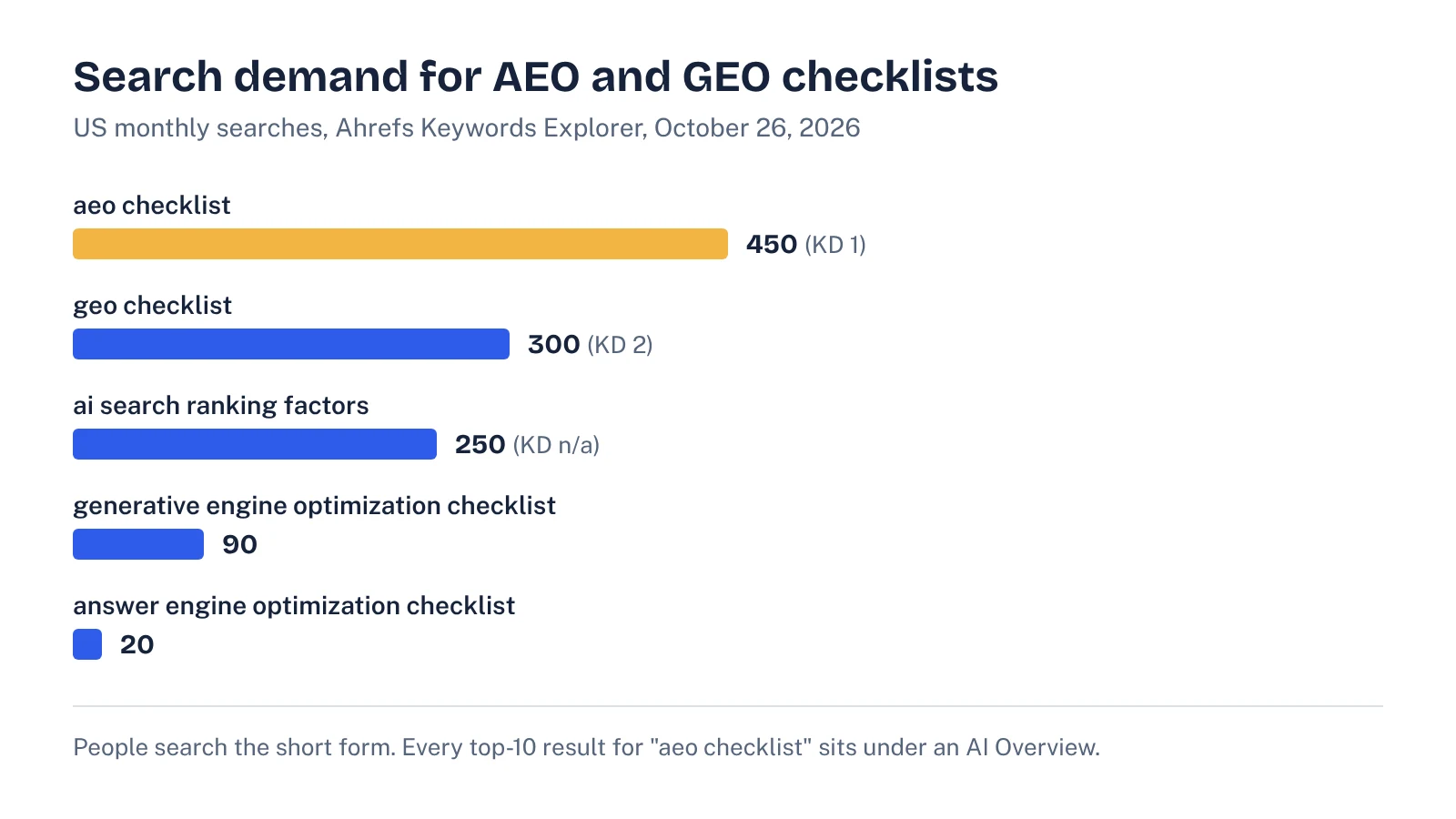
Every result in the top 10 for "aeo checklist" appeared below an AI Overview in the SERP snapshot we pulled. That is a fair sign of what the people searching want: a short, usable list, not another essay.
The five layers, and the order to work in
Answer engines work in a sequence. They need to fetch your page, find it when they search, pull a passage out of it, decide that passage is worth trusting, and then you need to know whether any of that happened. Each layer depends on the one above it. A beautifully written answer that sits behind a blocked crawler is invisible.
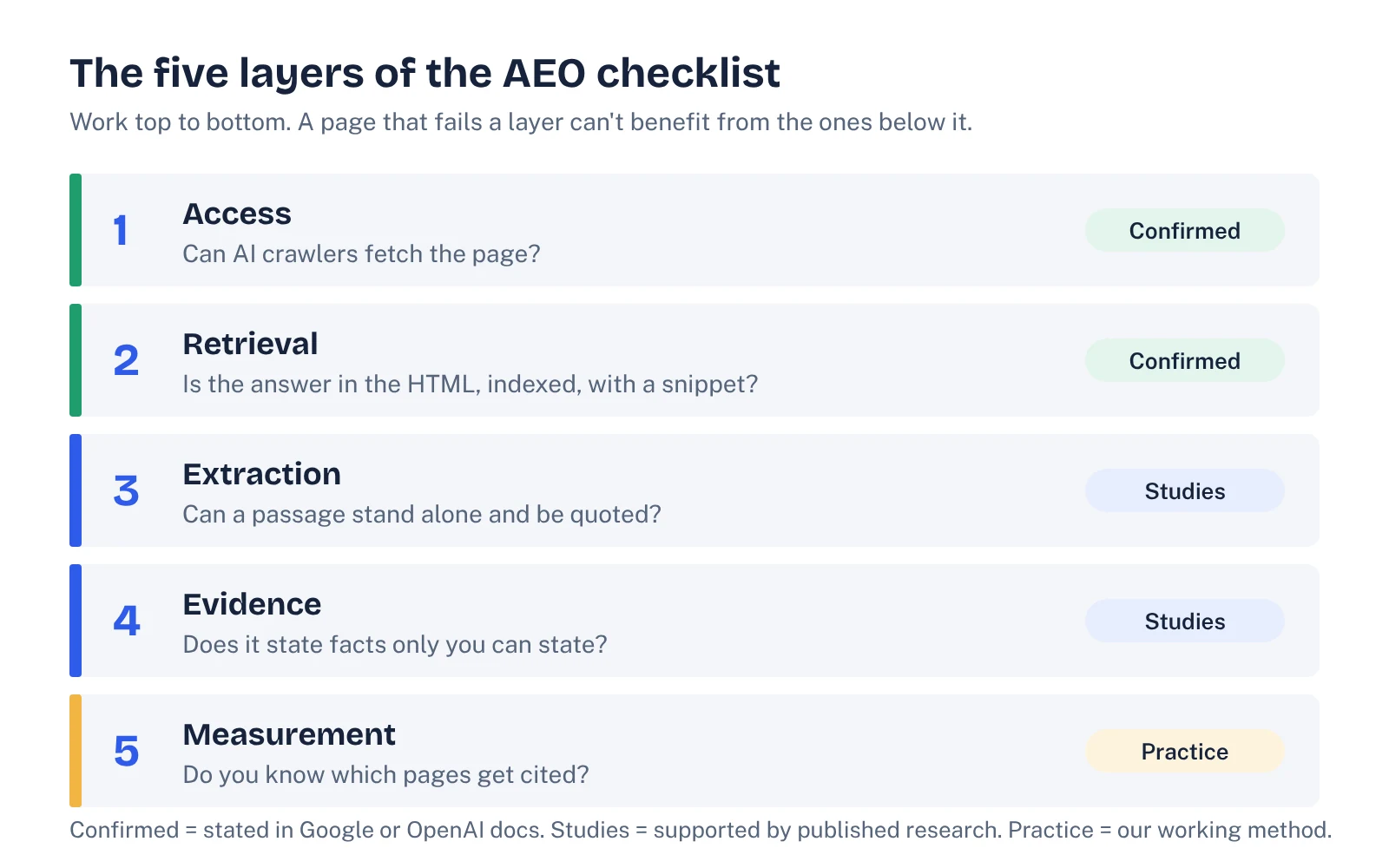
Here is the full checklist in one table. The sections after it explain the tests that need more than a line.
| # | Check | Pass/fail test | Evidence |
|---|---|---|---|
| 1 | OAI-SearchBot allowed | robots.txt has no Disallow that matches OAI-SearchBot for the page | Confirmed (OpenAI) |
| 2 | Googlebot allowed, page indexed | URL Inspection in Search Console shows "URL is on Google" | Confirmed (Google) |
| 3 | Snippet allowed | No nosnippet or tight max-snippet on the page | Confirmed (Google) |
| 4 | Key facts in raw HTML | View source (not the rendered DOM) shows the price, limits and answer text | Practice |
| 5 | One canonical URL per fact | Pricing, specs and policies live on one page each, with a self-canonical | Confirmed (Google: reduce duplicates) |
| 6 | Question-shaped headings | At least half of H2s match a real buyer question | Practice |
| 7 | Answer first | The first 1–2 sentences under each H2 answer it without the heading | Studies |
| 8 | Self-contained passages | No section opens with "this", "these" or "it" | Practice |
| 9 | Facts in tables or lists | Comparisons, plans and limits are in HTML tables, not images | Practice |
| 10 | First-party facts published | Price, integrations, security and limits answerable from your own site | Studies (Ahrefs) |
| 11 | Something original | Each key page contains data, a method or experience not found on rival pages | Confirmed (Google: non-commodity content) |
| 12 | Consistent entity facts | Name, category and pricing match across site, G2, LinkedIn and docs | Practice |
| 13 | Dated and reviewed | Visible updated date; reviewed in the last 6 months | Practice |
| 14 | AI referrals tracked | GA4 shows sessions with source chatgpt.com, perplexity.ai and similar | Confirmed (OpenAI UTM) |
| 15 | Citations logged per URL | A fixed prompt set, run on a schedule, with every cited URL recorded | Practice |
Notice what's missing: llms.txt, special AI markup and "chunking". We explain why in the skip list below.
Layers 1 and 2: access and retrieval (checks 1–5)
These are the only items the platforms state outright, so do them first.
Crawler access. OpenAI's publisher FAQ says that "any public website can appear in ChatGPT search", but you need to "make sure you aren't blocking OAI-SearchBot." Its crawler documentation is explicit that sites opted out of OAI-SearchBot "will not be shown in ChatGPT search answers." Blocking GPTBot is a separate choice: it only signals that your content should not be used for training, and "each setting is independent of the others." Our guide to AI crawlers lists the user agents for the other assistants.
Indexing and snippets. Google's guide to generative AI features (updated July 2026) sets the bar plainly: "a page must be indexed and eligible to be shown in Google Search with a snippet." A page with nosnippet can rank and still be useless to AI Overviews and AI Mode.
Raw HTML. Google says it can process JavaScript "as long as it isn't blocked." Other crawlers are less documented, so we treat it as a risk to remove rather than a fact to argue about. The test takes one minute:
- Open the page, then open View Source (Ctrl+U or Cmd+Option+U).
- Search the source for your price, your main plan names and the first sentence of your key answer.
- If any of them are missing, they are rendered client-side. Ask engineering to server-render that block.
One canonical home per fact. Google lists reducing duplicate content among its technical basics. For SaaS, the common failure is pricing stated four ways: the pricing page, an old blog post, a help-center article and a partner page. Pick one source of truth and update or redirect the rest.
Layers 3 and 4: passages worth quoting (checks 6–13)
Once a page can be fetched, the question is whether a model can lift a useful passage from it, and whether it should trust that passage.
Write so a passage stands alone
Put the answer in the first one or two sentences under each heading, then add the detail. Then run a blunt test: cover the heading with your hand and read the first sentence. If it still makes sense, it can be quoted. If it starts with "This is why…", it can't.
Be careful not to overcorrect. Google states that "there's no requirement to break your content into tiny pieces for AI to better understand it" and that "you don't need to write in a specific way just for generative AI search." Clear headings and direct answers help human readers too. Fragmenting a page into 40-word blocks helps nobody.
Publish the facts only you can state
This is the layer with the strongest recent data. In an Ahrefs study published in October 2026, 84.4% of ChatGPT answers to factual questions (pricing, features, company details) cited at least one official source, and 63.4% of those citations went to official websites. For comparison questions, the figures were 68.3% and 46.4%. The same study found the word "price" rising from 6.04% to 8.88% of ChatGPT's fan-out searches in a single month.
The practical reading: when a buyer asks what you cost or whether you integrate with Salesforce, ChatGPT looks for your answer first. If your pricing says "Contact sales" and your integrations page is a logo wall, it has nothing to cite and will use whoever does have an answer. Our playbook on how to get cited by ChatGPT goes deeper on this.
Add one thing nobody else has
Google asks for "non-commodity content" with a unique point of view rather than summaries of what already exists. For a SaaS company that usually means product usage data, benchmark numbers from your own tests, a worked example with real configuration, or an opinion your team can defend. If a page could have been written by any competitor, it competes on authority alone, and you probably lose.
See your own AI visibility, free
Get a one-page audit of how ChatGPT, Perplexity and Gemini treat your brand against up to three competitors, plus your biggest gap. In your inbox within 48 hours.
Get my free auditWhich checks matter on which SaaS pages
Not every item applies everywhere. Use this map to decide where to spend an afternoon.
| Page type | Prompts it should answer | Checks that matter most |
|---|---|---|
| Pricing | "How much does X cost?" "Does X have a free plan?" | 4, 5, 9, 10, 13 |
| Integrations and features | "Does X integrate with HubSpot?" "Does X support SSO?" | 4, 9, 10, 12 |
| Comparison (X vs Y) | "X vs Y for a 50-person team" | 7, 9, 11, 13 |
| Use-case or industry page | "Best tool for [job] in [industry]" | 6, 7, 11, 12 |
| Docs and help center | "How do I set up X with Y?" | 1, 4, 6, 8 |
| Blog guides | Category and how-to questions | 6, 7, 8, 11 |
If you only have time for one page type this month, make it pricing. It answers the questions the Ahrefs data shows ChatGPT increasingly searching for, and it's the page most often hidden behind a form.
Layer 5: know whether it worked (checks 14–15)
Checklists usually end with "track your AI visibility". Here's what that means in practice.
Referral traffic. OpenAI says ChatGPT "automatically includes the UTM parameter utm_source=chatgpt.com in referral URLs" (from its publisher FAQ). In GA4, build a landing-page report filtered to AI sources so you can see which URLs people actually click through to. Our guide to tracking AI traffic has the exact setup.
Citations by URL. Run a fixed set of buyer prompts in ChatGPT, Perplexity and Google AI Mode on a schedule, and log every cited URL, not just whether your brand was named. Answers vary run to run, so use enough prompts and repeat runs before reading anything into a change. Our guide to AI prompt tracking covers how to build a prompt set you can trust.
Google's own report. Google's guide points to a generative AI performance report in Search Console for measuring visibility in its AI features, and adds that "no third-party tool has access to our internal ranking or AI systems." Use tools for coverage across engines, and Google's data for Google.
What to leave off your AEO checklist
A good checklist is also a list of things not to spend time on. Google's guide is unusually direct here:
- llms.txt and "AI text files". Google says you don't need new machine-readable files or markup, and that Google Search itself doesn't use them: they will "neither harm nor help." Other services may read them, so it's a low-cost option, not a priority. More in our llms.txt guide.
- Special AI schema. Google says there is no special schema.org markup for generative AI search and structured data isn't required, though it still helps with rich results. Keep your existing schema accurate and move on.
- Chunking and AI-style rewrites. Covered above. Write clearly for people.
- Manufactured mentions. Google warns that seeking inauthentic mentions across the web is less helpful than it looks.
- Mass-produced query pages. Pages made "primarily to manipulate rankings or generative AI responses" fall under Google's scaled content abuse policy.
How to run this checklist in one week
- Day 1: Run checks 1–3 sitewide. They take an hour and can unblock everything.
- Day 2: List your ten buyer fact questions and map each to a URL (check 10).
- Day 3: Run checks 4–9 on your pricing page and top two feature pages.
- Day 4: Fix entity facts on G2, LinkedIn and your docs (check 12).
- Day 5: Set up GA4 AI referrals and a 30–50 prompt citation log (checks 14–15), then record a baseline.
Re-run the citation log monthly. When a page you fixed starts getting cited, copy what worked to the next page type on the map.
FAQ
What should an AEO checklist include?
Five layers in order: crawler access, indexing and retrieval, passages that can be quoted on their own, first-party facts and original content, and measurement. Each item should come with a test you can run, so you know whether the page passes rather than guessing.
How do I check the AEO of a website?
Start with robots.txt (is OAI-SearchBot allowed?), Search Console URL Inspection (is the page indexed?), and View Source (are your price and key answers in the raw HTML?). Then ask ChatGPT, Perplexity and Google AI Mode the questions buyers ask about you and log which URLs they cite. A cited third party where your own page should be is your to-do list.
Is there a difference between an AEO checklist and a GEO checklist?
Mostly naming. AEO (answer engine optimization) and GEO (generative engine optimization) describe the same work of getting your pages used and cited in AI answers. A good checklist for either covers the same access, content and measurement checks.
Do I need llms.txt or special schema for AEO?
Not for Google. Its guide to generative AI features says you don't need new machine-readable files or special markup, and that llms.txt will neither help nor harm your Search visibility. Structured data is still useful for rich results, so keep it accurate, but it isn't an AI requirement.
How long does AEO take to show results?
Access fixes can matter as soon as pages are recrawled, but there is no published timeline for citations. Set a baseline with a fixed prompt set before you change anything, then compare monthly, because AI answers vary from run to run.