AI search ranking factors: what the studies actually show
AI search ranking factors fall into four gates: whether a system can fetch and use your page, whether the page ranks for the query or its sub-queries, whether a passage is worth quoting, and whether your brand is talked about elsewhere. Only the first gate is documented by Google and OpenAI. Below, every factor is graded by the evidence behind it.
- Access is the only documented requirement: OpenAI says sites that opt out of OAI-SearchBot won't be shown in ChatGPT search answers, and Google requires pages to be indexed and snippet-eligible.
- Rankings still matter, but less directly than in 2025. Ahrefs found 37.9% of AI Overview citations came from the top 10 in its 2026 update, down from about 76% in July 2025.
- Branded web mentions had the strongest correlation with AI Overview brand visibility (0.664) in Ahrefs' 75,000-brand study, ahead of Domain Rating (0.326) and backlinks (0.218).
- In the GEO lab study, adding statistics, quotations and cited sources lifted visibility by roughly 30% each; keyword stuffing did not help.
- Google says no special schema, AI text files or markup are needed. Treat those as optional, not as ranking factors.
There is no official list, so grade the evidence
Neither Google nor OpenAI publishes ranking factors for AI answers. What you find when you search "ai search ranking factors" is a mix of three things: requirements the platforms have documented, correlations from large studies, and tactics someone tried once and wrote up as a rule.
Those deserve very different amounts of your team's time. A documented requirement is a blocker. A strong correlation is a good bet. A lab result is a hint about what works on a test bench. A tactic with no evidence is a guess.
So instead of another flat list of 20 factors, this post sorts each one by the strength of the evidence behind it, and by where it acts in the pipeline. If you want the broader playbook first, read our guide to AI search optimization; this post is the evidence layer underneath it.
Demand for the topic is spread across several phrasings. In Ahrefs Keywords Explorer this morning (US, October 27, 2026), "ai ranking factors" showed 300 monthly searches, "ai search ranking factors" 250, "chatgpt ranking factors" 200, "ai overview ranking factors" 50 and "llm ranking factors" 40. Ahrefs had no difficulty score for any of them yet, which usually means a young topic with thin, unsettled results.
The four gates between your page and an AI answer
It helps to stop thinking about one ranking and think about four gates. Each has its own factors, and you can only pass a later gate if you pass the earlier ones.
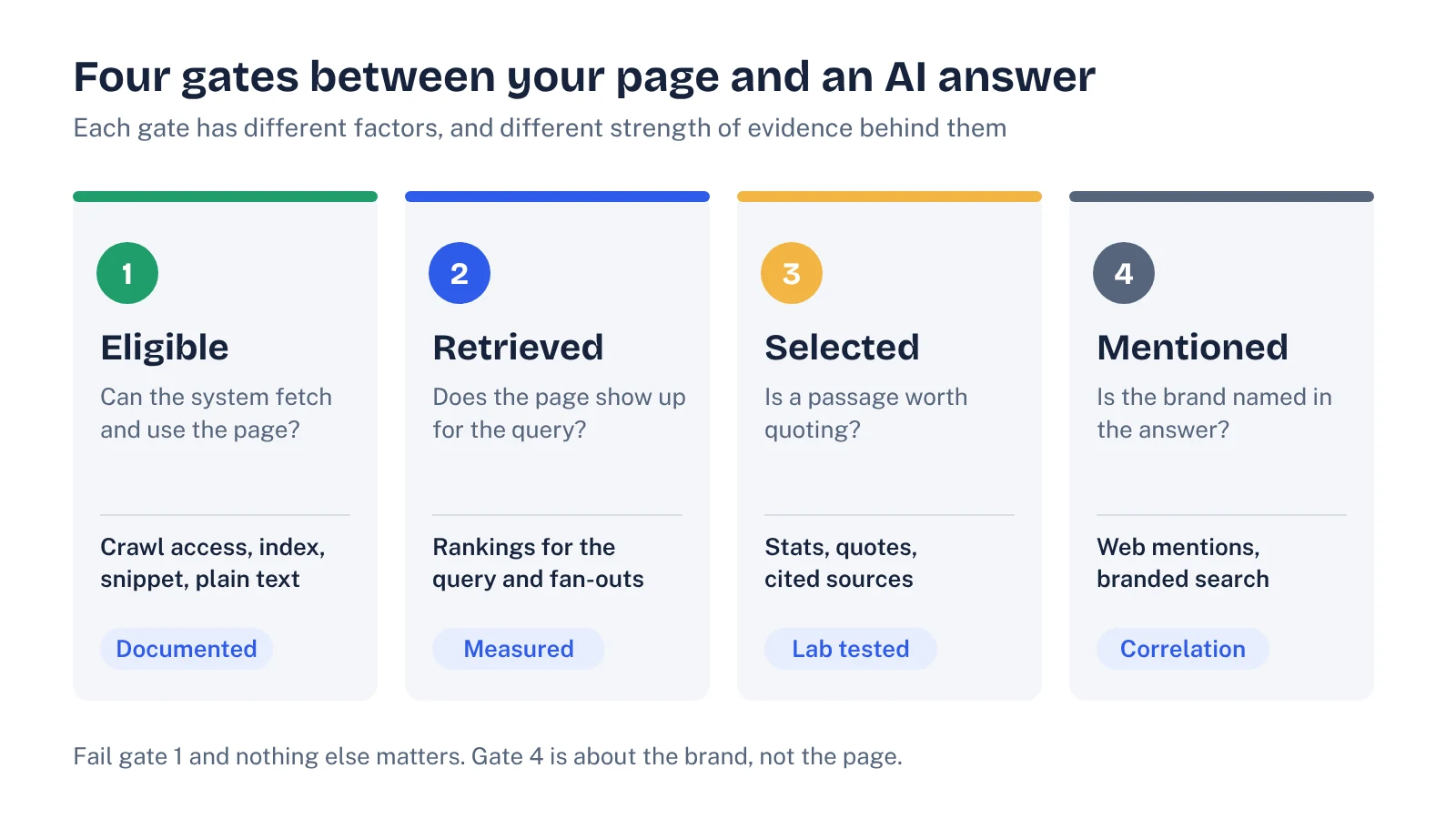
- Eligible. Can the system fetch your page and is it allowed to use it?
- Retrieved. Does your page come back when the system searches the question, or one of the sub-questions it generates?
- Selected. Once retrieved, is there a passage worth quoting or summarizing?
- Mentioned. Separately from your own pages, does the model know your brand well enough to name it?
The first three gates are about pages being cited. The fourth is about brands being named, which can happen without any link to you at all. Our post on AI brand mentions covers that difference in detail.
Gate 1: the factors that are actually documented
These are the only factors you can call requirements, because the platforms say so in their own documentation.
- Crawler access for ChatGPT search. OpenAI's crawler documentation says OAI-SearchBot is used to surface websites in ChatGPT search, and that "sites that are opted out of OAI-SearchBot will not be shown in ChatGPT search answers." Blocking GPTBot (training) is a separate choice and doesn't remove you from search.
- Indexed and snippet-eligible for Google. Google's page on AI features and your website says a page must be indexed and eligible to be shown in Google Search with a snippet. A
nosnippettag or anoindexkeeps you out. - Crawling allowed through the whole stack. Google specifically mentions robots.txt and "any CDN or hosting infrastructure." Bot protection on a CDN can block crawlers without anyone on the marketing team knowing. Our guide to AI crawlers shows how to check.
- Important content in text. Google asks that important content be available in textual form. Pricing in an image, or features only inside an interactive widget, are easy to miss.
The same Google page is just as useful for what it rules out. It says there are no additional requirements or special optimizations for AI Overviews or AI Mode, no special schema.org markup to add, and no need to create "new machine readable files, AI text files, or markup." That covers llms.txt, which we looked at in our llms.txt explainer.
Gate 2: rankings still feed retrieval, but less directly
AI Overviews and ChatGPT search both start by searching. So classic rankings matter, but the link between "rank in the top 10" and "get cited" has weakened.
Ahrefs measured this twice. In July 2025, about 76% of pages cited in AI Overviews also ranked in the original search results. In its March 2026 update, covering 863,000 keyword SERPs and about 4 million AI Overview URLs, only 37.9% of cited URLs appeared in the top 10. Another 31.2% ranked 11 to 100, and 31.0% ranked outside the top 100.
Ahrefs' explanation is query fan-out: the system runs several related searches and cites pages that rank for those sub-queries instead of the original one. Google's own documentation confirms that AI Overviews and AI Mode may use fan-out across subtopics. The practical change is that you need to rank for the questions around your main keyword, not just the head term. Our guide on how to rank in AI Overviews goes deeper on the Google side.
Gate 4: brand signals beat links in the biggest study
The largest public study of brand-level factors is Ahrefs' analysis of 75,000 brands. It compared each brand's site metrics with how often the brand was mentioned in AI Overviews, using Spearman correlation.
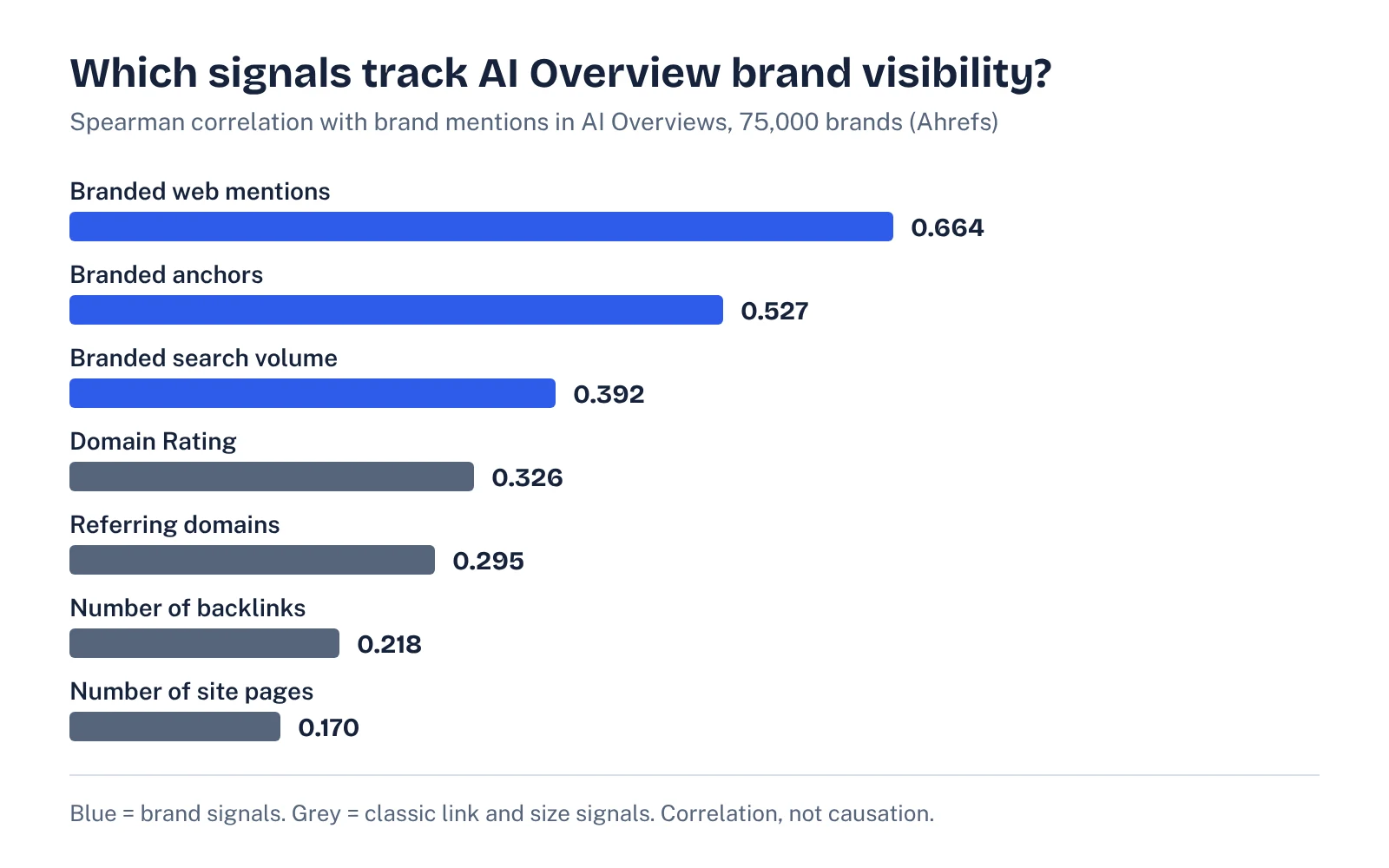
Three things stand out. Branded web mentions (0.664) were the strongest signal by a wide margin. The number of backlinks (0.218) was weak, and the number of pages on the site (0.17) barely registered, so publishing more pages is not a factor on its own. And the gap between the top and bottom of the table was large: brands in the top quartile for web mentions averaged 169 AI Overview mentions, while the bottom half averaged between 0 and 3.
Keep the caveats in view. This is correlation, not causation, and Ahrefs says so. Big brands get mentioned everywhere, including in AI answers, for the same underlying reason. The study measured AI Overviews only, filtered for domains above DR 40, and used Ahrefs' own Brand Radar data.
See your own AI visibility, free
Get a one-page audit of how ChatGPT, Perplexity and Gemini treat your brand against up to three competitors, plus your biggest gap. In your inbox within 48 hours.
Get my free auditGate 3: what lab tests say about quotable content
The most cited experiment is the GEO paper from researchers at Princeton, Georgia Tech, the Allen Institute for AI and IIT Delhi (Aggarwal et al., arXiv 2311.09735). They rewrote source pages in different ways and measured how visible each source became in generated answers, across a benchmark of about 10,000 queries.
- Adding statistics improved visibility by about 32% on average.
- Citing sources improved it by up to about 34%.
- Adding quotations improved it by about 30%.
- Keyword stuffing gave little or no gain, and sometimes made results worse.
The headline claim is "up to 40%" better visibility. Treat this as directional. It was a controlled benchmark, not live ChatGPT or Google traffic, and the engines have changed since 2024. Still, the direction matches what we see in practice: specific, sourced, self-contained passages get quoted; vague marketing copy doesn't.
The scorecard: every common factor, graded
Here is how the factors that show up in most "AI ranking factors" lists hold up against the evidence above.
| Factor | Gate | Evidence | What it means for you |
|---|---|---|---|
| OAI-SearchBot allowed in robots.txt | 1 | Documented (OpenAI) | Blocker. Check today. |
| Indexed, snippet allowed, crawlable through CDN | 1 | Documented (Google) | Blocker. Check in Search Console. |
| Key facts in plain text, not images | 1 | Documented (Google) | Blocker for pricing and specs pages. |
| Ranking for the query and its sub-queries | 2 | Measured (Ahrefs, 863K SERPs) | High value. Cover the question cluster, not one keyword. |
| Branded web mentions | 4 | Correlation 0.664 (Ahrefs) | High value. Earn mentions in reviews, lists and press. |
| Branded search volume | 4 | Correlation 0.392 (Ahrefs) | Medium. A result of brand work, not a lever. |
| Statistics, quotes and cited sources | 3 | Lab tested (GEO paper) | Medium to high. Cheap to add to existing pages. |
| Domain Rating and backlinks | 2, 4 | Correlation 0.22 to 0.33 (Ahrefs) | Medium. Helps classic rankings more than AI mentions. |
| Number of pages on the site | 4 | Correlation 0.17 (Ahrefs) | Low. Volume alone does little. |
| Special schema for AI | None | Google: not needed | Keep schema accurate; don't expect AI lift. |
| llms.txt and AI text files | None | Google: not needed | Optional. Not a ranking factor for Google. |
| Keyword stuffing | 3 | Lab tested: no gain | Skip. |
Notice what is missing: freshness, author bios, word count and "E-E-A-T signals" appear on many lists, but we found no public, large-scale study isolating them for AI answers. They may matter. Nobody has shown how much yet, so we left them off rather than guess.
How to test these factors on your own brand
Studies tell you what tends to work across thousands of sites. Your category may behave differently, so run a small test before you reorganize the roadmap.
- Clear gate 1 first. Check robots.txt for OAI-SearchBot, run URL Inspection on your top 20 pages, and view source on pricing and feature pages to confirm the facts are in the HTML.
- Build a fixed prompt set. 30 to 50 buyer questions, split by category, problem, comparison and pricing. Our guide to AI prompt tracking explains how to make one you can trust.
- Record a baseline. Run each prompt several times in ChatGPT, Perplexity and Google AI Mode. Log whether your brand is named and which URLs are cited.
- Change one gate at a time. For example, rewrite five pages with sourced statistics and standalone answers, and leave five similar pages alone as a comparison.
- Re-run after recrawl. Compare cited URLs and mention rates monthly, not daily. AI answers vary from run to run, so small swings are noise.
The bottom line
If you only do three things: make sure every AI crawler that matters can reach and use your pages, write the passages you want quoted with real numbers and named sources, and invest in getting your brand mentioned on the sites buyers and assistants both read. Everything else on most ranking-factor lists is either unproven or a side effect of those three.
FAQ
What are the ranking factors for AI search?
No AI platform publishes a ranking-factor list. What is documented is eligibility: crawler access, indexing and snippet eligibility, and content in plain text. Beyond that, studies point to organic rankings for the query and its fan-out sub-queries, quotable passages with statistics and sources, and how often your brand is mentioned across the web.
What are ChatGPT's ranking factors?
OpenAI hasn't published ranking factors for ChatGPT search. It does say that sites opted out of OAI-SearchBot won't be shown in ChatGPT search answers, so crawler access is the one confirmed requirement. Everything else, such as freshness or brand mentions, comes from third-party studies and should be tested on your own prompts.
Do backlinks matter for AI search?
They matter less than brand mentions, according to Ahrefs' study of 75,000 brands. Branded web mentions correlated at 0.664 with AI Overview brand visibility, versus 0.218 for the number of backlinks and 0.326 for Domain Rating. Links still help you rank in classic search, which feeds retrieval.
Does ranking on Google help you appear in AI Overviews?
Yes, but less directly than it used to. Ahrefs' 2026 update found 37.9% of AI Overview citations also appeared in the top 10 for the original query, and 31.2% ranked 11 to 100. Google uses query fan-out, so ranking for related sub-queries counts too.
Is structured data an AI search ranking factor?
Google says there's no special schema.org markup you need to add to appear in AI Overviews or AI Mode. It does ask that structured data match the visible text. Keep schema accurate for rich results, but don't expect it to lift AI visibility on its own.
Sources
- Google Search Central: AI features and your website
- OpenAI: Overview of OpenAI crawlers
- Ahrefs: An analysis of AI Overview brand visibility factors (75K brands studied)
- Ahrefs: Update: 38% of AI Overview citations pull from the top 10 (March 2026)
- Aggarwal et al.: GEO: Generative Engine Optimization (arXiv 2311.09735)
- Ahrefs Keywords Explorer, US, pulled October 27, 2026