AI SEO strategy for B2B SaaS: one plan for AI answers and Google search

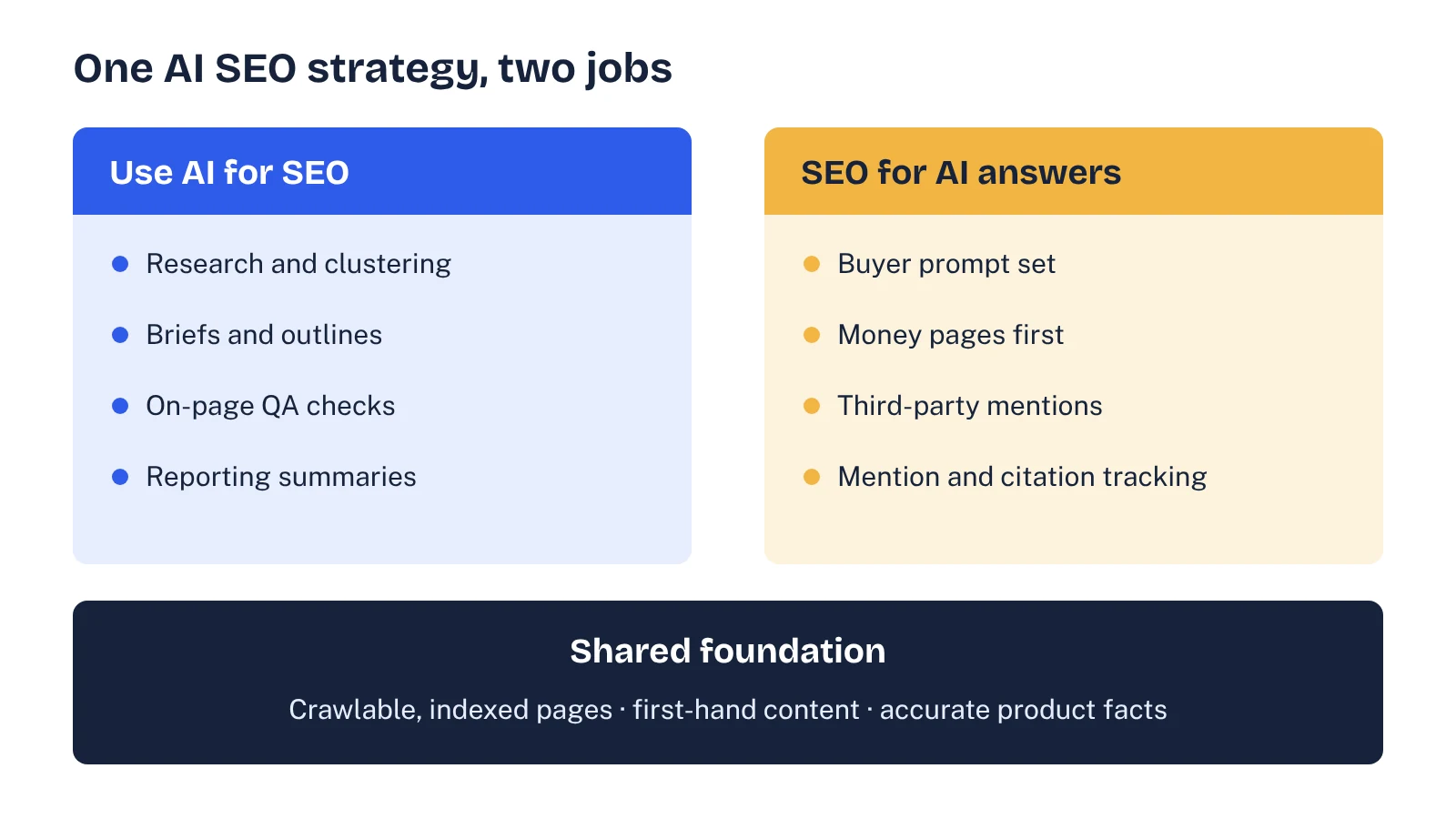
An AI SEO strategy is a plan for two jobs at once: using AI to do SEO work faster, and making your brand visible in AI answers from Google AI Mode, AI Overviews, ChatGPT and Perplexity. For B2B SaaS teams, both jobs share one foundation: useful, first-hand content on pages search engines can crawl. This guide gives you five decisions, the guardrails, and a 90-day plan.
- "AI SEO strategy" has two meanings. In Ahrefs US data, most related searches are about using AI tools for SEO, but a growing set is about SEO for AI Mode and AI answers.
- Google's July 2026 guide says AI features run on its core ranking systems, so the SEO foundation still carries most of the weight.
- AI answers often cite pages that don't rank top 10 for the original query: 38% of AI Overview citations came from top-10 pages in Ahrefs' March 2026 study.
- Use AI for research, clustering, briefs and QA. Keep humans on positioning, first-hand proof and final edits, and never mass-produce pages for AI queries.
- Measure both jobs: hours saved and pages shipped, plus mentions and citations on a fixed prompt set.
What "AI SEO strategy" means: two jobs, one plan
Ask five marketers what an AI SEO strategy is and you will get two kinds of answers. Some mean using AI to do SEO: research, briefs, drafts, audits. Others mean SEO for AI: getting your brand mentioned and cited when buyers ask Google AI Mode, ChatGPT or Perplexity for a recommendation.
The search results for "ai seo strategy" show the same split. When we pulled the US SERP in Ahrefs on November 13, 2026, it opened with an AI Overview, then Salesforce's guide to using AI for SEO, three Reddit threads about adapting SEO to AI search, Growth Memo's strategy piece, and Semrush's list of ways to use AI for SEO. Searchers and Google both treat the phrase as covering both jobs.
For a B2B SaaS team, splitting these into two plans is a mistake. They compete for the same people, the same budget and the same pages. A team that uses AI to publish faster but ignores how assistants describe its product is optimizing the wrong output. A team that chases AI citations by hand, with no AI in its own workflow, will run out of hours.
So treat it as one strategy with two jobs and a shared foundation.
What the search data says people are looking for
We pulled the matching terms for "ai seo strategy" in Ahrefs Keywords Explorer (US, November 13, 2026). The head term gets about 1,000 searches a month with a keyword difficulty of 22 and a traffic potential of 5,400, which tells you the topic is mostly searched through its broader parent, "ai seo".
The longer variants lean heavily toward the first job. Terms like "ai agent for seo strategy" (500), "ai seo content strategy generator" (500), "ai seo strategy creator" (400) and "seo strategy with ai" (400) are people looking for tools to do the work. The second job shows up in newer, more specific phrases: "google ai mode and seo strategy" (350), "seo strategy for new ai mode on google" (300) and "ai answer seo strategy" (150).
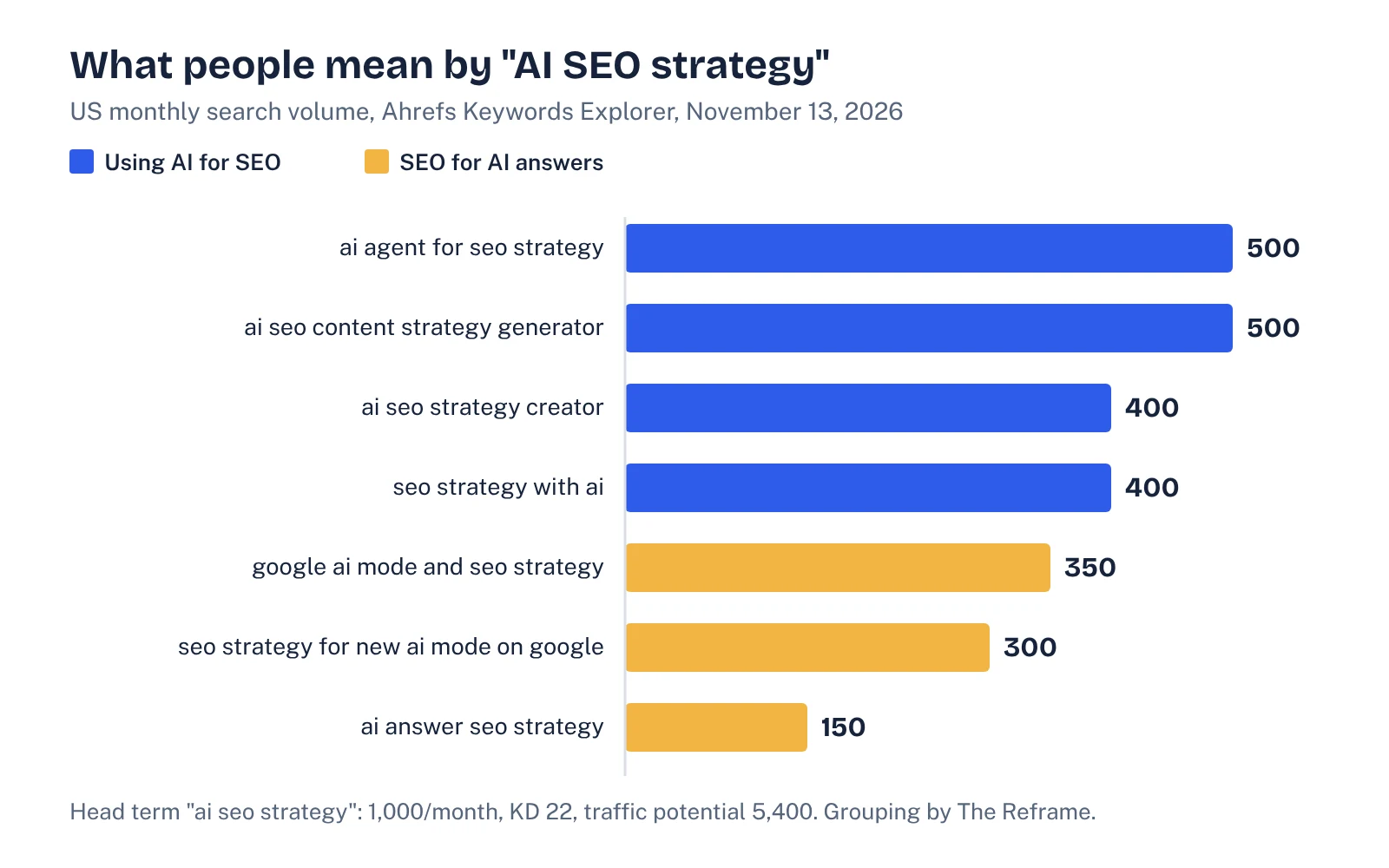
The takeaway for planning: your team will be pitched AI tools for the first job constantly. The second job gets less noise, and it is the one that decides what a buyer hears about you before they ever reach your site.
What changed in search, and what didn't
Start from what Google has said in writing, because it removes a lot of busywork. Google's guide to optimizing for generative AI features, updated July 10, 2026, says AI Overviews and AI Mode rely on its core ranking and quality systems. It says you don't need llms.txt or AI-specific markup because "Google Search itself doesn't use them", that there is no requirement to chunk content, and that structured data isn't required for generative AI search. It also warns that mass-producing pages to manipulate AI responses can violate its scaled content abuse policy.
What did change is which pages get pulled into answers. Google's AI features documentation says AI Overviews and AI Mode may use a "query fan-out" technique, running multiple related searches across subtopics. The effect shows up in the data:
- In Ahrefs' March 2026 study of about 4 million AI Overview URLs across 863,000 SERPs, 38% of cited URLs also ranked in the top 10 for the query. Ahrefs' July 2025 analysis had put that figure at about 76%.
- In Ahrefs' 2025 study of 15,000 long-tail prompts, only 12% of links cited by ChatGPT, Gemini and Copilot appeared in Google's top 10 for the same prompt. Perplexity was higher, at 28.6%.
Read together: ranking well still matters, because the same systems and the same index sit underneath. But ranking for your head term is no longer enough. Assistants pull from pages that answer the narrower follow-up questions, and from other sites that talk about you.
The five decisions in an AI SEO strategy
A strategy is a set of choices, not a list of tactics. These five cover both jobs. Write your answer to each on one page and get sign-off before you buy tools.
| Decision | Question to answer | B2B SaaS example |
|---|---|---|
| 1. Goal and metric | What outcome are you paying for? | Demo requests from organic and AI referrals, plus share of mentions on 40 buyer prompts |
| 2. Query and prompt set | Which searches and AI questions matter commercially? | "best [category] for mid-market", "[you] vs [rival]", "does [you] integrate with Salesforce" |
| 3. Page priorities | Which pages must win first? | Pricing, comparison, alternatives, integration and security pages before new top-of-funnel posts |
| 4. Off-site sources | Where do assistants learn about your category? | Review sites, partner directories, analyst lists, active Reddit threads |
| 5. AI in the workflow | Which tasks get AI help, and who signs off? | AI drafts briefs and QA checks; a product marketer approves every claim |
If your team already has a one-page GEO strategy, decisions 2 to 4 are the same work. The extra piece an AI SEO strategy adds is decision 5: being deliberate about where AI sits in your own process.
Where AI belongs in your SEO workflow
The first job is mostly about speed with guardrails. AI is good at summarizing, grouping and checking. It is weak at knowing what your product does this quarter, what your customers actually say, and what you can legally claim. Split tasks on that line.
| Task | Let AI do | Keep with a human |
|---|---|---|
| Keyword and prompt research | Cluster exports, group by intent, flag gaps | Choosing which clusters matter to revenue |
| SERP and competitor review | Summarize top pages, list what they cover | Deciding the angle and what you can add |
| Briefs and outlines | First draft of headings and questions | Product facts, positioning, examples |
| Drafting | Rough sections from your own notes and data | First-hand proof, final edit, claims review |
| On-page QA | Check titles, meta, links, alt text, schema validity | Fixes that change meaning |
| Reporting | Summarize Search Console and tracking exports | Interpreting why something moved |
The guardrail that matters most is Google's own. Its guide asks for "non-commodity content" with a unique point of view and first-hand experience, and it names scaled content made to manipulate AI answers as a policy risk. An AI workflow that turns one keyword list into 200 thin pages fails both jobs: Google can demote it, and assistants have nothing original to cite.
A 90-day AI SEO plan for a B2B SaaS team
This plan assumes a small team: one SEO or content lead, part-time help from product marketing, and a developer for a few hours a month.
- Weeks 1 to 2: Baseline. Write the five decisions. Build a prompt set of 30 to 50 buyer questions. Run each in AI Mode, ChatGPT and Perplexity, several times, and log whether you are mentioned, cited, or described wrongly. Pull the Search Console generative AI performance report and your current rankings for the matching queries. Our AI visibility audit guide has a free template for this step.
- Weeks 2 to 3: Technical check. Confirm your key pages are indexed, eligible for snippets and not hidden behind JavaScript, tabs or logins. Check that your robots.txt doesn't block the search crawlers you want, such as OAI-SearchBot for ChatGPT search.
- Weeks 3 to 4: Set up the AI workflow. Pick two or three tasks from the table above. Write a short prompt library and a review checklist for each. Time a few runs so you know the real saving.
- Weeks 4 to 8: Fix the money pages. Start with pages where assistants get your facts wrong or name a competitor instead. Update pricing ranges, plan names, integrations and security details. Add a direct answer under each heading and the proof only you have. The steps are in our guide to AI content optimization.
- Weeks 6 to 10: Cover the fan-out questions. For each priority prompt, list the follow-up questions a buyer would ask next. Answer them on existing pages first, and create new pages only where a real gap exists. Our explainer on query fan-out shows how to find them.
- Weeks 6 to 12: Off-site work. Correct your profiles on the review sites and directories that show up in answers for your category. Contribute where your buyers already discuss tools, under your real name.
- Week 12: Re-measure and decide. Re-run the same prompt set with the same settings. Compare mentions, citations and wrong facts against week 1, alongside rankings, clicks and demo requests. Keep what moved, drop what didn't.
See your own AI visibility, free
Get a one-page audit of how ChatGPT, Perplexity and Gemini treat your brand against up to three competitors, plus your biggest gap. In your inbox within 48 hours.
Get my free auditHow to measure both jobs
Each job needs its own scoreboard, and both report into the same business goal.
| Job | Leading indicators | Outcome |
|---|---|---|
| Use AI for SEO | Hours per brief or page, pages shipped per month, QA errors caught before publish | More quality pages for the same team |
| SEO for AI answers | Mention rate and citation rate on your prompt set, wrong facts found and fixed, Search Console generative AI impressions | Demo requests from organic and AI referrals |
Two cautions. AI answers vary between runs, so measure each prompt several times and look at rates, not single screenshots. And don't credit one change for everything: if you fixed a pricing page and also got listed in a new directory, you can't separate the two from one re-check. A prompt tracking setup with a fixed list and a fixed schedule makes the comparison fair.
What to leave out of your AI SEO strategy
A good strategy says no to things. Based on Google's guidance and what we see in audits, these rarely earn a place in the first 90 days:
- llms.txt as a priority. Google says its Search doesn't use it. If you want one, it's a 20-minute job, not a strategy pillar. Our llms.txt explainer covers what it does and doesn't do.
- Rewriting everything "for AI". Google says you don't need to write differently for AI or chase every long-tail variant. Fix facts and add proof instead.
- Special AI schema. There isn't any. Keep the structured data that earns rich results, and keep it accurate.
- Manufactured mentions. Google's guide says artificial mentions don't help, and buyers notice planted comments faster than algorithms do.
- Buying a tool before decision 2. Without a prompt set tied to revenue, a tracking dashboard just gives you numbers nobody acts on. If you are comparing options, start with our guide to generative engine optimization tools.
The short version: keep the SEO foundation, use AI where it saves real hours, and spend the time you save on the pages and sources that shape what assistants say about you.
FAQ
What is an AI SEO strategy?
An AI SEO strategy is a plan that covers how you use AI tools in your SEO work and how you earn visibility in AI-generated answers. The first part is about speed and quality control. The second is about being mentioned and cited by systems like Google AI Mode, ChatGPT and Perplexity.
Is AI SEO different from traditional SEO?
Less than most vendors suggest. Google says its AI features rely on the same core ranking and quality systems as regular Search, and that you don't need special files or markup for them. What changes is where you measure, which pages matter most, and how much off-site mentions influence what assistants say about you.
How do you build an SEO strategy with AI tools?
Start with the tasks that are slow and repetitive: keyword clustering, SERP summaries, brief drafts, internal-link suggestions and on-page QA. Give each one a human reviewer and a quality bar. Keep positioning, product claims, first-hand examples and final edits with people who know the product.
How should SEO strategy change for Google AI Mode?
Keep the technical basics and content quality that Google already rewards, then widen your coverage of the follow-up questions buyers ask. AI Mode and AI Overviews break queries into related searches, so pages that answer specific comparison, pricing and integration questions get more chances to be cited. Track results in Search Console's generative AI performance report.
Sources
- Google Search Central: Optimizing your website for generative AI features on Google Search (updated July 10, 2026)
- Google Search Central: AI features and your website
- Ahrefs: Just 38% of AI Overview citations come from top 10 pages (March 2026)
- Ahrefs: Only 12% of AI cited URLs rank in Google's top 10 for the original prompt (August 2025)
- OpenAI: Overview of OpenAI crawlers
- Google Search Central Blog: Introducing Search generative AI performance reports in Search Console (June 2026)
- Ahrefs Keywords Explorer and SERP overview, US data pulled November 13, 2026