Perplexity visibility tracker: how to track your rank and citations in Perplexity

A Perplexity visibility tracker runs a fixed set of buyer prompts through Perplexity and records three things: whether your page comes back in its search results, where it sits in the numbered sources, and whether the answer names your brand. Because Perplexity shows its sources, it is the easiest AI assistant to track well. This guide covers what to measure, a do-it-yourself setup and what to ask a tool.
- "Rank" in Perplexity means three different things: your position in its search results, your position in an answer's numbered sources, and whether the answer text names you. Track them separately.
- Perplexity's Search API returns up to 20 ranked web results per query and costs $5 per 1,000 requests, so a retrieval check on a 40-prompt set costs very little.
- Sonar Chat Completions support ended on September 27, 2026, according to Perplexity's docs. If your scripts or your vendor still call Sonar, ask how they were migrated to the Agent API.
- Answers change between runs. Log every run, report rates rather than single positions, and treat small moves as noise.
- Before you pay for a tracker, ask how it collects answers, how many times it runs each prompt, how it defines position, and whether you can export raw responses.
What "rank" means in Perplexity
Perplexity is the most transparent of the big AI assistants. Every answer comes with a numbered list of sources, and the answer text points back to them with markers like [1] and [3]. That makes it the easiest assistant to track, but it also means "rank" can mean three different things. Most trackers blend them into one number. You'll get better decisions if you keep them apart.
- Retrieval rank. Does your page come back when Perplexity searches the web for the buyer's question, and how high? If it isn't retrieved, it can't be cited.
- Source position. If the answer uses your page, where does it sit in the numbered sources? Source 1 tends to carry more of the answer than source 9.
- Answer mention. Does the answer text name your brand, and does it recommend you? You can be cited without being recommended, and recommended from someone else's page.
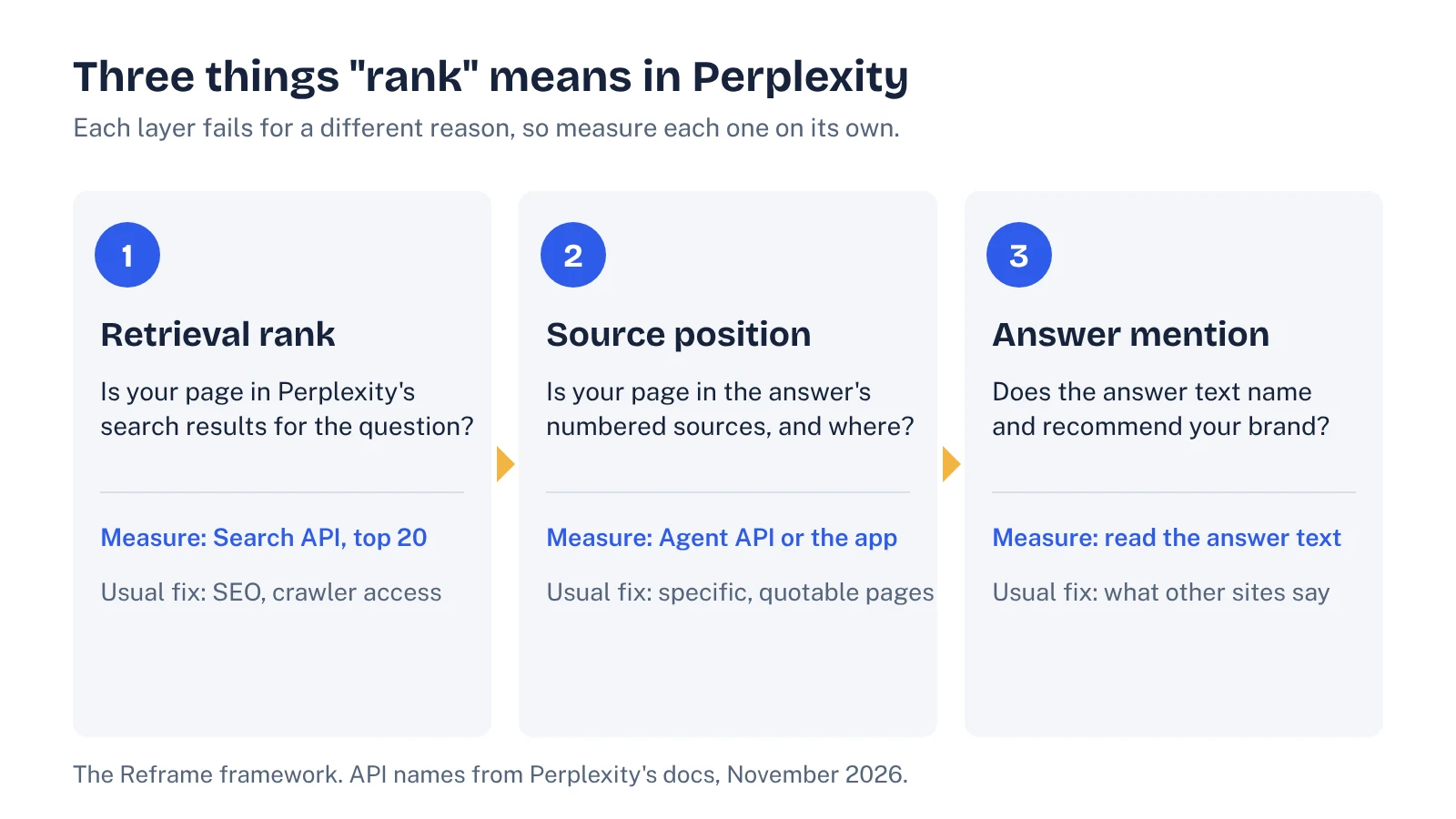
The layers fail for different reasons. A retrieval problem is usually an SEO or crawler problem. A source-position problem is usually about how quotable and specific the page is. A mention problem is often about what other sites say about you. Our guide on how to rank in Perplexity covers the fixes for each. This post is about measuring them.
What people search for, and a caution about the numbers
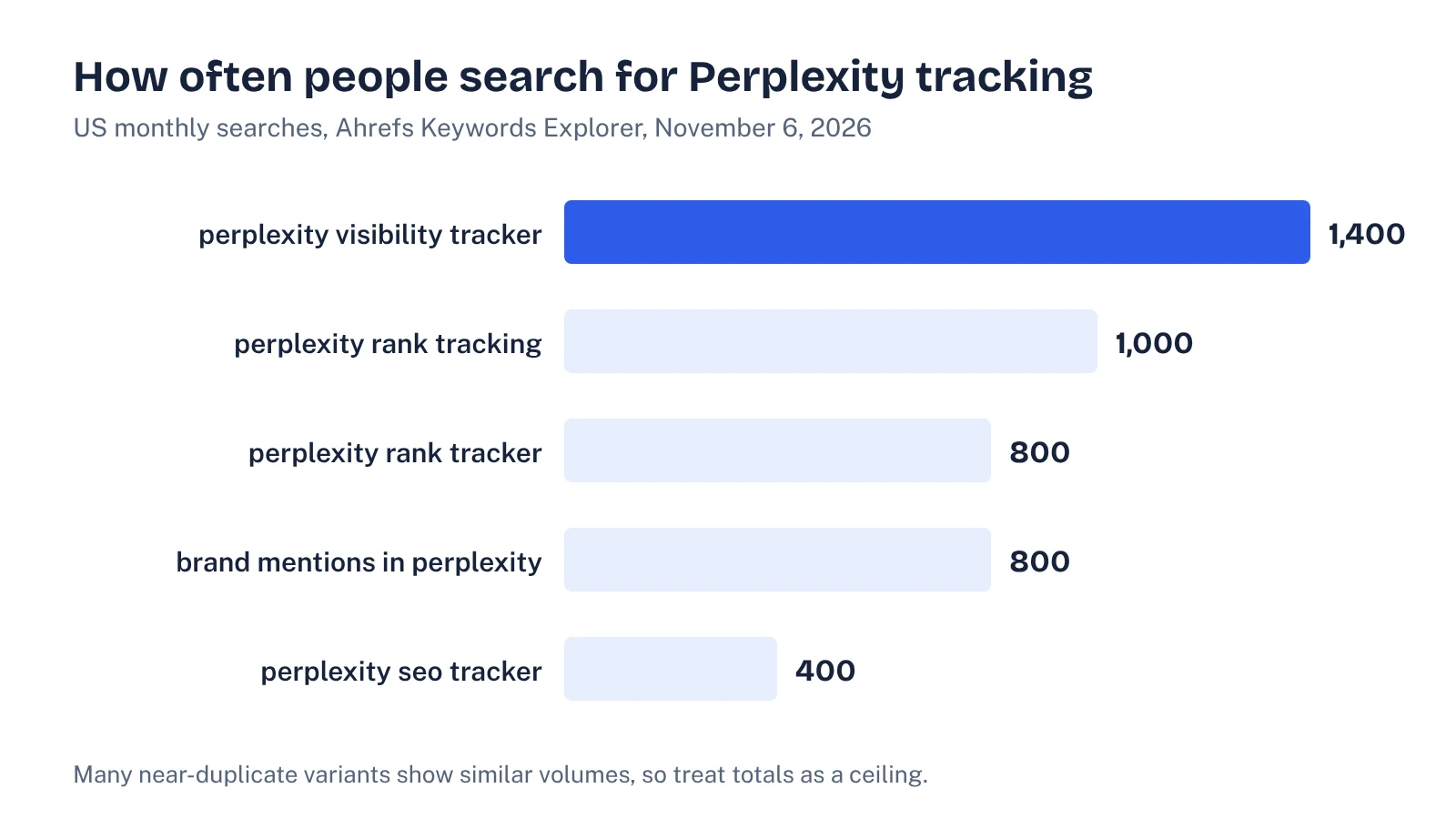
We pulled the related queries from Ahrefs Keywords Explorer this morning (US, November 6, 2026). Demand is real, and the top results are almost all tool landing pages: in the top 10 for "perplexity rank tracking," Ahrefs shows an AI Overview followed by vendor pages from Rankability, AIclicks, Advanced Web Ranking, Keyword.com and ProRankTracker, plus two list posts.
| Query | US monthly searches | Keyword difficulty |
|---|---|---|
| perplexity visibility tracker | 1,400 | 1 |
| perplexity rank tracking | 1,000 | 4 |
| perplexity rank tracker | 800 | not yet scored |
| brand mentions in perplexity | 800 | 3 |
| perplexity seo tracker | 400 | not yet scored |
One caution. In the same pull, at least 20 near-identical variants ("best perplexity rank tracker software," "perplexity seo rank tracking tools," "top perplexity rank tracker") each showed 800 to 1,000 searches a month. Real buyers don't phrase one need 20 ways at equal volume. Our read is that some of this demand comes from automated querying, possibly by tracking tools themselves. Treat the totals as a ceiling, not a forecast. The low difficulty scores are more reliable: few established pages target these terms yet.
Three ways to collect Perplexity data
You can check the app by hand, script Perplexity's APIs, or pay for a tracker. Each one sees Perplexity slightly differently, so know which one your numbers come from.
1. Manual checks in the app
Closest to what a buyer sees. Use a clean, logged-out session (or a fresh profile), keep the mode the same every time, and copy the full answer and source list into a sheet. It's free and slow. For 20 to 40 prompts it takes a few hours a month, which is fine for a first baseline.
2. Perplexity's APIs
Perplexity offers two APIs that matter here. The Search API returns "ranked web results as JSON, not a generated answer," with a title, URL, snippet and dates for each result. You can ask for 1 to 20 results per query and set a country. That gives you a direct read on layer 1, retrieval rank.
The Agent API with its web_search tool generates an answer and returns the sources as a list of results, each with a stable id "used to reference the result in citations." That covers layers 2 and 3. You can set a user location (country, plus optional region and city), which matters if your buyers are in specific markets.
Check one thing before you build on old code. Perplexity's migration guide says Sonar Chat Completions support ended on September 27, 2026. Synchronous and streaming Sonar requests are being reformulated as Agent API requests, rolling out by model, and asynchronous Sonar requests are no longer supported. If your scripts, or a vendor's, were built on Sonar's citations field, the data may have changed shape or method this autumn. Note the date in your tracking log so a jump in your numbers isn't mistaken for a real change.
3. A third-party tracker
Scheduled, scalable and usually comes with competitor dashboards. The catch is method. Advanced Web Ranking's help page says it records the URLs in the "Sources" section of each Perplexity result and can compare them with Google and Bing, currently for the US market. Rankability's product page lists citations, text mentions, position and competitor domains. Neither page says whether answers come from the app or an API, or how many times each prompt is run. That's normal for vendor pages, and it's exactly what you should ask about (see the questions below).
| Method | Layers it covers | Cost | Main weakness |
|---|---|---|---|
| Manual, in the app | 2 and 3 | Time only | Slow; hard to repeat enough runs |
| Search API | 1 | $5 per 1,000 requests ($1 for fast search) | No answer, so no mentions |
| Agent API + web_search | 2 and 3 | $2.50 per 1,000 searches, plus model tokens | Close to the app, not identical |
| Third-party tracker | Usually 2 and 3 | Subscription | Method often not disclosed |
Prices are from Perplexity's docs as of November 6, 2026. Check them before you budget.
Set up a Perplexity tracker in a week
- Write the prompt set (day 1). 30 to 40 real buyer questions across category, use case, comparison, alternatives and pricing. Pull wording from sales calls and support tickets, not just keyword tools. Freeze the list; changing prompts breaks your trend line.
- Name your competitors (day 1). Pick three to five. Write down every name variant they use, so your parser counts "Acme" and "Acme.io" as one brand.
- Run a retrieval check (day 2). Send each prompt to the Search API with 20 results and your main country. Record whether your domain appears and at what position. At $5 per 1,000 requests, 40 prompts cost about 20 cents.
- Run answer checks (days 2 to 4). Run each prompt three times, through the Agent API or by hand in the app. Save the full answer text and the ordered source list every time. Three runs of 40 prompts gives you 120 answers.
- Tag every answer (day 5). For each one: your domain cited (yes/no), its source position, your brand named (yes/no), recommended (yes/no), and which competitors appear.
- Spot-check the app (day 5). Take 10 prompts and compare your API results with the app. If they differ a lot for your category, weight the app checks more.
- Write the baseline (day 6 or 7). Report the metrics below, list the 10 domains Perplexity cites most for your prompts, and set the date for the next monthly run.
The metrics worth reporting
Keep the report short. Five numbers cover most of what a SaaS marketing lead needs:
- Retrieval rate: share of prompts where your domain appears in the Search API's top 20.
- Citation rate: share of answers that cite at least one of your URLs.
- Average source position: where your URL sits when it is cited. Report it next to the citation rate, never alone. Position 2 in 5% of answers is worse than position 5 in 40%.
- Mention rate and recommendation rate: share of answers that name you, and that suggest you as an option.
- Share of voice: your mentions divided by all mentions of you and your named competitors. Our AI share of voice guide has the formula and variants.
A position-weighted citation score
If you want one number for layer 2, weight each citation by its position: score 1 for source 1, 1/2 for source 2, 1/3 for source 3, and 0 when you aren't cited. Average across all answers. It rewards being cited often and early. Here's how it works with hypothetical numbers for one prompt run three times:
| Run | Your source position | Score |
|---|---|---|
| 1 | 1 | 1.00 |
| 2 | 3 | 0.33 |
| 3 | Not cited | 0.00 |
| Prompt score | 0.44 |
This is our framework, not a Perplexity metric. The 1/position weight is a simple assumption. Pick a weighting, write it down, and don't change it between months.
How much change is real
Answers vary between runs, so every rate has a margin of error. With 120 answers and a 25% citation rate, the 95% margin is about ±7.7 points (simple binomial approximation, our calculation). A move from 25% to 30% next month is inside that range. Our Gemini visibility tracker guide has a full table of sample sizes; the same math applies to Perplexity.
See your own AI visibility, free
Get a one-page audit of how ChatGPT, Perplexity and Gemini treat your brand against up to three competitors, plus your biggest gap. In your inbox within 48 hours.
Get my free auditWhen a Perplexity tracker tool is worth paying for
A script plus a sheet is enough for one product, one market and up to about 40 prompts a month. A tool starts to earn its fee when you track several products or markets, need weekly data, want the same method across ChatGPT, Gemini, Perplexity and AI Overviews, or have a team that won't maintain scripts. Our roundup of AI visibility tools compares the main options.
Ask every vendor these questions before you sign:
- Do you collect answers from the Perplexity app, the API, or both? Logged in or out? Which mode?
- If you used Sonar, how and when did you move to the Agent API, and did your numbers shift?
- How many times do you run each prompt per check, and do you show the variance?
- How do you define "position": order in the source list, order of first mention in the text, or something else?
- Which locations can I set, and is that a real user location or just a country hint?
- Can I export every raw answer and source list, with timestamps?
- Can I bring my own prompt set and keep it fixed?
A vendor that answers all seven clearly is usually one whose numbers you can defend in a board deck.
Common Perplexity tracking mistakes
- Treating one screenshot as a ranking. One answer proves that something happened once.
- Merging retrieval and citation. If you aren't retrieved, the fix is SEO and crawler access. If you're retrieved but not cited, the fix is the page itself. A blended score hides which one you have.
- Ignoring the source list when you're named. If Perplexity recommends you based on an outdated review page, that page is shaping your pitch. Fix it or outrank it.
- Changing prompts every month. You lose the trend line. Add new prompts as a separate group.
- Forgetting the traffic side. Visibility should show up as visits. Perplexity referrals can land in GA4's Referral channel rather than an AI channel; our guide to tracking AI traffic in GA4 shows the custom channel fix.
What to do with the first month of data
Sort your prompts into three groups. Prompts where you aren't retrieved go to your SEO backlog. Prompts where you're retrieved but not cited go to content: make those pages more specific, add clear comparisons and current numbers. Prompts where competitors are named and you aren't go to PR and partnerships, starting with the domains in your cited-sources log.
If you want a structured way to run this across every assistant, not just Perplexity, our guide to running an AI visibility audit includes a free template with the prompt set, tagging columns and scoring already built in.
FAQ
What is a Perplexity rank tracker?
It is a tool or script that runs a fixed list of prompts through Perplexity on a schedule and records which sources each answer cites, in what order, and which brands the answer names. Most tools then report your citation rate, average source position and share of voice against competitors.
Can I track Perplexity rankings for free?
Yes, at small scale. Run 20 to 40 buyer prompts in Perplexity in a clean session, two or three times each, and log the numbered sources and brand mentions in a sheet. It takes a few hours a month. Perplexity's Search API is a cheap next step if you want to automate the retrieval check.
Is the Perplexity API the same as the Perplexity app?
Not exactly. The Agent API's web search tool and the Search API use Perplexity's search, but the consumer app has its own modes, models and settings, and logged-in users can see personalized results. Treat API data as a close proxy and spot-check it against the app each month.
How often should I check Perplexity visibility?
Monthly is enough for most B2B SaaS teams. Run a weekly check on a small set of high-intent prompts during a launch or a content push. Because answers vary from run to run, checking more often on a small sample mostly adds noise.
Sources
- Perplexity Docs: Search API overview (ranked results, filters, pricing)
- Perplexity Docs: Agent API web search tool
- Perplexity Docs: Migrate from Sonar to the Agent API
- Perplexity Docs: OpenAI compatibility (Sonar and Agent API response fields)
- Advanced Web Ranking Help: Perplexity AI search engine tracking
- Rankability: Perplexity Rank Tracker (product page)
- Ahrefs Keywords Explorer and SERP overview (US data pulled 6 November 2026)