Agentic search: what it means for B2B SaaS marketing, and how to make your site agent-ready
Agentic search is when an AI system takes a goal, plans its own searches, reads and compares pages, and returns a result or takes an action, instead of handing you a list of links. For B2B SaaS, it means an agent may build your buyer's shortlist. This guide shows how agents evaluate vendors and what to fix on your site.
- Agentic search turns a goal into many searches and page visits, then returns a shortlist, report or action for a person to approve.
- In G2's 2026 Buyer Behavior Report, 47% of B2B buyers would let an AI agent research and recommend software; only 9% would let one buy within guardrails.
- Agents try to verify each requirement. Missing pricing, gated security facts and image-only integration lists are where SaaS vendors drop out.
- Test it yourself: give an agent your buyers' real task and watch where it leaves your site.
- Measure with a fixed set of buyer tasks, AI mention rates, AI referral traffic and server logs.
What agentic search is, in plain terms
Classic search returns a list of links. AI search, like an AI Overview or a quick ChatGPT answer, reads a few sources and writes a summary. Agentic search goes one step further: you give an AI system a goal, and it decides which searches to run, which pages to open, what to compare and, sometimes, what to do next.
The difference is who does the work. In the first two, a person still runs the research and makes the decisions. In agentic search, the system plans and runs the research itself, then hands back a result or a recommendation. The person checks the result and approves the final step.
This is no longer a lab idea. OpenAI launched ChatGPT agent in July 2025, which combines a visual browser, a text browser, a terminal and app connectors so it can complete tasks on its own virtual computer. One of OpenAI's own example tasks is analyzing three competitors and turning the findings into a slide deck. At I/O in May 2026, Google said AI Mode had passed one billion monthly users and announced Search agents, starting with information agents that monitor the web in the background and send you updates.
What people search for, and what the top results miss
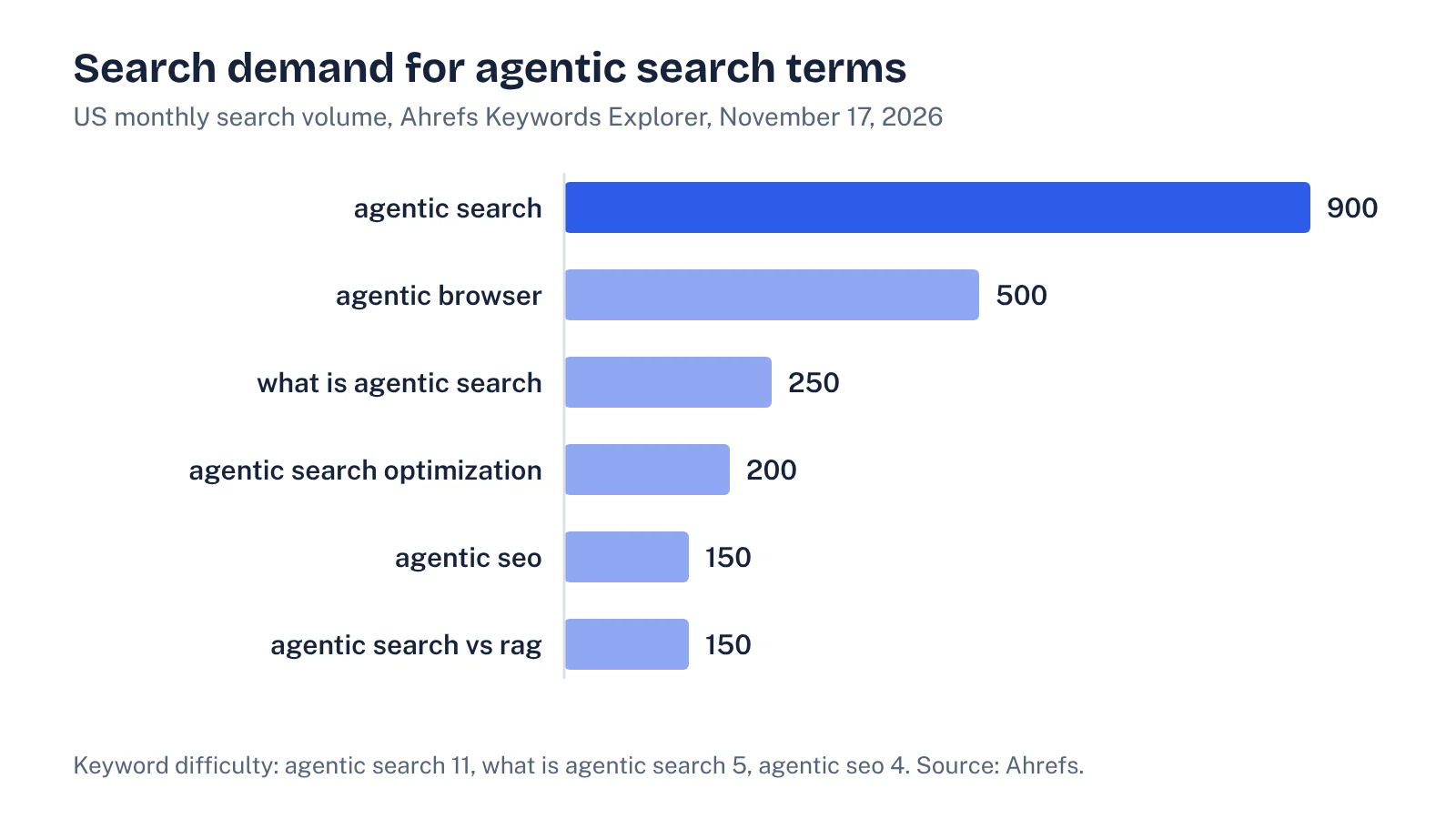
We pulled US data from Ahrefs Keywords Explorer on November 17, 2026. The head term has decent demand and low difficulty, and marketers have started searching for the optimization side of it.
| Keyword (US) | Monthly volume | Keyword difficulty |
|---|---|---|
| agentic search | 900 | 11 |
| agentic browser | 500 | 22 |
| what is agentic search | 250 | 5 |
| agentic search optimization | 200 | not yet rated |
| agentic seo | 150 | 4 |
| agentic search vs rag | 150 | not yet rated |
| agentic search vs ai search | 50 | 19 |
Google shows an AI Overview for "agentic search", and the results are split between two audiences. Half the top 10 is written for developers: Mistral, OpenSearch, Meilisearch and Firecrawl explain how to build agentic retrieval into a product. The marketing half, from Semrush and Conductor, explains the concept well but uses consumer examples like booking a venue. None of the pages we read walk through how an agent evaluates B2B software, or what a SaaS team should change on its site. That is what this guide covers.
Traditional search vs AI search vs agentic search
It helps to see the three side by side, because most SaaS teams are now dealing with all three at once.
| Traditional search | AI search | Agentic search | |
|---|---|---|---|
| Input | Keywords | A question | A goal or task |
| Who runs the research | The person | The system, in one pass | The system, over many steps |
| Output | Ranked links | A written answer with citations | A shortlist, report or completed action |
| What it reads on your site | Whatever the person clicks | A few passages that answer the question | Pricing, docs, security, integrations, reviews: whatever the task needs |
| Where you win or lose | Ranking and the click | Being cited or named | Being verifiable at every step |
That last row is the important one. An AI Overview can mention you based on a single strong passage. An agent working through a task will try to confirm each requirement. If it cannot find your pricing model, your SOC 2 status or your HubSpot integration, it is likely to move on to a vendor where it can.
How an agent researches software vendors
Take a realistic prompt a marketing ops lead might give ChatGPT agent: "Find three product analytics tools for a 50-person B2B SaaS company. They must integrate with HubSpot, have SOC 2 Type II, and cost under $1,000 a month. Compare them in a table and tell me which to trial first."
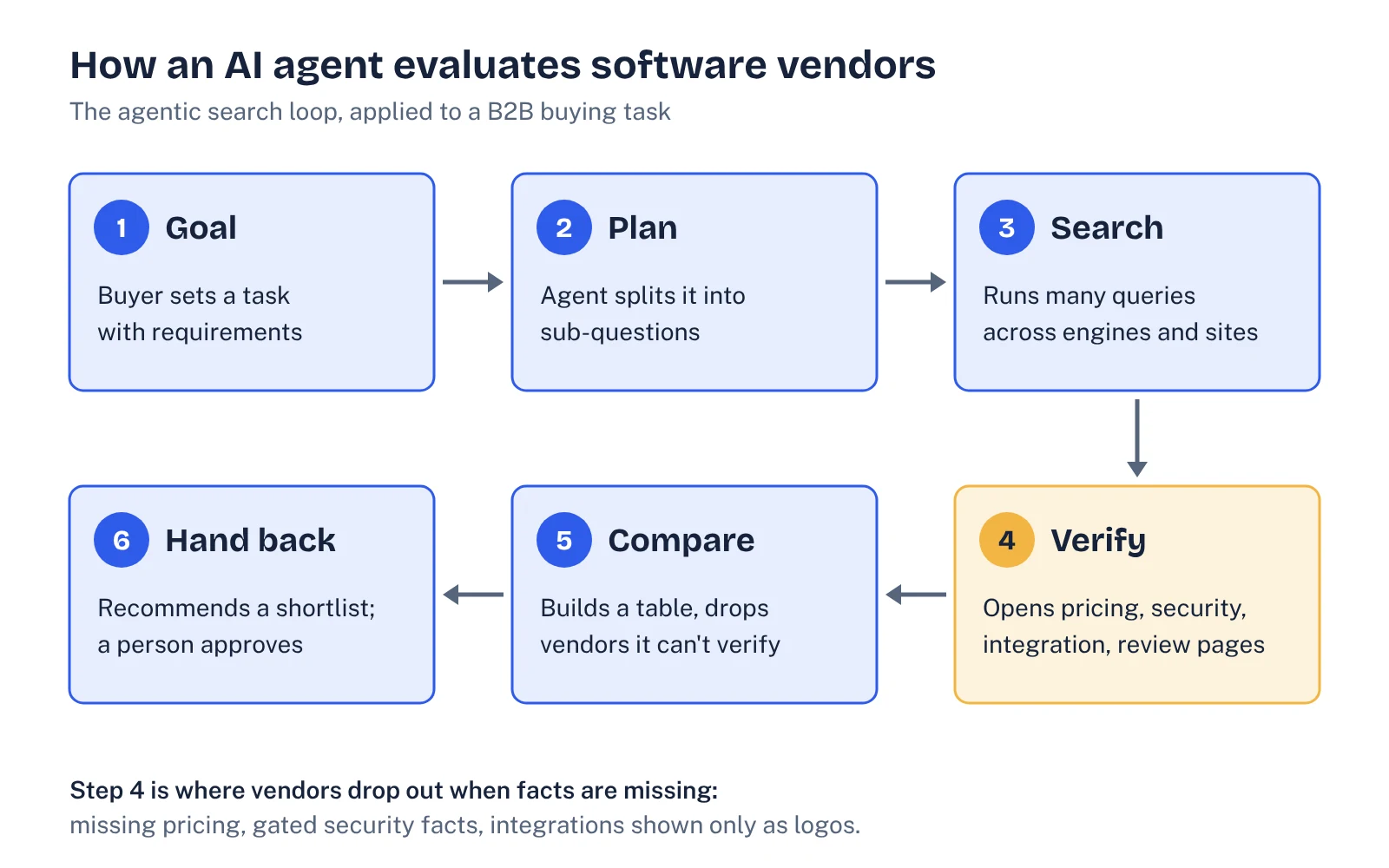
An agent will usually break that into sub-questions, much like the query fan-out behind AI Mode, but with more steps and actual page visits. Each sub-question maps to a page on your site or a third-party page about you.
| Sub-question the agent needs to answer | Where it will look | Common SaaS gap |
|---|---|---|
| Which tools are in this category? | Roundups, review grids, AI answers, Reddit threads | Not listed on the pages that rank for "best X tools" |
| Does it integrate with HubSpot? | Integrations page, app marketplace listing, docs | Integration exists but is only shown as a logo, with no crawlable text |
| Is it SOC 2 Type II? | Security or trust page | Trust details sit behind a form or a sales call |
| What does it cost at this size? | Pricing page, review sites | "Contact sales" with no starting price or pricing model |
| What do customers say? | G2, Capterra, community threads | Thin or outdated review profiles |
| Can I start a trial? | Signup flow | Trial hidden behind a demo request |
You do not need to publish every number to win. But you do need to give the agent something it can verify. "Plans start at $X per month, billed annually" or "pricing is per tracked user; see our pricing page for tiers" both answer the question. A blank "Talk to sales" page often does not.
Why B2B SaaS teams should care now
The clearest signal comes from buyers themselves. G2's 2026 Buyer Behavior Report, based on a survey of more than 1,000 B2B software buyers published in July 2026, asked how far they would let AI agents go in the buying process.
| G2 2026 Buyer Behavior Report finding | Share of buyers |
|---|---|
| Use or plan to use AI agents in the buying process | 61% |
| Would let an agent research and recommend, with humans keeping the final decision | 47% |
| Would let an agent execute purchases within approved guardrails | 9% |
| Would let an agent buy without pre-approval | 2% |
Read that carefully. Agents buying SaaS on their own is still rare. Agents doing the research and building the shortlist is already mainstream intent. The same report found review sites (38%) narrowly overtook AI chatbots (37%) as the top source shaping shortlists, which is a reminder that agents and review sites feed each other: our guide to B2B review sites and AI visibility covers that link.
The traffic side is shifting too. Cloudflare's July 2026 report said non-human traffic passed 50% of internet traffic for the first time. Some of those visitors are agents acting for a real buyer. They will not show up as a normal session in your analytics, but they are reading your pages.
How to make your SaaS site agent-ready
Most of this is good SEO and good product marketing done properly. The difference is that an agent is less forgiving than a human skimming your site. Work through these in order.
- Run your own category task. Give ChatGPT agent, or Perplexity's Comet browser, the kind of task your buyers would set: category, company size, two must-have integrations, a compliance need and a budget. Watch where it goes, what it reads, and where it drops you. Repeat with two or three variations.
- Make the facts crawlable text. Integrations, compliance badges and pricing tiers are often images, tabs that load on click, or PDFs. Put the key facts in plain HTML on the page. Our guide to schema markup for AI search covers the structured data that helps here.
- Answer the pricing question. Publish a starting price, a pricing model or a range. If you cannot, explain what pricing depends on and what a typical customer at a given size can expect.
- Open up your trust page. List certifications, data residency, SSO and the date of your last audit in text. Keep the full report gated if you need to, but make the headline facts public.
- Write comparison and "alternatives" pages honestly. Agents compare vendors. Give them a fair, specific comparison on your own site, with the criteria buyers use.
- Fix third-party facts. Check that G2, Capterra, marketplace listings and partner directories say the same thing as your site. Contradictions make you harder to verify.
- Do not block the agents you want. Check robots.txt and your bot protection rules. Our guide to AI crawlers explains which user agents train models and which fetch pages for a user in real time.
- Keep humans in the loop on conversion. Agents mostly hand back a shortlist, and a person approves the next step. Make the trial or demo path simple once that person arrives.
See your own AI visibility, free
Get a one-page audit of how ChatGPT, Perplexity and Gemini treat your brand against up to three competitors, plus your biggest gap. In your inbox within 48 hours.
Get my free auditHow to measure agentic search visibility
There is no Search Console for agents yet, so measurement is a mix of proxies. Keep them simple and repeat them on the same dates each month.
- Task pass rate: run a fixed set of 10 to 20 buyer tasks in one or two agents each month. Record whether you make the shortlist and, if not, at which step you dropped out.
- Mention and citation rate: track how often assistants name you across a fixed prompt set. Our guide to running an AI visibility audit includes a free template for this baseline.
- AI referral traffic: segment sessions from chatgpt.com, perplexity.ai and similar referrers, and watch which pages they land on. Our post on tracking AI traffic shows the setup.
- Server logs: look for user-initiated AI fetchers hitting pricing, security and integration pages. Rising hits on those pages are an early signal that agents are evaluating you.
Agents are still uneven. Results vary from run to run, and the products change often. Treat single runs as anecdotes and look at patterns across several runs.
What not to do
Agentic search does not need a separate content strategy, and it does not reward tricks. Hidden text aimed at agents, invented comparison claims or fake reviews are a risk to your brand and to how assistants describe you. The foundations that help you show up in AI Overviews still matter here: clear, accurate, crawlable pages and a good reputation on other sites.
The useful mindset shift is this: for years, the question was "will a buyer find this page?" Now it is also "could an assistant complete a buyer's task using only what we publish?" If the answer is no, the fix is usually clearer facts, not more content.
FAQ
What is agentic search?
Agentic search is a form of AI search where the system is given a goal rather than a single question. It plans sub-queries, runs searches, opens and compares pages, and returns a result or takes an action. ChatGPT agent and Google's Search agents in AI Mode are examples.
What is the difference between agentic search and AI search?
AI search, like an AI Overview, reads a few sources and writes one answer to one question. Agentic search works over many steps toward a goal, visits pages to check specific facts, and can hand back a shortlist or complete a task. The person sets the goal and approves the outcome instead of doing the research.
What is agentic search vs RAG?
Retrieval-augmented generation (RAG) fetches relevant documents once and uses them to write an answer. Agentic search wraps retrieval in a loop: the system decides what to search next based on what it found, and keeps going until the task is done. Many agentic systems use RAG as one of their tools.
How do I optimize for agentic search?
Make the facts an agent needs easy to find and verify: pricing model, integrations, security and compliance details, and honest comparisons, all in crawlable text. Keep third-party profiles consistent with your site, avoid blocking the AI user agents you want, and test with real buyer tasks.
What is an example of an agentic browser?
ChatGPT Atlas, OpenAI's browser with a built-in agent mode, and Perplexity's Comet are two examples. Both can browse sites and complete multi-step tasks for the user, with the person able to watch and take over.
Sources
- Google: A new era for AI Search, Elizabeth Reid, VP Search, May 19, 2026
- OpenAI: Introducing ChatGPT agent, July 17, 2025
- G2: New G2 research, AI is reshaping how B2B software deals are won and lost (2026 Buyer Behavior Report), July 22, 2026
- Cloudflare: Content Independence Day, one year on: building the business model for the agentic Internet, July 1, 2026
- Semrush: Agentic search: how AI agents will decide which brands get found, April 7, 2026
- Ahrefs Keywords Explorer and SERP overview, US data pulled November 17, 2026